
On this page
Start here
Quick answer
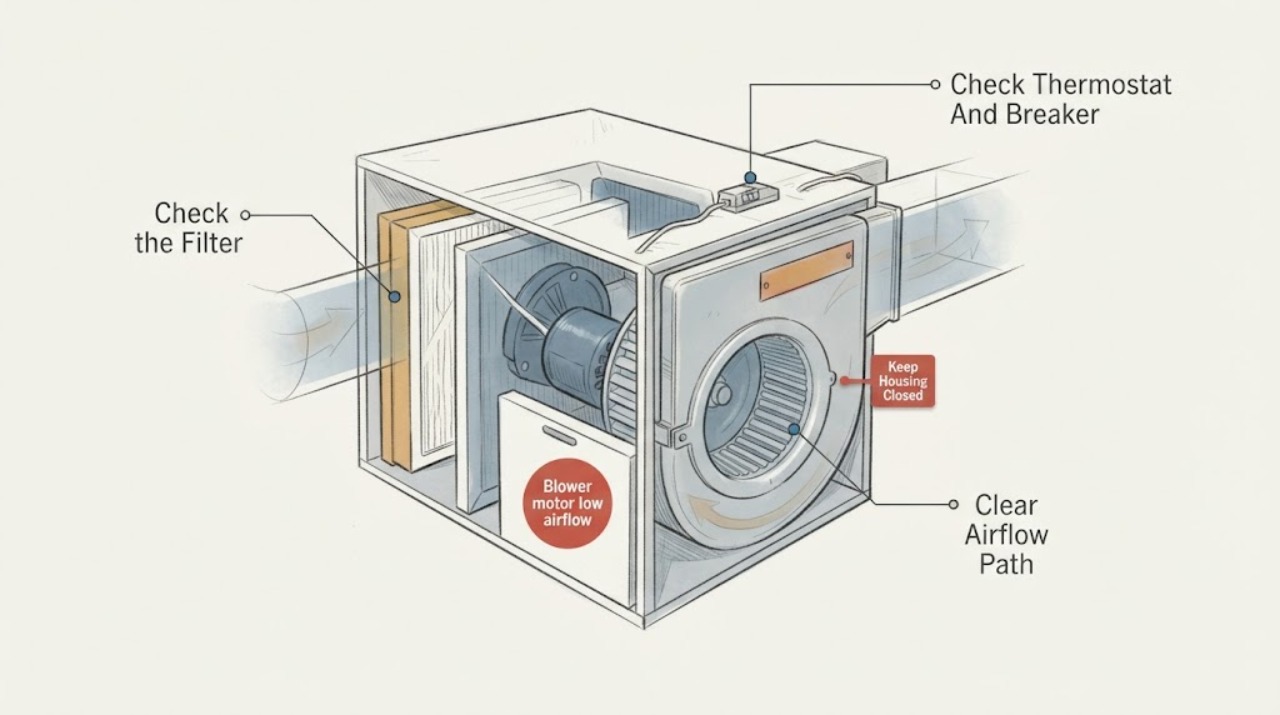
Low airflow does not by itself prove that the blower motor has failed. First note whether every register is weak or only one area, confirm the thermostat is calling normally, inspect and replace an accessible filter exactly as the equipment instructions specify, and make sure return grilles and supply registers are not blocked. Look for visible ice or water, but do not open the blower compartment or touch wiring or a capacitor. If the blower does not start, only hums, makes grinding or scraping noise, airflow is intermittent, a breaker trips again, or there is overheating, smoke, or a burning smell, stop using the equipment and arrange qualified HVAC service. A technician can then test the motor, capacitor, control, wheel, duct resistance, and safety controls; do not bypass a safety device or change wiring, fan speed, or refrigerant settings as a low-airflow experiment.
Before you begin
Safety first
- This article covers ordinary-access observation and an equipment-instruction-approved filter or opening check only. Internal electrical, motor, capacitor, control, safety, moving-part, refrigerant, coil, and duct repairs require qualified HVAC service.
Work through in order
Diagnostic checks
Use only checks that match the exact appliance or system and its official guide.
-
Check 1
With the thermostat operating normally and without removing equipment panels, compare airflow at several supply registers and check the return grille for obvious obstruction.
Expected result: Record whether all registers are weak, only one room or branch is weak, the return has restricted intake, or airflow changes when the system starts and stops.
Next step: Continue with the filter and register checks when the restriction is accessible; arrange HVAC diagnosis when the pattern is widespread, intermittent, or unexplained.
Stop if: Stop if there is smoke, a burning smell, water near electrical equipment, exposed wiring, or any need to remove an access panel.
Why this matters
Why: Weak airflow everywhere supports a shared filter, return, coil, duct, control, or blower check. A single weak branch points more toward a local register, damper, or branch-duct issue and does not establish a failed motor.
-
Check 2
Verify the thermostat has the intended heating or cooling mode and fan setting, then observe the equipment breaker or disconnect from the outside without opening electrical covers or repeatedly resetting it.
Expected result: Note whether the thermostat calls normally, the blower starts, the breaker is tripped, the system stops after starting, or the same protection trips again.
Next step: Correct only the thermostat setting described by the owner instructions and record the result. If the breaker trips again or the blower still will not start, leave the equipment off and request qualified HVAC service.
Stop if: Do not repeatedly reset a tripping breaker, bypass a door or limit switch, open the electrical compartment, or touch conductors or a capacitor.
Why this matters
Why: An incorrect fan setting or a single clearly identified power interruption can explain absent or reduced circulation, but repeated trips, a blower that will not start, or a shutdown after starting can indicate a fault or safety response rather than a setting problem.
-
Check 3
Remove and inspect only the accessible air filter using the equipment instructions, and check that return grilles and supply registers are open and free of furniture, dust mats, or other obvious blockage.
Expected result: Record whether the filter is visibly loaded, wet, damaged, missing, installed backward, the filter slot is not accessible, or the returns and registers are clear.
Next step: Replace a damaged or loaded filter only with the exact size and type specified by the equipment instructions, confirm airflow direction, restore the grille, and retest once. If the filter is clear or low flow remains, proceed to the visible symptom check and service boundary.
Stop if: Do not force a filter, stack filters, use an unspecified restrictive replacement, wash a disposable filter, or open the blower compartment to reach another filter.
Why this matters
Why: A clogged or incorrectly installed filter and blocked return can restrict the air reaching the blower; a clear filter and open air path make a motor, wheel, coil, duct, control, or system-resistance issue more plausible but do not prove which part failed.
-
Check 4
From ordinary safe access, look for visible ice on the accessible coil or refrigerant line, water or condensate overflow, crushed or disconnected external ducting, and unusual temperature change at the registers; do not scrape ice or open the cabinet.
Expected result: Classify the system as dry and clear, visibly iced, leaking or overflowing, externally damaged, or not safely observable.
Next step: If icing persists, water is near electrical equipment, or duct damage is visible, turn the equipment off as the owner instructions permit and arrange HVAC service. Do not resume repeated cooling or heating cycles to test an unresolved condition.
Stop if: Do not chip ice, apply heat, handle refrigerant lines or electrical parts, climb into unsafe access areas, or continue operation when water reaches electrical equipment.
Why this matters
Why: Ice can be associated with restricted airflow or another heat-pump or cooling fault, while water or damaged ducting can reduce delivery or create a separate equipment and property risk. A clear exterior does not rule out a hidden coil, duct, or blower problem.
-
Check 5
During one normal call for heating or cooling, listen from outside the equipment cabinet for whether the blower starts and runs smoothly; do not remove the blower door or place hands near moving parts.
Expected result: Note normal airflow with a smooth sound, a silent blower, a hum without airflow, grinding or scraping, intermittent starting, overheating, smoke, or a burning odor.
Next step: Leave the equipment off and request qualified HVAC diagnosis for any abnormal symptom. If the sound is smooth but airflow remains low after the filter and openings are corrected, provide the technician with the airflow pattern and filter result for an airflow and blower assessment.
Stop if: Stop immediately for smoke, burning smell, overheating, repeated breaker trips, exposed moving parts, or any need to test a capacitor, wiring, motor, wheel, belt, or control board.
Why this matters
Why: A silent or humming blower, abnormal mechanical noise, intermittent operation, overheating, smoke, or burning odor is consistent with an electrical, motor, wheel, bearing, belt, control, or safety problem that cannot be safely isolated by external observation. Smooth operation with low flow keeps filter, return, coil, duct, and system-resistance causes in play.
-
Check 6
After only the safe thermostat, filter, return, and register checks are complete, make one normal call and compare the same registers with the original observation.
Expected result: Record whether airflow is restored, improved but still weak, unchanged, intermittent, or accompanied by ice, water, noise, overheating, or a breaker trip.
Next step: Stop troubleshooting and arrange HVAC service when airflow is unchanged or unstable, and give the technician the before-and-after pattern, filter details, thermostat setting, and visible symptoms.
Stop if: Do not keep cycling the system to reproduce a fault, reset a breaker repeatedly, or operate through smoke, burning odor, overheating, water, or persistent ice.
Why this matters
Why: Restored airflow supports an external restriction or setting as a contributor. Persistent or intermittent low airflow after those checks means the system needs professional measurement of the blower, wheel, coil, duct resistance, controls, and safety operation; new hazard symptoms override further testing.
Use your observations
Decision map
Find the observation that best matches what you see, then follow the next safe action.
-
PATH 01Safety boundary
What you see
The filter is visibly loaded or the return path or registers are obviously blocked, and there are no electrical or burning symptoms.
Do this next
Correct the accessible obstruction according to the owner instructions, install the exact specified filter with its airflow direction, and make one controlled retest.
Why this path and its safety boundary
Why it matters: The restriction can reduce the air reaching and leaving the blower and can increase motor runtime and wear.
Safety stop: Stop if airflow remains low, the filter slot or obstruction requires panel disassembly, or the system develops ice, water, noise, overheating, or a breaker trip.
-
PATH 02Safety boundary
What you see
Most registers are normal but one room or branch remains weak.
Do this next
Check only the visible register and external duct path; request HVAC duct or balancing assessment if the branch remains weak or access would require opening a ceiling, wall, or cabinet.
Why this path and its safety boundary
Why it matters: A local register, damper, disconnected or crushed branch duct, or room return problem is more plausible than a whole-system blower motor failure.
Safety stop: Do not cut into ductwork or walls, adjust hidden dampers, or enter unsafe access areas to chase one weak branch.
-
PATH 03Safety boundary
What you see
Visible ice, persistent freezing, condensate overflow, or water near the equipment is present.
Do this next
Stop repeated operation, follow the owner instructions for shutting down the affected heating or cooling call, and arrange qualified HVAC service.
Why this path and its safety boundary
Why it matters: Restricted airflow is one possible contributor to icing, but refrigerant, defrost, coil, drain, or other faults can also be involved; water adds property and electrical risk.
Safety stop: Do not chip ice, apply heat, handle refrigerant, clear concealed drains, or operate when water can reach electrical components.
-
PATH 04Safety boundary
What you see
The blower is silent, hums without starting, starts intermittently, makes grinding or scraping noise, overheats, smells burned, smokes, or trips a breaker.
Do this next
Leave the equipment off and request qualified HVAC service; report the sound, odor, timing, breaker behavior, equipment type, and airflow pattern.
Why this path and its safety boundary
Why it matters: These symptoms can involve the motor, capacitor, wheel, bearings, belt, wiring, control, or safety devices and are not a safe user-level motor replacement diagnosis.
Safety stop: Do not open the blower compartment, test live voltage, touch a capacitor, bypass a door or limit switch, or keep resetting protection.
-
PATH 05Safety boundary
What you see
The blower sounds smooth and runs, but all registers remain weak after the specified filter and accessible air-path checks.
Do this next
Arrange HVAC airflow diagnosis and ask the technician to check filters, motor operation, wheel, coil, ductwork, controls, and airflow or pressure under normal operation.
Why this path and its safety boundary
Why it matters: A hidden coil or duct restriction, high system resistance, control issue, blower wheel problem, fan selection or installation issue, or inadequate airflow may remain; sound alone cannot clear the motor or system.
Safety stop: Do not change blower speed, rewire the motor, alter ductwork, adjust refrigerant, or use a higher-restriction filter to compensate.
-
PATH 06Safety boundary
What you see
The thermostat fan or operating mode is incorrect, or there was one clearly identified power interruption without a repeat trip or hazard.
Do this next
Restore only the documented thermostat setting and observe one normal cycle; request service if the blower does not start or the breaker trips again.
Why this path and its safety boundary
Why it matters: A control setting or interruption can prevent expected blower operation, but recurring shutdowns require fault and safety diagnosis.
Safety stop: Do not repeatedly reset a breaker or bypass equipment safety controls.
Helpful context
Understand the symptom
Separate an airflow restriction from a blower motor fault
The blower moves return air through the equipment and into the ductwork. Low flow can therefore originate at the filter, return, registers, coil, duct system, controls, or blower assembly, not only at the motor. If every register is weak, think about a shared restriction or system problem; if one room or branch is weak, the local register, damper, or branch duct deserves attention. A blower that is silent, repeatedly stops, hums, grinds, or trips protection changes the decision toward professional diagnosis rather than more filter cleaning.
Use ordinary-access checks first
Thermostat mode, a clogged filter, blocked returns, and closed or obstructed registers are safe external checks when performed according to the equipment instructions. A filter protects the HVAC motor, and a clogged filter can sharply reduce airflow, increase runtime, and increase motor wear. Record the filter size and orientation before replacing it, and use only the exact replacement specified for the equipment. Do not remove panels to reach a motor or capacitor.
Ice, water, noise, and electrical symptoms set the service boundary
Visible ice can accompany restricted airflow or another heat-pump or cooling-system fault; persistent icing or water near electrical equipment needs service rather than repeated operation. Smoke, a burning smell, repeated breaker trips, overheating, or a motor that will not start are stop conditions. Internal diagnosis may involve high-voltage wiring, a capacitor, a control board, limit or safety switches, the blower wheel, bearings, belt, or duct static pressure, so those checks belong to a trained HVAC professional.
Safety boundary
Stop conditions
- Stop immediately for smoke, a burning smell, overheating, a breaker that trips again, exposed wiring, or water near electrical equipment; leave the equipment off and arrange qualified HVAC service.
- Do not open the blower compartment, touch or test a capacitor, handle live wiring, bypass a blower door or safety switch, or attempt internal motor, wheel, belt, bearing, control, or limit-switch work.
- Do not change motor wiring or fan speed, adjust refrigerant, alter ductwork, chip ice, apply heat to a frozen coil, or repeatedly cycle equipment to force a result.
- Do not force a filter, stack filters, or use a replacement whose size or type is not confirmed by the equipment instructions; do not treat a clear filter as proof that the motor has failed.
- If low airflow persists after ordinary-access checks, or if the cause is not visible without panel or cabinet access, stop troubleshooting and request qualified HVAC diagnosis.
Only after diagnosis
Potential parts
- replacement air filter
Consider this only when the accessible filter is loaded, damaged, missing, or the equipment instructions specify replacement as part of routine maintenance.
Confirm the exact dimensions, airflow direction, filter type, and equipment instructions; do not substitute an unspecified restrictive filter. - blower motor or motor assembly
Consider this only after a qualified technician confirms a motor fault rather than a filter, air-path, control, wheel, coil, duct, or system-resistance cause.
Match the exact equipment model, electrical specifications, mounting, rotation, controls, and manufacturer requirements; do not infer fit from appearance. - blower capacitor or control component
Consider this only when professional testing identifies the capacitor or control as the cause of a no-start, intermittent, or abnormal blower condition.
A qualified technician must verify the exact component and electrical rating for the equipment; capacitors and controls are not user-level trial parts. - blower wheel, belt, or bearing component
Consider this only when professional inspection finds a damaged, obstructed, misaligned, worn, or mechanically noisy blower assembly.
Confirm the exact blower assembly and equipment configuration; internal moving-part service requires safe isolation and qualified repair.
When checks do not resolve it
Need a professional?
Arrange qualified HVAC service when low airflow persists after the specified filter, thermostat, return, and register checks; when the blower is silent, humming, intermittent, noisy, overheating, or not moving air; when a breaker trips again; when visible ice or condensate is persistent; when there is water near electrical equipment; or when diagnosis would require opening a panel. The technician should determine whether the cause is the motor, capacitor, wheel, bearings, belt, control or safety device, coil, duct restriction, system resistance, or installation issue before recommending a compatible repair.
Safety scope: This article covers ordinary-access observation and an equipment-instruction-approved filter or opening check only. Internal electrical, motor, capacitor, control, safety, moving-part, refrigerant, coil, and duct repairs require qualified HVAC service.
Common questions
FAQ
Does low airflow prove the blower motor is bad?
No. A filter, return, register, coil, duct restriction, control, or system-resistance problem can also reduce delivered air. A motor that will not start, hums, runs intermittently, makes abnormal noise, overheats, or trips protection needs professional diagnosis rather than a motor replacement guess.
What can I check without opening the HVAC cabinet?
Check the thermostat setting, compare several registers, inspect an accessible filter, and make sure return grilles and supply registers are open and unobstructed. Follow the equipment instructions for filter replacement and stop if a panel, wiring, capacitor, moving part, ice, water, or electrical hazard becomes involved.
Should I keep running the system if the blower hums or the breaker trips?
No. A hum without airflow, repeated breaker trips, overheating, smoke, or a burning smell can indicate an electrical, motor, control, or safety problem. Leave the equipment off and arrange qualified HVAC service; do not keep resetting protection or bypass a safety control.
Can a dirty filter cause low airflow and motor wear?
Yes. DOE says a clogged filter can dramatically reduce airflow and increase runtime and motor wear. Replace an accessible filter only with the exact size and type specified by the equipment instructions, and do not use an unspecified restrictive filter as a workaround.
What if I see ice or water while airflow is low?
Persistent ice can be associated with restricted airflow or another heat-pump or cooling fault, and water near electrical equipment adds a safety and property risk. Stop repeated operation, do not chip ice or apply heat, and arrange qualified HVAC assessment according to the equipment instructions.
Read the exact guide
Official sources
- Air Handler TroubleshootingTrane · Trane residential air-handler troubleshooting guidance; the installed equipment's owner instructions and a qualified technician control a particular system.
- Furnace Blower Not WorkingTrane · Trane residential furnace troubleshooting guidance; not every air handler or heat pump has the same controls or symptoms.
- HVAC Proper Installation: FiltersU.S. Department of Energy Building Science Education · U.S. Department of Energy building-science guidance on HVAC filters; the installed system's filter instructions determine the correct replacement.
- Furnace Blower MotorCarrier · Carrier residential furnace blower-motor guidance; symptoms overlap across systems but do not identify a particular component without testing.
- Heat Pump Repair and Service TipsCarrier · Carrier heat-pump service guidance; freezing and airflow causes vary by equipment and must be assessed for the installed system.
- HVAC Myths and RealitiesTrane · Trane technical educational material with commercial HVAC context; it supports the distinction between airflow-system diagnosis and homeowner motor repair, not a particular residential design.
Community feedback
Share a repair observation
Share a plain-text repair observation. Accepted observations are published automatically; this page may take a moment to update.