
On this page
Start here
Quick answer
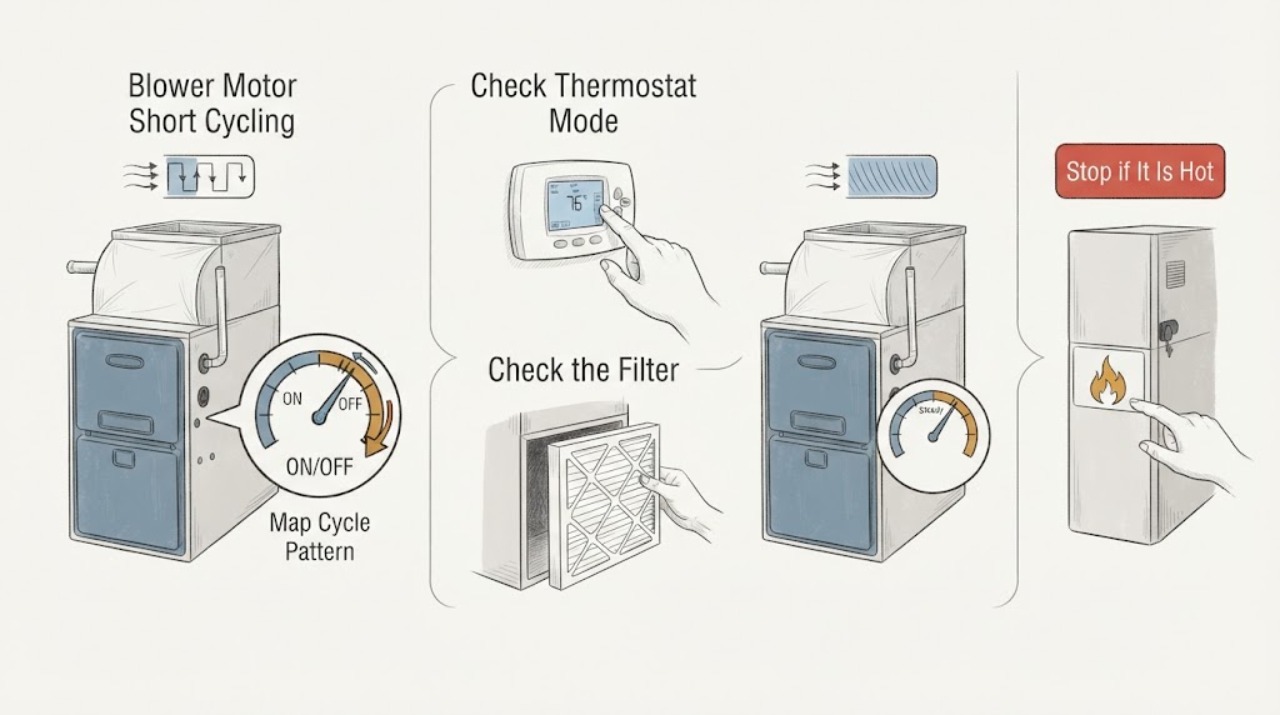
A blower motor that starts and stops repeatedly before the heating or cooling call is complete is not the same as a normal brief fan overrun. First determine whether only the blower is cycling or the whole HVAC system is ending its call, then check the thermostat fan mode, the accessible air filter, and blocked return or supply grilles. A dirty filter or restricted airflow can overheat a furnace and trigger a safety shutdown, while a thermostat, limit control, motor, capacitor, or control-board fault needs professional testing. If there is a burning smell, smoke, exposed wiring, a hot cabinet, a repeatedly tripping breaker, or continued rapid cycling after safe airflow checks, turn the system off and arrange qualified HVAC service.
Work through in order
Diagnostic checks
Use only checks that match the exact appliance or system and its official guide.
-
Check 1
From a safe position, watch one operating sequence and note when the blower starts and stops relative to the thermostat call. Do not open the equipment cabinet or touch the motor.
Expected result: The blower runs briefly after the call ends; it starts and stops while the thermostat still calls for heat or cooling; or the entire system starts and stops together.
Next step: Record the sequence and continue with only the external airflow and thermostat checks if there is no hazard. Do not label the motor failed from sound or timing alone.
Stop if: Stop for smoke, burning odor, exposed wiring, a hot cabinet, unusual flame behavior, or any need to enter the cabinet.
Why this matters
Why: A short post-cycle run can be normal fan delay. Repeated blower changes while a call remains active point toward airflow, a limit or control response, or motor operation. If the whole system cycles together, the thermostat or system-level issue may be primary rather than the blower motor itself.
-
Check 2
Check the accessible thermostat settings: use the intended Heat or Cool mode, confirm the temperature request is intentional, and verify whether Fan is set to Auto or On. Do not remove the thermostat faceplate or alter wiring.
Expected result: Fan is set to On, the system mode or setpoint does not match the intended call, or the settings look correct while the blower still cycles.
Next step: If the exact thermostat instructions allow it, select the intended mode and Fan Auto, then observe one normal call. If the pattern returns or the thermostat behaves erratically, stop and provide the settings and timing to an HVAC professional.
Why this matters
Why: Fan On can make the blower run independently of heating or cooling, and an incorrect mode or setpoint can create an apparent cycling complaint. Correct settings do not clear a motor, airflow, limit, or control fault.
-
Check 3
With the system off and the filter location safely accessible, inspect the filter for heavy dust, collapse, moisture, or an incorrect fit. Replace it only with the size and type specified by the equipment or filter instructions; do not operate the system without a filter.
Expected result: The filter is visibly dirty, damaged, wet, missing, or obstructive; or it is clean, dry, correctly seated, and unobstructed.
Next step: If the filter is clearly due for replacement, fit the correct replacement, restore the system, and observe one cycle. If rapid cycling continues, or the filter is wet or repeatedly loads with debris, stop and arrange service rather than raising motor speed or removing internal parts.
Why this matters
Why: A restricted filter can reduce airflow, stress the blower, and cause a furnace to overheat and shut down on a safety limit. A clean filter makes that one cause less likely but does not rule out blocked ducts, a dirty coil, a motor fault, or a control issue.
-
Check 4
From the room side, check that return grilles and supply registers are open and not covered by furniture, drapes, boxes, or other obstructions. Do not enter ductwork or attempt to clean a concealed coil.
Expected result: One or more returns or supplies are blocked; airflow is weak across several rooms; or grilles are open and airflow appears normal.
Next step: Move only an obvious room-side obstruction, then observe one cycle. If airflow remains weak or the blower still cycles, turn the system off and request a qualified airflow and blower assessment.
Why this matters
Why: Blocked return or supply air can reduce the air moving across the heat exchanger and contribute to a safety shutdown or abnormal blower behavior. Normal room-side grilles do not prove the internal coil, ductwork, or blower wheel is clear.
-
Check 5
Without opening the HVAC cabinet, note whether the thermostat and system display have power and whether the nearby service switch or circuit breaker shows an obvious off or tripped state. Do not keep resetting a breaker or remove electrical covers.
Expected result: The system is dead, a breaker trips again, the service switch is off, or power appears present while the blower cycles.
Next step: If there is no damage and the household procedure permits one reset, reset a tripped breaker once; if it trips again, leave it off and request service. Do not bypass a door switch or work inside the unit.
Stop if: Stop for heat, arcing, smoke, damaged wiring, or any breaker that trips again.
Why this matters
Why: A power interruption can change the observed sequence, but a recurring trip points to an electrical or motor fault rather than a setting. Power present at the thermostat does not prove that the blower motor circuit is safe or healthy.
-
Check 6
During a safe observation, compare the blower behavior with the rest of the system: note whether burners or the outdoor unit stop at the same time, whether supply air becomes weak or cold, and whether the thermostat still shows an active call. Do not inspect flame, refrigerant, or internal controls.
Expected result: The blower stops while the call remains active; the furnace shuts down and the blower continues; the blower never reaches normal airflow; or all equipment stops together.
Next step: Give the exact pattern to a qualified HVAC technician and leave internal diagnosis to them. If the system overheats, emits an odor, or repeatedly shuts down, stop operating it until assessed.
Why this matters
Why: These patterns separate a possible airflow or safety-limit response from a motor or control signal problem, but they cannot identify a capacitor, motor winding, limit switch, or board without measurements. A blower that cannot maintain airflow can also contribute to overheating.
-
Check 7
Only after correcting an obvious thermostat setting, filter, or room-side obstruction, run one supervised heating or cooling call and record whether the blower completes the sequence. Do not make repeated reset attempts to force a result.
Expected result: The blower completes the call with normal airflow; it short cycles again; it runs continuously with no call; or a warning sign appears.
Next step: If the symptom returns or the blower runs abnormally, turn the system off and arrange qualified service. Supply the timing, settings, filter result, airflow pattern, and any display indication.
Stop if: Stop immediately for smoke, burning odor, excessive heat, exposed wiring, loud mechanical distress, or a repeated breaker trip.
Why this matters
Why: A stable cycle after an obvious correction suggests that condition contributed, but recurrence means the system still needs diagnosis. Continuous operation without a call can involve the thermostat, fan control, limit control, or motor circuit. A warning sign overrides all further testing.
Use your observations
Decision map
Find the observation that best matches what you see, then follow the next safe action.
-
PATH 01Next step
What you see
There is smoke, a burning odor, arcing, exposed wiring, an unusually hot cabinet, a carbon-monoxide alarm, or another immediate hazard.
Do this next
Turn the system off only if that can be done without approaching the hazard, leave as needed, and use emergency or qualified HVAC help; do not resume testing.
-
PATH 02Next step
What you see
The blower runs for a short period only after the heating or cooling call has ended, then stops normally.
Do this next
Treat the observed overrun as possible normal fan timing, monitor the next call, and use the exact equipment manual for expected operation.
-
PATH 03Next step
What you see
The filter is dirty or damaged, room-side returns or supplies are blocked, or airflow is weak.
Do this next
Correct only the obvious filter or room-side obstruction safely, observe one cycle, and request service if short cycling continues or the restriction returns.
-
PATH 04Next step
What you see
Fan On, an incorrect mode or setpoint, or an apparent thermostat control issue explains the timing.
Do this next
Use the exact thermostat instructions to select the intended mode and Fan Auto, then observe one call; persistent or erratic behavior needs professional assessment.
-
PATH 05Next step
What you see
The furnace, air handler, or outdoor unit ends its call together with the blower before the requested temperature is reached.
Do this next
Treat the symptom as system-level short cycling rather than proof of a blower failure; leave limit, sizing, ignition, refrigerant, and control diagnosis to a qualified HVAC professional.
-
PATH 06Next step
What you see
The thermostat call remains active but the blower stops, restarts, fails to reach normal airflow, or runs without a call after safe external checks.
Do this next
Turn the system off and arrange qualified service for airflow, motor, capacitor or electronic-drive, limit-control, and board testing; do not open the cabinet.
-
PATH 07Next step
What you see
The filter, grilles, and thermostat settings are normal but rapid cycling returns.
Do this next
Stop operating the equipment and provide the technician with the cycle timing, mode, airflow observations, and model information for a scoped diagnosis.
Helpful context
Understand the symptom
First separate normal fan timing from short cycling
The blower can intentionally run after the heat or cooling call ends, so a single short overrun does not prove a motor fault. Short cycling is the repeated start-stop pattern that occurs before the requested heating or cooling operation is complete. Note the thermostat call, blower sound, supply-air flow, and whether the burners or outdoor equipment also stop; that pattern is more useful than guessing from the motor noise alone.
Keep the inspection external
Do not reach into a moving blower, remove access panels, test a capacitor, bridge a safety switch, or handle live wiring. Do not keep resetting a breaker that trips. If the cabinet is unusually hot, there is smoke or a burning odor, wiring is exposed, or a carbon-monoxide alarm sounds, leave the equipment off and use the appropriate emergency response.
What a technician needs to know
Record the system mode, thermostat fan setting, approximate time from blower start to stop, whether the heating or cooling call remains active, filter condition, visible airflow, any diagnostic display, and whether the symptom began after maintenance or a power interruption. A technician can then check airflow, temperature limits, motor operation, capacitor or electronic-drive behavior, controls, and the equipment sequence without treating the symptom as proof of one failed part.
Safety boundary
Stop conditions
- Do not reach into a moving blower, remove panels, test a capacitor or live circuit, bypass a safety switch, alter motor wiring, or keep resetting a tripping breaker.
- Stop immediately for smoke, burning odor, arcing, exposed wiring, excessive heat, loud mechanical distress, a carbon-monoxide alarm, or any unsafe access condition.
When checks do not resolve it
Need a professional?
Use qualified HVAC service for persistent blower short cycling, weak or absent airflow, a blower that stops during an active call, abnormal fan operation after a safe correction, overheating, or any internal electrical, motor, control, combustion, or refrigerant diagnosis.
Have this ready
- Provide the equipment model and fuel or system type, thermostat mode and fan setting, approximate start-stop timing, whether the whole system cycles, filter and grille observations, visible display indications, recent maintenance or power events, and the safety symptoms observed.
Common questions
FAQ
Is a blower running briefly after the furnace stops always short cycling?
No. A brief fan overrun after a heating or cooling call can be part of normal operation. The more concerning pattern is repeated blower start-stop behavior before the call is satisfied, especially with weak airflow, overheating, or an active warning.
Can a dirty filter make the blower motor short cycle?
Yes. A restricted filter can reduce airflow, stress or overheat the blower, and cause a furnace safety limit to shut down the heat before the cycle is complete. Replace a clearly dirty filter with the specified type, then arrange service if the pattern remains.
How can I tell whether the thermostat or blower is the problem?
Note whether the thermostat still calls for heat or cooling when the blower stops, and check the accessible mode and Fan setting. Those observations can separate a control signal issue from a blower or safety response, but they cannot prove which internal component failed.
Should I replace the blower motor when it starts and stops repeatedly?
Not from this symptom alone. Restricted airflow, a thermostat, a limit control, a capacitor or electronic drive, wiring, and the motor can produce related patterns. Have a qualified technician test the sequence and component operation before selecting a part.
Read the exact guide
Official sources
- 48VG Ultra Low NOx: Owner’s Information ManualCarrier · Carrier packaged gas-heat/electric-cooling equipment safety, filter, blower, and service guidance; used for general HVAC safety boundaries, not fitment or model identity
- Furnace Short Cycling: Causes and SolutionsTrane · Trane gas-furnace short-cycling explanation and airflow, thermostat, limit, and service guidance; used as comparable HVAC guidance
- Furnace Blower Not Working: Causes and SolutionsTrane · Trane gas-furnace blower operation and homeowner troubleshooting guidance; used here for comparable HVAC blower behavior, not a model-specific claim
Community feedback
Share a repair observation
Share a plain-text repair observation. Accepted observations are published automatically; this page may take a moment to update.