
On this page
Start here
Quick answer
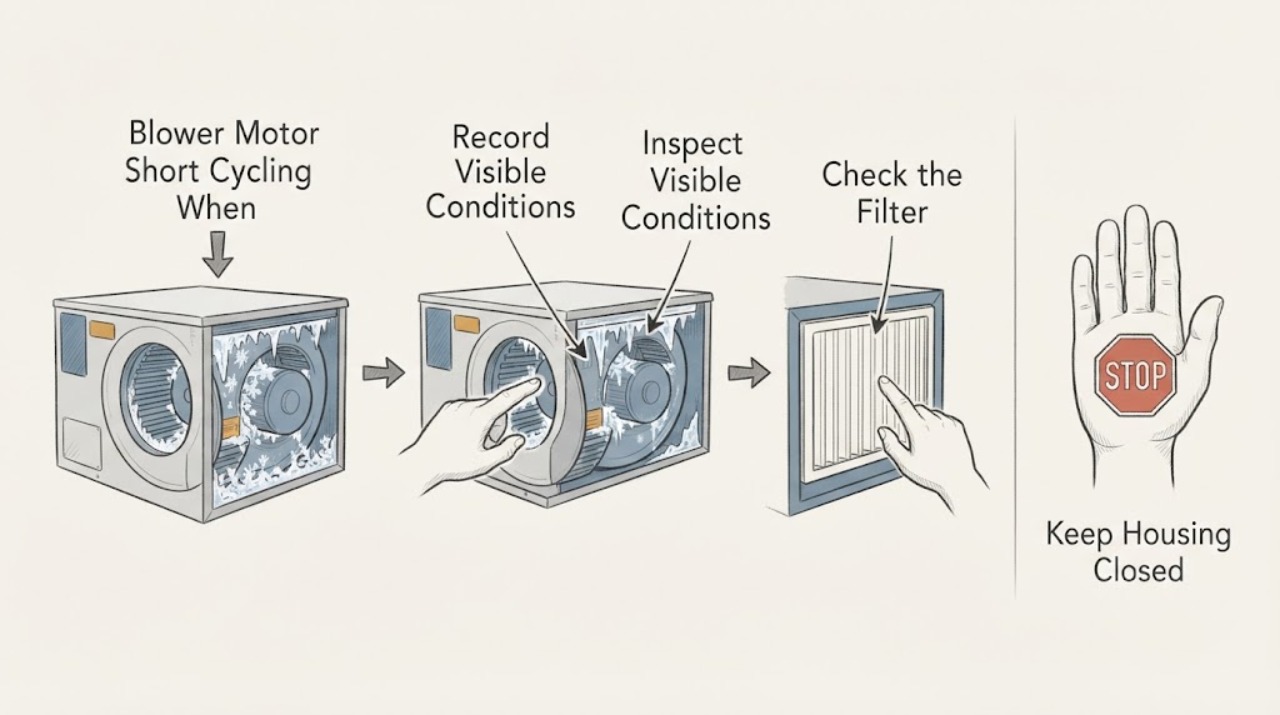
If the inside of an HVAC system is frozen up and the blower motor is short cycling, turn the cooling function off and allow the evaporator coil to thaw naturally. Do not keep restarting cooling, chip the ice, pour hot water on the coil, or open the air handler. From a dry, safe position, record how often the blower starts and stops, inspect the accessible filter and return grilles, look for condensate overflow, and note whether airflow is weak or the motor sounds strained. A dirty filter or blocked air path may be accessible, but a blower motor, capacitor, evaporator coil, drain, thermostat control, electrical fault, or refrigerant problem requires HVAC service.
Work through in order
Diagnostic checks
Use only checks that match the exact appliance or system and its official guide.
-
Check 1
At the thermostat, switch cooling to OFF and note whether the indoor blower is running, stopping, or making a new sound. Record whether the short cycles occurred during cooling, fan-only operation, or both; do not keep calling for cooling to reproduce the fault.
Expected result: Cooling stops but the blower continues normally, the blower stops with the cooling call, or the system keeps trying to start and stop.
Next step: Keep cooling off and allow a natural thaw. If there is smoke, a burning odor, water near electrical equipment, or a protective trip, stop all testing and arrange urgent HVAC or electrical help.
Why this matters
Why: A cooling-related pattern may be responding to a frozen coil or refrigeration control, while a blower-only failure points more toward the blower motor, capacitor, control, or power path. Continued cycling is not a reason to keep testing.
-
Check 2
From a dry position, look for frost or ice on accessible tubing or the indoor-unit exterior and check the visible condensate area for a pan or floor that is wet or overflowing. Do not open the cabinet or touch wiring.
Expected result: Ice is visible, meltwater is controlled, water is overflowing, or there is no ice or water.
Next step: Leave cooling off and let the coil thaw naturally. Keep water away from electrical equipment and call HVAC service for overflow, hidden moisture, or an uncertain indoor-unit condition.
Why this matters
Why: Ice supports a frozen-coil branch, while overflow can indicate a drain or water-damage hazard. No visible ice does not rule out an internal frozen coil or an airflow or control problem.
-
Check 3
After the system is off, inspect the accessible air filter and visible return and supply grilles. Replace a loaded filter only with the type and size specified by the equipment instructions, and remove only an obvious obstruction outside the equipment.
Expected result: The filter is dirty, a return or supply path is blocked, or the accessible airflow path is clear.
Next step: Correct the accessible filter or grille issue, keep cooling off until all ice is gone, and call HVAC service if the motor remains abnormal or the system freezes again.
Why this matters
Why: A dirty filter or blocked grille can reduce airflow across the evaporator coil and contribute to freezing and short cycling. A clear path shifts attention to the blower, coil, drain, controls, ductwork, or refrigerant.
-
Check 4
Once the coil has thawed and the area is completely dry, observe airflow from the registers during a permitted fan call without reaching toward the blower. Listen for humming, scraping, rubbing, vibration, or repeated stopping.
Expected result: Airflow is normal, weak, absent, intermittent, or accompanied by an unusual motor sound.
Next step: Do not run cooling if airflow is abnormal or icing returns. Have an HVAC technician inspect the blower motor and related electrical and airflow components.
Why this matters
Why: Normal airflow after thaw makes a temporary restriction possible but does not prove the blower motor is healthy. Weak, absent, or unstable airflow supports a blower motor, capacitor, control, duct, or remaining-ice service branch.
-
Check 5
Note the thermostat mode, fan setting, temperature demand, filter change history, and whether the short cycling began after maintenance, a power event, or a change in weather. Do not repeatedly change settings to force a cycle.
Expected result: The pattern is tied to a thermostat setting, begins immediately after a power or service event, or continues with correct settings and clear airflow.
Next step: Restore only the documented normal setting and keep cooling off if the interior is frozen. Provide the timeline to HVAC service rather than opening controls or wiring.
Why this matters
Why: A setting or installation change may explain an apparent cycle issue, while persistence with correct settings and clear airflow raises concern for a control, blower, coil, drain, or refrigerant fault.
-
Check 6
Make a safe visual note of any tripped breaker, service switch position, scorching, smoke, hot odor, or damaged insulation. Do not open the electrical panel, reset protection repeatedly, or touch the blower motor or capacitor.
Expected result: A protective device has opened, electrical heat or odor is present, or no electrical warning is visible.
Next step: Leave protection devices alone and call qualified HVAC or electrical service for any abnormal sign. Keep the cooling system off while the coil or blower condition is unresolved.
Why this matters
Why: A trip or heat signal can indicate a motor, capacitor, contactor, wiring, or control fault and is not a normal response to a frozen coil. No visible warning does not make internal electrical testing safe.
-
Check 7
After a complete natural thaw and any permitted filter correction, record whether the system completes a normal cycle without new ice, weak airflow, water, noise, or a protective trip. Observe only if the area is dry and the equipment instructions or technician allow a restart.
Expected result: The cycle remains stable, or short cycling, icing, weak airflow, water, noise, or protection trips return.
Next step: Turn cooling OFF at the first sign of recurrence and contact HVAC service with the complete sequence; do not keep restarting to compare results.
Why this matters
Why: A stable cycle supports a resolved accessible airflow restriction but does not prove the root cause. Any recurrence points to an unresolved mechanical, electrical, control, drain, duct, or refrigerant issue.
Use your observations
Decision map
Find the observation that best matches what you see, then follow the next safe action.
-
PATH 01Next step
What you see
Ice is visible or the indoor coil cabinet is frozen.
Do this next
Let the system thaw naturally, do not chip or heat the ice, and check only the accessible filter, grilles, and dry condensate area.
Why this path and its safety boundary
Why it matters: Treat the evaporator coil as frozen and stop cooling before diagnosing short cycling.
-
PATH 02Next step
What you see
The filter is loaded or visible return and supply paths are blocked, with no water or electrical hazard.
Do this next
Correct the accessible restriction according to the equipment instructions, keep cooling off until thawed, and escalate if airflow remains weak or icing returns.
Why this path and its safety boundary
Why it matters: Restricted airflow is a plausible contributor to the freeze and short cycling.
-
PATH 03Next step
What you see
The filter and grilles are clear, but the blower is weak, absent, intermittent, noisy, or overheating.
Do this next
Keep the system off and call HVAC service; do not touch the motor, capacitor, fan wheel, wiring, or cabinet interior.
Why this path and its safety boundary
Why it matters: A blower motor, capacitor, control, mounting, or duct issue may be reducing airflow.
-
PATH 04Next step
What you see
Meltwater overflows, the drain or pan appears blocked, or water reaches wiring or electrical equipment.
Do this next
Do not operate the system or use electrical equipment in the wet area. Isolate power only if it can be done without contact with water, then call HVAC or electrical service.
Why this path and its safety boundary
Why it matters: Water damage and shock risk now take priority over the cycle symptom.
-
PATH 05Next step
What you see
The coil freezes again after a complete thaw and an accessible filter or grille correction.
Do this next
Stop cooling and arrange HVAC diagnosis; do not add refrigerant, open the coil, or keep restarting the system.
Why this path and its safety boundary
Why it matters: An underlying airflow, blower, dirty-coil, thermostat, drain, low-refrigerant, or leak issue remains.
-
PATH 06Next step
What you see
A breaker trips, a switch or enclosure is hot, or smoke, burning odor, arcing, or repeated motor stopping is present.
Do this next
Stop testing, leave the protective device alone, keep clear of wet equipment, and call qualified HVAC or electrical service.
Why this path and its safety boundary
Why it matters: Treat this as an electrical or motor safety event rather than routine short-cycle troubleshooting.
-
PATH 07Next step
What you see
The coil is thawed, the area is dry, the filter is correct and clean, airflow is normal, and no recurrence occurs.
Do this next
Monitor for renewed frost, short cycling, weak airflow, water, or unusual sound and schedule service if any returns.
Why this path and its safety boundary
Why it matters: A temporary accessible airflow restriction is possible, but one stable cycle does not prove the system is fully healthy.
Helpful context
Understand the symptom
Why freezing and short cycling can appear together
Short cycling means the system starts and stops before completing a normal cycle. A frozen evaporator coil can block airflow and change system performance; a blower motor that is weak, overheats, or stops can reduce airflow enough to contribute to icing. A dirty filter, blocked return, thermostat issue, low refrigerant, dirty coil, drain problem, or electrical protection event can create a similar pattern, so the motor should not be blamed from the symptom alone.
Stop cooling before checking the easy causes
Switch the thermostat out of cooling and let the ice thaw naturally. Keep the area below the indoor unit protected from meltwater only when it can be done without touching electrical equipment. Inspect the filter and visible grilles after the system is off, but do not remove a cabinet cover to reach the blower or coil.
A clean filter does not clear the diagnosis
If replacing a loaded filter and clearing a visible return or supply obstruction does not stop the pattern, the remaining possibilities include the blower motor or capacitor, an inaccessible coil, a condensate restriction, duct airflow, thermostat control, electrical protection, or low refrigerant. Do not test a capacitor, add refrigerant, open the coil circuit, or bypass a safety device.
Recurrence after thaw is the important result
Once the ice is gone and the area is dry, a brief observation can show whether airflow is normal. If the coil freezes again, the blower stops, water overflows, or the system resumes short cycling, switch cooling off and report the sequence to HVAC service. Repeated resets can turn an airflow or control fault into more serious equipment damage.
Safety boundary
Stop conditions
- Keep cooling OFF while the evaporator coil is frozen. Never chip ice, pour hot water on it, use a torch, or open the refrigerant circuit.
- Stop immediately for smoke, burning odor, arcing, hot wiring or enclosures, repeated breaker trips, or an overheating or scraping blower; do not reset protection or open a panel.
- Stop if meltwater reaches wiring, an outlet, a control, or standing water; do not use a hair dryer, heater, or other electrical appliance in the wet area.
- Do not touch the blower motor, capacitor, contactor, fan wheel, coil, refrigerant line, wiring, or internal control. Stop homeowner checks when any of those would need testing or removal.
Only after diagnosis
Potential parts
- air filter
Consider this only when the installed filter is loaded or damaged and the equipment instructions identify a replacement.
Match the equipment instructions for dimensions and filter type; a new filter cannot correct a blower, coil, drain, control, duct, or refrigerant fault. - blower motor
Consider this only after professional testing confirms that the blower motor is failing after the coil is thawed and accessible airflow restrictions are addressed.
Confirm the air-handler model, motor type, electrical rating, mounting, and manufacturer fit information with the HVAC professional. - blower motor capacitor
Consider this only when the equipment design includes a serviceable capacitor and professional testing identifies it as the cause of short cycling or weak blower operation.
Capacitors store hazardous energy; the exact rating and fit must be confirmed and installed by a qualified technician.
When checks do not resolve it
Need a professional?
Call HVAC service for a frozen evaporator coil that returns after a complete natural thaw, a blower motor that is weak or stopped, or short cycling with a clean filter and open grilles., Arrange prompt service for condensate overflow, water near the air handler, a suspected refrigerant issue, a dirty or inaccessible coil, or any fault that requires opening the cabinet., Use qualified electrical help for repeated breaker trips, hot or damaged wiring, arcing, smoke, or an electrical odor, especially around wet equipment.
Have this ready
- Give the equipment type and model if known, cycle timing, thermostat mode, blower behavior, visible ice and meltwater, filter and grille state, condensate observations, breaker behavior, previous freeze-ups, and any recent maintenance or power event.
Common questions
FAQ
Can a frozen coil make the blower motor short cycle?
It can reduce airflow and make the blower work against a blocked path, while a weak or stopped blower can also contribute to coil icing. Turn cooling off, let the coil thaw naturally, and have the blower and coil causes assessed rather than assuming one part is at fault.
What should I do first when the inside is frozen up?
Switch cooling OFF and let the ice thaw naturally. Do not chip it, pour hot water on it, use a torch, or keep restarting the system. You may inspect the accessible filter and grilles from a dry position without opening the air handler.
Can I fix short cycling by changing the filter?
A loaded filter can restrict airflow and may be an accessible contributor, but a clean filter does not rule out a blower motor, coil, drain, duct, thermostat, electrical, or refrigerant problem. If freezing or short cycling returns, call HVAC service.
Should I set the blower fan to ON to melt the ice?
Follow the equipment instructions or technician guidance. Keep cooling OFF, and do not run the blower when it is abnormal, water is near electrical equipment, or the motor is overheating or making a harsh sound. Natural thaw is safer than forcing a damaged system to run.
When is a frozen-coil short-cycle problem urgent?
Stop immediately for smoke, burning odor, arcing, repeated protection trips, water near wiring, overflow, severe vibration, or an overheating or scraping blower. Keep the system off and arrange qualified HVAC or electrical help.
Read the exact guide
Official sources
- Air Handler TroubleshootingTrane · Air-handler filter, frozen evaporator coil, blower motor failure, water leakage, and professional service guidance
- Troubleshoot an Air Conditioner | AC Troubleshooting | CarrierCarrier · AC filter, airflow, short cycling, condensate, electrical, frozen evaporator coil, and refrigerant troubleshooting boundaries
- Will Frozen AC Fix Itself? A Guide To Frozen AC CoilsCarrier · Frozen evaporator coil causes, cooling shutdown, natural thaw, airflow checks, and professional repair boundaries
Community feedback
Share a repair observation
Share a plain-text repair observation. Accepted observations are published automatically; this page may take a moment to update.