
On this page
Start here
Quick answer
Small roaches or suspected egg cases along a baseboard usually mean the area is close to shelter, food, or moisture, but a single sign does not identify the species or prove an infestation. Photograph the sign without touching or opening the baseboard, note when and where activity appears, and look for accessible food, water, clutter, and entry gaps. Use monitoring and sanitation to learn the pattern. If you choose a ready-to-use, enclosed bait station, keep it away from children and pets and follow its exact label; never mix pesticides, spray over bait, use foggers, or improvise an application. Repeated nymphs or egg cases, activity in several rooms, asthma or allergy concerns, or a problem that persists after safe prevention is a reason to call a licensed pest professional.
Before you begin
Safety first
- The homeowner scope is visual observation, ordinary food and water control, safe monitoring, and—only when the label allows—a child- and pet-inaccessible enclosed bait station. Do not mix pesticides, use foggers, spray broadly, open baseboards or appliances, disturb egg cases, treat electrical equipment, or perform concealed crack or void work.
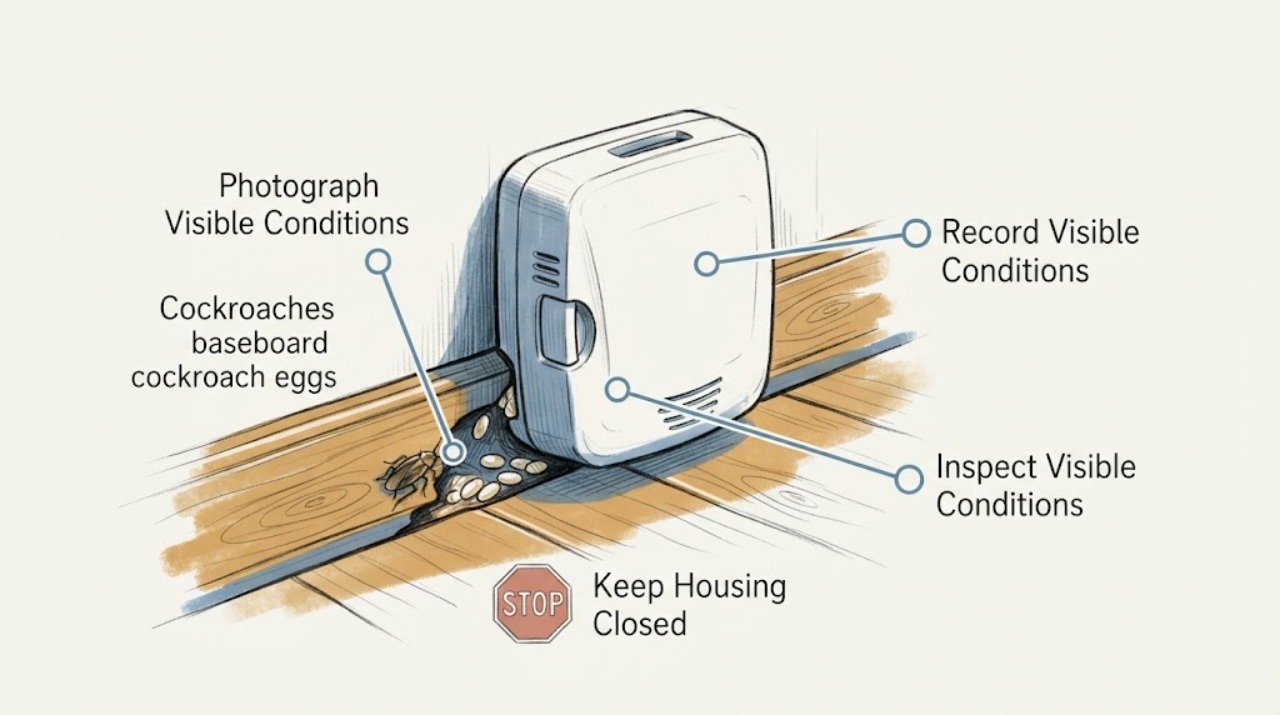
Work through in order
Diagnostic checks
Use only checks that match the exact appliance or system and its official guide.
-
Check 1
From a clean, well-lit position, photograph the baseboard sign and note its exact room, wall, corner, nearby cabinet or plumbing, and whether it is on the floor edge, wall face, or another surface. Do not touch, crush, scrape, lift the baseboard, or open a wall.
Expected result: Record whether the sign looks like a moving small roach, a dark capsule, shed skin, droppings, or unrelated debris, while treating the identification as provisional.
Next step: Save the photo and continue with timing and environment observations. If the sign is associated with children, pets, food areas, or allergy concerns, keep the area separated and arrange professional advice.
Stop if: Stop if identification would require touching, disturbing, collecting, opening the baseboard, moving a heavy appliance, or contacting droppings or unknown material.
Why this matters
Why: A photo and location can help an extension specialist or pest professional identify the insect and its likely harborage; appearance alone cannot confirm a species or determine treatment.
-
Check 2
For several ordinary observation periods, record when activity appears and where it is concentrated along the baseboard, without waiting in a dark room, chasing insects, or disturbing their hiding place.
Expected result: Note whether sightings are isolated or recurring, limited to one baseboard section or present in multiple rooms, and whether they cluster near warmth, plumbing, food storage, or a visible gap.
Next step: Use the record to guide safe monitoring and service. Do not increase pesticide use simply because the count is uncertain.
Stop if: Stop the observation routine if roaches spread into food preparation areas, activity is widespread, anyone has respiratory or allergy symptoms, or the inspection would involve entering a void or moving equipment.
Why this matters
Why: A recurring pattern or multiple life stages is more concerning than an isolated sighting, while a location pattern can point a professional toward moisture, food, or a hidden harborage.
-
Check 3
Look at the accessible area around the baseboard for crumbs, grease, open food or pet food, standing water, dampness, a plumbing leak, cardboard clutter, or a visible gap. Clean and dry only ordinary reachable surfaces; do not disturb a suspected egg case or contaminate food-contact areas.
Expected result: Record whether food, water, warmth, clutter, or a gap is present and whether the area can be kept clean and dry without demolition or chemical treatment.
Next step: Store food and pet supplies in closed containers, remove accessible crumbs and clutter, address a plainly visible leak through the appropriate repair route, and continue monitoring.
Stop if: Stop if cleaning would require handling droppings, opening walls or appliances, touching wet electrical equipment, applying chemicals, or disturbing a suspected egg case.
Why this matters
Why: Reducing accessible food, water, and shelter can make the area less favorable, but it does not remove a hidden population or prove the source of the insects.
-
Check 4
If a monitoring device is appropriate for the room and can be placed out of reach of children and pets, use a commercially packaged sticky monitoring trap according to its label. Place it near the observed baseboard activity without putting it on food surfaces, inside an outlet, or into a wall gap.
Expected result: Record whether the device catches anything, the general size or appearance of catches without handling them, and whether activity remains near the baseboard or appears elsewhere.
Next step: Follow the product label for safe disposal or ask a pest professional to interpret the pattern. Keep the device and any catch away from children, pets, food, and direct contact.
Stop if: Stop if the device cannot be kept inaccessible, if it is placed near food or electrical equipment, if handling it would expose you to insects or debris, or if activity is widespread.
Why this matters
Why: Monitoring can show location and recurrence and can help a professional target an inspection; it is not a substitute for identification or a complete treatment plan.
-
Check 5
If you decide to use a ready-to-use enclosed cockroach bait station, verify from its label that the product and location are permitted, place it only as directed and out of reach of children and pets, and do not add spray, powder, or another chemical nearby.
Expected result: Note whether the station remains intact and whether sightings or monitoring activity change over time, without opening the station, handling bait, or treating a surface that the label excludes.
Next step: Keep following the label and sanitation measures only if the situation remains controlled. Call a licensed pest professional for recurring signs, uncertain identification, broad activity, or any need for sprays, dusts, void treatment, or crack sealing.
Stop if: Stop pesticide use immediately for exposure, an unlabeled or improvised mixture, a product accessible to children or pets, food contamination, a wet electrical area, or any request to fog or spray broadly.
Why this matters
Why: A labeled enclosed station can be one part of an integrated pest-management approach, but no response, continued nymphs or egg cases, or activity in several areas suggests that professional inspection is needed.
Use your observations
Decision map
Find the observation that best matches what you see, then follow the next safe action.
-
PATH 01Safety boundary
What you see
The observation is isolated, identification is uncertain, and no recurring activity or environmental attractant is found.
Do this next
Keep the photo, maintain food and water control, and use safe monitoring if appropriate. Seek identification if another sign appears.
Why this path and its safety boundary
Safety stop: Do not open the baseboard, collect unknown material, or apply pesticide just to confirm what the sign was.
-
PATH 02Safety boundary
What you see
Small roaches or suspected egg cases recur near the same baseboard or appear in more than one room.
Do this next
Arrange a licensed pest-management inspection and provide the photos, locations, timing, environmental observations, and monitoring record.
Why this path and its safety boundary
Safety stop: Do not assume a single spray, fogger, powder, or crack treatment will solve a hidden or multi-room problem.
-
PATH 03Safety boundary
What you see
Accessible food, pet food, dampness, a leak, clutter, or a visible gap is present near the baseboard.
Do this next
Remove accessible food and clutter, keep the area dry, and route a visible plumbing or building repair through the appropriate service. Continue monitoring without disturbing the wall or baseboard.
Why this path and its safety boundary
Safety stop: Stop if the source is behind an appliance, inside a wall, near wet electrical equipment, or otherwise not safely reachable.
-
PATH 04Safety boundary
What you see
A ready-to-use enclosed bait station is considered, but children or pets can reach the area, the label does not cover the location, or the user would need to mix or add another product.
Do this next
Do not use the product. Ask a licensed pest professional for a site-specific plan.
Why this path and its safety boundary
Safety stop: No pesticide mixing, unlabeled application, open bait, fogger, broad spray, or placement on food-contact surfaces.
-
PATH 05Safety boundary
What you see
Activity is widespread, rapidly increasing, associated with asthma or allergy concerns, or persists after safe sanitation and monitoring.
Do this next
Call a licensed pest professional and request identification, inspection of baseboard and adjoining harborage, and an integrated treatment plan.
Why this path and its safety boundary
Safety stop: Do not continue escalating home chemicals or disturb concealed spaces while waiting for service.
-
PATH 06Safety boundary
What you see
There is suspected chemical exposure, food contamination, a wet electrical area, or anyone develops concerning symptoms.
Do this next
Stop the activity, move people and pets away, follow the product label's first-aid or emergency directions if applicable, and contact appropriate medical, poison-control, electrical, or professional pest support.
Why this path and its safety boundary
Safety stop: Do not clean up a chemical spill or wet electrical hazard by improvisation or continue applying products.
Helpful context
Understand the symptom
Do not assume one sign tells the whole story
A nymph is an immature cockroach and is generally smaller and wingless, while an egg case is a capsule rather than a loose cluster of ordinary insect eggs. Other insects and debris can look similar, and species differ in appearance and hiding habits. Treat the observation as a lead to document, not as proof that a particular product or treatment is correct.
Baseboards are a clue, not a treatment plan
A baseboard edge can connect a wall void, floor gap, cabinet, or plumbing route with food and moisture. Do not pry the baseboard open, spray into a wall, or seal a crack before you understand whether insects are active there. Safe inspection, monitoring, food and water control, and professional identification provide a more useful sequence.
Use pesticide products conservatively
If a product is used at all, choose only a legally labeled, ready-to-use enclosed bait station that is suitable for the location, and follow the container label. Keep it inaccessible to children and pets, away from food and food-contact surfaces, and do not combine it with sprays, powders, homemade mixtures, or foggers. A widespread, recurring, or uncertain problem is better handled by a licensed pest professional.
Only after diagnosis
Potential parts
- roach-bait-station
Consider this category only when the product label permits the intended location, the station can remain inaccessible to children and pets, and activity is limited enough for a labeled monitoring-and-control plan; recurring or broad activity needs professional treatment.
Confirm the label, target pest, placement restrictions, and household safety requirements for the exact product before use; never mix products or place bait on food-contact surfaces. - sticky-trap
Consider this category for observation of location and recurrence when it can be placed safely and kept away from children, pets, food, and electrical equipment; it is not a complete treatment.
Use only a packaged monitoring device with clear directions for the room and dispose of it according to its label without direct contact with insects or debris. - crack-sealant
Consider this category only after activity has been identified and the gap is confirmed as an appropriate, dry, non-structural sealing target; sealing an active harborage or moisture route can hide the cause.
Confirm the surface, moisture condition, and intended indoor use with the product instructions or pest professional; do not open walls or seal around wet electrical, plumbing, or unknown conditions.
When checks do not resolve it
Need a professional?
Call a licensed pest professional for recurring nymphs or egg cases, activity in multiple rooms, uncertain identification, signs near electrical equipment or concealed voids, asthma or allergy concerns, broad reproduction, chemical exposure, or a problem that persists after safe sanitation and monitoring.
Safety scope: The homeowner scope is visual observation, ordinary food and water control, safe monitoring, and—only when the label allows—a child- and pet-inaccessible enclosed bait station. Do not mix pesticides, use foggers, spray broadly, open baseboards or appliances, disturb egg cases, treat electrical equipment, or perform concealed crack or void work.
Have this ready
- Provide photos, room and baseboard locations, activity timing, suspected life stage, monitoring observations, food or water findings, pet and child access, and any products already used. Keep the professional informed of possible moisture or building-entry issues.
Common questions
FAQ
Are small roaches near a baseboard definitely an infestation?
No. A single observation can be misidentified or isolated, but recurring small roaches or suspected egg cases are more concerning. Photograph the sign, monitor the location, and arrange professional identification if it repeats or spreads.
What do cockroach nymphs and egg cases look like?
Nymphs are immature cockroaches and are generally smaller and wingless. Egg cases are capsules, but appearance varies and other debris can confuse identification. Use a clear photo or a pest professional rather than relying on a guess.
Should I spray the baseboard or use a fogger?
Do not spray broadly, fog, or mix products. If a ready-to-use enclosed bait station is considered, it must be labeled for the location and kept away from children and pets. Recurring or widespread activity calls for licensed pest service.
Can I seal the baseboard crack right away?
Not before the activity and any moisture route are understood. Sealing an active harborage or an unknown wet or electrical condition can hide the cause. Ask a pest or building professional when the gap is not clearly safe and appropriate to seal.
When should I call a pest professional?
Call when nymphs or egg cases recur, activity appears in multiple rooms, identification is uncertain, anyone has allergy or asthma concerns, the problem persists, or treatment would involve sprays, dusts, voids, appliances, or concealed spaces.
Read the exact guide
Official sources
- CockroachesUniversity of Minnesota Extension · General educational guidance for recognizing possible cockroach life stages, monitoring baseboard and edge activity, and reducing food and moisture; identification varies by species and region.
- Smart Pest Control to Protect Your HealthU.S. Environmental Protection Agency · General household pest-control guidance supporting food, water, shelter reduction, sealing entryways, and label-directed use of traps or bait stations; it does not replace a product label or professional site assessment.
Community feedback
Share a repair observation
Share a plain-text repair observation. Accepted observations are published automatically; this page may take a moment to update.