
On this page
Start here
Quick answer
Recurring cockroaches usually need a pattern-based inspection, not another random spray. Record when sightings happen, where they occur, and whether you also find droppings, egg cases, shed skins, moisture, food residue, clutter, or openings around pipes and doors. Dry leaks, remove accessible food and water sources, reduce hiding places, and have a licensed pest professional or building manager coordinate follow-up when activity continues. Do not mix pesticides, fog rooms, apply products off-label, or treat one sighting as proof of a full infestation.
Before you begin
Safety first
- Do not mix pesticides, fog rooms, apply products off-label, disturb contaminated material, or seal service openings without qualified review; protect children, pets, food, and people with asthma from exposure.
Work through in order
Diagnostic checks
Use only checks that match the exact appliance or system and its official guide.
-
Check 1
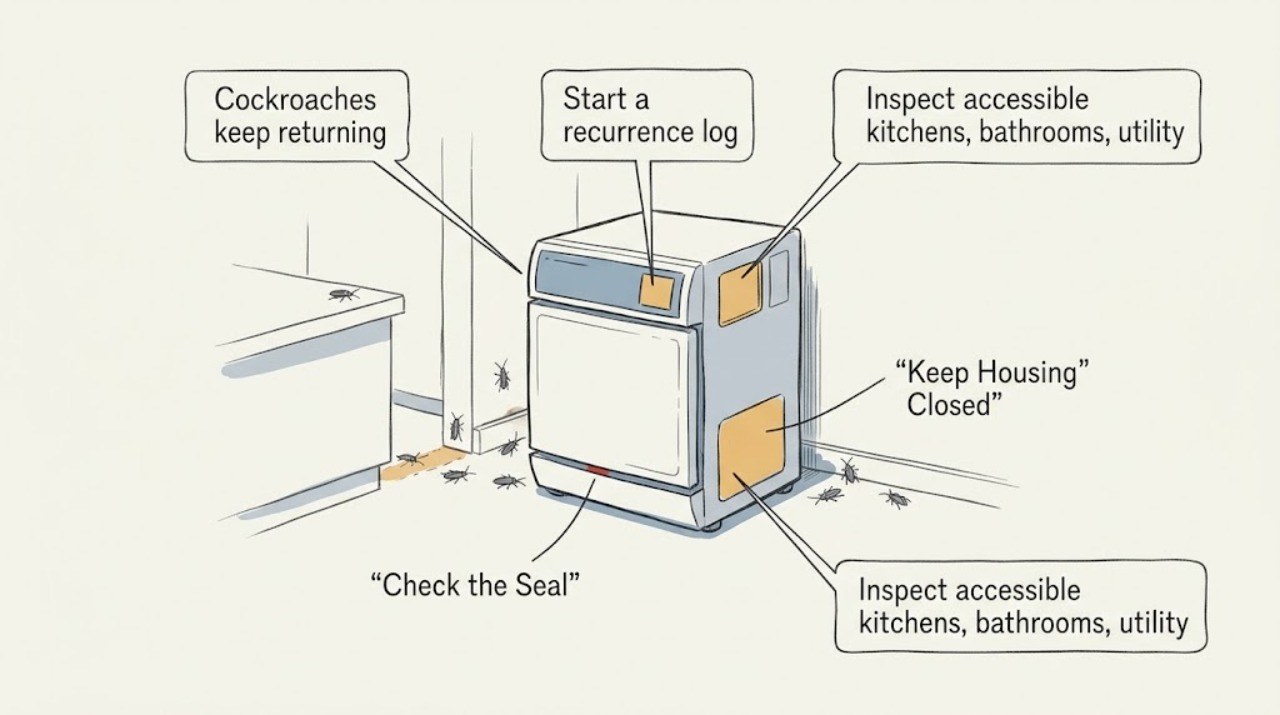
Start a recurrence log for each sighting or sign: date, time, room, floor level, approximate appearance, and whether the insect was alive, dead, or only represented by droppings or an egg case; do not handle evidence.
Expected result: Record whether activity is isolated or repeated, daytime or nighttime, concentrated in one room or distributed, and whether the appearance is consistent across sightings.
Next step: Share the log and photographs with a pest professional or building manager and ask for monitoring and identification before any new treatment is selected.
Stop if: Stop handling or cleaning evidence if there may be significant droppings, allergy or asthma concerns, or contamination in an inaccessible area; request professional guidance.
Why this matters
Why: A repeated, location-linked pattern is more actionable than a single uncertain sighting, but one sign cannot establish species, population size, or a treatment failure. Accurate identification helps prevent the wrong product or approach.
-
Check 2
Inspect accessible kitchens, bathrooms, utility areas, and pet areas for food crumbs, grease, open packages, food waste, standing water, wet sponges, condensation, dripping fixtures, or damp cabinets without moving heavy appliances or entering concealed spaces.
Expected result: Record the specific food or water source, whether it is present overnight or between uses, and whether activity is clustered near that source.
Next step: Clean accessible residue, seal food and pet food, dry surfaces, and report or repair leaks through the appropriate maintenance or plumbing channel; keep the log to see whether the pattern changes.
Stop if: Stop if a leak reaches electricity, cleaning would disturb suspected contamination, or a repair requires plumbing, appliance, or structural access.
Why this matters
Why: Food and water can sustain pests even after a prior treatment, but finding a source near one sighting does not prove it is the only source. EPA identifies food, water, and shelter as basic conditions to reduce through IPM.
-
Check 3
Visually check accessible edges and storage for cardboard, paper bags, clutter, gaps at baseboards, openings around pipes, door or window gaps, and unsealed service penetrations; do not drill, open walls, or dismantle cabinets.
Expected result: Record the location and size impression of each possible shelter or entry route, whether it connects to another room or unit, and whether activity signs occur nearby.
Next step: Reduce accessible clutter, retain photos, and ask maintenance or a pest professional to assess and seal suitable openings without blocking required ventilation or drainage.
Stop if: Stop if sealing would affect gas, electrical, HVAC, plumbing, fire-safety, or ventilation components, or if the opening leads into a concealed or unsafe area.
Why this matters
Why: An access or harborage route can allow recurrence even when food is controlled, while an isolated gap without signs is only a possibility. Building-wide or shared-wall routes need coordinated maintenance rather than a room-only treatment.
-
Check 4
Review the previous control history: date, provider or product, rooms treated, visible response, follow-up visits, and when activity returned; do not reapply or combine products while reviewing the record.
Expected result: Record whether activity declined and returned, never declined, appeared in a new location, or was reported by another unit or household member after treatment.
Next step: Give the full record to the treating professional or property manager and request a documented IPM follow-up plan with monitoring, source correction, and targeted control decisions.
Stop if: Stop pesticide use if the label, treated-area instructions, or product identity is unknown, or if people or pets could be exposed.
Why this matters
Why: A return after improvement can indicate a continuing source, re-entry, untreated harborages, or a new introduction. No improvement can indicate misidentification, inaccessible habitat, or an unsuitable treatment, but none can be concluded from timing alone.
-
Check 5
If a monitoring method is already available and safe for the household, place or inspect a non-broadcast monitor only in a dry location inaccessible to children and pets, following its instructions; do not use it to touch or capture insects by hand.
Expected result: Record whether activity is found near the kitchen, bathroom, appliance edge, entry, or another location and whether captures or signs increase, decrease, or remain absent over the monitoring period.
Next step: Photograph or record the monitor result and use it with the recurrence log to guide a professional inspection rather than escalating to broad spraying.
Stop if: Stop using or moving the monitor if it is contaminated, damaged, accessible to a child or pet, or located where food preparation could be affected.
Why this matters
Why: Monitoring can show where activity is concentrated and whether a pattern persists, but an empty monitor does not prove the home is pest-free and a single capture does not establish the source.
Use your observations
Decision map
Find the observation that best matches what you see, then follow the next safe action.
-
PATH 01Safety boundary
What you see
There is one uncertain sighting and no repeated signs or supporting food, water, shelter, or entry clues.
Do this next
Log and photograph any future sighting, maintain dry and clean conditions, and avoid pesticide use until identification or a meaningful pattern exists.
Why this path and its safety boundary
Safety stop: Do not treat one sign as proof of an infestation.
-
PATH 02Safety boundary
What you see
Repeated sightings or signs are concentrated near a food or water source.
Do this next
Correct the accessible source, repair or report moisture, continue monitoring, and ask a pest professional to assess the nearby harborage.
Why this path and its safety boundary
Safety stop: Do not mix products or use off-label pesticide applications to compensate for an unresolved source.
-
PATH 03Safety boundary
What you see
Activity is clustered near gaps, plumbing penetrations, doors, appliances, or shared walls.
Do this next
Request coordinated maintenance and pest inspection so entry and harborage conditions are addressed along with any treatment.
Why this path and its safety boundary
Safety stop: Do not drill, foam, caulk, or remove covers around services without confirming that the opening is safe to seal.
-
PATH 04Safety boundary
What you see
Activity improved after a prior treatment and then returned, or appears in multiple rooms or units.
Do this next
Provide the treatment history and recurrence log and request a documented follow-up plan with monitoring, source correction, and targeted professional control.
Why this path and its safety boundary
Safety stop: Do not add another pesticide or fog the space without a qualified plan and strict label compliance.
-
PATH 05Safety boundary
What you see
Droppings, allergens, pests, or treatment residue are present in a large, inaccessible, or health-sensitive area.
Do this next
Keep occupants and pets away from the area and arrange professional pest and, if needed, cleaning or remediation assessment.
Why this path and its safety boundary
Safety stop: Stop sweeping, vacuuming, handling, or disturbing contaminated material when exposure or asthma risk is possible.
Helpful context
Understand the symptom
Recurrence can mean surviving pests, a missed harborage, a continuing food or moisture source, or new entry from another room or unit. It can also reflect a single sighting that has not yet established a pattern. EPA’s integrated pest management approach starts with monitoring and accurate identification, then prevention and targeted control based on what the observations show.
Use a simple log with date, time, room, approximate size or appearance, and what was found nearby. Look from normal standing positions with ordinary lighting. Do not handle insects, droppings, egg cases, or contaminated material with bare hands, and do not disturb suspected nesting areas just to confirm a guess.
Food, water, shelter, and entry routes are the practical recurrence map. Wipe accessible spills, keep food and pet food sealed, empty food waste regularly, dry sinks and counters, report plumbing leaks, and remove cardboard or clutter where it can be done safely. These steps reduce support for pests but do not prove that the source has been eliminated.
If a prior treatment did not hold, collect the treatment date, product or service record, rooms treated, and the activity seen afterward. A professional can use that history to adjust monitoring and treatment. Do not add a different pesticide, combine products, or re-enter a treated area outside the product label or professional instructions.
Only after diagnosis
Potential parts
- drain-cover
Consider this only if a plumber or pest professional confirms that an accessible drain opening is a plausible entry route and the cover will not interfere with required drainage.
Match the drain opening and flow requirements; do not cover a drain that needs ventilation, access, or a functioning trap. - crack-sealant
Consider this only after a professional identifies a non-service opening that contributes to pest access and confirms the area is dry and safe to seal.
Choose a material appropriate to the joint and surrounding surface; do not seal electrical, gas, plumbing, HVAC, drainage, or fire-safety openings without qualified review. - roach-bait-station
Consider this only when the species and placement are appropriate, the product is registered and labeled for the intended use, and children and pets cannot access it.
Follow the complete product label and any professional plan; never open, mix, transfer, or combine pesticide products or place bait near food-preparation surfaces.
When checks do not resolve it
Need a professional?
Call a pest professional or building manager when sightings recur, signs appear in multiple rooms or units, moisture or entry routes persist, a prior treatment did not hold, or the source is inaccessible.
Safety scope: Do not mix pesticides, fog rooms, apply products off-label, disturb contaminated material, or seal service openings without qualified review; protect children, pets, food, and people with asthma from exposure.
Have this ready
- Provide the recurrence log, photographs, location and timing, suspected food or water sources, entry or harborage clues, household and pet constraints, prior treatment records, and monitoring results.
Common questions
FAQ
Does seeing one cockroach mean the infestation is back?
Not by itself. Log the sighting and look for a repeated time-and-location pattern or supporting signs. Accurate identification and monitoring are more useful than treating one uncertain sign as proof of a population.
Why do cockroaches return after treatment?
Possible explanations include a continuing food or water source, an access or harborage route, untreated areas, activity in another unit, or a new introduction. The timing of return is a clue, not proof of one cause.
Can I spray a different pesticide if the first treatment did not work?
Do not mix or stack products or use them off-label. Give the treatment record and recurrence log to a qualified pest professional, who can reassess identification, sources, access, monitoring, and the safest targeted control.
Read the exact guide
Official sources
- Pest Control: Resources for Housing ManagersU.S. Environmental Protection Agency · Used for the branch where recurrence crosses rooms or units and requires residents, maintenance, and pest professionals to coordinate.
- Do you really need to use a pesticide?U.S. Environmental Protection Agency · Used for accessible food, water, clutter, entry, and child/pet boundaries; it does not establish that any one source caused this recurrence.
- Reference Guide for Indoor Air Quality in SchoolsU.S. Environmental Protection Agency · Used for general principles that food, moisture, and pest residue can matter to occupants; household actions remain limited to safe observation and source correction.
- Integrated Pest Management (IPM) PrinciplesU.S. Environmental Protection Agency · Used to frame recurrence as a monitoring and source-correction problem rather than an automatic reason for broad pesticide use.
Community feedback
Share a repair observation
Share a plain-text repair observation. Accepted observations are published automatically; this page may take a moment to update.