
On this page
Start here
Quick answer
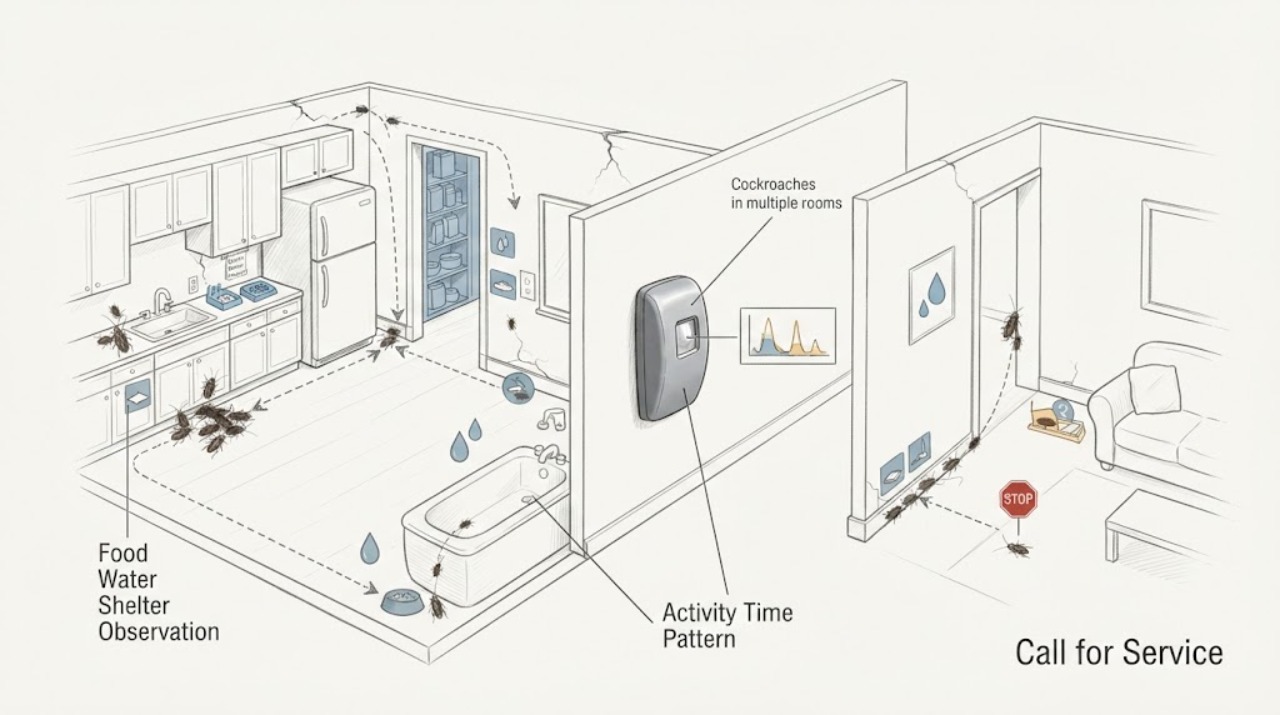
Cockroaches or evidence in multiple rooms should be treated as a whole-property pest-management issue, not as a reason to spray each room independently. From a safe distance, map which rooms show live sightings or evidence, when activity occurs, and whether food, water, leaks, clutter, or building-entry conditions are shared between rooms. Do not handle insects, droppings, egg cases, contaminated items, or dead pests; do not mix or apply pesticides, use a fogger, open walls, or move appliances to chase activity. Contact a licensed pest-control professional promptly and, in a rental or multi-unit building, notify the property manager so adjacent units and shared pathways can be assessed.
Work through in order
Diagnostic checks
Use only checks that match the exact appliance or system and its official guide.
-
Map rooms with sightings or evidence
From normal, well-lit access points, list each room or area where you saw a live cockroach or noticed possible evidence, and record the date without touching or moving anything.
Expected result: Note whether activity is limited to one room, concentrated near kitchens or bathrooms, present in bedrooms or living areas, or visible in several floors or units; distinguish a direct sighting from an unconfirmed mark.
Next step: Send the room list and dates to a licensed pest-control professional and, for a rental or multi-unit building, to the property manager. Keep people and pets away from any suspected contaminated area until the professional provides instructions.
Stop if: Stop if mapping would require entering an unsafe, restricted, heavily contaminated, or occupied area, or if you would need to move appliances, open walls, or handle insects or residue.
Why this matters
Why: A multi-room pattern suggests that a professional should consider shared routes and building conditions rather than treating one isolated cabinet. EPA recommends monitoring and accurate identification before choosing control, and a single unconfirmed mark is not the same evidence as repeated live sightings.
-
Record when activity appears
Use ordinary observations from occupied rooms to record whether sightings occur during the day, after lights go out, after cooking, after plumbing use, or at a consistent time; do not deliberately disturb hiding places or set up unapproved chemicals.
Expected result: Note the time, room, visible direction of travel if any, and whether activity repeats over several days. Do not infer a species or infestation size from one sighting.
Next step: Share the time pattern with the pest professional and ask for an inspection plan that covers the affected rooms and likely shared routes. Do not chase or trap insects by hand.
Stop if: Stop if observation would require staying in a room with strong fumes, touching residue or droppings, disturbing nests or egg cases, or delaying professional help despite repeated activity.
Why this matters
Why: A repeated time or room pattern helps a professional plan monitoring and inspection, while an irregular pattern may still reflect hidden activity. EPA's IPM principles emphasize monitoring and identification before control; timing alone cannot identify the source.
-
Observe shared food, water, and shelter conditions
Without moving appliances or handling contaminated items, visually note accessible food scraps, uncovered pet food or water, leaks, condensation, standing water, overflowing trash, and clutter or cracks that are already visible in the affected rooms.
Expected result: Record whether the same moisture, food, trash, or shelter condition appears in more than one room, near a plumbing route, or in a common area; do not open walls or pull out cabinets to look behind them.
Next step: Photograph only safe, non-sensitive conditions and report leaks, moisture, and building-maintenance concerns to the responsible manager or qualified trade. Ask the pest professional to incorporate those observations into an IPM plan.
Stop if: Stop if the observation involves touching waste, droppings, dead pests, mold, contaminated food, chemicals, or damaged building materials, or if it requires opening walls or moving heavy items.
Why this matters
Why: EPA says cockroaches need food, water, and shelter and recommends addressing those sources as part of safer pest management. A shared condition can help a professional and property manager look beyond the first room, but it does not prove that the condition caused the infestation.
-
Check safe, visible entry and shared-route clues
From the home's normal side of doors, windows, vents, and plumbing penetrations, observe only visible gaps, damaged screens, moisture, or signs that rooms share a wall or service route; do not seal openings, remove covers, enter another unit, or access a utility space.
Expected result: Note whether affected rooms border a common wall, hallway, kitchen, bathroom, trash area, or visible service penetration, and whether a door or screen is visibly unable to close; avoid measuring, probing, or disturbing the opening.
Next step: Give the route clues to the licensed pest professional and property manager. Let qualified maintenance staff address building defects after the pest professional documents what matters for the treatment plan.
Stop if: Stop at any opening that is damaged, electrically or mechanically hazardous, inside a restricted area, or only reachable by removing a cover or entering another unit.
Why this matters
Why: EPA housing guidance identifies access and travel routes, moisture, and cooperation among residents and building staff as relevant parts of an IPM response. These observations can help determine whether the property manager and adjacent areas need coordinated inspection, but they do not identify a hidden nest.
Use your observations
Decision map
Find the observation that best matches what you see, then follow the next safe action.
-
PATH 01Next step
What you see
Live sightings or credible evidence repeat across several rooms or on multiple days.
Do this next
Arrange prompt licensed professional pest-control service for a whole-property assessment and provide the room, time, food-water, and route observations. Do not spot-spray independently.
-
PATH 02Next step
What you see
The home is rented, attached, or part of a multi-unit building.
Do this next
Notify the landlord or property manager and request coordinated inspection of shared pathways and adjacent units; do not enter another unit or shared utility area.
-
PATH 03Next step
What you see
There is only one uncertain mark, shed, or insect sighting and no repeated pattern.
Do this next
Document it from a distance and ask a professional to identify it before treatment. Do not make pesticide decisions based on one unconfirmed observation.
-
PATH 04Next step
What you see
Someone has already applied a product, there is an unknown chemical, or a person or pet may have been exposed.
Do this next
Keep people and pets away from the area, preserve the product label if it can be done without contact, and contact poison-control, medical, veterinary, or emergency services as appropriate. Do not mix or apply another product.
-
PATH 05Next step
What you see
There are strong fumes, extensive contamination, vulnerable occupants, or an unsafe building condition.
Do this next
Leave the affected area if safe to do so and request qualified pest, building, or emergency assistance. Do not clean, handle, or disturb contaminated material yourself.
Helpful context
Understand the symptom
Why several rooms change the decision
A sighting in more than one room can reflect shared food or water sources, movement through building gaps, or a population that is not limited to one cabinet. EPA describes integrated pest management as monitoring and identifying the pest, reducing food, water, and shelter, and choosing the least hazardous effective control. The room map is useful evidence for a professional; it is not proof of the population size or source.
Keep people and pets out of the treatment role
Use observation only. Do not touch cockroaches, droppings, egg cases, contaminated food or containers, or dead insects. Do not mix products, use a fogger, spray unapproved areas, seal wall openings, dismantle cabinets, or pull appliances away from walls. A licensed professional should select and apply any treatment, with household members following the provider's written preparation and re-entry instructions.
Include the building when rooms share walls
EPA notes that effective pest management in multifamily housing requires cooperation among residents, maintenance, property management, and pest professionals. If this is a rental, apartment, or attached building, report the room pattern and any visible moisture or access concern to the manager as well as arranging service. Do not enter another unit or a shared utility space to investigate.
When checks do not resolve it
Need a professional?
Arrange professional service promptly for repeated sightings, activity in several rooms, daytime activity, evidence near food or sleeping areas, or any pattern that returns after ordinary maintenance. Notify a property manager in a rental or multi-unit building. Seek urgent medical, veterinary, poison-control, or emergency help for suspected pesticide exposure, fire, respiratory distress, or an unsafe contaminated area.
Common questions
FAQ
Does one cockroach mean the whole home is infested?
No. One sighting is not proof of the population size or source. Document it safely and watch for a repeated room or time pattern; repeated activity across rooms warrants professional assessment.
Should I spray every room or use a fogger?
No. Do not mix products, fog, broadcast-spray, or use pesticides off label. A licensed professional should identify the pest and select an integrated, risk-aware treatment plan.
What should renters do when several rooms are affected?
Notify the landlord or property manager with the room and timing pattern and request coordinated pest-management service. Do not enter another unit or shared utility space to investigate.
What should I record before the pest professional arrives?
Record rooms, dates, times, repeated activity, and safe visible food, water, moisture, trash, shared-wall, or entry-route clues. Do not handle insects, droppings, egg cases, dead pests, chemicals, or contaminated items.
Read the exact guide
Official sources
- Smart Pest Control to Protect Your HealthU.S. Environmental Protection Agency · General household guidance for cockroach-related food, water, shelter, professional service, and pesticide-safety decisions; not a property-specific treatment plan.
- Integrated Pest Management (IPM) PrinciplesU.S. Environmental Protection Agency · Framework for interpreting room, timing, and source observations before treatment; it does not identify this infestation or authorize pesticide use.
- Pest Control: Resources for Housing ManagersU.S. Environmental Protection Agency · Relevant when multiple rooms, units, shared walls, or building routes may be involved; residents should not enter restricted areas or perform building work.
Community feedback
Share a repair observation
Share a plain-text repair observation. Accepted observations are published automatically; this page may take a moment to update.