
On this page
Start here
Quick answer
A kitchen cabinet gap can be a cockroach hiding or travel route, but a sighting there does not by itself prove the gap is the source. First document signs from a safe, accessible position: live or dead roaches, droppings, shed skins, egg cases, grease or food residue, and moisture near the sink or pipes. Use a plain monitoring trap only where children and pets cannot reach it, and do not open the kick plate, drill, dust a void, mix chemicals, or spray into the gap. Repeated sightings, egg cases, daytime activity, signs in multiple rooms, or an inaccessible gap are reasons to arrange a pest inspection and treatment plan.
Work through in order
Diagnostic checks
Use only checks that match the exact appliance or system and its official guide.
-
Check 1
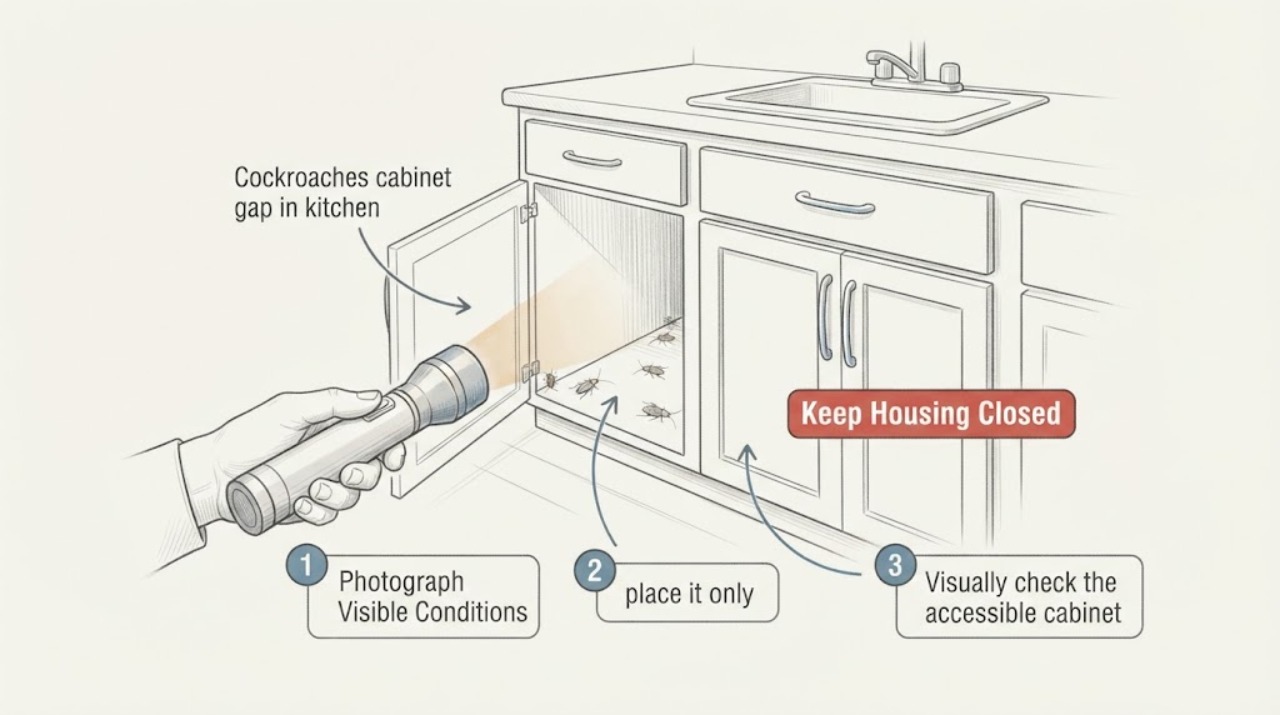
From a stable, well-lit position, inspect the visible cabinet gap, toe-kick edge, adjacent floor, and nearby wall without removing panels or reaching into the void. Photograph any roach, dark specks, smear marks, shed skins, egg-case-like capsules, dead insects, or droppings without touching them.
Expected result: There is no visible evidence, one isolated insect, repeated evidence in the same gap, or evidence spread along the cabinet run and nearby wall.
Next step: Record the exact cabinet section, date, time, and evidence type; leave the gap undisturbed for the next observation.
Stop if: Stop if the evidence is inside an inaccessible void, a live insect is moving toward you, or inspection would require removing a panel, appliance, or plumbing cover.
Why this matters
Why: A single sighting can be a transient visitor. Repeated evidence or multiple life stages near the same gap raises the likelihood of an active harboring route and makes a professional inspection more useful than sealing or spraying by guesswork.
-
Check 2
If a non-chemical glue monitoring trap is already available or is chosen for observation, place it only in a dry, visible location beside the cabinet run where children and pets cannot reach it; do not put it on a food-preparation surface or inside the gap. Check it according to its label and avoid handling captured insects.
Expected result: The trap remains empty, catches one insect, catches repeated insects, or shows activity near the cabinet compared with another safe monitoring location.
Next step: Photograph the trap location and record dates and counts for the pest professional; discard or handle the trap only as its instructions direct.
Stop if: Do not place a trap where it can contact food, wet plumbing, heat, children, or pets, and stop if safe placement is not possible.
Why this matters
Why: A trap can show activity and relative location but cannot identify every species or prove that the cabinet gap is the source. Repeated catches or activity in more than one location support a whole-kitchen or whole-home inspection.
-
Check 3
Visually check the accessible cabinet floor, sink area, pipe collars, countertop edge, and nearby appliances for crumbs, grease, standing water, condensation, or a visible leak. Wipe ordinary food residue and dry accessible surfaces without opening equipment or disturbing the gap.
Expected result: The area is dry and clean, or there is a persistent leak, condensation, food residue, standing water, or damp material near the cabinet.
Next step: Document the moisture or residue, report a leak to the appropriate repair professional, and keep food and waste in closed containers while awaiting inspection.
Stop if: Stop if water is near an electrical appliance or outlet, a cabinet base is swollen or unstable, or cleaning would require moving an appliance.
Why this matters
Why: Food and water can sustain cockroach activity even when the gap is not the original entry point. NPIC and EPA both identify food, water, and shelter reduction as core prevention steps; a leak also needs a plumbing or building repair rather than pesticide alone.
-
Check 4
Trace the visible edge of the cabinet gap toward baseboards, wall corners, plumbing penetrations, and the floor without drilling, caulking, pulling molding, or removing the toe kick. Note whether the opening continues behind the cabinet or connects to another room.
Expected result: The gap ends at one small seam, continues behind the cabinet, surrounds a pipe, or appears to connect to a wall or adjacent room.
Next step: Photograph the route and identify every room or cabinet section where the gap seems to continue for the inspection request.
Stop if: Do not open a wall, remove cabinet parts, disturb plumbing penetrations, or insert dust, foam, or spray into a void.
Why this matters
Why: A continuous or concealed route can explain recurring sightings and may require inspection of neighboring harborage. A small visible seam may be a later exclusion repair, but sealing before activity and moisture are understood can hide evidence or leave the source untouched.
-
Check 5
Keep a short sighting log for the kitchen and adjacent rooms: date, time, location, approximate size or appearance if safely visible, whether the insect was moving or dead, and whether activity occurred in daylight or after the kitchen was quiet.
Expected result: There are no further sightings, occasional night sightings at one gap, repeated sightings, daytime sightings, egg cases, or signs in multiple rooms.
Next step: Share the log and photographs when booking service; keep the kitchen dry and food stored in sealed containers while waiting.
Stop if: Do not chase, crush, handle, or relocate insects in a way that spreads contamination or prevents identification.
Why this matters
Why: The pattern helps a professional prioritize inspection and species identification. Repeated, daytime, multi-room, or multiple-life-stage evidence suggests a more established infestation or a nearby source and should not be managed as a cosmetic cabinet-gap repair.
-
Check 6
Prepare the service handoff with the cabinet-gap photographs, trap observations if used, moisture or food-source notes, connected-gap map, sighting log, and the presence of children, pets, or anyone sensitive to pesticides. Ask the professional to identify the species, inspect the cabinet and adjacent voids, and explain the treatment and follow-up plan.
Expected result: The professional can access and inspect the suspected route, or the route is concealed or unsafe for a homeowner to examine.
Next step: Request a written plan that separates monitoring, sanitation or leak repair, exclusion work, any pesticide treatment, safety precautions, and follow-up checks.
Stop if: Stop homeowner treatment attempts; do not mix chemicals, fog the kitchen, apply loose dust, or use a pesticide off-label.
Why this matters
Why: A complete inspection determines whether the visible gap is a harborage, an entry path, or only a viewing point. Concealed voids, repeated activity, and food-area pesticide decisions require site-specific professional or label-based judgment.
Use your observations
Decision map
Find the observation that best matches what you see, then follow the next safe action.
-
PATH 01Safety boundary
What you see
No evidence appears after a careful visible check, and there are no sightings elsewhere.
Do this next
Continue low-risk housekeeping and monitor for new evidence; keep the location documented rather than sealing it immediately.
Why this path and its safety boundary
Safety stop: If a new sighting, droppings, or moisture appears, move to an inspection request instead of escalating chemicals yourself.
-
PATH 02Safety boundary
What you see
A single roach or one trap catch appears near the cabinet gap, with no egg cases, repeated signs, or activity in other rooms.
Do this next
Keep the observation log and arrange advice or an inspection if the sighting repeats; reduce accessible food, water, and clutter in the meantime.
Why this path and its safety boundary
Safety stop: Do not assume the gap is the source or close it before the activity pattern is understood.
-
PATH 03Safety boundary
What you see
Repeated catches or sightings cluster at the gap, especially with droppings, shed skins, or egg-case-like evidence.
Do this next
Arrange a cockroach inspection and treatment plan, providing the exact cabinet section and photographs.
Why this path and its safety boundary
Safety stop: Do not open the void, inject dust or spray, or use a fogger to reach concealed activity.
-
PATH 04Safety boundary
What you see
Moisture, a plumbing leak, food residue, or standing water is present near the cabinet.
Do this next
Address the underlying leak or building repair through the appropriate professional and include the moisture source in pest-control service information.
Why this path and its safety boundary
Safety stop: Stop cleaning or moving items if water is near electrical equipment, the cabinet is unstable, or access requires appliance removal.
-
PATH 05Safety boundary
What you see
Activity occurs in daylight, in multiple rooms, involves multiple life stages, or affects a home with children, pets, or a sensitive occupant.
Do this next
Treat this as a high-priority professional inspection; provide the room map and household safety constraints before any treatment is selected.
Why this path and its safety boundary
Safety stop: Do not improvise pesticide use, combine products, or use an unlabeled treatment in a kitchen.
-
PATH 06Safety boundary
What you see
The gap is concealed, inaccessible, or connected to plumbing, electrical equipment, or a wall void.
Do this next
Stop at visible observations and have a qualified pest professional coordinate any access or building repair.
Why this path and its safety boundary
Safety stop: Do not remove panels, drill holes, pull outlets or pipe covers, or disturb the cabinet structure.
Helpful context
Understand the symptom
Why the cabinet gap matters
The space beneath or beside a kitchen cabinet can connect to dark voids around plumbing, the wall, or the cabinet base. It may offer shelter close to food and water, but the gap can also simply be where a roach becomes visible while the harborage is elsewhere. The National Pesticide Information Center recommends identifying the cockroach species, monitoring activity with traps, reducing food and water sources, and sealing cracks or crevices as part of prevention. Treat the gap as evidence to map, not as proof that one product or one repair will solve the problem.
Use observation before treatment
A cabinet gap is close to food-preparation surfaces, plumbing, and sometimes electrical equipment. The U.S. Environmental Protection Agency emphasizes removing food, water, and shelter opportunities and keeping any bait in a tamper-resistant station inaccessible to children and pets. EPA integrated-pest-management guidance also treats kitchen cockroach control as a combination of monitoring, sanitation, building repair, and appropriately selected professional or label-directed treatment—not a reason to broadcast spray or improvise a chemical mixture.
What to do next
Make only low-risk observations and simple housekeeping changes that do not disturb the cabinet or spread contamination. Photograph the location, keep a short sighting log, and give the pattern to the pest professional. If an action would require removing a kick plate, opening a wall or cabinet void, handling a live roach, or placing pesticide near food, stop and ask for professional guidance.
Only after diagnosis
Potential parts
- sticky-trap
Consider only as a non-chemical monitoring aid when safe placement away from children, pets, food, water, and heat is possible; a catch indicates activity but does not diagnose the source.
Choose a clearly labeled monitoring product and follow its placement, checking, and disposal directions; do not treat it as a pesticide or place it inside a concealed cabinet void. - roach-bait-station
Consider only after species and activity are assessed and only when the product label permits the location; a bait station is not a substitute for moisture, sanitation, exclusion, or inspection.
Confirm the label, food-area restrictions, and child or pet access controls for the exact product; do not use loose bait, mix products, or apply anything inside an inaccessible void.
When checks do not resolve it
Need a professional?
Arrange a cockroach inspection promptly for repeated sightings, multiple trap catches, droppings or egg cases, daytime activity, signs in multiple rooms, a concealed cabinet gap, or a household with children, pets, or a pesticide-sensitive occupant.
Have this ready
- Provide the cabinet section and room map, dated photographs, trap observations if used, sighting log, moisture or leak notes, food or waste observations, and any household safety constraints. Ask for species identification, inspection of connected voids, treatment restrictions for the kitchen, and follow-up monitoring.
Common questions
FAQ
Does seeing one cockroach at a cabinet gap prove the gap is the nest?
No. The gap may be a travel route or viewing point while food, water, or shelter is elsewhere. Record the location and look for repeated evidence, moisture, and activity in adjacent rooms before deciding on service.
Should I seal the cabinet gap immediately?
Do not seal or disturb a concealed gap before the activity and moisture pattern are understood. A professional can decide whether exclusion is appropriate, what material is suitable, and whether the gap connects to a larger harborage or needs building repair.
Are sticky traps enough to solve cockroaches in a kitchen?
They are useful for monitoring and locating activity, but a trap does not identify every species or eliminate a hidden source. Repeated catches should be shared with a pest professional along with the trap locations and dates.
Can I spray or put powder into the cabinet gap?
Do not improvise treatment in a kitchen gap. Sprays or dusts can contaminate food areas, scatter roaches, or enter inaccessible spaces. Use only a product and placement that the label permits, and obtain professional guidance when the gap is concealed or activity is recurring.
What information should I give a pest-control inspector?
Give the exact cabinet section, dated photographs, sighting and trap log, signs of moisture or food, rooms affected, and whether children, pets, or sensitive occupants are present. Ask for species identification, connected-void inspection, kitchen precautions, and follow-up monitoring.
Read the exact guide
Official sources
- IPM for Schools: A How-To ManualU.S. Environmental Protection Agency · Provides a kitchen cockroach IPM sequence combining sticky-trap monitoring, sanitation, leak and building repair, and carefully scoped treatment rather than broad spraying.
- Do you really need to use a pesticide?U.S. Environmental Protection Agency · Supports reducing food, water, and shelter; sealing visible openings; and using tamper-resistant bait stations only where children and pets cannot touch them.
- CockroachesNational Pesticide Information Center, Oregon State University and U.S. Environmental Protection Agency · Supports species identification, trap monitoring, reduction of food and water, and visible crack or crevice prevention steps for kitchen activity.
Community feedback
Share a repair observation
Share a plain-text repair observation. Accepted observations are published automatically; this page may take a moment to update.