
On this page
Start here
Quick answer
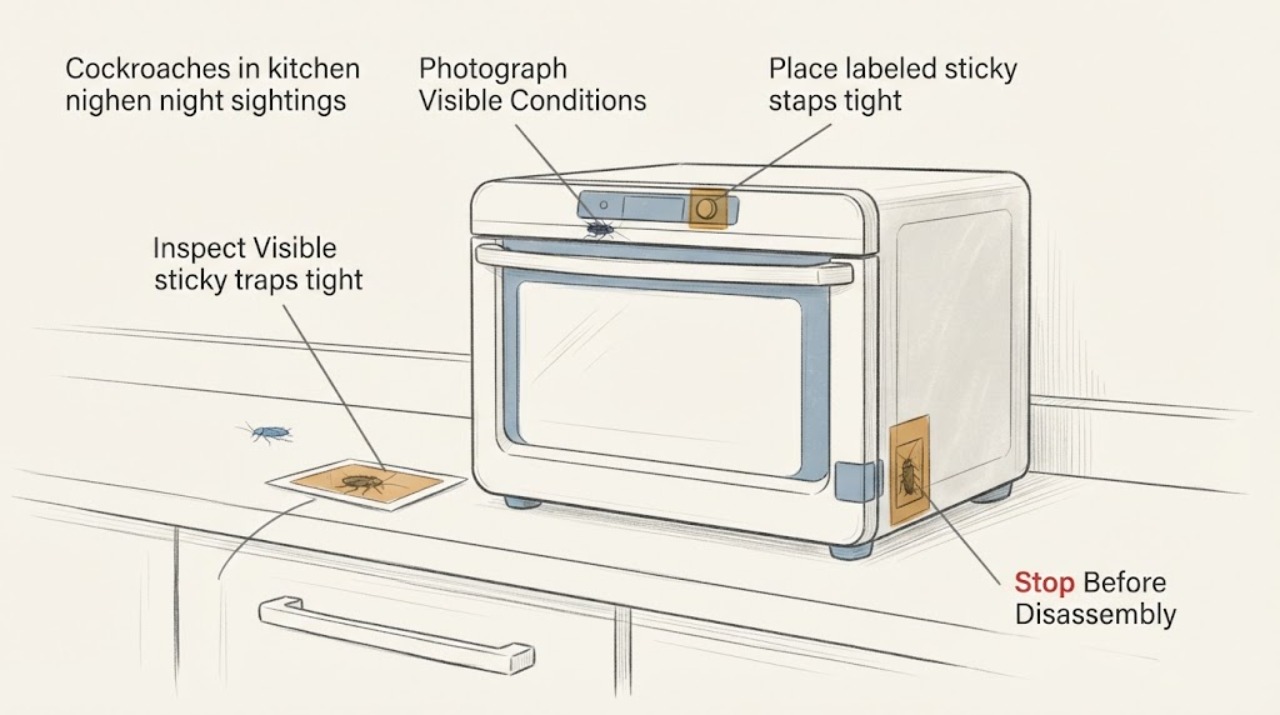
Seeing a cockroach at night is useful timing evidence, but it does not by itself prove the number of roaches or the species. Start a night-specific log with the time, exact kitchen location, direction of travel, nearby food or water, and a photo if one can be taken without chasing it. Place labeled sticky traps tight against edges near the sink, refrigerator, stove, and cabinets to find repeated activity, then inspect safely for daytime sightings, droppings, cast skins, egg cases, nymphs, moisture, leaks, cardboard, and cracks around plumbing. One isolated adult at night with no trap evidence is a different escalation from repeated captures, daytime activity, nymphs or egg cases, or signs in several rooms. Keep food and food-contact surfaces free of pesticides; do not use foggers, broad sprays, mixed chemicals, or unapproved treatment.
Before you begin
Safety first
- Use observation, sanitation, and labeled monitoring traps only. Do not fog, broadly spray, mix chemicals, apply pesticide to food-contact surfaces, dismantle appliances, or disturb suspected contamination.
Work through in order
Diagnostic checks
Use only checks that match the exact appliance or system and its official guide.
-
Check 1
For each night sighting, record the clock time, exact location, direction of travel, nearby sink or appliance, food or water present, and whether the insect was an adult-looking roach, a smaller wingless insect, or an uncertain look. Take a photo from a safe distance if possible; do not chase, crush, or handle it to identify it.
Expected result: Note whether sightings repeat at the same edge or cabinet, occur in more than one kitchen zone, follow a leak or food residue, or stop when lights come on. Record a single observation separately from repeated observations.
Next step: Keep the log for the next monitoring checks and provide it to a pest-management professional if activity repeats or evidence expands.
Stop if: Stop if identification would require contact with the insect, disturbing a contaminated area, spraying near food, or entering a hazardous or inaccessible space.
Why this matters
Why: Night activity is consistent with roach behavior, but one nighttime sighting does not establish infestation size or species. Repeated locations and timing are more useful for finding a harborage or entry route than an assumed species label.
-
Check 2
Place labeled sticky traps tight against edges where walls meet floors or cabinets, and near the sink, refrigerator, stove, and other likely travel edges. Keep traps away from food preparation and child or pet access, and follow the trap label for placement and disposal. Do not use traps as a reason to spray around them.
Expected result: Record the date, exact location, number of captures, insect size or appearance, and whether captures occur in one zone or several. Leave an empty trap recorded as evidence rather than moving it repeatedly.
Next step: Map the trap results with the night log. Use a licensed pest professional when captures recur, increase, include small nymphs, or occur in multiple rooms.
Stop if: Do not place traps on food-contact surfaces, touch captured insects, or continue if the trap area is contaminated, inaccessible, or unsafe for children or pets.
Why this matters
Why: Trap evidence shows where activity is concentrated and whether it is repeated; it is a monitoring result, not a precise population count or species confirmation. Captures near plumbing or warm appliances can identify a harborage area for inspection.
-
Check 3
From normal access, inspect the kitchen for visible harborage and resources without dismantling cabinets or appliances. Look for leaks or dampness under the sink, crumbs and grease, open food, standing dish water, cardboard or paper clutter, cracks at baseboards and pipe penetrations, and gaps around cabinets or appliances.
Expected result: Record a dry, uncluttered area; a recurring leak or moisture point; food or waste residue; or a crack, void, box, or appliance edge that could shelter roaches. Note whether the resource is near the nighttime sighting or trap capture.
Next step: Clean food residue, store food and waste closed, remove cardboard where practical, and report or repair leaks. Have a professional inspect concealed voids or appliance spaces.
Stop if: Do not open appliances, remove cabinet panels, disturb suspected droppings or egg cases, or apply any chemical near food, dishes, utensils, or preparation surfaces.
Why this matters
Why: Food, water, and shelter can sustain activity even when only one roach is seen at night. A moisture or harborage finding changes the next step toward correcting the resource and sealing or servicing the area, not toward broad pesticide use.
-
Check 4
During daylight, inspect only normally visible kitchen edges and adjacent rooms for additional activity or evidence. Look for live roaches, nymphs, egg cases, shed skins, droppings, odor, and activity behind or under accessible appliances without moving them. Do not disturb an egg case or clean suspected contamination into the air.
Expected result: Record no daytime evidence, a daytime adult, one or more small wingless nymphs, egg cases, droppings or cast skins, or evidence in rooms beyond the kitchen. Keep each room and evidence type separate in the log.
Next step: Photograph evidence in place and arrange pest-management inspection when daytime spread, nymphs, egg cases, repeated captures, or multiple rooms are involved.
Stop if: Stop for extensive droppings, mold-like growth, contaminated food or utensils, inaccessible appliance voids, or any need to fog, spray broadly, or dismantle equipment.
Why this matters
Why: A night-only sighting with no additional evidence is a lower-information branch. Daytime activity, nymphs, egg cases, or evidence in multiple rooms raises concern for a more established or broader harborage; it still does not identify species by timing alone.
-
Check 5
Combine the night log, trap map, resource and harborage observations, daylight findings, and photos into a service handoff. Mark whether evidence is isolated to one point, repeated in one kitchen zone, or distributed across rooms, and list all pesticides or cleaners already used without mixing or adding more.
Expected result: Classify the evidence as an isolated nighttime sighting, trap-supported local activity, daytime spread, life-stage evidence, or an unclear pattern with moisture or building access concerns.
Next step: Request a licensed pest-management inspection for repeated or expanding evidence and ask for a plan that addresses food, water, shelter, entry points, monitoring, and targeted treatment.
Stop if: Stop DIY treatment for fogger use, broad spraying, mixed chemicals, food-surface application, or any chemical exposure involving children, pets, or sensitive occupants.
Why this matters
Why: This classification helps a professional choose inspection and integrated pest management scope. It avoids treating a night sighting as a population count while still escalating promptly when life-stage or multi-room evidence appears.
Use your observations
Decision map
Find the observation that best matches what you see, then follow the next safe action.
-
PATH 01Safety boundary
What you see
One adult-looking insect was seen at night, with no trap capture, daytime evidence, or repeated location yet.
Do this next
Keep a night log, place edge-aligned sticky traps, remove food and water access, and monitor before choosing treatment.
Why this path and its safety boundary
Why it matters: This is an isolated observation, not proof of a population size or species.
Safety stop: Do not fog, broadly spray, or apply pesticide to counters, shelves, dishes, or other food-contact surfaces.
-
PATH 02Safety boundary
What you see
Sticky traps repeatedly capture roaches in one kitchen zone near a sink, appliance, cabinet edge, or plumbing route.
Do this next
Correct visible food, water, leak, and clutter sources and request targeted pest-management inspection for that zone.
Why this path and its safety boundary
Why it matters: The trap map supports localized activity or harborage but does not give a reliable total count or species diagnosis.
Safety stop: Do not move appliances, open cabinets, or spray around traps to force a result.
-
PATH 03Safety boundary
What you see
Roaches or evidence appear during daylight, in more than one kitchen area, or in adjacent rooms.
Do this next
Preserve the room-by-room map and arrange licensed inspection for connected harborages, entry routes, and an integrated treatment plan.
Why this path and its safety boundary
Why it matters: Daytime or multi-room evidence warrants faster professional escalation; timing still does not identify the species or exact population.
Safety stop: Do not seal an active route with chemicals, move contaminated items through the home, or start broad spraying.
-
PATH 04Safety boundary
What you see
Small wingless nymphs, egg cases, cast skins, droppings, or a characteristic odor are found.
Do this next
Photograph the evidence in place, keep food and utensils protected, and request prompt pest-management inspection and identification.
Why this path and its safety boundary
Why it matters: Life-stage or repeated evidence suggests more than a one-off adult visitor and should be professionally assessed.
Safety stop: Do not crush, vacuum, brush, or chemically treat the evidence in a way that spreads debris or contaminates food areas.
-
PATH 05Safety boundary
What you see
A leak, damp cabinet, standing sink water, cardboard clutter, crack, or appliance edge is near the sighting or trap activity.
Do this next
Dry and clean accessible food or water residue, report the leak, remove loose clutter, and have concealed voids assessed without dismantling the kitchen.
Why this path and its safety boundary
Why it matters: The resource or shelter may be sustaining the activity and can be a higher-value correction than an insecticide guess.
Safety stop: Do not apply pesticide where food, dishes, utensils, or wet electrical equipment could be contaminated.
-
PATH 06Safety boundary
What you see
The insect cannot be confidently identified, the evidence conflicts, or the source is hidden behind an appliance, wall, or cabinet.
Do this next
Keep photos, trap evidence, and room locations and submit them to a pest professional or insect-identification service.
Why this path and its safety boundary
Why it matters: Night activity alone cannot establish species, and hidden access makes DIY treatment unreliable.
Safety stop: Do not open walls or appliances, mix treatments, or use foggers to reach a hidden harborage.
Helpful context
Understand the symptom
Night timing changes monitoring, not the population count
Cockroaches commonly hide during the day and become active at night, so a night sighting is a useful time-and-location clue. It does not prove how many are present or which species is involved. Record each sighting separately and use traps to find repeated activity.
Use traps to map activity and harborage
The University of Minnesota Extension recommends placing sticky traps tight against edges and near cupboards, refrigerators, stoves, and sinks. Label each location and record captures without treating the number as a precise census. A repeated kitchen edge, plumbing route, or appliance area becomes the professional inspection priority.
Separate isolated sightings from life-stage and daytime evidence
One adult-looking insect at night with no other evidence is not the same decision as nymphs, egg cases, droppings, repeated captures, daytime activity, or findings in several rooms. Keep species uncertainty explicit and escalate when evidence broadens rather than assuming a night sighting explains the whole home.
Use integrated pest management around the kitchen
EPA identifies food, water, and shelter as the resources pests need and recommends reducing those resources and using tamper-resistant bait stations when baits are appropriate. Keep food-contact surfaces free of pesticide, do not use foggers or broad sprays, and never mix chemicals. A licensed professional should choose targeted treatment and address leaks, gaps, and harborages.
Safety boundary
Stop conditions
- Do not use foggers, bombs, broad sprays, mixed chemicals, or pesticide on counters, shelves, dishes, utensils, or other food-contact surfaces.
- Do not open appliances or walls, disturb suspected droppings or egg cases, or move contaminated items through the home.
- Do not treat one nighttime sighting as proof of species or infestation size; use separate logs and trap evidence.
- Stop and seek professional help for pesticide exposure, extensive contamination, vulnerable occupants, hidden harborages, or activity that broadens to daytime or multiple rooms.
Only after diagnosis
Potential parts
- sticky-trapUse the label's placement and disposal instructions. Traps help map activity but do not identify species or replace professional treatment when evidence repeats or spreads.
- roach-bait-stationKeep bait away from children, pets, food, dishes, and utensils; follow the product label and never combine with unapproved sprays or other chemicals. A bait station does not correct leaks or hidden harborages.
- door-sweepMatch the door bottom, threshold, weather exposure, and installation method. Do not block required drainage or ventilation and do not use it to seal an active interior harborage.
When checks do not resolve it
Need a professional?
Arrange licensed pest-management inspection when night sightings repeat, traps capture roaches, daytime or multi-room evidence appears, nymphs or egg cases are found, moisture or concealed harborage persists, or safe identification is uncertain. Seek prompt help for contamination, pesticide exposure, or vulnerable occupants.
Safety scope: Use observation, sanitation, and labeled monitoring traps only. Do not fog, broadly spray, mix chemicals, apply pesticide to food-contact surfaces, dismantle appliances, or disturb suspected contamination.
Have this ready
- Night sighting times, exact kitchen locations, directions, photos, and nearby food or water
- Trap locations, dates, captures, appearance, and whether evidence is localized or multi-room
- Daytime sightings, nymphs, egg cases, droppings, cast skins, and odor
- Leaks, dampness, cardboard, cracks, plumbing gaps, appliance edges, and food-storage observations
- Any product already used and confirmation that food surfaces, children, and pets were protected
Common questions
FAQ
Does seeing a cockroach at night prove I have a large infestation?
No. Roaches are often active at night, but one sighting does not establish the number or species. Use a time-and-location log and labeled sticky traps to find repeated activity and look for daytime or life-stage evidence.
Where should I place sticky traps in a kitchen?
Place them tight against edges near walls, cabinets, the sink, refrigerator, and stove, while keeping them away from food, children, and pets. Label locations and record captures rather than treating one trap result as a population count.
What is more concerning than one nighttime sighting?
Repeated trap captures, daytime activity, small wingless nymphs, egg cases, droppings or cast skins, and evidence in several rooms all justify faster professional inspection. None of these observations should be used to guess a species without identification.
Should I use a fogger or spray the kitchen broadly?
No. Do not use foggers, broad sprays, mixed chemicals, or pesticide on counters, shelves, dishes, utensils, or other food-contact surfaces. Use monitoring and resource reduction, then have a licensed professional choose targeted treatment.
When should I call pest control for night sightings?
Call when sightings repeat, traps capture roaches, activity appears during daylight or in multiple rooms, nymphs or egg cases are present, moisture or hidden harborage cannot be corrected safely, or a child, pet, or sensitive occupant could be exposed.
Read the exact guide
Official sources
- Do you really need to use a pesticide?U.S. Environmental Protection Agency · EPA consumer pest-control guidance supports reducing food, water, and shelter, sealing openings, and using tamper-resistant bait stations when appropriate; it does not identify a cockroach species or prescribe a treatment for a particular kitchen.
- CockroachesUniversity of Minnesota Extension · University Extension household cockroach guidance supports night-activity logging, edge-aligned sticky traps, life-stage observations, and professional treatment; local species and label requirements may differ.
Community feedback
Share a repair observation
Share a plain-text repair observation. Accepted observations are published automatically; this page may take a moment to update.