
On this page
Start here
Quick answer
One kitchen sighting does not prove an infestation, but repeated sightings, activity in daylight, small nymphs, egg cases, or signs in several areas justify a pest inspection. Make a safe record of when and where activity appears, then look only for visible moisture, food access, clutter, and entry gaps. Do not handle droppings or egg cases, disassemble appliances, mix products, use a fogger, or apply pesticide off-label. A pest professional can identify the insect and choose a treatment that accounts for food areas, children, pets, and moisture sources.
Work through in order
Diagnostic checks
Use only checks that match the exact appliance or system and its official guide.
-
Check 1
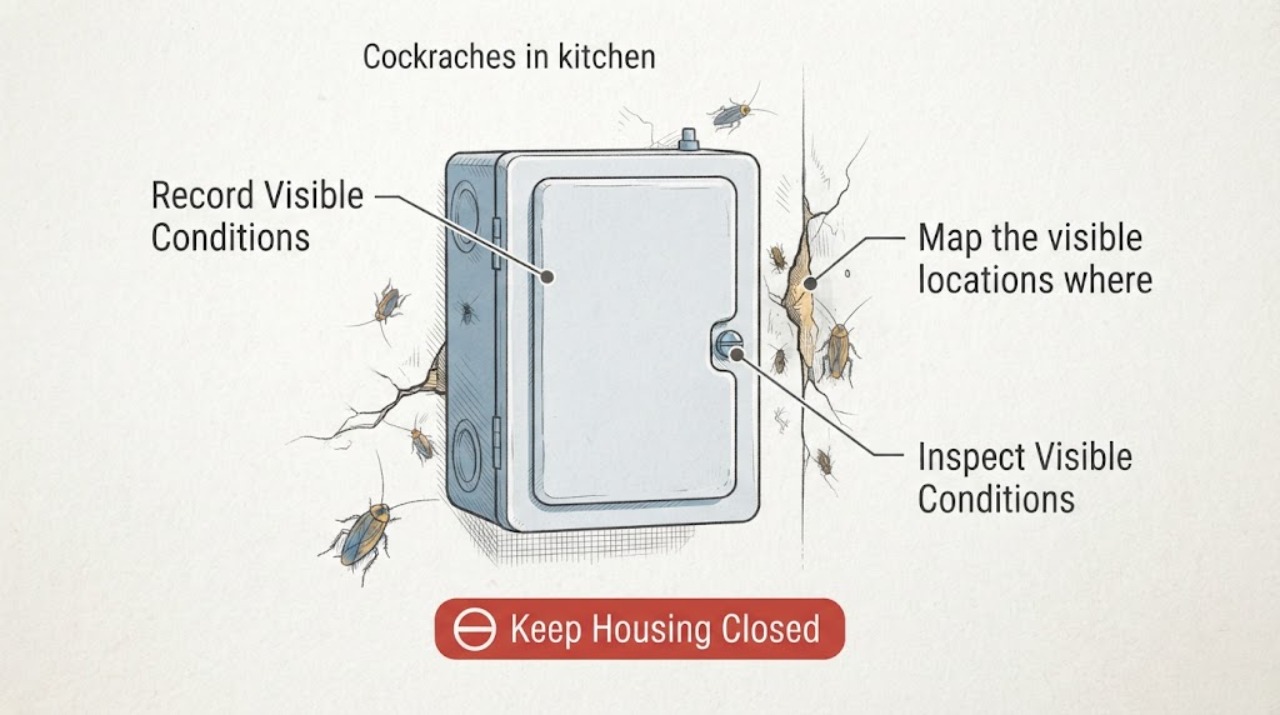
Make a time-and-pattern record for each sighting without touching the insect or surrounding material.
Expected result: Note the date, approximate time, lighting, whether the insect was moving or still, and whether the event was a single adult-looking insect, a smaller nymph-like insect, or repeated activity.
Next step: Keep the record and, only if it can be done without handling anything, take a clear photo for identification by a pest professional or qualified extension specialist.
Stop if: Stop if getting a closer view would require touching, disturbing, or chasing the insect into food, cabinets, or an appliance.
Why this matters
Why: Night-only activity can be easy to miss during the day, while repeated sightings, daytime activity, or small young insects make professional inspection more important; one observation is not species or infestation certainty.
-
Check 2
Map the visible locations where activity or signs appear, staying at the front of cabinets, along floor and wall edges, and around the sink area without opening hidden spaces.
Expected result: Record whether activity is limited to the sink or one cabinet, appears near a refrigerator or range exterior, follows a wall edge, or occurs in several kitchen zones.
Next step: Give the location map to the pest professional and identify any shared wall, adjacent unit, or nearby utility area if known.
Stop if: Stop before moving appliances, removing drawers, opening panels, or reaching into inaccessible gaps.
Why this matters
Why: A pattern near plumbing or warm, sheltered areas may point to moisture or harborage conditions; activity across several zones suggests a broader inspection rather than a single spot assumption.
-
Check 3
Look at readily visible kitchen water sources and surfaces for moisture conditions, without dismantling plumbing or appliances.
Expected result: Note a dripping faucet, damp cabinet base, condensation, standing water, a wet dish area, or no visible moisture; record whether the condition is persistent or only follows sink or dishwasher use.
Next step: Report the location and timing of moisture to the pest professional and arrange appropriate plumbing or appliance service if a leak is visible.
Stop if: Stop if water is near an electrical connection, the cabinet or floor is unstable, or investigating would require live inspection or appliance disassembly.
Why this matters
Why: Moisture can help explain why activity clusters near the sink or plumbing, but a dry visible surface does not rule out a hidden leak or another source.
-
Check 4
Review visible food, waste, and packaging conditions using normal hygiene and without handling contaminated material.
Expected result: Note uncovered food, crumbs or spills, pet food left out, an uncovered trash container, grease or clutter, or cardboard and grocery packaging recently brought into the kitchen.
Next step: Secure food and waste in ordinary clean containers, keep the record, and tell the professional which conditions were present; do not attempt to salvage suspect food.
Stop if: Stop if food, packaging, or surfaces may be contaminated and follow local food-safety or professional guidance instead of handling them further.
Why this matters
Why: Accessible food and shelter can sustain activity, while packaging can be an introduction route; these observations are contributing conditions, not proof of where the insects originated.
-
Check 5
From a safe standing position, look for visible entry points around exterior doors, windows, baseboards, and pipe penetrations under the sink, without removing trim or sealing anything yet.
Expected result: Record a visible gap, damaged screen or door seal, open pipe surround, or no obvious entry point, and note whether the gap aligns with a sighting location.
Next step: Photograph the area from a clean distance and ask the pest professional whether it should be sealed after identification and treatment planning.
Stop if: Stop if checking the opening would require removing trim, opening a wall, disturbing insulation, or contacting wiring or plumbing.
Why this matters
Why: An opening can be one route into the kitchen, but a hidden harborage, shared-wall movement, or transported item may also be involved; no visible gap does not rule out entry.
Use your observations
Decision map
Find the observation that best matches what you see, then follow the next safe action.
-
PATH 01Next step
What you see
There was one isolated sighting and no repeated activity, young insects, signs, moisture pattern, or food-access concern is observed.
Do this next
Keep a short observation record, improve ordinary food and water storage, and seek identification or service if sightings recur.
-
PATH 02Next step
What you see
Sightings repeat, occur in daylight, or include small nymph-like insects or multiple activity zones.
Do this next
Request a pest inspection promptly; do not infer species or treatment from a single photo or apply improvised pesticide.
-
PATH 03Next step
What you see
Activity clusters near a sink, dishwasher, pipe area, damp cabinet, or other persistent moisture.
Do this next
Arrange appropriate leak or plumbing attention while requesting pest service, and report the moisture timing and location.
-
PATH 04Next step
What you see
Activity follows new boxes, grocery bags, or stored packaging, with no other pattern yet.
Do this next
Keep the packaging and affected food area isolated from normal use only when safe and practical, avoid handling suspect material, and ask a professional for identification and next steps.
-
PATH 05Next step
What you see
Children, pets, asthma-sensitive occupants, or food-contact contamination concerns are present.
Do this next
Tell the pest professional before any treatment and keep people, pets, food, and utensils away from any product or treated area according to the professional's instructions.
Helpful context
Understand the symptom
Kitchens offer the combination of food, water, warmth, and shelter that can support cockroach activity. A sighting can also be a misidentified insect or a one-time introduction in a bag or box, so the useful first step is a pattern record rather than certainty from one sign. The University of Minnesota Extension notes that identification matters because similar-looking insects can be mistaken for cockroaches and that only a small proportion of a home's population may be seen.
Keep the investigation observational and food-safe. Do not touch droppings, egg cases, dead insects, or suspect food; do not pull out or open appliances; and do not spray countertops, cabinets, or food-contact surfaces. Never mix pesticides or cleaners and do not use bug bombs or foggers.
Only after diagnosis
Potential parts
- closed roach-bait station
Consider this category only after the pest is identified and the placement is appropriate for the kitchen, household occupants, and the professional's treatment plan.
Use only a registered, ready-to-use product whose label covers the intended location; keep it inaccessible to children and pets and away from food-contact surfaces. - sticky insect trap
Consider this category only as a monitoring aid after a professional or qualified source confirms that it is suitable and can be placed without exposing children, pets, or food.
A trap can show activity location but cannot establish species or eliminate an infestation; follow its directions and replace it safely. - door sweep
Consider this category only if a professional confirms a compatible exterior-door gap as an entry route.
Confirm the door type, threshold, clearance, and weather-seal fit before ordering; do not block required drainage or ventilation paths.
When checks do not resolve it
Need a professional?
Request pest service for repeated sightings, activity in daylight, nymph-like insects or egg cases, signs in multiple kitchen areas, activity near persistent moisture, or any uncertainty about identification. Ask for prompt guidance when food-contact surfaces may be contaminated or when children, pets, or respiratory-sensitive occupants are at risk.
Have this ready
- Provide the sighting timeline, safe photos if available, locations and time of day, visible moisture or food-access conditions, recent boxes or packaging, entry gaps, household occupants and pets, and any prior treatment history.
Common questions
FAQ
Does one cockroach in the kitchen mean I have an infestation?
Not necessarily. One sighting may be a misidentified insect or an isolated introduction, but repeated activity, daylight sightings, nymph-like insects, egg cases, or signs in several areas justify a professional inspection.
Where should I look first without taking appliances apart?
Record visible activity around the sink, cabinet fronts and edges, floor and wall lines, and the outside of appliances. Look for moisture and entry gaps without opening panels, moving appliances, or reaching into hidden spaces.
Should I spray the kitchen after seeing a cockroach?
Do not improvise. Do not mix products, use off-label pesticide, spray food-contact surfaces, or use a fogger. Get identification and professional guidance, especially where children, pets, food, or sensitive occupants are present.
What can bring cockroaches into a kitchen?
Possible routes include transported boxes or bags, visible openings, shared-building movement, and conditions that provide food, water, or shelter. The observation pattern can narrow the possibilities, but it cannot prove the source from one sighting.
Read the exact guide
Official sources
- Healthy Homes Action Steps for KitchensCenters for Disease Control and Prevention · Supports observing and reducing visible food and water access, protecting food areas, using closed traps or baits only when necessary, and avoiding foggers.
- Do you really need to use a pesticide?U.S. Environmental Protection Agency · Supports the food, water, shelter, and entry observations and the recommendation to use nonchemical prevention before considering pesticides.
- CockroachesUniversity of Minnesota Extension · Supports the caution that similar insects can be misidentified, that activity may be hidden, and that kitchen activity can cluster near plumbing, cupboards, sinks, and warm or moist areas.
Community feedback
Share a repair observation
Share a plain-text repair observation. Accepted observations are published automatically; this page may take a moment to update.