
On this page
Start here
Quick answer
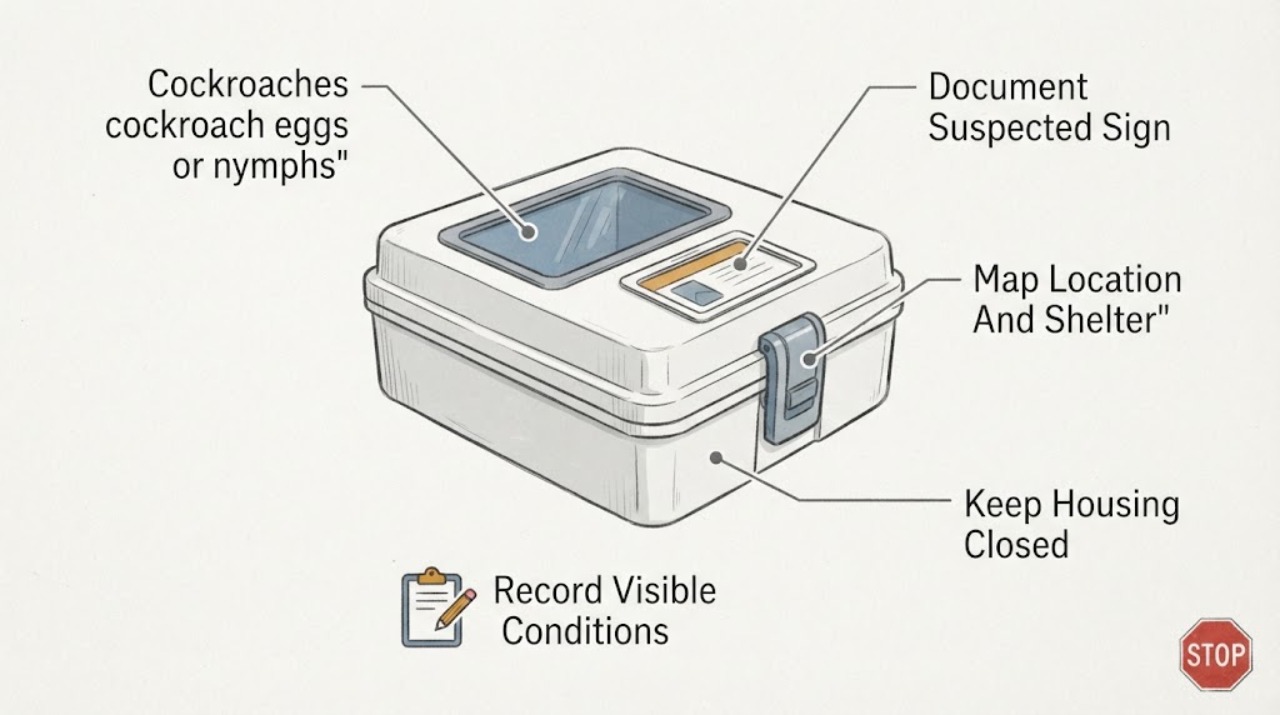
A suspected cockroach egg case or nymph is a reason to document and identify the pattern, not proof of an infestation from one sign. From a safe distance, photograph the object or insect, note where and when it appeared, and map nearby food, water, warmth, clutter, and repeated activity without touching droppings, egg cases, dead insects, or contaminated materials. Small wingless insects or repeated sightings of immature forms can make professional identification more important. Do not mix pesticides, use foggers, spray over bait, or apply an unlabelled treatment; contact a licensed pest professional when signs repeat, occur in food-preparation areas, affect multiple rooms or units, or involve children, pets, asthma, or contamination concerns.
Work through in order
Diagnostic checks
Use only checks that match the exact appliance or system and its official guide.
-
Check 1
Photograph the suspected egg case, nymph, shed skin, or insect from a safe distance using a scale reference already available in the scene; do not touch, crush, collect, or relocate it.
Expected result: Record visible shape, color, approximate size category, whether the insect has wings, whether the object is attached to a surface, and whether more than one similar sign is present.
Next step: Save the original photograph and ask a pest professional or qualified extension identification service to confirm what is visible before selecting treatment.
Stop if: Stop observation if it requires handling feces, shed skins, dead insects, unknown residue, or an object in a food-contact area.
Why this matters
Why: A small wingless insect or bean-like capsule may be consistent with a cockroach life stage, but look-alike insects and unrelated debris are possible. Identification becomes more reliable when a clear image and repeated pattern are available.
-
Check 2
Map each sighting or suspected case by room and visible location, such as near a sink, appliance exterior, baseboard, cabinet edge, bathroom plumbing, doorway, or stored cardboard; do not open appliances, cabinets, or wall cavities to search.
Expected result: Note whether signs cluster in one warm or damp area, appear along edges and cracks, occur near plumbing, or are spread across several rooms or units.
Next step: Provide the room map and photographs to the pest professional and keep the suspected area undisturbed for inspection.
Stop if: Stop if mapping would require moving heavy appliances, reaching into dark voids, disturbing droppings, or entering another unit or restricted area.
Why this matters
Why: A cluster near warmth, water, food, or shelter gives a professional a useful inspection route, while signs in multiple rooms or connected units raise the scope beyond a single visible insect.
-
Check 3
Record the date, time, lighting, temperature or moisture context that is already known, and whether the sighting was moving, stationary, isolated, or repeated; do not intentionally flush insects out or create a food or water lure.
Expected result: Note whether activity is mostly at night, whether any daytime sightings recur, whether nymphs and adults appear together, and whether sightings increase after a leak, delivery, move, or weather change.
Next step: Share the timeline with the pest professional so the inspection and monitoring plan can be based on a pattern rather than one sighting.
Stop if: Stop and avoid the area if activity is in a food-preparation zone, contamination is visible, or a child, pet, or sensitive person could contact the evidence.
Why this matters
Why: Cockroaches are commonly hidden during the day, and repeated immature sightings can indicate active reproduction or an ongoing entry source, but activity timing alone cannot establish species or infestation size.
-
Check 4
From a clean, accessible position, note visible food residue, open food or pet food, standing water, leaks, dampness, cardboard, paper clutter, and unsealed gaps near the mapped signs; do not handle suspected contaminated items or apply chemicals while inspecting.
Expected result: Classify each nearby condition as absent, possible, or clearly visible, and record whether it is inside the home, in a shared area, or at an entry point.
Next step: Correct only ordinary, low-risk housekeeping from a clean position, such as closing food containers or reporting a leak, and ask the professional to assess inaccessible or contaminated areas.
Stop if: Stop if cleanup would aerosolize debris, expose you to unknown residue, require moving an appliance, or put food-contact surfaces at risk.
Why this matters
Why: Food, water, and shelter can support cockroach activity, while a visible leak, cluttered storage area, or open gap gives a professional a practical prevention lead. These conditions do not identify the species or prove that one caused the sighting.
-
Check 5
Review any existing monitoring evidence, such as dated photographs or a sticky trap that is already in place, without touching, opening, or repositioning it; do not start an improvised trapping or pesticide program in a food or child-access area.
Expected result: Record the date, location, number and appearance of captured insects if legible from a distance, and whether the evidence is consistent with the photographed signs.
Next step: Send the monitoring history to a licensed pest professional and ask for an integrated inspection covering entry, moisture, shelter, and adjacent rooms or units when relevant.
Stop if: Stop handling any trap or evidence if it may contain pesticide, bodily residue, mold, or material that could contaminate skin, food, pets, or children.
Why this matters
Why: Repeated evidence in the same area is stronger for routing an inspection than a single unidentified object, but a trap image still does not replace species identification or a treatment plan.
Use your observations
Decision map
Find the observation that best matches what you see, then follow the next safe action.
-
PATH 01Next step
What you see
The sign is a single object, an unclear photograph, or an insect that could be a look-alike.
Do this next
Seek identification from a pest professional or extension service before treating; preserve the image and do not make a species or infestation claim.
-
PATH 02Next step
What you see
Similar nymphs, egg-case-like objects, or other signs recur in one area or across rooms.
Do this next
Arrange a prompt licensed pest inspection and provide the map, photographs, and timeline; ask for an integrated plan rather than a one-product response.
-
PATH 03Next step
What you see
Signs are in a food-preparation or storage area, or children, pets, asthma, allergy, or contamination concerns are involved.
Do this next
Keep food and utensils protected, avoid handling evidence, and use a licensed professional who can specify safe treatment and cleanup boundaries.
-
PATH 04Next step
What you see
Activity appears in multiple rooms, adjacent units, shared plumbing areas, or near an ongoing leak or inaccessible void.
Do this next
Report the issue to the building manager or responsible maintenance contact and request coordinated pest and moisture inspection; do not open walls or treat shared spaces yourself.
Helpful context
Understand the symptom
Egg cases and nymphs are clues, not a complete diagnosis
University of Minnesota Extension describes cockroaches as having egg, nymph, and adult stages; nymphs are smaller and wingless, while egg cases vary by species. Other insects can look similar, so one dark capsule or tiny insect should not be treated as certain identification. A pattern of repeated, consistent observations in warm, damp, sheltered areas is more useful to a pest professional than a guess based on one object.
Keep observation clean and low-risk
Use a phone camera, notes, and room-level mapping from a clean, stable position. Do not pick up or crush a suspected egg case, sweep contaminated debris into the air, open appliances or wall cavities, or move food and pet items through a suspected area. The U.S. Environmental Protection Agency recommends an integrated approach that considers food, water, shelter, monitoring, and label-directed product use.
Only after diagnosis
Potential parts
- roach bait station
Consider this category only after identification and a professional or label-directed plan establish that a bait station is appropriate for the location and occupants; do not use one to guess what an unidentified object is.
Confirm the product is registered for the intended use and keep it inaccessible to children and pets; follow the complete label and never mix or layer products. - sticky trap
Consider this category only as a low-risk monitoring aid when placed in a safe, non-food-contact location and included in an inspection plan; it is not proof of species or a complete treatment.
Keep it away from children, pets, food, and contamination-sensitive surfaces, and follow the product directions or the pest professional’s placement guidance. - crack sealant
Consider this category only after the active pest and moisture conditions are assessed and the gap is confirmed as an appropriate low-risk exclusion point.
Confirm compatibility with the surface and location, and do not seal an active leak, electrical opening, ventilation path, or inaccessible void without professional guidance.
When checks do not resolve it
Need a professional?
Contact a licensed pest professional when suspected nymphs or egg cases recur, multiple rooms or units show activity, signs occur around food preparation, or the species is uncertain. Seek prompt help when contamination, asthma/allergy concerns, children or pets, a persistent leak, or inaccessible voids are involved.
Have this ready
- Provide original photographs, room and location map, date/time activity log, visible food/water/shelter conditions, any existing monitoring evidence, recent moves or deliveries, and information about children, pets, food areas, or sensitive occupants.
Common questions
FAQ
Does one cockroach egg case prove there is an infestation?
No. It may be an egg case, but debris and other insects can look similar. Photograph it without touching it, record the location, and look for a repeated pattern that a pest professional can identify.
What does a cockroach nymph look like?
Nymphs are immature cockroaches that are generally smaller and wingless than adults, but color and markings vary by species. A clear photo and professional identification are safer than relying on size alone.
Why do small roaches keep appearing?
Repeated small insects may reflect an active life cycle, a nearby harborage, entry from another area, or a look-alike insect. Record where and when they appear and ask for an inspection instead of assuming the cause.
Should I spray pesticide when I find eggs or nymphs?
Do not mix products, use a fogger, spray over bait, or apply a treatment without confirming the pest, location, label, and occupant-safety requirements. A licensed professional can recommend an integrated plan.
When should I call pest control?
Call when signs recur, multiple rooms or units are involved, activity reaches food areas, identification is uncertain, or children, pets, asthma, allergies, contamination, leaks, or inaccessible voids are concerns.
Read the exact guide
Official sources
- Smart Pest Control to Protect Your HealthU.S. Environmental Protection Agency · EPA describes integrated pest management, keeping products away from children and pets, following labels, and choosing licensed professionals; it does not replace an on-site inspection.
- CockroachesUniversity of Minnesota Extension · The extension page describes egg cases, nymphs, adult activity, common hiding areas, and the need for expert identification when uncertain; species details vary by region and do not prove a diagnosis from one sign.
- Do you really need to use a pesticide?U.S. Environmental Protection Agency · EPA guidance supports reducing food, water, and shelter, sealing entry points, using tamper-resistant bait stations where appropriate, and avoiding unsafe pesticide use; it does not identify a particular cockroach species or prescribe a private treatment plan.
Community feedback
Share a repair observation
Share a plain-text repair observation. Accepted observations are published automatically; this page may take a moment to update.