
On this page
Start here
Quick answer
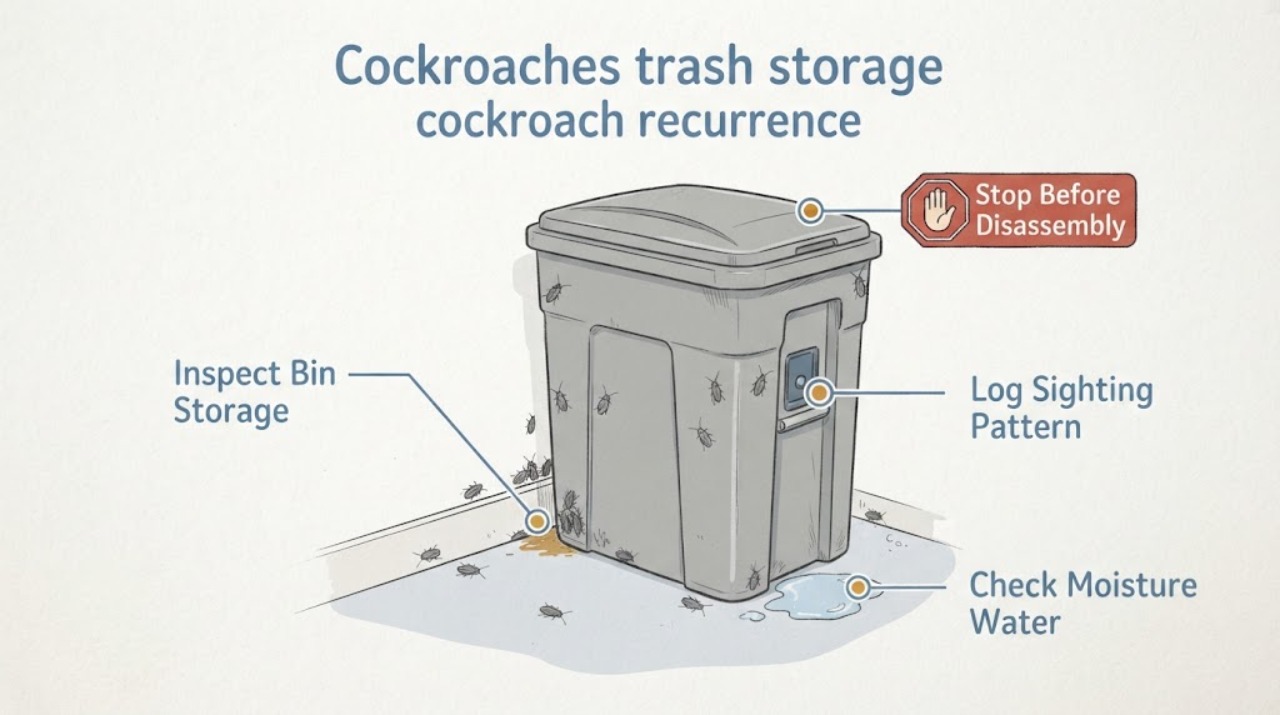
When cockroaches keep returning around trash storage, treat the bin area as a food, water, shelter, and entry-route investigation. Record where and when sightings occur, then check for loose lids, leaks, food residue, overflowing bags, wet recyclables, cardboard, cracks, and nearby drains. Keep waste in closed pest-resistant containers, remove it on the normal collection schedule, rinse food residue from recyclables, and report leaks or building-wide sanitation problems. Do not mix pesticides or cleaning chemicals, broadcast-spray the area, or place bait where children or pets can reach it. Arrange qualified pest control when sightings continue after these low-risk checks, occur in multiple rooms, or include egg cases or daytime activity.
Work through in order
Diagnostic checks
Use only checks that match the exact appliance or system and its official guide.
-
Check 1
For several sightings, record the date, time, exact location, number seen, and whether the cockroach was near the trash lid, bag, recycling, floor drain, sink, or a wall edge. If safe, photograph the insect or evidence without touching it.
Expected result: Sightings cluster at the trash container; occur near a drain or damp area; appear along a wall or doorway; occur in several rooms; or include small nymphs, egg cases, or daytime activity.
Next step: Use the pattern to guide the next inspection and share it with a pest professional if recurrence continues. Do not spray the insect or disturb egg cases to obtain a better photo.
Stop if: The sighting pattern indicates a heavy or building-wide infestation, or you would need to handle droppings, egg cases, or contaminated waste without suitable protection.
Why this matters
Why: A cluster at trash storage supports a local food or shelter source, while damp areas and drains suggest a water or entry route. Several rooms, nymphs, egg cases, or daytime sightings indicate a broader or established problem rather than an isolated visitor.
-
Check 2
Inspect the trash and recycling containers from the outside: check whether lids close tightly, bags leak or overflow, food residue remains on the rim or bottom, cardboard is accumulating, and the container sits against a wall or in a damp, cluttered corner. Do not put bare hands into waste or reach into a hidden void.
Expected result: The lid is loose or missing; bags overflow or leak; food residue or wet recyclables remain; cardboard or clutter provides shelter; or the containers are closed, clean, and dry.
Next step: Use tight-fitting pest-resistant containers, tie bags, remove waste on the normal collection schedule, rinse food residue from recyclables, and clean spills using one compatible product according to its label. If the storage area is shared, report overflow or sanitation defects to the manager.
Why this matters
Why: Open containers, residue, leaks, and clutter can provide food, water, and hiding places that sustain recurrence. A clean, closed bin area makes it more important to check drains, leaks, building gaps, and neighboring sources.
-
Check 3
Look around the trash area, nearby sink or utility fixtures, floor drains, refrigerator or appliance lines, and exterior door for standing water, condensation, leaks, damp cardboard, or a musty odor. Check from an accessible position and report plumbing or building leaks rather than opening walls or drains.
Expected result: A leak, standing water, damp cardboard, or drain moisture is present; the area is dry but sightings occur near a drain; or no moisture pattern is visible.
Next step: Dry ordinary spills promptly, report or repair accessible leaks through the appropriate building or plumbing channel, and include the water pattern in a pest-control request. Do not pour pesticides or unapproved chemicals into a drain.
Why this matters
Why: Cockroaches need access to water as well as food, so a leak or damp storage area can keep them returning even after trash is removed. A drain-adjacent pattern may indicate an entry or shelter route. No visible moisture does not rule out concealed leaks or a neighboring source.
-
Check 4
From the room side, inspect the floor-to-wall joint, baseboards, pipe penetrations, cabinet edges, door sweep, window screens, and gaps around the trash-storage area. Look for droppings, grease marks, shed skins, or a visible crack without pulling trim or reaching into a wall cavity.
Expected result: A crack or opening is visible; evidence follows a pipe, baseboard, doorway, or drain; or no accessible entry route is visible.
Next step: Seal only small, dry, clearly accessible gaps with a suitable product according to its label after confirming there is no active leak or electrical hazard. Report larger, damp, shared-wall, or concealed openings for professional repair and pest inspection.
Why this matters
Why: Small openings can connect a trash area to wall voids, neighboring units, drains, or the outdoors. Evidence along a route helps a professional inspect the right path, while no visible gap does not exclude a concealed route.
-
Check 5
Ask whether nearby units, a shared trash room, compactor, loading area, or adjacent food-service space has the same sightings or sanitation problem. Compare the timing of your sightings with collection days and shared-area cleaning without entering restricted areas.
Expected result: Yes: other spaces show activity or a shared trash issue; no: the recurrence appears limited to the home; or the building scope is unknown.
Next step: Report shared-area activity to the property manager or pest professional and request coordinated inspection. Do not move waste or apply pesticides in another unit or restricted area.
Why this matters
Why: Cockroaches can move through shared walls, utility routes, trash rooms, and loading areas, so treating one bin may not stop a building-wide source. A limited pattern supports focusing on the local container and entry points, while unknown scope needs monitoring and management coordination.
-
Check 6
After the low-risk sanitation, moisture, and exclusion checks are addressed, continue the same sighting log and inspect the bin area on a consistent schedule. Note whether fresh droppings, egg cases, live roaches, or new activity appear despite closed containers and prompt waste removal.
Expected result: Activity stops; activity decreases but does not stop; or activity continues or increases in the same or additional locations.
Next step: Arrange qualified pest control for continued or expanding activity, and provide the full log, container observations, moisture findings, and any building-wide reports. Avoid escalating to stronger chemicals on your own.
Why this matters
Why: A reduction after removing food, water, shelter, or entry conditions supports those factors as contributors but does not prove the population is gone. Continued or expanding activity suggests a hidden, shared, or established source requiring professional identification and targeted control.
Use your observations
Decision map
Find the observation that best matches what you see, then follow the next safe action.
-
PATH 01Next step
What you see
Sightings cluster around an open or leaking bin, food residue, wet recyclables, overflow, or cardboard and clutter.
Do this next
Use tightly closed pest-resistant containers, tie and remove bags on schedule, rinse recyclables, clean spills safely, and monitor whether activity changes.
Why this path and its safety boundary
Why it matters: The trash-storage area is supplying food, moisture, or shelter that can sustain cockroach recurrence.
-
PATH 02Next step
What you see
Activity clusters near a drain, leak, condensation, damp cardboard, or a plumbing or appliance area.
Do this next
Report or repair the moisture source through the appropriate building or plumbing channel and include the location in a pest-control request. Do not pour pesticide into drains.
Why this path and its safety boundary
Why it matters: Water access or a damp route may be sustaining the cockroaches even when trash is well stored.
-
PATH 03Next step
What you see
Droppings, shed skins, or sightings follow a crack, pipe penetration, baseboard, doorway, or shared wall.
Do this next
Seal only a small, dry, accessible gap according to product instructions; report damp, large, shared, or hidden openings for coordinated building and pest inspection.
Why this path and its safety boundary
Why it matters: The trash area may be an entry or travel route rather than the original source.
-
PATH 04Next step
What you see
Other units, a shared trash room, compactor, loading area, or neighboring food area has activity or sanitation problems.
Do this next
Notify the property manager and request a coordinated IPM inspection and sanitation response across the connected areas.
Why this path and its safety boundary
Why it matters: A single-home treatment is unlikely to stop movement from a shared source.
-
PATH 05Next step
What you see
Activity continues or increases after closed-container and sanitation controls, appears in multiple rooms, includes nymphs or egg cases, or occurs during daylight.
Do this next
Arrange qualified pest control, provide the sighting log and source observations, and follow the professional's label-compliant treatment and follow-up plan.
Why this path and its safety boundary
Why it matters: The problem may be established, hidden, or larger than the trash-storage area.
-
PATH 06Next step
What you see
Only one or occasional sighting occurs, the container is closed and dry, and no droppings, egg cases, or additional route is found.
Do this next
Continue monitoring, keep trash and recyclables closed and clean, and escalate if sightings recur, spread, or show signs of an established population.
Why this path and its safety boundary
Why it matters: A single visitor or transient entry remains possible, but the evidence is not enough to declare the issue resolved.
Helpful context
Understand the symptom
Why trash storage can support recurring cockroaches
A trash can or recycling area can provide food residue, moisture, shelter, and a route into the building. One sighting does not identify the size or source of an infestation, so the useful first step is to monitor the pattern and inspect the conditions that make the area attractive. Integrated pest management (IPM) combines monitoring, prevention, exclusion, and targeted control instead of relying on a single spray.
Keep maintenance low-risk
Wear gloves for ordinary waste handling and follow the product label for any cleaner or pest-control product. Never mix pesticides or cleaning products, and do not use foggers or broadcast sprays as a first response. Keep bait and traps away from children, pets, food, and food-preparation surfaces. If droppings or heavy infestation are present, avoid dry sweeping that can spread contaminated dust and ask a professional about safe cleanup.
What the result changes
If the bin area has an open lid, leaks, food residue, or overflow, correct that condition and monitor again. If it is clean and closed but roaches still appear, look for moisture, drains, cracks, and routes from neighboring units or shared trash rooms. Continued sightings after sanitation and exclusion checks are a reason to use a qualified pest professional who can inspect the whole route and choose a targeted treatment.
Safety boundary
Stop conditions
- Recurring sightings after trash and moisture controls
- Nymphs, egg cases, heavy droppings, or daytime activity
- Activity in multiple rooms, units, or shared trash areas
- Unknown or concealed entry route, active leak, or inaccessible void
- Children, pets, or food could contact a proposed pesticide or bait location
- A cleanup would require handling heavy droppings or contaminated material without suitable protection
- Any plan involves mixing pesticides or cleaners, fogging, or broadcast spraying
Only after diagnosis
Potential parts
- drain cover
Consider this only if sightings cluster at an accessible, unused drain and a qualified building or plumbing assessment confirms that a compatible cover will not block required drainage.
Confirm drain size, safe drainage function, cleaning access, and local requirements before installing; a cover does not replace leak repair or pest inspection. - crack sealant
Consider this only for a small, dry, clearly accessible gap after ruling out an active leak, electrical hazard, and a shared or concealed building route.
Follow the product label and confirm the material, movement, ventilation, and repair limits; do not seal wet damage or block required vents. - roach bait station
Consider this only after monitoring identifies a localized cockroach route and only as a label-compliant targeted control, not as a substitute for closed trash, moisture control, and exclusion.
Use a registered product exactly as labeled and place it where children, pets, and food cannot reach it; never mix or transfer pesticide products.
When checks do not resolve it
Need a professional?
Call promptly for recurring activity, nymphs or egg cases, daytime sightings, multiple rooms or units, heavy droppings, a shared trash-room problem, or activity that continues after low-risk maintenance.
Have this ready
- Provide the sighting log, photos if available, container and recycling conditions, moisture or drain observations, accessible cracks or routes, collection timing, and whether neighboring units or shared areas report activity.
Common questions
FAQ
Why do cockroaches keep coming back near the trash can?
The area may still offer food residue, water, shelter, or an entry route. Check the lid, leaks, overflow, wet recyclables, cardboard, nearby drains, cracks, and shared trash areas instead of treating the bin alone.
Does a tight trash lid solve a recurring cockroach problem?
It can remove an important food source, but it does not prove the population is gone. Continue monitoring and check moisture, drains, cracks, neighboring units, and other food sources if sightings continue.
Should I spray the trash area or use a fogger?
Do not make broadcast spraying or fogging the first response. IPM starts with monitoring, sanitation, moisture control, and exclusion; if targeted control is still needed, use a qualified professional or a label-compliant tamper-resistant bait station kept away from children and pets.
When should I call a pest-control professional for recurring cockroaches?
Call when activity continues after closed-container and sanitation checks, appears in multiple rooms or units, includes nymphs or egg cases, occurs during daylight, or points to a shared trash room, hidden route, or established infestation.
Read the exact guide
Official sources
- Pest Control: Resources for Housing ManagersU.S. Environmental Protection Agency · Supports checking shared trash rooms and neighboring units when cockroach recurrence persists beyond one container.
- How to Control Pests Safely: Getting Rid of Roaches and MiceNew York City Department of Health and Mental Hygiene · Supports tight-lidded and regularly cleaned garbage, rinsed recyclables, moisture reduction, reporting weak vents, and sealing accessible gaps.
- Integrated Pest Management (IPM) PrinciplesU.S. Environmental Protection Agency · Supports the article's sequence of monitoring recurrence, correcting food/water/shelter conditions, excluding pests, and escalating to targeted professional control.
- Do you really need to use a pesticide?U.S. Environmental Protection Agency · Directly supports tight-lidded trash, frequent emptying, spill cleanup, sealing cracks, and tamper-resistant bait placement.
- Cockroaches and SchoolsU.S. Environmental Protection Agency · Supports treating dark, moist basement or plumbing areas and routine covered-garbage removal as relevant recurrence clues; school context is used only for general pest mechanics.
Community feedback
Share a repair observation
Share a plain-text repair observation. Accepted observations are published automatically; this page may take a moment to update.