
On this page
Start here
Quick answer
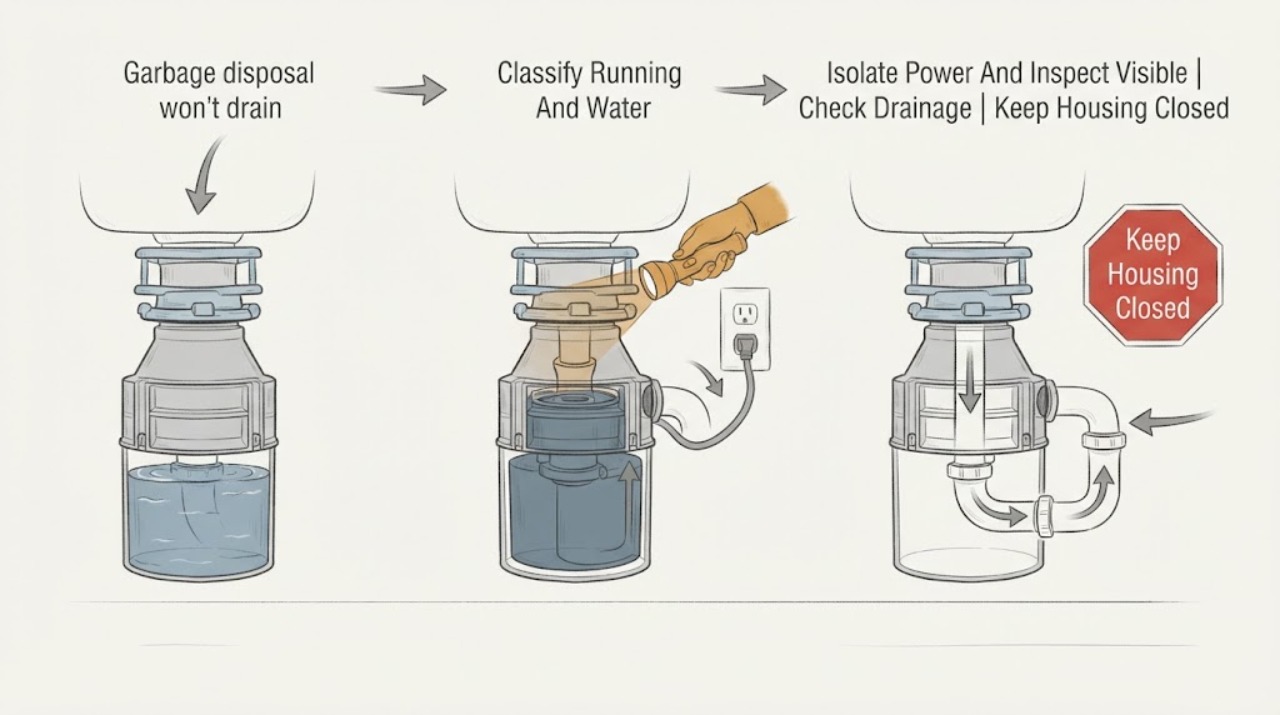
A garbage disposal that will not drain can have a clogged drain path, a jam that prevents the motor from moving the grinding plate, or an electrical fault that means the disposal is not actually running. First observe whether the motor runs and whether water swirls, then shut off power completely before looking for visible objects. If the disposal runs and water swirls, follow the exact model instructions for a gentle plunger check with the other sink basin blocked; never put a hand into the chamber. If the motor only hums, remains silent, trips protection, smells burned, leaks, or needs a cabinet, wiring, capacitor, or internal-pipe repair, leave it off and call a qualified plumber or appliance technician. Do not pour grease into the drain, use a hand to search for debris, repeatedly reset the unit, or force a jammed mechanism.
Before you begin
Safety first
- This article covers symptom classification, power-isolated visible inspection, and a manufacturer-permitted gentle drain check only. Internal disposal, electrical, motor, grinding, trap, shared-drain, and connected-hose work requires qualified service.
Work through in order
Diagnostic checks
Use only checks that match the exact appliance or system and its official guide.
-
Check 1
From above the sink, with hands and tools kept out of the opening, use the normal switch briefly only to determine whether the disposal runs and whether the standing water moves or forms a whirlpool.
Expected result: Record one of these patterns: motor runs and water swirls, motor runs but water does not move, motor hums without rotation, or there is no sound; also note whether one or both sink basins back up.
Next step: Use the matching branch below: isolate power before any visible-object or jam check, and use a gentle drain-path check only when the disposal is running normally and there is no hazard symptom.
Stop if: Stop immediately for smoke, burning odor, a leak, exposed wiring, repeated breaker trips, or any need to reach into the chamber.
Why this matters
Why: A running motor with a whirlpool supports a blocked drain line. A running motor without a whirlpool supports a jam or obstruction. Humming without rotation supports a mechanical jam, while silence or repeated electrical protection points toward a power or equipment fault rather than a simple drain clog.
-
Check 2
Turn off the wall switch and disconnect power by unplugging the disposal or switching off its circuit as the installed instructions permit; remove standing water if needed, then use a flashlight to inspect only for visible objects and use long-handled tongs or pliers to remove an object that is clearly reachable.
Expected result: Record whether a utensil, bone, pit, glass, metal, fibrous material, or other object is visible; whether it comes out without force; or whether the chamber is not safely visible.
Next step: Restore no power while hands or tools are near the opening. If the object is removed without force, keep power off until the area is clear and proceed to one controlled reset or drain-path test only if the unit and instructions permit it.
Stop if: Never put a hand into the disposal, use a hand-held tool while power is connected, pry aggressively, or continue when glass, metal, a leak, or an inaccessible object is involved.
Why this matters
Why: A reachable object can explain a jam or restricted outlet, but a clear chamber does not rule out a hidden jam or a clog farther down the drain. An object that requires force, hand access, or cabinet disassembly is outside a safe ordinary check.
-
Check 3
When the motor runs normally, there is no electrical or leak hazard, and the disposal instructions do not prohibit it, block the other opening of a double sink and use a plunger gently over the disposal opening; keep hands out of the water and chamber.
Expected result: Note whether water level falls, the blockage releases, both basins exchange water, or there is no change; do not force a plunger against a leaking or damaged flange.
Next step: If flow returns, flush with cold water and run the disposal only as the manufacturer's instructions direct. If the sink remains blocked or backs up again, stop and arrange qualified plumbing service.
Stop if: Do not plunge when the unit is electrically unsafe, leaking, visibly damaged, full of sharp fragments, or connected to a condition that requires opening pipes; never use chemical drain cleaner in the disposal as a substitute for diagnosis.
Why this matters
Why: A released blockage supports a drain-line obstruction. No change, water moving into the other basin, or a clog that returns points toward a deeper drain, trap, shared branch, or disposal connection problem rather than proof that the motor needs replacement.
-
Check 4
If the unit hums, does not turn, or stopped after an obstruction, keep power disconnected and consult the exact disposal instructions for a model-specific wrench or reset procedure; do not force the mechanism or reach into the chamber.
Expected result: Record whether the mechanism moves only through the documented low-force procedure, whether the reset button stays in, whether the motor starts smoothly, or whether it remains silent, hums, stops, or trips protection.
Next step: After one safe, model-approved reset or jam-release attempt, leave the unit off and request service if operation is not smooth or draining does not return.
Stop if: Do not use an unspecified wrench, pry the turntable, bypass the reset or overload protector, repeatedly reset the unit, test live wiring, or open the motor housing.
Why this matters
Why: A documented release followed by smooth operation supports a temporary jam. Persistent humming, silence, a reset that pops again, or a breaker trip indicates an unresolved mechanical or electrical issue and is not a reason to keep trying the reset.
-
Check 5
With power left off, inspect the visible underside and surrounding cabinet for a loose drain connection, standing water, a kinked or crushed dishwasher drain hose, a damaged flange, or water reaching an outlet; do not loosen a trap or disconnect a hose.
Expected result: Record dry connections and an intact hose, a visible leak or drip, a backed-up shared drain, a kinked hose, or a condition that cannot be safely seen.
Next step: Keep the disposal off for any leak, water near electricity, or shared backup and arrange a qualified plumber. Only correct a clearly visible external obstruction if the equipment instructions permit it and no connection must be loosened.
Stop if: Do not loosen pipes, remove the trap, disconnect the dishwasher hose, touch wet electrical parts, or continue using the disposal while it leaks.
Why this matters
Why: A leak or shared backup can make the disposal appear not to drain while creating a plumbing or electrical hazard. A visible hose kink can restrict a connected dishwasher path, but it does not establish that the disposal itself is clear or that a pipe should be opened without service preparation.
-
Check 6
After a visible object is removed or an allowed drain-path check succeeds, make one controlled test with cold water and the disposal, keeping the sink clear and hands away from the opening.
Expected result: Record whether water drains normally, the disposal runs smoothly, the drain is slow, water backs up again, the motor hums or stops, or unusual noise or odor appears.
Next step: Stop testing and provide the technician with the original water pattern, motor sound, visible object, power-isolation step, plunger or jam result, and any leak or backup location.
Stop if: Do not run the disposal dry or with a hazard present, keep cycling a returning clog, or operate through smoke, burning odor, leaks, or electrical trips.
Why this matters
Why: Normal draining and smooth operation support a cleared obstruction. Slow or returning backup means the drain path remains restricted. Humming, stopping, unusual noise, odor, smoke, or a repeated reset or breaker response means the appliance needs service rather than another test.
Use your observations
Decision map
Find the observation that best matches what you see, then follow the next safe action.
-
PATH 01Safety boundary
What you see
The disposal motor runs and water visibly swirls, but the sink does not drain.
Do this next
With no hazard symptoms, use the disposal manufacturer's gentle plunger procedure; on a double sink, block the other opening. If the blockage is not released or returns, call a qualified plumber.
Why this path and its safety boundary
Why it matters: This pattern supports a clogged drain line rather than a stopped motor.
Safety stop: Stop for a leak, sharp fragments, chemical cleaner, a shared backup, or any need to open drain piping.
-
PATH 02Safety boundary
What you see
The disposal runs, but water does not form a whirlpool or leave the sink.
Do this next
Disconnect power, remove only a clearly visible object with long-handled tongs, and stop if the chamber is not clear without force. Arrange service for a hidden obstruction or persistent no-drain condition.
Why this path and its safety boundary
Why it matters: A jam, internal obstruction, or outlet restriction is more plausible than a simple motor no-start problem.
Safety stop: Do not reach in, pry, disassemble the disposal, or keep running it against standing water or an obstruction.
-
PATH 03Safety boundary
What you see
The disposal hums without rotation, starts and stops, or makes grinding or scraping noise.
Do this next
Leave power off and use only the exact model-approved jam-release procedure if it is clearly documented and safe. If the unit remains abnormal, request qualified service.
Why this path and its safety boundary
Why it matters: A mechanical jam or damaged grinding assembly is possible; repeated operation can overheat the motor or worsen damage.
Safety stop: Do not touch the chamber, use an unverified tool, force the turntable, bypass overload protection, or repeatedly reset the unit.
-
PATH 04Safety boundary
What you see
There is no sound, the reset button pops repeatedly, or a breaker trips when the disposal is used.
Do this next
Leave the unit off and arrange qualified appliance or electrical service. Provide the reset and breaker behavior without opening the electrical box.
Why this path and its safety boundary
Why it matters: This is an electrical or equipment-fault branch, not a drain-clearing invitation; power, switch, motor, overload protection, or wiring may need diagnosis.
Safety stop: Do not keep resetting, bypass protection, test live wiring, or touch the disposal when smoke, heat, or a burning odor is present.
-
PATH 05Safety boundary
What you see
Water leaks below the sink, reaches an outlet, backs up into both basins, or returns after the disposal appears to clear.
Do this next
Stop using the disposal, keep power off if water is near electrical parts, and arrange qualified plumbing service to isolate the disposal, trap, shared drain, and connected hose.
Why this path and its safety boundary
Why it matters: A leaking connection or shared/deeper drain problem creates a plumbing and possibly electrical hazard that a plunger or reset may not solve.
Safety stop: Do not loosen the trap, disconnect a hose, use chemical drain cleaner, or operate the unit while it leaks or the backup persists.
-
PATH 06Safety boundary
What you see
The obstruction is removed or an allowed drain check succeeds, and one test shows smooth operation with normal draining and no leak.
Do this next
Use cold water as the manufacturer's care guidance directs, feed waste gradually, and monitor the next few uses. Request service if slow draining or a jam returns.
Why this path and its safety boundary
Why it matters: The original condition was consistent with a temporary obstruction, but recurrence can indicate an underlying drain or disposal problem.
Safety stop: Do not feed grease, oil, hard foreign objects, or large amounts of fibrous or starchy waste, and stop for a new abnormal sound, odor, leak, or trip.
Helpful context
Understand the symptom
First separate a drain blockage from a disposal that is not operating
The same standing water can appear when the disposal is grinding normally but the drain path is blocked, when a foreign object jams the grinding mechanism, or when the motor never starts. With the switch used normally, listen and observe from above the sink without reaching in. A motor that runs and creates a visible whirlpool points toward the drain line; a motor that runs without moving water points toward a jam or obstruction; silence, repeated breaker trips, or a reset that keeps popping points toward an electrical or equipment fault.
Use only low-risk access under the sink and at the drain opening
Before looking for an object or touching the reset button, cut power at the wall switch and by unplugging the unit or switching off its circuit as the installed instructions allow. Remove standing water if needed and use a flashlight and long-handled tongs for a visible object; never use a hand inside the chamber. On a double sink, a plunger check works only when the other opening is blocked, and the disposal must be treated as a sharp, powered appliance even when it seems quiet.
Know when the drain or appliance needs a professional
A clog farther down the plumbing, a leak at the disposal or trap, an inaccessible object, repeated jamming, or any electrical symptom is not resolved by repeatedly forcing the unit. A technician can isolate the disposal, drain line, trap, dishwasher connection, motor, impellers, reset protection, and wiring. Stop immediately for smoke, burning odor, a leak near electrical parts, broken glass or metal that cannot be safely removed, or uncertainty about power isolation.
Safety boundary
Stop conditions
- Never put a hand into the disposal chamber, even when the switch is off; disconnect power before any visible-object or jam inspection and use only long-handled tools for a clearly reachable object.
- Stop for smoke, a burning smell, overheating, exposed wiring, repeated breaker trips, a reset that pops again, or water near electrical equipment; leave the disposal off and arrange qualified service.
- Do not use chemical drain cleaner in the disposal, mix cleaners, pour grease or oil into the drain, or keep operating against a standing-water backup.
- Do not pry a jammed mechanism, use an unspecified wrench, bypass overload protection, test live wiring, open the motor housing, or disassemble the trap or drain connection as a first-line check.
- If the clog is farther down the plumbing, returns after a gentle allowed check, or requires pipe, dishwasher-hose, cabinet, or wall access, stop and call a qualified plumber.
Only after diagnosis
Potential parts
- garbage disposal splash baffle or flange seal
Consider this category only when inspection confirms a damaged seal or baffle is causing a leak or allowing debris to obstruct the inlet, and the exact disposal design is known.
Confirm the exact disposal model and manufacturer fit information; a leak or damaged mounting interface should be assessed before ordering a seal. - garbage disposal motor or grinding assembly
Consider this only after qualified testing confirms an internal motor or grinding-assembly fault rather than a drain-line clog, jammed foreign object, switch, or overload condition.
Match the exact disposal model, mounting arrangement, electrical requirements, and manufacturer instructions; do not infer fit from appearance or symptoms alone. - garbage disposal reset or overload component
Consider this only when professional diagnosis confirms failed overload protection or a related equipment fault after the disposal remains silent or repeatedly trips.
The exact model and electrical design must be confirmed by the manufacturer or qualified technician; do not bypass or substitute protection as a test. - sink drain or disposal connection seal
Consider this only when a qualified inspection identifies a leaking disposal connection, flange, trap, or drain fitting as the cause of water loss or backup.
Confirm the exact connection and seal dimensions, installation arrangement, and plumbing requirements before replacing any fitting.
When checks do not resolve it
Need a professional?
Arrange qualified plumbing or appliance service when the disposal remains blocked after a safe, model-approved check; the clog is farther down the drain; water backs up into both basins; a connection or flange leaks; the motor hums, grinds, stalls, or remains silent; the reset or breaker trips again; an object is inaccessible; or any diagnosis would require opening the disposal, wiring, trap, dishwasher connection, cabinet, or wall. Smoke, burning odor, overheating, or water near electrical parts is an immediate stop condition.
Safety scope: This article covers symptom classification, power-isolated visible inspection, and a manufacturer-permitted gentle drain check only. Internal disposal, electrical, motor, grinding, trap, shared-drain, and connected-hose work requires qualified service.
Common questions
FAQ
Why does the garbage disposal run but the sink still will not drain?
A running disposal with water swirling can indicate a clogged drain line. If the disposal runs without moving the water, a jam or internal obstruction is more plausible. Disconnect power before any visible-object check and arrange plumbing service if a gentle allowed drain check does not clear or the blockage returns.
Can I reach into the disposal to pull out what is blocking it?
No. Disconnect power completely before inspecting, and use a flashlight plus long-handled tongs or pliers only for an object that is clearly visible and reachable. Never put a hand into the chamber, and stop for glass, metal, force, or uncertainty.
Should I press the reset button if the disposal will not drain?
Only if the unit's exact instructions support it and the symptom is consistent with a temporary jam or overload, with power isolated as instructed. A reset will not clear a deeper drain clog, and repeated trips, a reset that pops again, humming, smoke, or a silent motor require service.
Can a plunger clear a garbage-disposal drain clog?
InSinkErator describes a gentle plunger check for a running disposal with a drain-line clog and says to block the other sink opening on a double sink. Do not plunge a leaking or electrically unsafe unit, use chemical drain cleaner, or continue if the backup returns.
When is a no-drain disposal a plumber's problem?
Call when the blockage is deeper in the plumbing, water backs up into both basins, a connection leaks, the motor hums or stays silent, protection trips again, an object is inaccessible, or the repair requires opening pipes, the disposal housing, wiring, or the cabinet. Smoke, burning odor, overheating, or water near electrical parts is an immediate stop condition.
Read the exact guide
Official sources
- Jammed or Not Operating - DisposerWhirlpool Product Help · Whirlpool disposer operating guidance; model-specific wrench, reset, and access arrangements vary.
- How to Reset a Garbage DisposalWhirlpool Product Help · Whirlpool disposer support guidance; follow the exact instructions for the installed model and do not treat the reset procedure as a universal repair.
- Fixing a Clogged Garbage DisposalInSinkErator · InSinkErator support guidance for household garbage disposals; the installed disposal's manual controls model-specific procedures.
Community feedback
Share a repair observation
Share a plain-text repair observation. Accepted observations are published automatically; this page may take a moment to update.