
On this page
Start here
Quick answer
Start by turning the wall switch OFF and disconnecting power at the accessible plug or service switch; never put a hand into a disposal. If the disposal runs and the sink water swirls but does not leave, the likely focus is the drain line, P-trap, wall connection, or a shared double-sink path. A single sink may respond to a correctly placed plunger, but stop if water backs up, the trap is unknown, a dishwasher connection is involved, or chemical cleaner is present. Do not mix chemicals, use a disposal with a leak or electrical odor, or remove a jam while power is connected. A plumber should handle a deep or concealed clog and an electrician should handle unsafe wiring or repeated electrical trips.
Before you begin
Safety first
- Do not put hands or tools into the disposal, operate it while clearing a clog, mix or add drain chemicals, dismantle a chemical-exposed or pressurized connection, remove a trap with contaminated water, bypass protection, or work near wet electrical equipment.
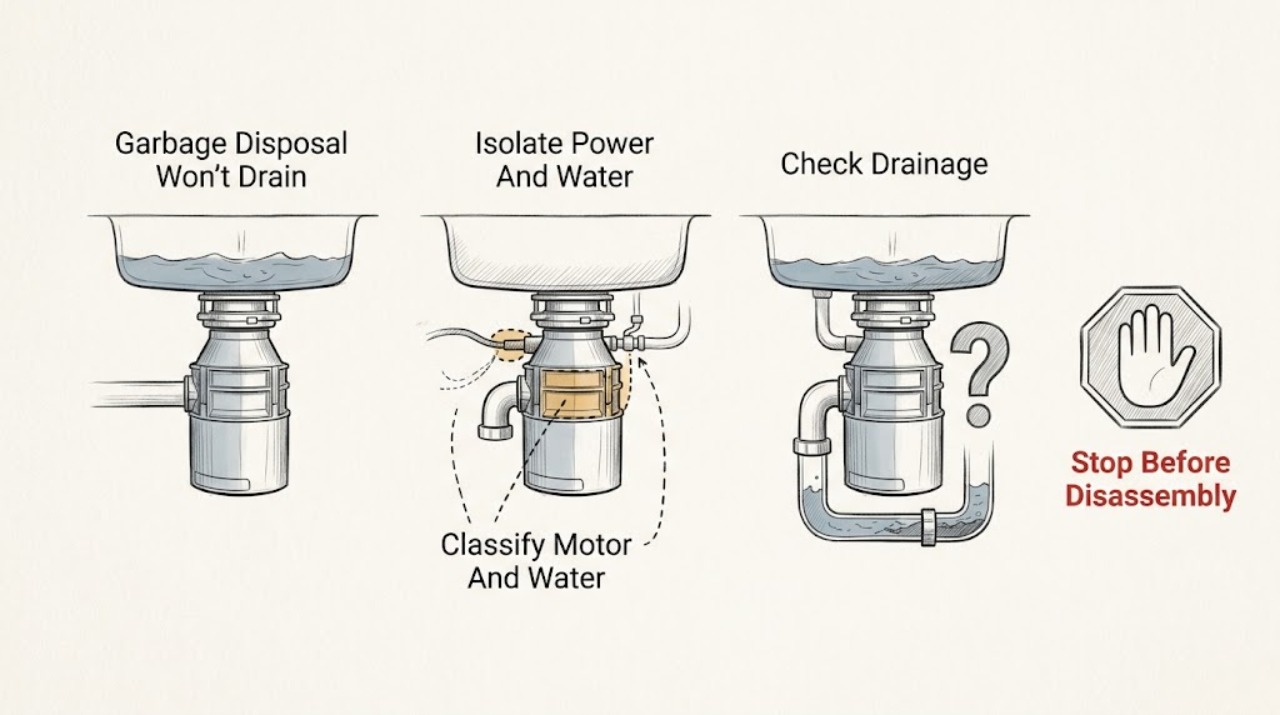
Work through in order
Diagnostic checks
Use only checks that match the exact appliance or system and its official guide.
-
Check 1
Turn the disposal wall switch OFF and disconnect power at the accessible plug or service switch before looking into the sink; stop the water and keep the stopper in place when the disposal is not being used.
Expected result: Record whether the unit is cord-connected or hardwired, whether the switch is clearly off, and whether water is standing, rising, leaking below the sink, or contaminated by a chemical product.
Next step: Keep power off and document the sink layout and water level; arrange a plumber for a leak, deep clog, chemical exposure, or any hardwired/uncertain isolation condition.
Stop if: Never put a hand into the disposer, reach through the splash guard, use a tool in the chamber, or continue if power cannot be positively isolated.
Why this matters
Why: Power isolation is required before clearing an object or investigating a disposal. Standing water with no chemical exposure supports a drain-path check; a leak, chemical exposure, or uncertain isolation makes DIY clearing unsafe.
-
Check 2
From outside the sink and with power still isolated, record whether the last safe switch operation left the disposal running normally, humming, silent, or stopping, and whether the sink water swirled or simply stayed still.
Expected result: Classify the symptom as motor ran with a whirlpool, motor ran without a whirlpool, motor did not run, motor hummed, or water backed into the other sink; do not restore power to reproduce it.
Next step: Keep the disposal off, use the matching branch below, and call a plumber for a downstream or shared-line restriction; use an electrician or appliance technician for unsafe electrical symptoms or a non-running unit.
Stop if: Do not repeatedly cycle the switch, reset protection to force a run, or attempt to free a jam while power is connected.
Why this matters
Why: A running motor with a whirlpool supports a downstream drain-line clog. A silent or humming motor shifts toward power/jam diagnosis, while cross-bowl backup supports a shared branch restriction. The water pattern does not identify a safe internal repair.
-
Check 3
With power isolated, inspect the visible discharge tube, P-trap area, sink tailpiece, dishwasher hose connection if present, and both sink bowls for a kink, sag, loose joint, obstruction, or water at a fitting; do not loosen a connection yet.
Expected result: Record whether the visible drain path is clear and correctly supported, a hose is kinked, a joint is wet, the P-trap is full, a dishwasher hose enters the disposal, or the restriction is beyond visible access.
Next step: Photograph the path and keep the disposal off; arrange plumbing service for a wet joint, concealed restriction, or any connection that would need to be loosened with standing or contaminated water.
Stop if: Do not remove a P-trap or hose when chemical cleaner is present, water is contaminated, the cabinet is wet near electricity, or the connection is corroded or pressurized.
Why this matters
Why: A visible kink, unsupported route, or leaking joint can interrupt drainage, while a clear visible path with retained water points farther into the trap or branch. A dishwasher connection may explain cross-flow or backup but does not make the disposal chamber safe to open.
-
Check 4
For a double-bowl sink, note which bowl holds water and whether the other opening is open or stopped; if a dishwasher is connected, record whether its drain hose enters the disposal and whether the dishwasher also backs up, without disconnecting the hose.
Expected result: Record disposal-side backup, opposite-bowl backup, both bowls standing, dishwasher-only backup, or no dishwasher connection; note any recent disposal or dishwasher installation.
Next step: Keep power off and provide the layout and installation history to a plumber; do not remove a dishwasher hose, knock out a plug, or open plumbing without model-specific instructions and safe isolation.
Stop if: Stop for wastewater overflow, sewage odor or contamination, an active leak, or water near an outlet, cord, or other electrical equipment.
Why this matters
Why: Opposite-bowl or both-bowl backup suggests a shared branch or P-trap restriction. A dishwasher-only symptom can involve its hose, air gap/high loop, or disposal inlet; a recent disposal installation raises the possibility of an installation plug or connection issue.
-
Check 5
Only if the water is ordinary household water, no chemical cleaner was used, power remains isolated, and the drain openings are safe to handle, place the correct stopper over the other bowl on a double sink and use a plunger gently over the disposal opening.
Expected result: Record whether water level drops, moves between bowls, remains unchanged, leaks from a joint, or splashes with an unusual odor or chemical warning.
Next step: Remove the stopper, clean up ordinary water safely, and make no more than one normal drain observation with power still off; call a plumber if the clog remains, returns, or is beyond the visible path.
Stop if: Do not plunge against chemical cleaner, force a seal on a damaged opening, use a disposer switch during plunging, or continue after a leak, sewage backup, or unusual splash.
Why this matters
Why: A drop in water level supports a loosened drain-line restriction. No movement, cross-bowl movement without drainage, leakage, or contaminated splash means the restriction or installation condition needs professional assessment.
-
Check 6
Check the sink and cabinet labels or memory for any drain-opening chemical, lye, solvent, grease, or hot-liquid product already used; do not add another product or attempt to neutralize it.
Expected result: Record no chemical exposure, a known chemical product and time, an unknown product, or chemical odor/irritation; note whether water is still standing.
Next step: Keep people away, keep power off, ventilate only from a safe position, and tell the plumber exactly what product was used; follow the product label or local poison/emergency guidance for exposure.
Stop if: Do not mix products, plunge a chemically exposed sink, touch the water, use a disposer, or remove a pipe or trap yourself.
Why this matters
Why: Chemical exposure changes the plumbing-service and personal-safety boundary. GE and InSinkErator warn against caustic drain cleaners or grease in a disposer/drain; a product already present can injure anyone opening the trap or splash guard.
-
Check 7
Prepare a service record with the disposal model if visible, single- or double-bowl layout, motor sound, whirlpool/backup behavior, water level, visible drain route, dishwasher connection, recent installation, and any chemical or leak history.
Expected result: Include whether the plunger changed the level, whether the clog returned, whether the P-trap or wall connection is reachable, and whether any electrical odor, heat, spark, or trip occurred.
Next step: Give the record and photos to a qualified plumber; include an electrician when the switch, cord, receptacle, hardwire, or protection has an unsafe symptom.
Stop if: Do not open the disposal, remove the trap, disconnect the dishwasher line, or restore power just to collect another symptom.
Why this matters
Why: These observations distinguish a disposal chamber issue from the assigned drain-line path, P-trap, shared branch, dishwasher connection, wall drain, or unsafe electrical condition without guessing at parts.
Use your observations
Decision map
Find the observation that best matches what you see, then follow the next safe action.
-
PATH 01Safety boundary
What you see
The disposal previously ran normally and water formed a whirlpool but did not leave the sink.
Do this next
With power isolated and no chemical exposure, use the limited gentle plunger check; arrange a plumber if it does not clear or the blockage is farther down the line.
Why this path and its safety boundary
Why it matters: A downstream drain-line, P-trap, branch, or wall connection restriction is more likely than a motor jam.
Safety stop: Do not reach into the chamber, use chemicals, or remove plumbing with contaminated or standing water.
-
PATH 02Safety boundary
What you see
The disposal is silent, hums, stops, or trips protection instead of running normally.
Do this next
Keep power isolated and arrange appliance service or electrician diagnosis; an internal jam or electrical fault requires the model's safe procedure or a professional.
Why this path and its safety boundary
Why it matters: This is primarily a power or disposer-jam/mechanics path, not proof of a drain-line clog.
Safety stop: Do not repeatedly reset, reach inside, use a tool while energized, or continue after a hot cord, odor, spark, or trip.
-
PATH 03Safety boundary
What you see
Water moves into the opposite bowl or both bowls remain full.
Do this next
Keep the disposal off, stop adding water, and arrange plumbing service with the sink layout and visible path photos.
Why this path and its safety boundary
Why it matters: The restriction may be in the shared P-trap, branch, or wall drain; the disposal filter or chamber alone is not a sufficient explanation.
Safety stop: Do not plunge against chemical cleaner, remove the trap with contaminated water, or continue after overflow.
-
PATH 04Safety boundary
What you see
A connected dishwasher also backs up, or the disposal/dishwasher connection was recently installed or changed.
Do this next
Do not run the dishwasher or disposal and ask a plumber to verify the hose, air gap/high loop, and disposal inlet according to both manuals.
Why this path and its safety boundary
Why it matters: The hose route, high loop/air gap, disposal inlet, or shared drain may be involved; the appliance connection needs installation-specific verification.
Safety stop: Stop for wastewater overflow, a leak, sewage odor, or water near electrical equipment.
-
PATH 05Safety boundary
What you see
Drain cleaner, lye, solvent, grease, or unknown chemical was added, or water is leaking from the disposal or drain fittings.
Do this next
Keep power off, keep people away, document the product and leak location without touching the water, and contact a plumber or appropriate emergency/poison guidance.
Why this path and its safety boundary
Why it matters: The immediate priority is chemical, cut, contamination, property, or electrical safety; DIY plunging or pipe removal can expose a person to the material.
Safety stop: Do not mix products, operate the disposal, plunge, touch water, or dismantle a chemical-exposed or leaking connection.
Helpful context
Understand the symptom
A drain-line clog is different from a disposal that will not run
The assigned problem is a garbage disposal that will not drain, with the drain line as the component. If the motor runs and water remains in the sink, the disposal may be grinding but the downstream line, trap, branch, or wall drain is restricted. If the motor only hums, is silent, trips protection, or is jammed, that is a separate power or disposer-mechanics path. Disconnect power before any object check, keep hands and tools outside the chamber, and do not use the switch as a repeated diagnostic.
Use the sink layout to narrow the first blocked point
With a double-bowl sink, water can move between bowls when the shared branch or disposal outlet is restricted. A dishwasher hose may enter the disposal or sink tailpiece, and an air gap or high loop may affect a connected dishwasher's symptoms. A standing-water clog can also be in the P-trap or farther into the wall. Inspect only visible connections and follow the installed manufacturer's arrangement; do not loosen a trap or hose when water is contaminated, chemical cleaner is present, or the connection cannot be isolated safely.
Plunging is limited and chemicals are not a shortcut
InSinkErator describes a gentle plunger method for a drain-line clog, with the second opening stopped on a double sink. That method is appropriate only when the water is ordinary household water, the disposal is isolated from power, the drain opening and stopper can be handled safely, and no chemical product has been poured into the sink. GE warns not to run lye or drain cleaners through a disposer; a plumber should handle a deep, recurring, or chemically exposed blockage.
Only after diagnosis
Potential parts
- disposer discharge tube or drain-line gasket
Consider only after a plumber confirms a damaged or incorrectly sealed discharge connection is causing the leak or obstruction.
Confirm the exact disposal model, tube geometry, gasket, mounting arrangement, and local plumbing requirements before selecting a part. - P-trap or drain-line section
Consider only after a plumber locates a cracked, blocked, improperly pitched, or incorrectly routed visible drain section.
Sizing, pitch, venting, dishwasher routing, and code compliance must be confirmed at the installation; do not choose a generic section from the symptom alone. - garbage disposal
Consider only if qualified diagnosis finds a failed disposer or unsafe unit after the drain line and power path are assessed.
Confirm sink flange, mounting, electrical connection, discharge, dishwasher inlet, capacity, and local plumbing/electrical requirements for the exact installation.
When checks do not resolve it
Need a professional?
Arrange qualified plumbing service when a running disposal still will not drain after the limited safe plunger check, the clog is in the P-trap or wall line, the symptom recurs, both sink bowls back up, a dishwasher connection is involved, or the filter/line arrangement is unknown. Use urgent electrical or plumbing help for sparks, smoke, a hot cord, repeated trips, active leaks, chemical exposure, sewage backup, or water near electricity.
Safety scope: Do not put hands or tools into the disposal, operate it while clearing a clog, mix or add drain chemicals, dismantle a chemical-exposed or pressurized connection, remove a trap with contaminated water, bypass protection, or work near wet electrical equipment.
Have this ready
- Provide the disposer model if visible, power connection type, single/double sink layout, motor sound, whirlpool and cross-bowl behavior, water level, visible drain-line and P-trap photos, dishwasher connection and installation history, plunger result, leak location, and any chemical product used.
Common questions
FAQ
Why does my garbage disposal run but the sink will not drain?
A running disposal with a whirlpool but retained water usually points downstream to the discharge tube, P-trap, shared branch, or wall drain. Keep power off for inspection, use only the limited safe plunger check when no chemical is present, and call a plumber for a deep or recurring clog.
Can I put my hand into the garbage disposal to clear it?
Never. Disconnect power before any object check and do not reach through the splash guard. If an object or jam cannot be handled by the exact manufacturer's safe procedure, leave the unit off and use qualified service.
Should I use chemical drain cleaner in a disposal that will not drain?
No. Official disposer guidance warns that lye or drain cleaners can corrode components, and chemicals make plunging or trap removal hazardous. Keep power off, do not mix products, record what was used, and call a plumber.
Why does water back up into the other sink bowl?
That pattern points toward a shared P-trap or branch restriction rather than a filter-like issue inside the disposer. Keep the disposal off, stop adding water, and arrange plumbing service, especially if both bowls overflow or wastewater is contaminated.
What if the dishwasher is connected to the disposal?
Record whether the dishwasher also backs up and whether the disposal or dishwasher was recently installed. The hose route, air gap/high loop, disposal inlet, or shared drain may be involved; do not disconnect the hose or remove an inlet plug without installation-specific instructions.
Read the exact guide
Official sources
- Disposer Will Not DrainGE Appliances · GE disposer support guidance used for general safety and symptom classification.
- Dishwasher - Not DrainingGE Appliances · GE dishwasher guidance used only for connected dishwasher drain-path context.
- Fixing a Clogged Garbage DisposalInSinkErator · InSinkErator disposer guidance; installed model and plumbing instructions control.
- Disposer Cleaning and DeodorizingGE Appliances · GE disposer care guidance used for the chemical-safety boundary.
- Garbage Disposal Installation, Care and Use ManualInSinkErator · InSinkErator manual example; exact disposer installation manual and local codes remain authoritative.
Community feedback
Share a repair observation
Share a plain-text repair observation. Accepted observations are published automatically; this page may take a moment to update.