
On this page
Start here
Quick answer
Keep water away from a cracked fiber-cement siding panel and inspect only from a safe, ground-level position. Record whether the crack is a small surface chip or extends through the panel, whether edges are swollen or soft, and whether caulk or flashing has failed nearby. Small isolated damage may be repairable with a compatible cementitious patch, but water exposure, repeated cracks, movement, or damaged sheathing calls for siding service before patching. Do not cut, sand, climb, pressure-wash, or remove the panel.
Before you begin
Safety first
- The self-check is visual only. Siding professionals handle ladder/access, dust-controlled cutting, panel removal, flashing, weather barrier, sheathing, and water-intrusion repair.
Work through in order
Diagnostic checks
Use only checks that match the exact appliance or system and its official guide.
-
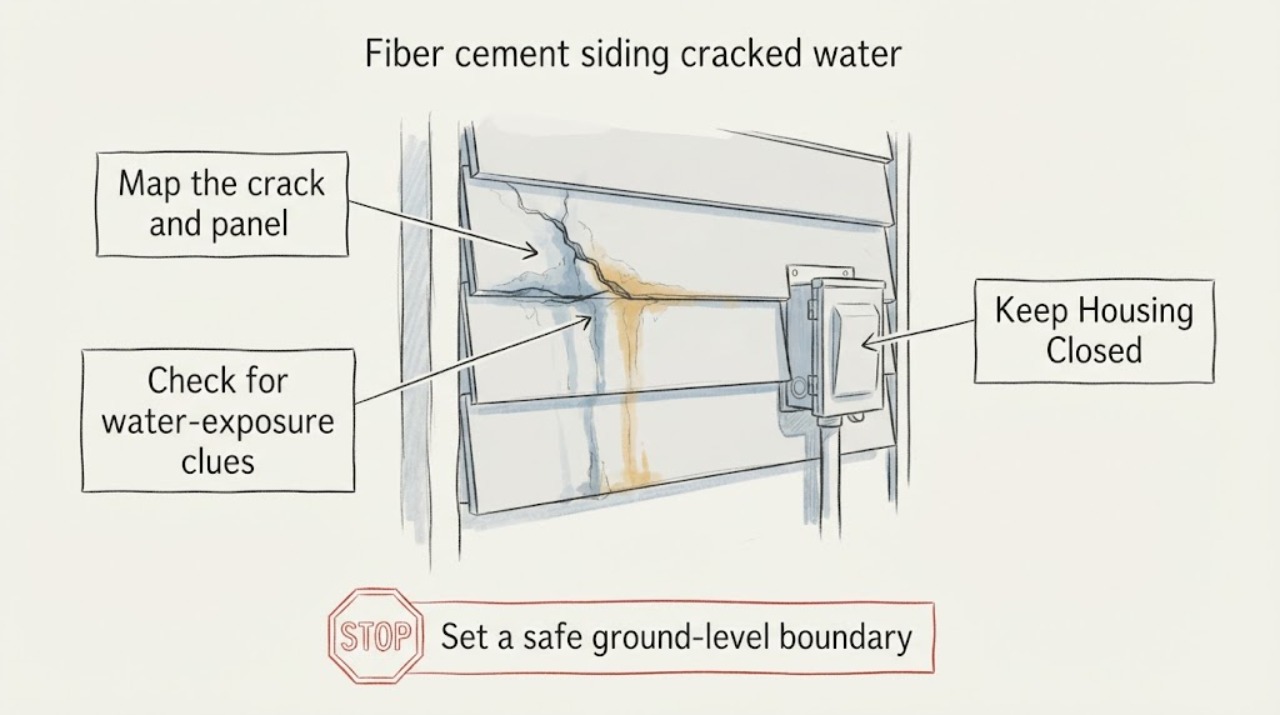
Set a safe ground-level boundary
Look at the panel from ground level without climbing, cutting, sanding, pressure-washing, or removing trim.
Expected result: The panel is safely visible, or access would require a ladder or dust-producing work.
Next step: Keep people clear and photograph the visible area.
Stop if: Stop if access requires a ladder or the panel is shedding dust.
Why this matters
Why: Safe observation can document damage; access beyond that is professional siding work.
-
Map the crack and panel edge
Photograph the crack, joints, corners, and edges. Note whether it stays in one panel, reaches a joint, or extends behind trim.
Expected result: The crack is isolated, crosses a joint, or its extent is hidden.
Next step: Record location and provide photos to siding service.
Stop if: Stop if mapping needs panel removal or probing.
Why this matters
Why: An isolated surface crack may have a limited repair path; a joint/hidden crack can involve movement or flashing.
-
Check for water-exposure clues
Inspect visible caulk, flashing, staining, swelling, soft edges, peeling finish, and dampness without opening the wall.
Expected result: The area is dry, or water/damage is present or recurs.
Next step: Protect the area from more water and request assessment.
Stop if: Stop for wet sheathing, mold, soft material, or active water.
Why this matters
Why: Water signs require finding the entry path before patching; dry conditions make a small cosmetic repair more plausible.
-
Compare nearby panels
From a safe stance, compare nearby panel alignment, gaps, fasteners, and repeated cracks without touching or loading the siding.
Expected result: Only one panel is affected, or a repeated pattern/misalignment is visible.
Next step: Document the pattern and request a siding professional.
Stop if: Stop if comparison requires moving panels or climbing.
Why this matters
Why: Repeated damage or misalignment suggests movement or installation/wall concerns rather than one patch.
-
Prepare the siding handoff
Provide photos, panel profile/finish, crack pattern, water clues, and any storm, impact, or remodel history.
Expected result: The record separates surface damage from water or wall concerns, or remains uncertain.
Next step: Request service before permanent patching.
Stop if: Stop when cutting, sanding, ladder access, or panel removal is needed.
Why this matters
Why: A clear record helps select compatible repair materials and inspection scope.
Use your observations
Decision map
Find the observation that best matches what you see, then follow the next safe action.
-
PATH 01Safety boundary
What you see
Small isolated crack, dry panel, and no movement.
Do this next
Ask whether a compatible cementitious patch is suitable after professional confirmation.
Why this path and its safety boundary
Safety stop: Do not patch a wet, moving, or edge-damaged panel.
-
PATH 02Safety boundary
What you see
Staining, swelling, soft edges, or recurring wetness.
Do this next
Request water-entry and wall assessment before surface repair.
Why this path and its safety boundary
Safety stop: Do not caulk over wet or deteriorated material.
-
PATH 03Safety boundary
What you see
Cracks repeat or cross joints/panels.
Do this next
Request siding and wall-envelope inspection.
Why this path and its safety boundary
Safety stop: Do not sand, cut, or remove panels.
-
PATH 04Safety boundary
What you see
Access or dust risk is present.
Do this next
Keep ground-level boundary and request trained siding service.
Why this path and its safety boundary
Safety stop: No ladder or dust-producing work.
-
PATH 05Safety boundary
What you see
Extent or material is uncertain.
Do this next
Provide photos and request diagnosis before ordering parts.
Why this path and its safety boundary
Safety stop: Do not choose material by color alone.
Helpful context
Understand the symptom
Treat the crack and water path separately
A crack can be impact damage, movement, fastening/installation stress, or a sign that water is entering at an edge or joint. Covering it cosmetically does not establish that the wall behind is dry.
Use ground-level observation only. Do not disturb dusty fiber-cement, cut or sand the panel, use a ladder, or remove trim and flashing; these tasks can release dust or expose the weather barrier.
Use the observations to choose the next step
James Hardie describes small cracks, chips, and dents as potentially repairable with a cementitious patching compound and recommends inspecting caulk at siding edges. Its guidance also emphasizes that product and climate details matter, so the panel type and water path must be identified first.
Prepare a clear service handoff
Photograph the condition, record the model or location, note when it started and what changed, and give those observations to the appropriate professional. Do not guess at a part or permanent repair until the cause and fit are confirmed.
Safety boundary
Stop conditions
- Do not climb, use a ladder, cut, sand, pressure-wash, or remove fiber-cement siding.
- Do not patch or paint over wet, soft, moldy, or moving material.
- Water entry, repeated cracking, soft edges, or hidden extent requires professional assessment.
- Protect people from dust and falling pieces and keep the area undisturbed.
Only after diagnosis
Potential parts
- exterior caulk
Relevant only for a confirmed fixed joint or failed perimeter seal after water entry is ruled out.
Match the substrate, joint, and manufacturer guidance; do not caulk over a moving or wet crack. - siding touch-up paint
Relevant only after sound, dry siding is repaired and the finish is confirmed.
Match the finish and color system; paint does not restore a cracked or water-damaged panel.
When checks do not resolve it
Need a professional?
Request siding service for cracks through a panel, repeated or spreading cracks, soft/swollen edges, failed caulk/flashing, staining, or any uncertainty about water behind the siding.
Safety scope: The self-check is visual only. Siding professionals handle ladder/access, dust-controlled cutting, panel removal, flashing, weather barrier, sheathing, and water-intrusion repair.
Common questions
FAQ
Can I patch a small crack in fiber-cement siding?
A small isolated crack may be eligible for a compatible cementitious patch after the panel is confirmed dry and sound. Do not patch if the crack moves, repeats, reaches an edge, or hides water damage.
Does water exposure mean the whole wall needs replacement?
Not necessarily. First identify the water path and inspect the panel, joints, flashing, and wall materials. A surface patch cannot prove that the wall behind is dry.
Can I pressure-wash cracked siding?
No. Avoid pressure washing, cutting, and sanding. Keep the area protected and request siding assessment, especially if the crack or finish is open to water.
Is fiber-cement siding repair safe from a ladder?
Do not use a ladder for this check. Access, dust control, panel removal, and flashing work should be handled by a trained siding professional.
Read the exact guide
Official sources
- Frequently Asked QuestionsJames Hardie · Supports conditional small-crack patching, caulk-edge inspection, water resistance, and product-specific care.
Community feedback
Share a repair observation
Share a plain-text repair observation. Accepted observations are published automatically; this page may take a moment to update.