
On this page
Start here
Quick answer
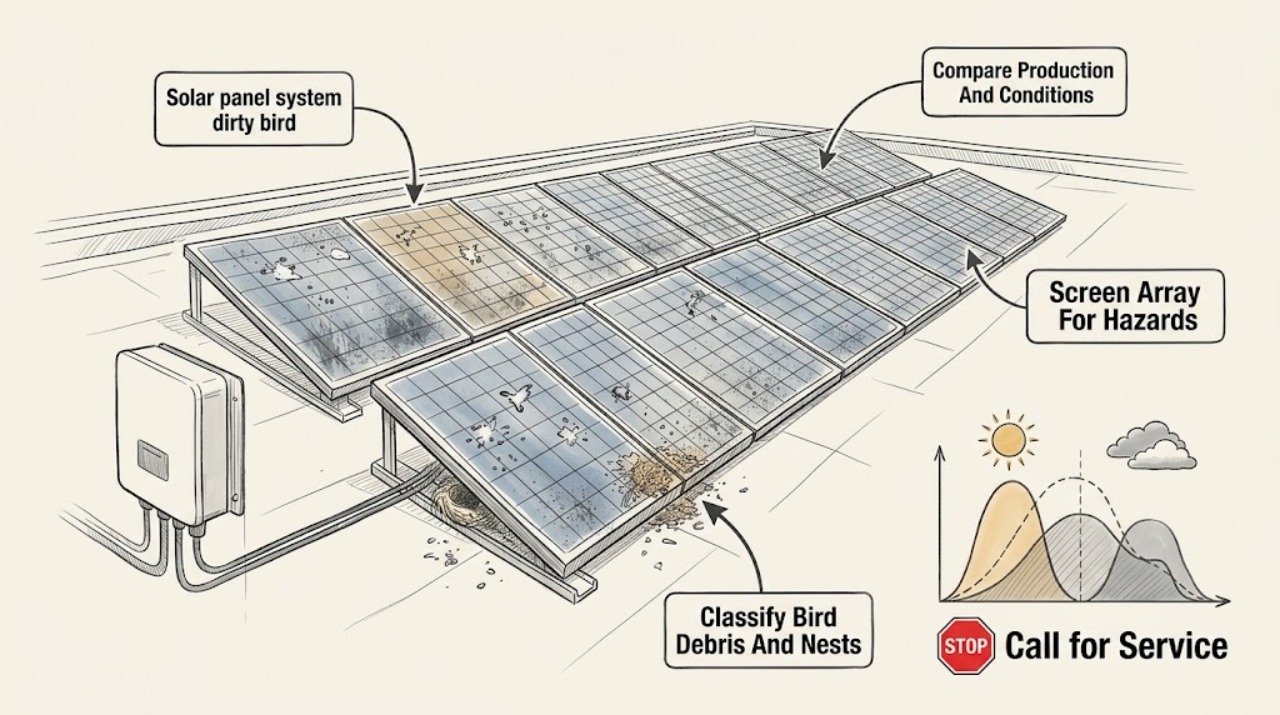
Bird droppings and nesting debris can shade the glass and reduce solar production, but a dirty panel is not automatically a failed panel or inverter. First check the system from the ground for cracked glass, loose or exposed wiring, a displaced module, nest material, and signs of heat or storm damage; compare production with recent weather and shade rather than relying on one cloudy-day reading. Never stand on panels, walk a roof, touch wiring, move a nest, or assume that opening one disconnect makes every module safe in sunlight. If the modules are intact and a ground-level rinse is explicitly allowed by the installed system’s instructions, clean only cool glass with the manufacturer-approved method; do not spray wiring or the underside, use high pressure or abrasive tools, or reach from a ladder. Excessive bird debris, roof access, damaged equipment, persistent output loss, or recurring nests belongs with a qualified solar service provider, with wildlife-safe prevention coordinated when needed.
Before you begin
Safety first
- This article supports non-contact ground-level observation and only a manufacturer-authorized, ground-level glass-cleaning decision. A qualified professional must handle roof access, module removal, wiring, connectors, inverter and disconnect work, mounting, nests, wildlife, damaged glass, and prevention hardware.
Work through in order
Diagnostic checks
Use only checks that match the exact appliance or system and its official guide.
-
Check 1
From the ground or another secure non-roof location, inspect the array visually for cracked or shattered glass, a lifted or displaced module, exposed or hanging conductors, scorch marks, water intrusion, or a damaged inverter enclosure; do not touch the array, wiring, or enclosure.
Expected result: The modules and visible wiring look intact, or there is cracked glass, exposed wiring, a displaced module, scorching, water in equipment, or storm damage.
Next step: Keep people away from a damaged area and contact a qualified solar professional; use the system owner’s emergency guidance rather than touching disconnects or attempting a repair. If the array appears intact, continue with non-contact observations.
Stop if: Stop immediately for cracked glass, exposed conductors, smoke, burning odor, water inside electrical equipment, loose modules, or anything that could fall.
Why this matters
Why: Intact modules permit only a cautious cleaning decision if access is also safe. Damage or exposed electrical parts can create shock, fire, or falling-object hazards and must not be treated as ordinary bird debris.
-
Check 2
From a safe viewing position, document whether the material is isolated droppings on the glass, broad dried soiling, leaves, feathers, active birds, or a nest under or between modules; do not disturb wildlife or reach beneath a panel.
Expected result: Only a few spots are on the glass, droppings cover multiple modules, material is packed below the array, birds are actively nesting, or there is no bird debris despite the reported output change.
Next step: Photograph the pattern and arrange solar cleaning or service for broad buildup, nests, or roof-mounted access. If no debris is visible, compare production and system alerts before cleaning anything.
Stop if: Do not remove nests, chase birds, use spikes or netting as a quick fix, or reach into gaps between modules.
Why this matters
Why: A small glass deposit may be handled by an approved ground-level cleaning method if every safety condition is met. Broad buildup or debris under the array raises the need for professional access and wildlife-safe handling. No visible bird debris makes shade, weather, monitoring, or an electrical issue more likely.
-
Check 3
Review the monitoring app or production meter and record comparable readings, weather, nearby shade, and the date the bird debris appeared; do not reset an inverter repeatedly to make a low reading disappear.
Expected result: Output fell when debris accumulated, output varies with clouds or new shade, the inverter shows an alert or the system is offline, or output is normal despite visible debris.
Next step: Use the pattern to choose cleaning versus service. Save screenshots and alert text for a technician, and do not cycle power as a substitute for an electrical inspection when the system trips or remains offline.
Stop if: Stop using the system as a troubleshooting experiment if there is an electrical alert with damage, smoke, burning odor, water intrusion, or unexplained repeated tripping.
Why this matters
Why: A change that tracks visible soiling makes cleaning worth evaluating, but it does not prove all lost production is from bird debris. Weather or shade can explain a variable reading, while an inverter alert or offline system needs electrical diagnosis. Normal output means cleaning may be cosmetic or preventive rather than urgent.
-
Check 4
Read the installed system and module instructions and decide whether a ground-level rinse of the glass is permitted; proceed only when the modules are cool, intact, reachable without a roof or ladder hazard, and the method keeps water away from wiring and the underside.
Expected result: The instructions allow a ground-level glass rinse and the array is cool and intact, the modules are hot or wet, the system instructions are unavailable, or cleaning requires roof access or reaching below modules.
Next step: If all conditions are satisfied, use only the installed system’s approved method and stop if debris does not release easily. Otherwise schedule a qualified solar cleaning provider and provide the debris photos and access constraints.
Stop if: Do not climb, walk, kneel, lean on, or place tools on panels; do not clean hot modules, damaged modules, wiring, junction areas, or the underside.
Why this matters
Why: A permitted, cool, intact, ground-level glass rinse can be a limited maintenance option. Heat, uncertain instructions, damaged modules, or elevated access changes this into a professional cleaning or inspection job; a system-specific manual takes priority over generic advice.
-
Check 5
If the system instructions permit the ground-level task and the modules are cool, use only clean ambient-temperature water and any soft, non-abrasive tool explicitly allowed by the manufacturer; let the surface release debris without scraping, force, or pressure.
Expected result: Droppings rinse away, residue needs light approved wiping, grit or dried material resists removal, water reaches wiring or beneath a module, or glass becomes scratched or cracked.
Next step: Stop for resistant debris or any damage and call a qualified solar cleaner or installer. If the glass is clean and intact, allow it to dry naturally and compare production under similar conditions later.
Stop if: Never use a pressure washer, steam, blade, metal sponge, abrasive cleaner, harsh chemical, or improvised tool; do not spray the underside, wiring, connectors, or inverter.
Why this matters
Why: Loose contamination can be removed without identifying a failed component. Resistant material, grit, access below the glass, or any surface damage increases the chance of module or system damage and is not a reason to use stronger pressure or chemicals.
-
Check 6
After an approved cleaning or professional visit, record the same production indicators again under comparable sunlight and note whether new droppings or nest material returns; do not open equipment or repeat cleaning on a damaged array.
Expected result: Output improves with comparable sunlight, output does not change, a system alert remains, or debris returns quickly beneath or around the array.
Next step: Give the before-and-after records to a qualified solar service provider if performance does not improve or alerts persist. For recurring birds, ask the installer and an appropriate wildlife professional for a non-shading, warranty-compatible prevention plan.
Stop if: Do not repeatedly reset a faulted system, add deterrents that contact or shade modules, or keep cleaning when birds, loose parts, or access hazards are present.
Why this matters
Why: An improvement supports soiling as one contributor but does not prove it was the only one. No improvement or a continuing alert shifts attention to shade, monitoring, inverter, wiring, module, or grid causes. Rapid recurrence calls for prevention planning rather than repeated risky access.
Use your observations
Decision map
Find the observation that best matches what you see, then follow the next safe action.
-
PATH 01Next step
What you see
The array is intact, debris is confined to the glass, production change tracks the buildup, the modules are cool, and the installed instructions permit a ground-level method without roof or ladder access.
Do this next
Use only the approved non-abrasive glass method, or hire a solar cleaning provider if the reach or access is not unquestionably safe. Compare production afterward under similar conditions.
Why this path and its safety boundary
Why it matters: Bird soiling is a plausible contributor and limited manufacturer-approved cleaning may be reasonable; it is not evidence that the inverter or modules have failed.
-
PATH 02Next step
What you see
Multiple modules are covered, debris is packed beneath the array, active birds or nests are present, or cleaning requires roof access or reaching between modules.
Do this next
Arrange a qualified solar cleaning or O&M visit and request a wildlife-safe prevention assessment. Keep people off the roof and do not pull nests or attach deterrents yourself.
Why this path and its safety boundary
Why it matters: This is a solar maintenance and wildlife-handling problem, not a safe household wash. Access, wiring, mounting, wildlife, and warranty concerns can coexist.
-
PATH 03Next step
What you see
Bird residue is visible, but production is normal for comparable sunlight and no cracks, alerts, exposed wiring, or mounting damage are visible.
Do this next
Monitor the pattern and schedule safe cleaning when it is justified by visible buildup or the system maintenance plan. Do not create a roof hazard to remove isolated spots.
Why this path and its safety boundary
Why it matters: The soiling may not be causing a material performance problem yet, and cleaning urgency depends on access, local conditions, and the system instructions.
-
PATH 04Next step
What you see
Output remains low after permitted cleaning, the modules look clean, or the inverter shows an alert, repeated trip, offline status, or an unexplained production change.
Do this next
Stop repeated resets and arrange qualified solar electrical service. Provide production history, weather, alert text, and before-and-after cleaning records; do not open enclosures or disconnect wiring.
Why this path and its safety boundary
Why it matters: Shade, weather, monitoring, inverter, wiring, module, or grid issues become more likely than surface bird debris; cleaning cannot diagnose energized equipment.
-
PATH 05Next step
What you see
Glass is cracked, a module or mount is displaced, wiring is exposed, equipment is wet or scorched, there is smoke or a burning odor, or the roof and access route are unsafe.
Do this next
Keep clear, prevent access to the affected area, and contact qualified solar and emergency professionals as appropriate. Follow the site-specific emergency procedure; do not touch or attempt to render the array safe yourself.
Why this path and its safety boundary
Why it matters: The immediate issue is physical or electrical safety, not dirt removal. PV modules can remain energized in sunlight even when the home appears to be switched off.
Helpful context
Understand the symptom
Confirm that debris is the problem before chasing a power loss
Bird droppings are visible soiling, but production also changes with cloud cover, shade, temperature, seasonal sunlight, system age, and inverter or electrical faults. A single low reading cannot isolate dirt. Record a comparable clear-day reading in the monitoring app, note which modules are affected, and compare the timing of the buildup with the output change. If the panels look clean but production remains low or the inverter reports a fault, treat that as a system diagnosis rather than a cleaning task.
Cleaning is limited by heat, access, and electrical exposure
PV modules can still produce current in sunlight, and a damaged or wet module increases shock risk. Manufacturer cleaning guidance calls for inspecting for cracks and loose connections first, working only when modules are cool, avoiding pressure and abrasive contact, and keeping water away from wiring and areas beneath the modules. A roof-mounted array is not a safe place for an improvised ladder, hose, or brush. Ground-level access or a qualified cleaning crew is the appropriate boundary.
Bird nests require a separate decision
A dropping on the glass is a cleaning issue; nesting beneath an array can involve cables, mounting clearances, live wildlife, and roof access. Do not pull a nest, push debris under a panel, install a barrier that shades modules, or alter the array without an installer’s assessment. Ask a solar professional about a wildlife-safe, non-shading prevention approach that preserves the system’s mounting, airflow, warranty, and local requirements.
Safety boundary
Stop conditions
- Never stand on, walk on, kneel on, lean on, or place tools on a solar panel; do not climb a roof or ladder for cleaning or inspection.
- Do not touch module wiring, connectors, junction areas, equipment interiors, or the underside, and do not assume that a single switch makes panels safe in sunlight.
- Do not clean cracked, shattered, displaced, wet, or scorched modules, and stop for exposed conductors, smoke, burning odor, or water in electrical equipment.
- Do not use pressure washers, steam, blades, metal or abrasive tools, harsh chemicals, or improvised detergents; never force dried bird debris off the glass.
- Do not remove active nests, handle wildlife, attach bird barriers, or alter array mounting and ventilation without qualified solar and wildlife guidance.
Only after diagnosis
Potential parts
- manufacturer-approved non-abrasive cleaning tool
Consider this category only when the installed module instructions allow ground-level cleaning, the panels are intact and cool, and the tool can reach the glass without a roof or ladder hazard.
Confirm the module manufacturer’s cleaning instructions and avoid pressure, metal, abrasive, or unapproved chemical contact; a tool is not a substitute for safe access or professional service. - wildlife-safe bird exclusion or prevention hardware
Consider this category only after a qualified solar and wildlife assessment confirms recurring nesting and selects a prevention method that does not shade, damage, or obstruct the array.
The installer must confirm mounting, cable, airflow, fire, wildlife, local, and warranty requirements for the exact array; do not attach generic netting, spikes, or barriers yourself. - solar module or module-level component
Consider replacement only if qualified inspection finds cracked glass, a failed module, or damaged module-level equipment that cannot remain safely in service.
Confirm exact electrical, mechanical, connector, and warranty compatibility with the installer or manufacturer; never order a replacement from visible bird debris or a low reading alone.
When checks do not resolve it
Need a professional?
Arrange qualified solar cleaning or O&M service when bird debris covers multiple modules, cleaning requires roof or ladder access, nests are beneath the array, the modules are hot or damaged, or the manufacturer’s cleaning procedure is unavailable. Request qualified solar electrical service when production remains low after safe cleaning, the inverter shows an alert or repeated trip, wiring or mounting looks damaged, or water has reached equipment. Treat smoke, burning odor, exposed conductors, cracked modules, loose modules overhead, or a dangerous roof as an urgent safety situation.
Safety scope: This article supports non-contact ground-level observation and only a manufacturer-authorized, ground-level glass-cleaning decision. A qualified professional must handle roof access, module removal, wiring, connectors, inverter and disconnect work, mounting, nests, wildlife, damaged glass, and prevention hardware.
Common questions
FAQ
Can bird droppings reduce solar panel output?
Yes, droppings and other soiling can block light on part of the glass and contribute to lower production. The size of the effect varies with coverage, weather, shade, system design, and monitoring conditions, so compare similar sunlight before blaming dirt for all of the loss.
Can I hose bird droppings off from the ground?
Only if the installed system’s instructions explicitly allow it, the modules are intact and cool, and the hose can reach from a secure ground-level position without spraying wiring or the underside. Do not use pressure, climb, or improvise a tool; hire a qualified cleaner when access or debris is uncertain.
Should I clean a solar panel when it is hot?
No. Manufacturer guidance warns that hot modules and cool water can create thermal stress, and sunlight can keep the system electrically active. Wait for the conditions and method specified by the installed system instructions, or use a qualified cleaning provider.
What should I do about a bird nest under solar panels?
Do not reach under the modules or remove the nest yourself. It may involve live wiring, sharp mounting parts, birds or eggs, and roof access. Arrange a qualified solar inspection and coordinate a lawful, wildlife-safe prevention plan that does not shade or damage the array.
Why is production still low after I cleaned the panels?
Clouds, shade, monitoring errors, inverter or wiring faults, module damage, and grid conditions can all affect production. Save before-and-after readings and any alerts, stop repeatedly resetting the system, and have a qualified solar provider diagnose it without opening energized equipment.
When is dirty solar equipment an emergency?
Treat cracked or displaced modules, exposed conductors, smoke, burning odor, wet electrical equipment, falling parts, or an unsafe roof as urgent—not as a cleaning job. Keep clear and contact appropriate solar, electrical, or emergency professionals from a safe location.
Read the exact guide
Official sources
- Life Cycle of Photovoltaic Systems: Operate and Maintain an Existing Photovoltaic SystemU.S. Department of Energy Federal Energy Management Program · General photovoltaic operations and maintenance guidance; system owners should follow their installed equipment manuals and qualified service plan.
- Solar Operations and Maintenance Resources for Plant OperatorsU.S. Department of Energy · General PV operations and maintenance overview; residential owners should adapt it through qualified providers and equipment-specific instructions.
- REC Guide to Best Practice – Panel CleaningREC Group · Product-specific guidance for REC panels; other manufacturers’ instructions may differ and take priority for their modules.
- Solar Panels with Powerwall Owner's ManualTesla · Product-specific guidance for Tesla solar panel systems; the installed system’s own manual and service requirements control.
Community feedback
Share a repair observation
Share a plain-text repair observation. Accepted observations are published automatically; this page may take a moment to update.