
On this page
Start here
Quick answer
Dust on a solar-panel system is a soiling condition that can reduce sunlight reaching the modules, but a dirty-looking surface does not prove it is the main cause of low production. First compare the visible dust pattern with the system's production trend under similar sunlight and check the inverter or monitoring status without opening electrical equipment. Note whether the dust is loose, baked on, mixed with pollen or bird residue, or repeatedly returning from nearby construction, farming, roads, or industrial activity. Do not climb onto a roof, walk on modules, spray electrical equipment, use abrasive tools or solvents, or disconnect energized wiring. If the array is ground-mounted and safely reachable, follow the module maker's cleaning instructions; otherwise use a qualified solar O&M provider, especially when production remains low after safe cleaning, modules are cracked, wiring or racking is damaged, or the work needs roof access.
Before you begin
Safety first
- Do not climb onto a roof or carport, walk on modules, handle exposed wiring or connectors, open inverters or combiner boxes, pressure-wash, use abrasive tools or solvents, spray electrical equipment, or keep resetting an inverter fault. Keep people away from loose or damaged modules and let qualified personnel isolate and test the system.
Work through in order
Diagnostic checks
Use only checks that match the exact appliance or system and its official guide.
-
Check 1
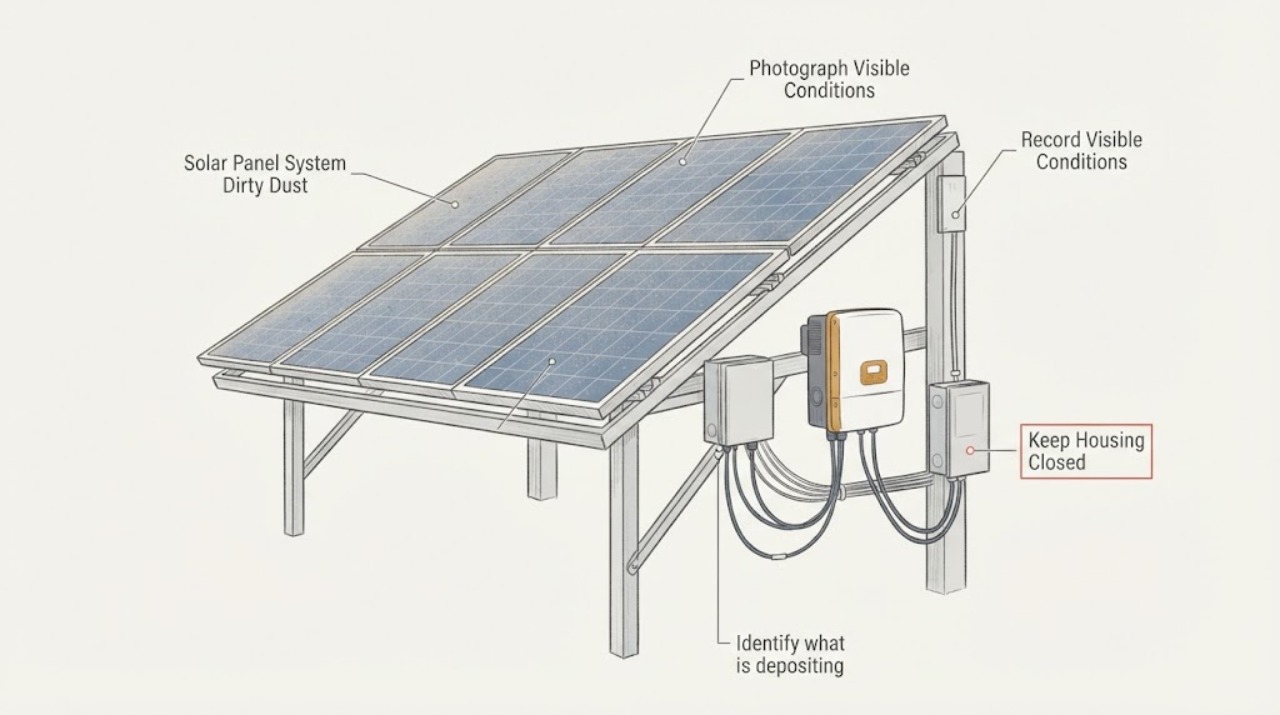
Look at the modules from the ground or another ordinary safe position and photograph the array without touching it. Compare the dust coverage across rows and note whether it is an even film, streaks below the frame, patches, bird residue, pollen, construction dust, or a hard-looking deposit.
Expected result: Soiling is uniform across the array; only a row or portion is dirty; the lower edges have streaks or deposits; or the surface shows cracks, chips, delamination, or other damage rather than dust alone.
Next step: Record the pattern and keep the photographs for comparison after rain or approved cleaning. Stop and arrange service for cracked, loose, visibly damaged, or electrically exposed components; do not touch the module or wiring to confirm it.
Stop if: Stop the inspection if a roof, ladder, elevated platform, unstable ground, overhead hazard, exposed conductor, broken glass, or loose module is involved.
Why this matters
Why: Uniform soiling can affect the whole array, while a localized pattern may point to shade, runoff, nearby debris, or a row-specific condition. Damage or delamination is not a cleaning problem and can require inspection even if the surface also looks dirty.
-
Check 2
Review the inverter display or monitoring portal from its normal user interface and compare recent daily output with days having similar sunlight, temperature, and shading. Record any offline state, warning, nuisance trip, or missing data; do not open the inverter or electrical enclosure.
Expected result: Output fell as dust accumulated while the inverter remains available; output is low but soiling is light; the system is offline or repeatedly tripping; or the monitoring data is incomplete.
Next step: Save the dates, screenshots, weather context, and warnings. Ask a qualified solar provider to test the system when it is offline, repeatedly tripping, or still underperforming after safe, approved cleaning.
Why this matters
Why: A matching soiling and production trend makes cleaning worth evaluating, but it does not prove the modules are the only loss. An offline, tripping, or poorly measured system needs an electrical or monitoring diagnosis before a wash is treated as the fix.
-
Check 3
Identify what is depositing the dust and how often it returns: nearby tilling or harvest, construction, unpaved roads, industrial exhaust, pollen, ash, bird activity, or long dry weather. Note whether normal rain removes the film or leaves streaks and concentrated deposits.
Expected result: The surface becomes dirty after a repeatable local event; rain normally clears it; rain leaves a residue; or the source is persistent and concentrated near one edge or row.
Next step: Document the source and recurrence, and coordinate any cleaning schedule with the system's maintenance plan. Do not spray agricultural chemicals or other treatments onto the modules, and do not use a cleaning chemical unless the module documentation and qualified provider approve it.
Why this matters
Why: The local source and rain cycle determine whether occasional cleaning, source reduction, or a planned O&M schedule is sensible. Streaks or concentrated residue can remain after rain and may need a module-compatible service method; recurring dust may make one cleaning only temporary.
-
Check 4
Determine whether the array can be reached for inspection or cleaning without climbing, walking on the modules, moving a ladder against the system, or reaching over electrical equipment. For a safely reachable ground-mounted array only, check the owner and module instructions for an approved cleaning method and note whether water quality, temperature, brushes, or detergents are restricted.
Expected result: The modules are safely reachable from ground level and the instructions permit a simple method; the array is on a roof or elevated structure; the instructions are missing; or the modules are hot, damaged, or near exposed electrical equipment.
Next step: Use only the documented method for a safely accessible array, or arrange qualified solar cleaning/O&M service. Never improvise with abrasive tools, solvents, high-pressure water, or a roof climb.
Stop if: Stop before cleaning if access is elevated, the surface is damaged, wiring or connectors are exposed, water could reach electrical equipment, or the module instructions cannot be confirmed.
Why this matters
Why: A manufacturer-approved, low-risk method may be suitable for an accessible array. An elevated, damaged, hot, electrically exposed, or undocumented system needs qualified service because an improvised cleaning method can cause falls, thermal shock, surface damage, or electrical risk.
-
Check 5
After normal rain or an approved cleaning service, compare the same module photographs and the production trend under comparable sunlight. Check whether the dust film is gone, whether streaks remain, and whether output or inverter behavior changed; do not repeatedly restart an inverter to force a result.
Expected result: The surface is clear and output improves; the surface is clear but output remains low; residue remains; or the inverter still reports a fault or stays offline.
Next step: Keep the before-and-after records and ask a qualified provider for electrical and performance testing when cleaning does not resolve the loss or a fault remains. Do not keep cycling the system or dismantle equipment.
Why this matters
Why: Improved output after the surface clears supports soiling as a contributor. No improvement with a clean surface makes shading, inverter, wiring, module, weather, or monitoring causes more likely. Remaining residue or a persistent system fault needs a different service scope than routine dust removal.
Use your observations
Decision map
Find the observation that best matches what you see, then follow the next safe action.
-
PATH 01Next step
What you see
Dust covers most modules in a similar pattern, the system remains online, and production declined during the same dry or dusty period.
Do this next
Use the system's monitoring history and approved maintenance plan to schedule cleaning only when it is safe and worthwhile. Compare production after the surface is clear rather than assuming a fixed cleaning interval.
Why this path and its safety boundary
Why it matters: Soiling is a credible contributor to the loss, but the size of the effect depends on local conditions and cannot be inferred from appearance alone.
-
PATH 02Next step
What you see
Only one row or edge has dust, streaks, bird residue, pollen, or a hard deposit, while neighboring modules remain relatively clear.
Do this next
Photograph the pattern, identify the source, and use a module-approved cleaning or inspection method from safe access. Arrange service if the deposit is bonded, the module is damaged, or the source keeps returning.
Why this path and its safety boundary
Why it matters: A local runoff, shading, deposition, or nearby source is more likely than uniform array soiling. The localized condition may also hide damage or a drainage issue.
-
PATH 03Next step
What you see
The modules are visibly clean after rain or approved cleaning, but production remains low or the inverter monitoring still reports a fault.
Do this next
Stop cleaning as the sole remedy and arrange qualified PV performance and electrical testing. Keep the before-and-after production records and do not open or reset equipment repeatedly.
Why this path and its safety boundary
Why it matters: Dust is unlikely to be the only cause. Shade, inverter availability, wiring, module degradation or damage, weather, and measurement problems need consideration.
-
PATH 04Next step
What you see
The panels are on a roof or carport, access requires climbing, a module or cable is damaged, or water could reach electrical equipment.
Do this next
Keep people away from the area, do not touch or wash the system, and arrange qualified solar O&M or electrical service for inspection and safe isolation.
Why this path and its safety boundary
Why it matters: The immediate issue is physical or electrical safety, not routine dust removal. Cleaning can wait until the array is inspected and made safe.
-
PATH 05Next step
What you see
The array becomes dusty again after nearby construction, farming, unpaved-road activity, pollen, ash, industrial activity, or a predictable dry season.
Do this next
Ask the O&M provider to record the soiling source and set a condition-based inspection plan. Do not apply unapproved coatings or chemicals to prevent dust without module and provider approval.
Why this path and its safety boundary
Why it matters: A one-time wash may provide only short-lived improvement. Source reduction, timing around the event, and a documented O&M schedule may matter more than repeated unscheduled cleaning.
Helpful context
Understand the symptom
Dust is a performance clue, not a complete diagnosis
A layer of airborne dust can reduce the light reaching a photovoltaic module. The impact varies with the amount and type of soiling, rain, season, tilt, local dust sources, and the system's operating condition. A production drop can also come from shade, inverter status, wiring, module damage, weather, or monitoring errors. Use the dust observation together with a performance trend and the inverter status before deciding that cleaning alone will restore output.
Keep cleaning outside the electrical and fall hazard zone
The checks below are visual and monitoring-based. Use ground-level access where possible and never step on a module or use a roof array as a walkway. Do not open combiner boxes or inverters, handle connectors, disconnect wiring, pressure-wash modules, scrub with abrasive materials, apply solvents, or climb a roof to reach dust. If safe cleaning is not possible from the ground or the system is damaged, use a qualified solar O&M provider.
Only after diagnosis
Potential parts
- module-compatible cleaning consumable
Consider this category only when the module instructions permit owner cleaning, the array is safely reachable without climbing, and the deposit is confirmed as removable surface soiling.
Confirm the module maker's permitted water, detergent, tool, and temperature requirements. Do not assume a household cleaner, abrasive pad, solvent, or pressure washer is compatible. - soiling or performance-monitoring sensor
Consider this category only for a larger or repeatedly soiled system where the O&M provider determines that measuring soiling and clean reference output would improve the cleaning decision.
Confirm the monitoring platform, electrical design, communications, mounting, and provider integration before selecting equipment. A sensor cannot replace inspection of a low-producing system.
When checks do not resolve it
Need a professional?
Stop and arrange qualified solar O&M service for rooftop or elevated cleaning, cracked or loose modules, exposed wiring, water near electrical equipment, inverter faults or repeated trips, storm or fire damage, or output that remains low after approved cleaning. Do not walk on modules, pressure-wash, use abrasives or solvents, or open electrical equipment to investigate dust.
Safety scope: Do not climb onto a roof or carport, walk on modules, handle exposed wiring or connectors, open inverters or combiner boxes, pressure-wash, use abrasive tools or solvents, spray electrical equipment, or keep resetting an inverter fault. Keep people away from loose or damaged modules and let qualified personnel isolate and test the system.
Common questions
FAQ
Can dust on solar panels lower their output?
Yes, dust and other soiling can block part of the light reaching photovoltaic modules and reduce generation. The effect varies with the deposit, rain, local dust source, weather, and system condition, so compare the visible pattern with monitoring data rather than assuming any fixed loss.
Should I clean rooftop solar panels myself?
Not if cleaning requires a roof, ladder, walking on modules, touching wiring, or working near electrical equipment. For a ground-mounted array that is safely reachable, follow the owner and module instructions exactly; otherwise use qualified solar O&M service and avoid improvised brushes, solvents, or pressure washing.
How often should a dusty solar system be cleaned?
There is no universal interval. DOE guidance ties soiling and cleaning needs to local dust sources, rain, pollen, construction, agriculture, and other site conditions. Track the array and production, then use an O&M plan to clean when the expected performance benefit justifies safe service.
What if the panels are clean but power is still low?
A clean surface makes dust less likely to be the only cause. Check the inverter and monitoring history and arrange qualified performance and electrical testing for shade, wiring, module damage, inverter availability, weather, or measurement problems. Do not repeatedly reset the system to force output.
What cleaning products are safe for solar modules?
Use only the method stated by the module manufacturer or qualified O&M provider. DOE's cleaning guide describes plain water or mild detergent for applicable PV modules and warns against brushes, solvents, abrasives, and harsh detergents; the array's own instructions control, and elevated work remains a professional boundary.
Read the exact guide
Official sources
- Farmer's Guide to Going SolarU.S. Department of Energy · Official guidance on airborne agricultural dust, pollen, and soiling-dependent generation loss
- Life Cycle of Photovoltaic Systems: Operate and Maintain an Existing Photovoltaic SystemU.S. Department of Energy, Federal Energy Management Program · Official lifecycle guidance for monitoring output, securing damaged arrays, and qualified inspection or testing
- Step 5: Project Operations and MaintenanceU.S. Department of Energy, Office of Indian Energy · Official PV O&M guide for soiling-dependent cleaning and qualified service scope
- Solar Operations and Maintenance Resources for Plant OperatorsU.S. Department of Energy · Official PV O&M guidance for managing soiling and maintaining system performance
Community feedback
Share a repair observation
Share a plain-text repair observation. Accepted observations are published automatically; this page may take a moment to update.