
On this page
Start here
Quick answer
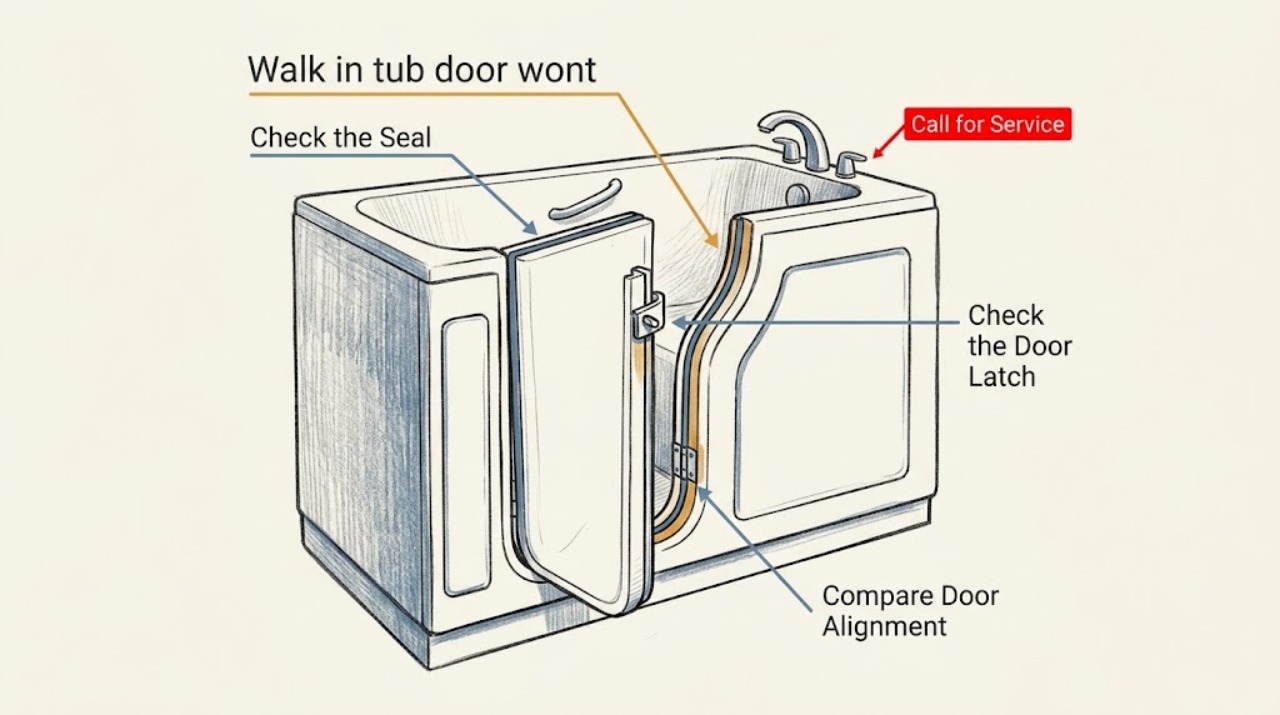
Keep the walk-in tub empty and do not force the door closed. From a stable standing or seated position, inspect the door seal, latch and handle, frame alignment, sill, and visible debris without disassembly. A folded seal, a gap that changes from top to bottom, a latch that does not engage with normal light operation, or a door that drags can prevent a watertight closure. Do not fill the tub, adjust the latch, remove the door, repipe plumbing, or continue using the tub when the door will not securely latch. Arrange qualified walk-in-tub service and provide photos, the tub model, and the exact point where engagement stops.
Work through in order
Diagnostic checks
Use only checks that match the exact appliance or system and its official guide.
-
Inspect the seal for folds, damage, or displacement
With the tub empty and the door open, look along the full visible seal and the mating surface without pulling it out. Note folds, twists, cuts, hardened sections, gaps, trapped hair or grit, water marks, and places where the seal appears to sit outside its channel.
Expected result: A displaced or folded seal can interfere with latch engagement; a cut, hardened, or missing section can prevent a watertight seal even when the handle appears to move. A clean, evenly seated seal shifts attention toward alignment or latch hardware.
Next step: Photograph the seal and the matching door edge. If the manufacturer's instructions permit gentle surface cleaning, use only that instruction; otherwise leave the seal untouched and request service.
Stop if: Stop if the seal is torn, detached, embedded in the frame, or would require removal, adhesive, a tool, force, or entering the tub to reach it. Do not fill the tub to test it.
Why this matters
Why: The seal condition separates a safe visual-cleaning or replacement discussion from a latch or door-alignment service issue. It does not prove that wiping or reseating will restore watertight performance.
-
Observe normal latch and handle engagement with no force
With the tub empty, operate the handle or latch only through its normal light movement described in the owner's manual. Observe whether it reaches its normal end position, whether both sides engage if the design has multiple points, and whether the latch releases normally without forcing or leaning on the door.
Expected result: A handle that stops early, feels loose, or never reaches engagement suggests latch, seal, or alignment trouble. A handle that moves normally while the door remains visibly open or uneven suggests that the receiving point or door position needs professional inspection.
Next step: Record the point where movement stops and whether the door is flush at the latch side. Keep the tub unused and send that description and a photo to qualified walk-in-tub service.
Stop if: Stop immediately if the handle binds, the latch springs unexpectedly, the door shifts, the frame cracks, or normal light operation does not engage. Do not force closure, remove the latch, or adjust hardware.
Why this matters
Why: Manufacturer descriptions treat light, normal handle operation as part of securing the watertight seal. Excess resistance is a stop signal, not a cue to tighten, bend, lubricate, or adjust the mechanism yourself.
-
Compare door alignment and frame gaps
From outside the tub, view the closed-but-unlatched door at the hinge side, latch side, top, and sill. Without pressing on it, note whether the gap is even, the door sits high or low, it rubs the frame, the hinge side appears shifted, or the door edge meets the seal at one corner before another.
Expected result: An uneven gap or corner contact points toward door, hinge, frame, or installation alignment; an even door with a clean alignment but failed engagement points more toward the latch or its receiving hardware. Visual alignment cannot confirm structural support behind the frame.
Next step: Take a straight-on photo and a side photo with no person leaning on the door. Report rubbing, movement, recent work, and whether the issue appeared suddenly or gradually.
Stop if: Do not lift, shim, pry, bend, remove hinges, loosen fasteners, or force the door into alignment. Stop if the frame, surrounding tile, floor, or wall appears loose or cracked.
Why this matters
Why: The pattern tells a technician which area to inspect first without asking the owner to adjust the door. Alignment changes can also follow movement, nearby plumbing work, or a frame issue.
-
Look for visible debris at the sill and latch path
With the door open and the tub empty, look at the sill, seal contact area, latch receiver, and visible frame channel for hair, grit, soap residue, dropped objects, or a piece of seal material. Remove nothing that is sharp, embedded, behind a guard, or attached to the mechanism.
Expected result: Loose surface debris may explain a new, localized obstruction; embedded material, a damaged receiver, or debris behind a guard requires service. A clean path with the same latch failure shifts the diagnosis toward alignment or hardware.
Next step: Photograph the obstruction in place and identify its location. If it is plainly loose and the manual permits safe surface removal, follow that instruction only; otherwise leave it for the technician.
Stop if: Do not scrape, pry, use solvents, remove guards, reach behind the latch, or test by filling the bath. Stop for glass, sharp metal, loose tile, water damage, or any embedded object.
Why this matters
Why: The observation distinguishes a visible no-force obstruction from a door or latch fault without disassembling the water-containment system.
-
Decide whether the tub can remain in service
Answer yes or no: with the tub empty and no force applied, does the door close evenly and latch through its normal light operation while the seal appears continuous and undisturbed?
Expected result: Yes supports following the model's ordinary care instructions; no means keep the tub out of service and arrange qualified repair. A successful empty-door latch does not authorize a fill test if the seal is damaged or the manual requires a specific service check.
Next step: For no, provide the model, photos, latch stopping point, seal condition, alignment pattern, debris location, and any recent installation or plumbing work to a walk-in-tub technician.
Stop if: Do not fill the tub, use it for bathing, force closure, disassemble the latch or seal, modify plumbing, or continue after water leakage or frame movement is observed.
Why this matters
Why: A watertight door cannot be inferred from appearance alone. The no-force result helps prioritize service without exposing the bathroom to a leak or asking the user to adjust safety hardware.
Use your observations
Decision map
Find the observation that best matches what you see, then follow the next safe action.
-
PATH 01Safety boundary
What you see
The seal is folded or displaced, or loose surface debris is visible at the sill or latch path, with no frame movement or sharp hazard.
Do this next
Follow only model-approved surface care instructions and document the condition. If the seal will not sit evenly or the obstruction is embedded, arrange service for seal or latch evaluation.
Why this path and its safety boundary
Safety stop: Do not pull out the seal, use adhesive or solvent, scrape the channel, or fill the tub to test it.
-
PATH 02Safety boundary
What you see
The gap is uneven, the door rubs, the handle stops early, the receiver does not meet the latch, or the door shifts during normal light operation.
Do this next
Keep the tub empty and request qualified walk-in-tub service. Provide straight-on and side photos and describe where engagement stops.
Why this path and its safety boundary
Safety stop: Do not pry, shim, bend, lift, loosen, adjust, or remove the latch, hinges, frame, or seal.
-
PATH 03Safety boundary
What you see
There are water marks, a wet floor, cracked tile, loose wall or floor material, frame movement, or a damaged seal that cannot be verified as watertight.
Do this next
Do not use the tub and request urgent walk-in-tub service; involve plumbing or water-damage professionals if the surrounding building materials are wet.
Why this path and its safety boundary
Safety stop: Do not perform a fill test, open plumbing, remove finishes, or use the tub until the door and surrounding area are assessed.
Helpful context
Understand the symptom
A walk-in tub door is a water-containment safety part
The latch and seal are not just cosmetic trim. Manufacturer information describes a handle or latch that secures a watertight seal, while walk-in-bath warranties commonly identify the door seal as a covered component. A door that will not latch should remain out of service until the cause is identified.
Inspect without adding water or force
The useful checks are visual and low-force: look for folds, debris, uneven gaps, hinge-side movement, and visible latch engagement with the tub empty. Do not try to prove a repair by filling the bath, leaning on the door, forcing a handle, or opening the door assembly.
Model-specific service is appropriate
Door direction, seal design, latch geometry, drain interlocks, and adjustment procedures vary by tub. A qualified technician can use the model information and photos to determine whether the issue is a cleanable obstruction, a seal or latch part, alignment, or a larger installation or plumbing problem.
Only after diagnosis
Potential parts
- tub door latch
Consider a latch only after qualified diagnosis shows that the seal is intact and the latch or receiver fails to engage or hold through normal light operation.
Confirm the tub manufacturer, model, door orientation, latch geometry, and service instructions before ordering; do not assume cross-model fit. - tub door seal
Consider a seal only when the model-specific inspection identifies a cut, hardened, displaced, or missing seal that prevents a watertight closure.
Confirm the exact tub model, seal profile, channel, adhesive or retention method, and installation requirements before ordering or fitting.
When checks do not resolve it
Need a professional?
Call a qualified walk-in-tub technician when the door will not latch, the seal is damaged or displaced, the handle binds, the frame or hinge appears shifted, a latch receiver does not align, debris is embedded, or any water mark or leak is present. Include plumbing or water-damage service if the surrounding floor, wall, or tile is wet.
Have this ready
- Provide the tub manufacturer and model, door orientation if known, photos of the seal, latch, frame gaps, sill, and obstruction, the handle stopping point, recent installation or plumbing work, and whether any water has reached the floor or wall.
Common questions
FAQ
Can I force the walk-in tub door closed if the latch is almost engaged?
No. Keep the tub empty and stop at normal light resistance. Forcing the door can damage the latch or seal and can create a leak risk; arrange qualified service.
Should I fill the tub to see whether the door leaks?
No. A door that does not latch securely should not be tested with water. Photograph the seal, latch, alignment, and sill from outside and request service.
What can make a walk-in tub door fail to latch?
Common observable possibilities include a folded or damaged seal, debris at the sill or receiver, uneven door alignment, latch or handle trouble, or frame movement. Visual observations cannot identify the repair with certainty.
Can I adjust the latch or hinges myself?
Do not adjust, loosen, bend, lift, or remove them. Walk-in-tub door hardware is part of water containment and safe use; have a qualified technician inspect the model-specific mechanism.
Read the exact guide
Official sources
- KOHLER Walk-In Bath Safety FeaturesKohler Co. · Kohler walk-in bath product information; other tub models may use different door and latch designs.
- Limited Warranty Walk-In BathAmerican Standard · American Standard walk-in baths and the warranty terms stated on the page; warranty coverage does not establish fit or repair method for another model.
Community feedback
Share a repair observation
Share a plain-text repair observation. Accepted observations are published automatically; this page may take a moment to update.