
On this page
Start here
Quick answer
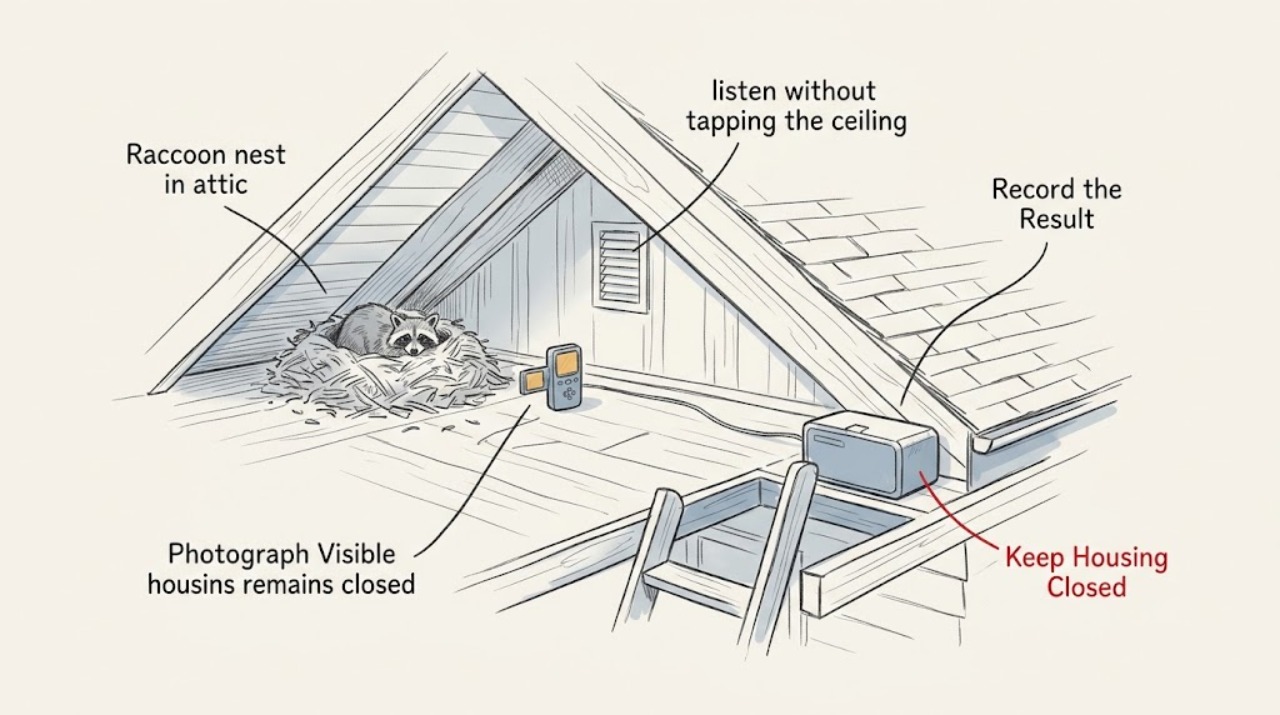
Treat a suspected raccoon nest in an attic as an urgent wildlife-service call, not a DIY attic job. From the living space and from ground level only, record when the noise occurs, where signs appear, and whether a possible entry point or food attractant is visible. Keep people and pets away, do not enter the attic, touch an animal or nest, trap or bait, clean droppings, climb onto the roof, or seal an opening while the den may be occupied. Ask a qualified wildlife professional or local animal-control agency to confirm the species, entry point, and whether kits are present, then handle humane eviction, family reunification, cleanup, and exclusion after the space is confirmed vacant.
Before you begin
Safety first
- The resident should not enter the attic, handle an animal or kit, remove a nest or feces, set a trap, use poison or bait, climb the roof, or seal an opening while occupancy is possible.
Work through in order
Diagnostic checks
Use only checks that match the exact appliance or system and its official guide.
-
Check 1
From the occupied living space, listen without tapping the ceiling or opening an access panel, and note the room, date, and time of scratching, heavy movement, chittering, or repeated thumps.
Expected result: Nighttime movement that starts and stops near one ceiling or wall suggests an animal is using a nearby void, but silence during a short observation does not establish that the den is empty.
Next step: Keep the log and tell the professional whether the activity is isolated to one area, occurs after dark, or includes possible kit vocalizations.
Stop if: Stop observing and leave the area if movement is accompanied by an animal entering the room, aggressive behavior, falling ceiling material, or a strong odor that makes the space unsafe.
Why this matters
Why: Raccoons are commonly more active at night, and a sound log helps the wildlife professional plan a safe inspection without anyone entering the attic.
-
Check 2
From floor level inside the home, look only at accessible surfaces for a new ceiling stain, sag, odor, loose vent cover, or nest material that can be seen without opening anything; take a photo from a safe distance if useful.
Expected result: A localized stain, sag, odor, or visible material can indicate moisture, animal activity, or contamination, while no visible sign does not rule out a den above the ceiling.
Next step: Keep occupants and pets out of the affected area and include the room location and any visible change in the service request; arrange urgent help if the ceiling is wet or deforming.
Stop if: Stop immediately if the ceiling is actively leaking, bulging, shedding material, or if droppings or nest material are within reach; do not touch, sweep, vacuum, or clean it.
Why this matters
Why: The result tells the service provider which room needs protection and whether a water-damage or health-risk concern should be handled along with wildlife removal.
-
Check 3
From the ground, sidewalk, or another stable place, visually scan the roofline, eaves, soffits, chimney cap, and vent screens without climbing, reaching, or using a ladder; photograph only what is visible.
Expected result: A displaced screen, damaged soffit, gap, or repeated animal route can identify a possible access area, but an apparently intact exterior does not exclude a concealed opening.
Next step: Send the location and photos with the request for an on-site inspection; leave any suspected opening alone until occupancy and the presence of kits are professionally assessed.
Stop if: Stop if the observation would require a ladder, roof access, leaning over an edge, moving a cover, or approaching a raccoon.
Why this matters
Why: A ground-level photo gives the professional a starting point and helps prevent a resident from opening or sealing the wrong location.
-
Check 4
From the ground, note whether tightly closed trash containers, pet food, birdseed, animal feed, fallen fruit, or other accessible food is present around the property, and secure only containers that can be handled safely without approaching wildlife.
Expected result: An open or easily accessible food source may explain repeated activity near the building; no obvious attractant does not identify the den or prove that raccoons are responsible.
Next step: Keep lids closed and move pet food indoors when practical, then report the observation; never put bait out and never use food to draw an animal into view.
Stop if: Stop if a raccoon is near the container, the lid is damaged in a way that requires contact with contaminated material, or securing it would put you within reach of an animal.
Why this matters
Why: Removing a safe, accessible attractant can reduce additional visits while the professional investigates, but it does not evict an occupied den.
-
Check 5
Prepare the service call by recording any daylight sightings, repeated location, possible young vocalizations, visible exterior access area, ceiling changes, odor, and whether people or pets may have entered the area; use distance photos only.
Expected result: Possible kits, an adult repeatedly entering the same area, an animal acting abnormally in daylight, or contamination near living space changes the urgency and the precautions for the visit.
Next step: Request a qualified wildlife inspection and ask the provider to verify species, entry points, occupancy, and offspring before any exclusion or repair is started.
Stop if: Treat the situation as urgent and stop all observation if the animal is aggressive, injured, trapped inside the living area, or if a person or pet may have been bitten or exposed to feces.
Why this matters
Why: The professional needs to know about likely family occupancy and health or safety concerns before planning humane eviction, reunification, cleanup, and exclusion.
Use your observations
Decision map
Find the observation that best matches what you see, then follow the next safe action.
-
PATH 01Next step
What you see
Nighttime sounds or repeated movement are present, even without a visible animal.
Do this next
Request a professional inspection and provide the time-and-location log; do not enter the attic to confirm it.
-
PATH 02Next step
What you see
Kit-like vocalizations, a mother entering repeatedly, or other signs of family occupancy are possible.
Do this next
Do not seal, trap, bait, or harass the animal. Tell the wildlife professional that young may be present so humane eviction and reunification can be planned.
-
PATH 03Next step
What you see
An animal is seen behaving abnormally in daylight, acting aggressively, or entering the living space.
Do this next
Move people and pets away without cornering the animal and contact local animal control or an urgent wildlife professional.
-
PATH 04Next step
What you see
Droppings, nest material, or a strong odor is visible or detectable from the living area.
Do this next
Keep the area closed to children and pets, do not touch or clean it, and tell the professional about the possible contamination.
-
PATH 05Next step
What you see
A possible exterior entry point is visible from ground level.
Do this next
Photograph it from a safe distance and leave it open until a professional confirms that the animal and any young have left.
Helpful context
Understand the symptom
Why the first visit should be an inspection
A raccoon can use an attic or chimney as a den, and a mother may be accompanied by kits. Wisconsin Department of Natural Resources guidance notes that kits can remain with their mother for an extended period, while Missouri conservation guidance warns that young may be present before repairs are made. That means a quiet opening is not proof that the space is empty. The safe objective is to document the situation from accessible areas and let a trained professional plan eviction, reunification, sanitation, and permanent exclusion in that order.
Keep the area controlled while you wait
Close interior doors to keep people and pets away from the room below the suspected den, and do not disturb a ceiling, attic hatch, vent, or nest material. If an animal is visible in the yard, observe from a distance rather than approaching it. Do not use poison, bait, smoke, repellents, or improvised harassment. If anyone may have contacted feces or contaminated material, tell the service provider; CDC guidance treats raccoon latrines as a possible parasite-exposure concern and recommends prompt professional handling of confined-space contamination.
When checks do not resolve it
Need a professional?
Call a qualified wildlife professional or local animal-control agency as soon as an attic den is suspected, and treat an animal in the living space, possible kits, aggressive or abnormal behavior, ceiling damage, or fecal contamination as urgent.
Safety scope: The resident should not enter the attic, handle an animal or kit, remove a nest or feces, set a trap, use poison or bait, climb the roof, or seal an opening while occupancy is possible.
Have this ready
- Provide the address, room and ceiling location, time-and-date sound log, distance photos of visible ground-level exterior damage, daylight sightings, possible kit sounds, food attractants, and any known contact with people or pets.
Common questions
FAQ
Should I seal the attic opening as soon as I find it?
No. A raccoon family may still be inside, and sealing too early can separate a mother from kits or force an animal into the living space. Photograph the opening from the ground and have a wildlife professional confirm vacancy before exclusion work.
Can I go into the attic to check for babies?
No. Do not enter, handle nest material, or disturb the ceiling or hatch. Record sounds and visible signs from safe occupied areas and tell the professional that kits may be present.
What should I do about raccoon droppings?
Keep people and pets away and do not sweep, vacuum, touch, or clean droppings in an attic or other confined space. Tell the wildlife provider about the contamination so appropriate professional cleanup can be arranged.
Does no noise mean the raccoon has left?
No. A short quiet period does not prove vacancy. Activity can vary, and kits may be present even when the adult is away. Let the professional verify occupancy before any repair or exclusion.
Read the exact guide
Official sources
- Raccoon | Keep Wildlife WildWisconsin Department of Natural Resources · Supports the possibility of attic or chimney denning, nocturnal activity, and the need to account for kits before exclusion.
- Raccoon LatrinesCenters for Disease Control and Prevention · Supports keeping people away from raccoon feces or nest contamination and escalating confined-space cleanup to trained professionals.
- Raccoon ControlMissouri Department of Conservation · Supports ground-level observation of likely entry areas and safe reduction of accessible food sources while a professional evaluates an occupied den.
Community feedback
Share a repair observation
Share a plain-text repair observation. Accepted observations are published automatically; this page may take a moment to update.