
On this page
Start here
Quick answer
Stop repeatedly resetting the breaker. From a dry, safe position, note whether the breaker trips with the Admiral refrigerator unplugged or only after the refrigerator is connected or starts. A breaker that will not stay on with the refrigerator disconnected points toward the household circuit, outlet, or protection device and needs qualified electrical attention. If it stays on until the refrigerator is connected, inspect the visible plug, cord, outlet, and circuit arrangement for moisture or damage and confirm that the refrigerator is not using an extension cord or adapter. Do not open the cabinet or test the compressor, defrost heater, fan, or wiring. If the refrigerator repeatedly trips the breaker, shows a damaged or wet cord/outlet, or the cause is not clearly an external circuit issue, leave it disconnected and arrange qualified appliance or electrical service.
Before you begin
Safety first
- Do not repeatedly reset a tripping breaker, use an extension cord or adapter, remove outlet covers, bypass grounding or protection, open the refrigerator cabinet, or test energized wiring. Stop immediately for smoke, burning odor, arcing, heat, water, or damaged insulation.
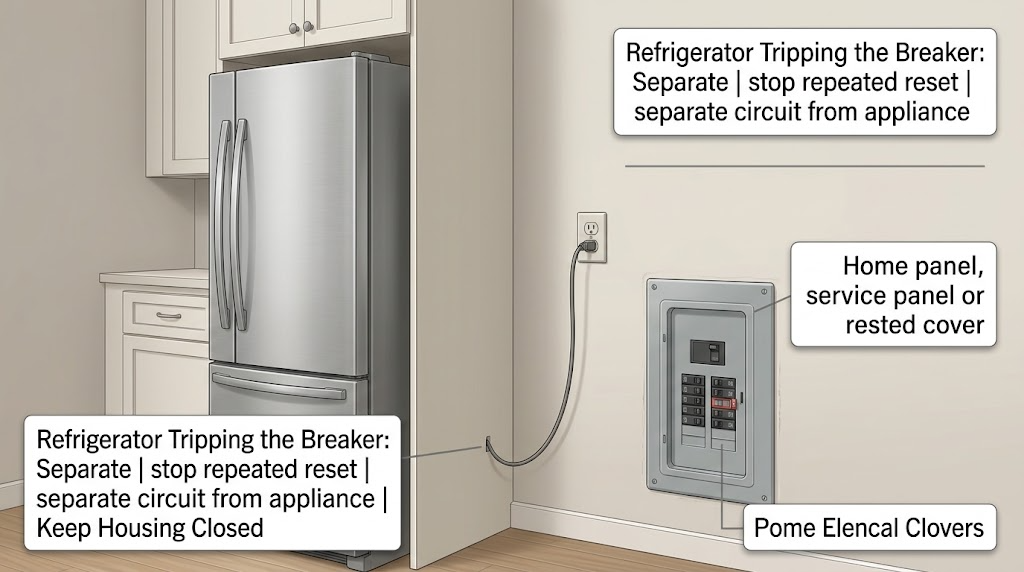
Work through in order
Diagnostic checks
Use only checks that match the exact appliance or system and its official guide.
-
Check 1
Stop using the refrigerator and do not repeatedly reset the breaker. From a dry, stable position, note whether there is smoke, a burning odor, visible arcing, water near the outlet, a damaged cord, or heat at the plug or receptacle.
Expected result: There is an immediate electrical or moisture hazard, or the area is dry with no visible damage.
Next step: For any hazard, keep clear, do not touch wet electrical parts, and contact qualified electrical or appliance service. If the area is dry and stable, continue only with the non-invasive circuit separation check.
Stop if: Do not touch the plug or outlet with wet hands, spray the area, or continue operating after smoke, burning odor, arcing, or repeated protection trips.
Why this matters
Why: Smoke, odor, arcing, heat, water, or damaged insulation makes this an immediate stop condition; absence of visible damage does not clear the circuit or appliance.
-
Check 2
If it can be done from a dry, safe position without moving the refrigerator or reaching behind wet equipment, disconnect the refrigerator from the outlet and reset the breaker once; do not reconnect the appliance if the breaker trips again or the outlet is damaged.
Expected result: The breaker trips while the refrigerator is disconnected, or it stays on until the refrigerator is reconnected.
Next step: If the breaker trips while disconnected, leave it off and arrange qualified electrical service. If it stays on but trips again when the refrigerator is connected, leave the refrigerator disconnected and arrange appliance service.
Stop if: Do not perform repeated reset tests, use a power strip or extension cord, or move a built-in refrigerator to reach the connection.
Why this matters
Why: A trip with the appliance disconnected makes a household circuit, outlet, or protection-device issue more likely. A trip only after reconnection makes the refrigerator, its cord, or its immediate connection more suspect; neither result identifies the failed part.
-
Check 3
With the refrigerator disconnected, inspect only the visible plug, cord, outlet face, and circuit arrangement for cuts, scorch marks, looseness, moisture, an adapter, or an extension cord; compare the setup with the exact model guide.
Expected result: The refrigerator uses an extension/adapter, the plug or cord is damaged or wet, the outlet is loose or scorched, or the visible external path appears intact and grounded.
Next step: Do not operate through an extension or adapter. Leave a damaged, wet, loose, or scorched connection isolated and call qualified electrical service; if the external path is intact but the refrigerator still trips, escalate to appliance service.
Stop if: Do not remove the outlet cover, change wiring, bypass the ground, or substitute a larger fuse or breaker.
Why this matters
Why: Admiral's guide calls for a grounded, separate circuit and its checklist includes the plug, fuse, and outlet. A damaged or unsuitable external connection can trip protection; an intact appearance does not rule out an internal appliance fault.
-
Check 4
Without repeatedly powering the refrigerator, record when the trip occurred relative to plugging in, cooling starting, a defrost period, door opening, water/ice operation if fitted, or any other event.
Expected result: The trip is immediate on connection, occurs only when cooling starts, follows a water/ice event, or is intermittent and cannot be tied to an event.
Next step: Keep the refrigerator disconnected for any repeated or unexplained trip and provide the timing record, model, and photos of safe external observations to a qualified technician.
Stop if: Do not open the cabinet, bypass the breaker, run an exposed appliance, or test live components to reproduce the trip.
Why this matters
Why: Timing helps service compare a circuit/connection symptom with an appliance operating event, but it cannot by itself prove a compressor, defrost heater, fan, water valve, or control fault.
-
Check 5
Prepare the exact Admiral model and serial information, breaker behavior with the refrigerator disconnected and connected, outlet/circuit setup, cord and moisture observations, and the timing of any trip.
Expected result: The circuit trips with the appliance disconnected, the refrigerator trips it on reconnection, external damage is present, or the cause remains uncertain.
Next step: Leave the unsafe or repeatedly tripping setup disconnected and contact Admiral support or a qualified appliance/electrical professional with the recorded evidence.
Stop if: Do not replace a compressor, relay, defrost part, fan, control, cord, fuse, or breaker based only on the symptom label.
Why this matters
Why: These patterns point to different service scopes, but none supports a consumer-level diagnosis of a specific internal part. Admiral's support path is regional, so model and market details matter.
Use your observations
Decision map
Find the observation that best matches what you see, then follow the next safe action.
-
PATH 01Next step
What you see
The breaker trips or will not remain on while the Admiral refrigerator is disconnected, or other devices on the circuit show the same problem.
Do this next
Leave the circuit off and arrange qualified electrical service. Do not keep resetting it or move the refrigerator to another circuit as a workaround.
-
PATH 02Next step
What you see
The breaker stays on with the refrigerator disconnected but trips when the refrigerator is reconnected or begins operation, with no obvious external outlet fault.
Do this next
Keep the refrigerator disconnected and arrange qualified appliance service. Do not open the cabinet or infer whether the compressor, defrost system, fan, or control is responsible.
-
PATH 03Next step
What you see
The visible plug, cord, or outlet is wet, scorched, loose, damaged, or connected through an extension cord or adapter.
Do this next
Do not operate the refrigerator or handle the damaged connection. Arrange qualified electrical service and follow the exact Admiral installation requirements.
-
PATH 04Next step
What you see
The breaker trips intermittently, the external path looks intact, or the timing cannot be established without repeatedly powering the refrigerator.
Do this next
Stop testing, preserve the model and timing information, and arrange qualified appliance/electrical service. Repeated reset attempts are not a safe diagnostic method.
Helpful context
Understand the symptom
Treat a tripping breaker as an electrical stop signal
A refrigerator that trips protection may have a problem in the household circuit, the outlet, the cord, or the appliance. The first decision is not which refrigerator part to buy; it is whether the protection device trips even when the refrigerator is disconnected. Do not keep resetting it to force the refrigerator to run.
Use the Admiral guide's external power boundary
The opened Admiral use-and-care guide calls for a grounded, separate circuit and tells the owner to check the plug, fuse, and outlet in its service checklist. Those are external observations. They do not authorize opening the cabinet, measuring live voltage, or diagnosing a compressor or defrost component.
The timing of the trip is useful evidence
Record whether the breaker trips immediately when the plug is connected, when cooling starts, after a door or defrost event, or at random. Timing can help a technician separate a circuit fault from an appliance fault, but it is not proof of a particular component. Leave the refrigerator disconnected for repeated trips, damage, moisture, smoke, or a burning smell.
When checks do not resolve it
Need a professional?
Arrange qualified electrical service when the circuit trips with the refrigerator disconnected or the outlet/cord is damaged. Arrange qualified appliance service when the refrigerator trips the breaker on reconnection or operation, or the cause remains unexplained.
Safety scope: Do not repeatedly reset a tripping breaker, use an extension cord or adapter, remove outlet covers, bypass grounding or protection, open the refrigerator cabinet, or test energized wiring. Stop immediately for smoke, burning odor, arcing, heat, water, or damaged insulation.
Have this ready
- Exact Admiral model and serial information
- Whether the breaker trips with the refrigerator disconnected or only after reconnection
- Grounding, circuit, plug, cord, outlet, and moisture observations
- Trip timing and any smoke, odor, heat, water, or unusual operating symptom
Common questions
FAQ
Why does my Admiral refrigerator keep tripping the breaker?
The first safe distinction is whether the circuit trips with the refrigerator disconnected or only after the refrigerator is connected or starts. The first pattern points more toward the household circuit; the second makes the refrigerator or its immediate connection more suspect, but neither identifies a specific part.
Can I keep resetting the breaker to see if the Admiral refrigerator starts?
No. Repeated resets can worsen an electrical fault. Reset only once during a safe circuit-separation check; leave the circuit or refrigerator disconnected for another trip, damage, moisture, smoke, or odor.
Should an Admiral refrigerator use an extension cord?
The opened Admiral guide calls for a grounded, separate refrigerator circuit. Do not use an extension cord or adapter as a workaround; have an unsuitable or damaged connection assessed by a qualified electrician.
Does a breaker trip prove the Admiral compressor is bad?
No. A breaker trip can involve the circuit, outlet, cord, or several appliance systems. Do not open the cabinet or test live parts; provide the trip timing and external observations to qualified service.
Read the exact guide
Official sources
- Contact Us | Admiral Appliances | Home Appliances for the Middle East & AfricaAdmiral Appliances · Admiral product-support contact path and regional model/service context
- Norge Admiral Refrigerator Repair Manual NT19HX3GL 8D58B NT19HX3GL 8D78B NT19HX3GL 9D46A NT19HX3GL 9D46B NT19HX3GLAdmiral · Admiral refrigerator electrical connection, grounded circuit, plug/fuse/outlet checks, and service checklist for the named guide models
Community feedback
Share a repair observation
Share a plain-text repair observation. Accepted observations are published automatically; this page may take a moment to update.