
On this page
Start here
Quick answer
Treat a Bosch refrigerator that trips a breaker as an electrical stop condition, especially if the protection opens again when the refrigerator is connected. Leave the protection in its tripped state and stop repeated reset attempts. From a dry, safe position, record whether the trip occurred at connection, startup, or later, and inspect only the accessible cord, plug, receptacle faceplate, and surrounding floor for damage, heat, moisture, odor, smoke, or sparking. Do not use an extension cord or power strip, do not move the refrigerator to another outlet as a test, and do not remove the breaker-panel or appliance covers. If the refrigerator has a damaged cord, water near electrics, burning smell, heat, smoke, or sparking, keep clear and arrange qualified electrical or appliance service. Even without visible damage, a repeated trip needs professional diagnosis of the refrigerator and the household circuit.
Before you begin
Safety first
- This article covers only stopping use, recording the trip pattern, and dry external observation of the cord, plug, receptacle area, and household load pattern. A qualified technician or electrician must handle breaker, receptacle, wiring, internal appliance, control, compressor, inverter, and refrigeration diagnosis.
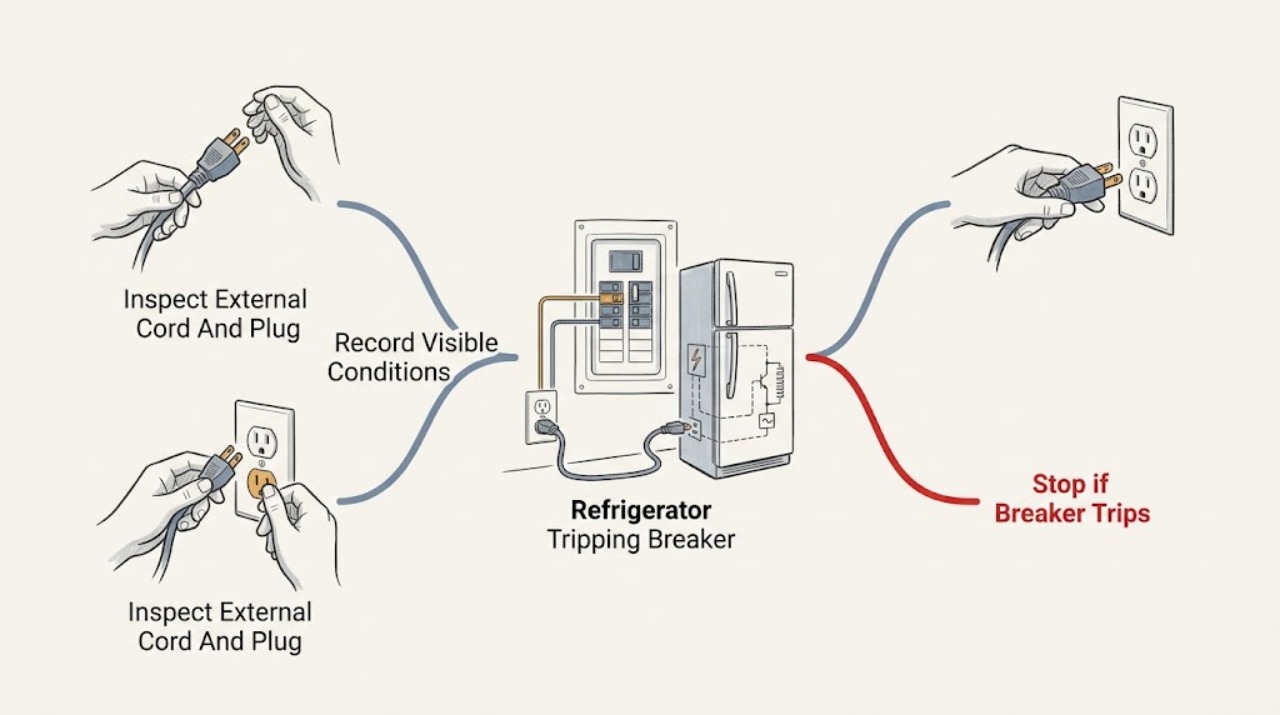
Work through in order
Diagnostic checks
Use only checks that match the exact appliance or system and its official guide.
-
Check 1
Stop using the Bosch refrigerator and leave the tripped protective device in its present state. From a dry, safe position, record whether the opening happened when the plug was connected, when cooling started, during a defrost or ice-making event, or after the refrigerator had run for a while. Note any alarm, display, sound, smell, heat, smoke, or visible moisture.
Expected result: The protection opened immediately, opened only after the refrigerator ran, opened during a particular cycle, or the trip was accompanied by heat, odor, smoke, sparking, water, or a damaged cord.
Next step: Keep the refrigerator disconnected from use and arrange qualified appliance or electrical service. For a hazard symptom, keep clear and isolate the area; do not attempt another power cycle to reproduce the event.
Stop if: Do not repeatedly restore power to see whether the breaker will hold.
Why this matters
Why: Immediate or repeat opening implicates the refrigerator, cord, plug, receptacle, circuit, or protective device but does not identify which one. A delay or cycle-linked opening is still an electrical fault signal, not evidence that continued operation is safe. Any heat, odor, smoke, spark, moisture, or damage raises the urgency.
-
Check 2
With the refrigerator left disconnected and without moving the appliance, look at the accessible power cord, plug body, and plug blades for cuts, crushed insulation, looseness, discoloration, melting, or moisture. Look around the accessible receptacle and floor for heat marks, water, or a burning odor without touching a suspect surface.
Expected result: The cord or plug is damaged, loose, hot, discolored, wet, or odorous, or the visible cord and receptacle area appear dry and undamaged.
Next step: If any damage, heat, moisture, odor, or looseness is present, keep clear and arrange qualified service; do not handle the plug to continue diagnosis. If the exterior is normal, continue only with documenting the outlet and circuit conditions, not with live testing.
Stop if: Do not bend plug blades, repair the cord, open the plug, touch wet electrical equipment, or handle a hot or damaged connection.
Why this matters
Why: A visible cord, plug, or receptacle defect can explain a trip and creates a shock or fire concern. A normal-looking exterior does not clear the refrigerator's internal electrical system or the branch circuit.
-
Check 3
Without opening the electrical panel or reconnecting the refrigerator, identify from normal household use whether other appliances or lights on the same branch lost power or were operating at the time. Check only labels or user-accessible information for the affected breaker or GFCI, and record whether the refrigerator normally shares the receptacle with other loads.
Expected result: Only the refrigerator is associated with the opening, several devices on the branch lost power, the receptacle is shared with other loads, or the circuit pattern is unknown.
Next step: Leave the affected circuit or appliance out of use and give the trip pattern to a qualified technician or electrician. Do not move the refrigerator to another outlet, change the protective-device rating, or reconnect loads to compare results.
Stop if: Do not remove the panel cover, operate exposed switches, or perform outlet or breaker measurements.
Why this matters
Why: A refrigerator-only pattern makes an appliance, cord, or receptacle fault more plausible; several affected loads or a shared heavily used branch makes circuit loading or household wiring more plausible. Neither pattern proves that the other side is safe.
-
Check 4
Confirm externally whether the Bosch refrigerator is connected directly to the intended receptacle or is using an extension cord, adapter, power strip, or other temporary connection. Record any moisture, condensation, recent cleaning, move, installation, or cord strain near the plug without changing the connection.
Expected result: An extension, adapter, power strip, wet area, recent move, strained cord, or other abnormal connection is present, or the refrigerator is directly connected in a dry, intact area.
Next step: Do not use a temporary connection or reconnect the refrigerator to another outlet. Keep the appliance out of service and have a qualified provider assess the cord, receptacle, circuit, and appliance installation.
Stop if: Do not pull a plug through water, use a bypass or adapter, or attempt to make the refrigerator operate by defeating protective equipment.
Why this matters
Why: A temporary or damaged connection adds a possible source of overheating or poor contact, while moisture or cord strain increases the hazard. Direct connection in a dry, intact area does not rule out an appliance or branch-circuit fault.
-
Check 5
Prepare the exact Bosch model and serial information, the affected protective device type and label, the trip timing, the external cord and receptacle observations, and any concurrent refrigerator symptom for the service call. Keep perishable food in a known-safe cold appliance while the Bosch refrigerator remains disconnected.
Expected result: The refrigerator is safe to leave disconnected with no visible hazard, or a hazard remains present; the trip history may be complete, partial, or unknown.
Next step: Arrange qualified Bosch appliance service when the refrigerator is the suspected load and a qualified electrician when the receptacle, branch circuit, or protective device is implicated; coordinate both when the source is uncertain.
Stop if: Do not remove covers, replace internal parts, or restore power solely to obtain a better symptom.
Why this matters
Why: A clear history helps the provider decide whether to investigate the appliance, cord and plug, receptacle, branch circuit, or protection device first. Missing history is not a reason to energize the refrigerator again.
Use your observations
Decision map
Find the observation that best matches what you see, then follow the next safe action.
-
PATH 01Safety boundary
What you see
The breaker, fuse, GFCI, or similar protection opens immediately when the refrigerator is connected or opens again after a prior event.
Do this next
Leave the refrigerator and affected circuit out of service and arrange qualified appliance and/or electrical diagnosis. Provide the timing and which other devices lost power.
Why this path and its safety boundary
Why it matters: A persistent fault involving the refrigerator, cord, plug, receptacle, branch circuit, or protective device is more likely than a harmless nuisance event.
Safety stop: Do not keep restoring power to make the refrigerator run.
-
PATH 02Safety boundary
What you see
The accessible cord, plug, receptacle, floor, or cabinet is wet, hot, discolored, loose, smoking, sparking, or has a burning odor.
Do this next
Keep clear, stop using the appliance, and arrange qualified electrical or appliance service. Isolate power or water only if the control can be reached without touching the hazard.
Why this path and its safety boundary
Why it matters: The immediate concern is shock, fire, or water-related electrical danger, not identifying a refrigerator part.
Safety stop: Do not touch wet or hot electrical equipment or attempt to inspect inside the panel.
-
PATH 03Next step
What you see
The refrigerator is the only known load associated with the opening, the rest of the branch appears normal, and there is no safe visible way to clear the event externally.
Do this next
Keep the refrigerator disconnected and arrange qualified appliance service; have an electrician assess the receptacle or circuit if its condition or loading is uncertain.
Why this path and its safety boundary
Why it matters: A refrigerator cord, plug, receptacle, or internal appliance fault becomes more plausible, but the breaker itself and circuit wiring remain possible.
-
PATH 04Safety boundary
What you see
Several devices on the same branch lost power, the receptacle is shared with other loads, or the protective device opens independently of the refrigerator.
Do this next
Leave the affected branch out of service as appropriate and arrange a qualified electrician. Do not increase the protective-device rating or move the refrigerator as a test.
Why this path and its safety boundary
Why it matters: Branch loading, receptacle wiring, or household protection is more plausible than a refrigerator-only fault, although the refrigerator should still remain disconnected until assessed.
Safety stop: Do not open the panel or attempt household electrical repairs.
-
PATH 05Safety boundary
What you see
The cord, plug, receptacle area, and floor look dry and intact, but the refrigerator has caused a repeated trip or will not remain powered.
Do this next
Keep the refrigerator disconnected and arrange qualified Bosch appliance service, with an electrician involved if the circuit or receptacle is also suspect.
Why this path and its safety boundary
Why it matters: No visible defect does not clear the appliance's internal electrical system or the branch circuit; an internal fault can require qualified testing.
Safety stop: Do not reconnect, bypass protection, or test live components to locate the fault.
Helpful context
Understand the symptom
A tripped breaker is a protection event, not a refrigerator reset prompt
The trip pattern can help a qualified provider separate an appliance fault from a circuit or receptacle problem, but it cannot safely identify a compressor, inverter, control, cord, or breaker failure from the outside. Record the exact model, which protective device opened, what the refrigerator was doing, and whether other devices lost power. Keep the refrigerator and the affected circuit out of service until the safe external checks and service decision are complete.
Stop at external observation
Do not remove the service-panel cover, appliance rear cover, terminal cover, or control housing. Do not probe a receptacle or live wiring, substitute a higher-rated protective device, bypass GFCI/AFCI protection, or connect the refrigerator through an extension cord or power strip. If a plug, outlet, floor, cord, or cabinet is wet, hot, discolored, smoking, sparking, or damaged, keep clear and call qualified service; isolate power only when the disconnect can be reached without touching the hazard.
Safety boundary
Stop conditions
- Stop using the refrigerator for a repeated protective-device opening, or immediately for water near electrics, a hot or discolored plug or outlet, burning smell, smoke, sparking, exposed wiring, or a damaged cord.
- Do not repeatedly restore power, move the refrigerator to another outlet as a test, use an extension cord or power strip, or substitute a higher-rated breaker or fuse.
- Do not remove the breaker-panel cover or appliance covers, probe live wiring, bypass GFCI/AFCI or other protection, repair the cord, or open internal electrical or refrigeration systems.
- Keep the affected appliance or circuit out of service and arrange qualified appliance and/or electrical service when the source of the trip is not clearly resolved by safe external observation.
Only after diagnosis
Potential parts
- Bosch refrigerator power cord
Consider this only if qualified service confirms cord damage or an approved cord fault; a repeated trip can originate in the receptacle, branch circuit, protection device, or internal appliance instead.
Confirm the exact Bosch model and the manufacturer's approved cord specification before ordering; do not repair or substitute the cord as a user check. - Bosch refrigerator control or power component
Consider an internal control, inverter, compressor, or other power component only after qualified diagnosis identifies it as the cause of the trip; a breaker event alone is not enough.
Confirm the exact model, diagnostic result, and manufacturer-approved part before any replacement; internal electrical work is for qualified service.
When checks do not resolve it
Need a professional?
Safety scope: This article covers only stopping use, recording the trip pattern, and dry external observation of the cord, plug, receptacle area, and household load pattern. A qualified technician or electrician must handle breaker, receptacle, wiring, internal appliance, control, compressor, inverter, and refrigeration diagnosis.
Common questions
FAQ
Why does my Bosch refrigerator keep tripping the breaker?
A repeated trip can involve the refrigerator, power cord, plug, receptacle, branch circuit, or protective device. The trip timing and which other devices lost power can guide a qualified provider, but a visible exterior check cannot identify the failed component safely.
Should I keep resetting the breaker for my Bosch refrigerator?
No. Treat a repeated opening as a stop condition. Leave the protection and refrigerator out of use, record the event, and arrange qualified appliance or electrical service; do not restore power repeatedly to reproduce the fault.
Can I plug my Bosch refrigerator into another outlet to test it?
Do not move the refrigerator to another outlet as a test, and do not use an extension cord or power strip. Keep it disconnected and have a qualified provider assess the appliance, cord, receptacle, and circuit.
What can I safely check when a Bosch refrigerator trips power?
From a dry, safe position, record when the trip happened and look without touching for cord, plug, receptacle, floor, or cabinet damage, heat, moisture, odor, smoke, or sparking. You may also record whether other devices on the branch lost power. Do not open panels or perform electrical measurements.
When should I call an electrician versus Bosch appliance service?
Use qualified appliance service when the refrigerator appears to be the only affected load and the external circuit looks normal; use a qualified electrician when the receptacle, branch, protective device, or several loads are implicated. If the source is uncertain, coordinate both and keep the refrigerator disconnected.
Read the exact guide
Official sources
- Use and Care Manual B36.D..Bosch · Bosch B36.D.. refrigerator family represented by the opened manual; use the matching manual for model-specific controls and installation.
- CPSC Guide to Home Wiring HazardsU.S. Consumer Product Safety Commission · General U.S. home-wiring safety guidance for a refrigerator connected to a household branch circuit; local electrical rules and qualified assessment control repairs.
- Get Support - RefrigerationBosch Home Appliances · Bosch refrigeration support route for model-specific troubleshooting and qualified repair.
Community feedback
Share a repair observation
Share a plain-text repair observation. Accepted observations are published automatically; this page may take a moment to update.