
On this page
Start here
Quick answer
If a Blomberg refrigerator trips a circuit breaker, RCD, or fuse, leave the appliance off and separate the appliance symptom from a household-circuit symptom using external observation only. Note whether the trip occurs immediately when the refrigerator is connected, when the compressor starts, after water or condensation is present, or only when other appliances share the circuit. From a dry position, look for a damaged or hot plug or cord, scorch marks, buzzing, water near electrical parts, or a breaker that will not remain on; do not perform live testing, open the plug or panel, or keep resetting the breaker. Blomberg manuals require a grounded, appropriately fused supply, prohibit extension or multiway connections, and say a damaged power cable must be replaced by a qualified electrician. A repeated trip is a stop-and-service condition: keep the refrigerator disconnected and contact a qualified electrician and/or Blomberg service, while protecting food according to its temperature and safety needs.
Before you begin
Safety first
- This article covers external observation only. Do not perform live voltage testing, open the plug, outlet, breaker panel, control area, or rear cover, replace internal fuses or wiring, bypass a breaker or RCD, use an extension or multiway adaptor, move or tip the refrigerator, or reconnect it repeatedly.
Work through in order
Diagnostic checks
Use only checks that match the exact appliance or system and its official guide.
-
Check 1
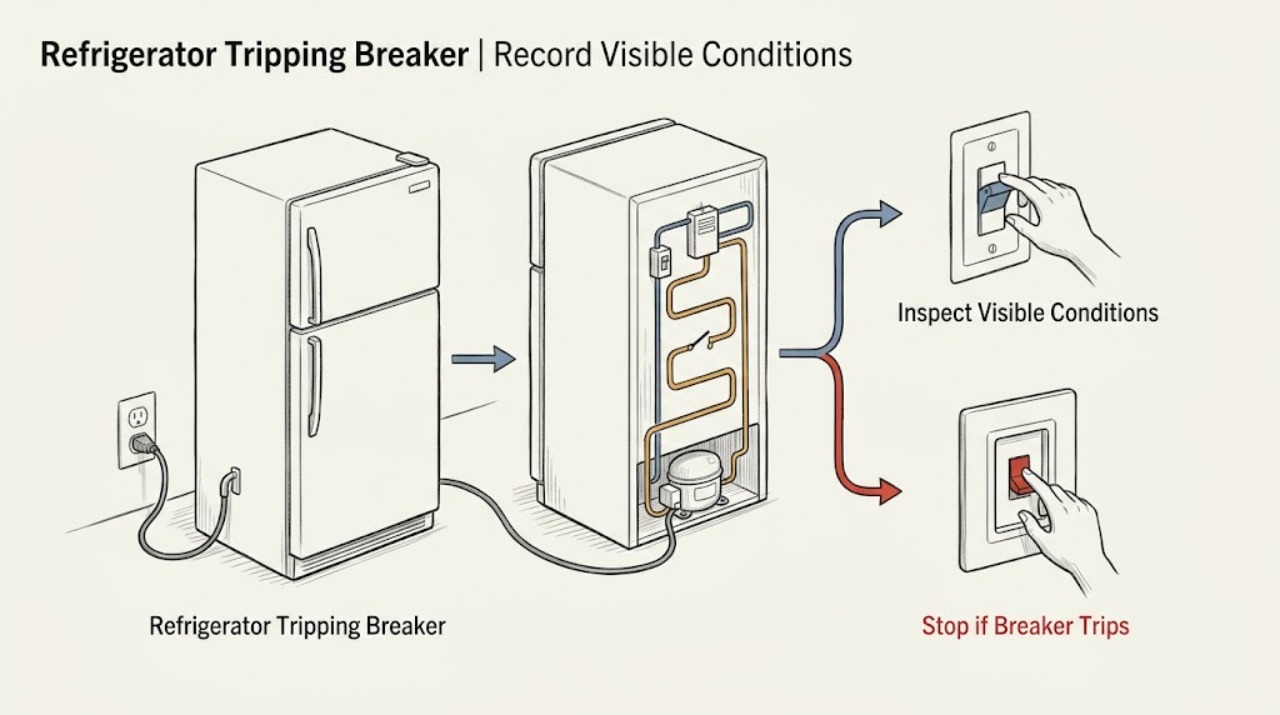
From a dry, stable position, record whether the breaker, RCD, or fuse trips when the refrigerator is connected, when cooling starts, after a defrost or water event, or only when other appliances operate. Note whether the interior light or display was on, whether the compressor or fan had been running, and whether the trip has happened once or repeatedly.
Expected result: Classify the event as immediate connection trip, start-up trip, delayed or intermittent trip, trip with water or odor, or circuit trip only when other loads are present.
Next step: Keep the refrigerator disconnected and use the timing record for the electrician or Blomberg service technician. Do not reconnect it repeatedly to determine whether the trip returns.
Stop if: Stop immediately for smoke, sparking, burning odor, a hot or damaged plug or cord, water near electrical parts, exposed wiring, or a breaker or RCD that will not remain on.
Why this matters
Why: An immediate or start-up trip keeps the appliance, cord, plug, outlet, or compressor start path in view. A trip tied to other loads can involve circuit loading or household wiring. Water, heat, scorch marks, buzzing, or a repeated trip is an unsafe fault pattern regardless of timing.
-
Check 2
With the refrigerator disconnected and the breaker left in its existing safe state, visually inspect only the accessible plug, cord, strain relief, outlet face, and nearby floor for cuts, crushed insulation, looseness, scorch marks, unusual heat, moisture, or a burning smell. Do not remove covers, pull a built-in refrigerator out, touch a wet plug, or make any powered measurement; leave electrical testing to a qualified professional.
Expected result: Record whether the external power path is intact and dry, visibly damaged or hot, wet or scorched, or inaccessible behind cabinetry.
Next step: Leave the refrigerator disconnected for any damage, moisture, heat, or inaccessible connection and arrange a qualified electrician or appliance technician. Provide photos from a safe distance.
Stop if: Do not touch wet electrical parts, open the outlet or plug, perform live voltage testing, replace wiring, or use the appliance with a damaged cord.
Why this matters
Why: Visible damage, heat, moisture, or scorching makes the power path unsafe and can explain a trip. An intact-looking exterior does not clear the outlet, wiring, compressor, or internal refrigerator components.
-
Check 3
Without opening the consumer unit or manipulating a protective device, note which labeled circuit or RCD appears to have operated, whether lights or other appliances on that circuit also lost power, and whether the refrigerator shares a socket, extension, multiway adaptor, or other high-load equipment. Keep the refrigerator unplugged while making this observation.
Expected result: Record whether the event affected only the refrigerator connection, the whole circuit, or several circuits, and whether extension or multiway equipment is present.
Next step: Do not restore a tripping circuit to test the refrigerator. Arrange a registered or qualified electrician for circuit-level investigation, and tell Blomberg service if the appliance alone is implicated.
Stop if: Do not bypass, wedge, repeatedly reset, or replace a protective device, and do not connect the refrigerator through an extension, adaptor, or multiway strip.
Why this matters
Why: A whole-circuit event or multiple-load pattern makes household wiring, overload, or protective-device issues more likely; a refrigerator-only event keeps the appliance or its dedicated connection in view. Blomberg prohibits extension cables and multiway plugs for the refrigerator supply.
-
Check 4
From outside the appliance, check for a wet floor, water around the plug route, condensation or a leak near the rear, a damaged cabinet or liner, unusual heat at the front or sides, and food or ice thawing. Do not remove the rear cover, tip the refrigerator, disturb refrigerant tubing, or reach into a wet area.
Expected result: Record whether the appliance is dry and intact, has water near electrical equipment, has a damaged liner or cabinet, feels unusually hot, or has lost cooling after the trip.
Next step: Keep power isolated and arrange qualified electrical or refrigeration service for any water, damage, heat, or cooling loss. Protect perishable food using appropriate food-safety guidance while waiting.
Stop if: Do not touch exposed wiring, wipe around a live plug, move the refrigerator, open the sealed system, or operate it after water ingress or visible damage.
Why this matters
Why: Water near electrical equipment, physical damage, or abnormal heat raises the immediate safety risk. Loss of cooling after a trip can be a consequence of lost power or a separate refrigeration fault; it does not justify reconnecting an appliance that tripped protection.
-
Check 5
Collect the exact model and serial information from the rating label only if it is accessible without moving or opening the refrigerator, then compile the trip timing, external photos, circuit context, cooling state, and any safety signs for service. Do not perform another power-up attempt while waiting for advice.
Expected result: Record the model and serial details, the protective device type if known, whether the trip is reproducible from history, and whether the appliance is currently disconnected and food has been moved if needed.
Next step: Contact Blomberg service and a qualified electrician as appropriate. Keep the refrigerator disconnected until the professional confirms the supply and appliance are safe to energize.
Stop if: Do not energize the refrigerator to collect more evidence, open electrical covers, replace an internal component, or bypass the breaker or RCD.
Why this matters
Why: Model and serial information lets Blomberg locate the correct manual, repair route, and parts information. A complete timing and safety record helps the electrician distinguish a household circuit fault from an appliance fault without repeated energization.
Use your observations
Decision map
Find the observation that best matches what you see, then follow the next safe action.
-
PATH 01Next step
What you see
The protective device trips as soon as the refrigerator is connected or when it starts, while other loads are not involved.
Do this next
Keep the refrigerator disconnected and arrange qualified appliance and electrical diagnosis. Do not reconnect it to confirm the pattern.
Why this path and its safety boundary
Why it matters: A fault in the refrigerator, plug, cord, outlet, or compressor start path is more likely than a simple frost or temperature issue, but the exact component cannot be identified by timing alone.
-
PATH 02Next step
What you see
The trip affects other outlets or occurs only when the refrigerator operates with other substantial loads or through an extension or multiway connection.
Do this next
Leave the refrigerator disconnected, remove extension or multiway equipment from the plan, and arrange a qualified electrician to assess the circuit. Do not reset repeatedly or test by adding loads.
Why this path and its safety boundary
Why it matters: Circuit loading, wiring, the protective device, or an unsuitable connection is more likely, although the refrigerator may still contribute.
-
PATH 03Next step
What you see
The plug, cord, outlet face, or nearby area has scorch marks, unusual heat, looseness, moisture, buzzing, damaged insulation, or a burning odor.
Do this next
Do not touch or energize the connection. Keep people away from the hazard and arrange qualified electrical service; provide photos only from a safe, dry position.
Why this path and its safety boundary
Why it matters: The external electrical path is unsafe and takes priority over refrigerator cooling diagnosis.
-
PATH 04Next step
What you see
A trip is accompanied by water near the appliance, cabinet or liner damage, abnormal heat, smoke or odor, or the refrigerator no longer maintains temperature.
Do this next
Keep power isolated, protect food using food-safety guidance, and arrange urgent qualified electrical and refrigeration service. Do not move, tip, or open the refrigerator.
Why this path and its safety boundary
Why it matters: There may be water exposure, insulation damage, an internal electrical fault, or a consequential cooling failure; the appliance is not safe to re-energize as a user test.
-
PATH 05Next step
What you see
There was one trip, no visible damage or moisture is present, the refrigerator is now disconnected, and the household circuit context is unknown.
Do this next
Do not use a repeated reset as a test. Give the event timing and model information to Blomberg service or a qualified electrician, who can decide when controlled re-energization is safe.
Why this path and its safety boundary
Why it matters: A transient supply event, circuit condition, or developing appliance fault remains possible; a clean exterior cannot clear the refrigerator or wiring.
Helpful context
Understand the symptom
A breaker trip is a safety signal, not a refrigerator reset step
A trip may be caused by the refrigerator, its plug or cord, the outlet, the circuit load, or household wiring. The timing is useful evidence, but repeatedly restoring power can re-energize a fault. Record what happened, then leave the appliance disconnected while the cause is assessed by a qualified professional.
Keep the refrigerator's cooling behavior separate from the electrical fault
A compressor may pause during an automatic defrost cycle or after a sudden power interruption, and a refrigerator can make normal liquid or fan sounds. Those observations do not make a breaker trip safe to ignore. If the appliance remains powered without tripping but no longer cools, that is a separate service symptom; if the protective device trips, electrical safety takes priority.
Do not troubleshoot behind the cabinet or inside the appliance
Blomberg's electrical guidance requires an accessible, grounded supply and says damaged cables need qualified replacement. A refrigerator can contain mains wiring, a compressor start circuit, fan and defrost components, and a sealed cooling system. External photos and timing records are useful; opening covers, probing terminals, bypassing protection, or moving a built-in unit is not a user check.
Only after diagnosis
Potential parts
- refrigerator power cord or plug assembly
Consider this category only when a qualified electrician or authorized technician confirms external cord or plug damage and specifies a manufacturer-compatible replacement.
Confirm the exact model, regional plug configuration, grounding requirements, and manufacturer fit information. Do not repair or replace the cord as a breaker-trip experiment. - compressor start device or overload assembly
Consider this category only if controlled professional diagnosis links an appliance-only trip at compressor start to the start or overload assembly.
Confirm the exact compressor and model-specific service part. This is an internal electrical repair, not a user replacement. - refrigerator control or defrost electrical assembly
Consider this category only when a technician identifies a control or defrost electrical fault after the supply and cord are cleared.
Match the exact model, revision, connectors, and manufacturer service information; a breaker trip alone does not establish a compatible part.
When checks do not resolve it
Need a professional?
Keep the Blomberg refrigerator disconnected and arrange qualified electrical or appliance service after any repeated breaker, RCD, or fuse trip, or immediately for smoke, sparks, burning odor, heat, damaged insulation, water near electrical parts, or a protective device that will not remain on. A registered electrician should assess the household circuit when several loads or outlets are affected; Blomberg service should assess the appliance when it alone triggers the event or no external cause is visible.
Safety scope: This article covers external observation only. Do not perform live voltage testing, open the plug, outlet, breaker panel, control area, or rear cover, replace internal fuses or wiring, bypass a breaker or RCD, use an extension or multiway adaptor, move or tip the refrigerator, or reconnect it repeatedly.
Common questions
FAQ
Should I reset the breaker when my Blomberg refrigerator trips it?
Do not repeatedly reset it as a refrigerator test. Leave the appliance disconnected, record whether other outlets or loads were affected, and arrange qualified electrical or appliance diagnosis. A repeated trip can involve the appliance or household wiring.
What visible signs mean I should stop using the Blomberg refrigerator?
Stop for smoke, sparks, burning odor, unusual heat, scorch marks, damaged insulation, water near electrical parts, exposed wiring, or a breaker or RCD that will not remain on. Keep the refrigerator disconnected and seek qualified help; do not touch wet electrical equipment.
Could a Blomberg refrigerator trip the breaker only when the compressor starts?
The timing keeps the compressor start path, cord, outlet, appliance control, and circuit in view, but it does not identify a failed part. Do not reconnect it to reproduce the event; provide the timing to a qualified technician.
Can I use an extension cord after my Blomberg refrigerator trips?
No. The opened Blomberg electrical guidance prohibits extension cables and multiway plugs for the refrigerator connection. Keep the appliance disconnected and have the outlet, circuit, and refrigerator assessed by qualified professionals.
What information should I provide when booking service for a breaker trip?
Provide the exact model and serial information, protective-device type, trip timing, whether other outlets or loads were affected, photos of any visible damage or moisture, and whether cooling or food temperature changed. Blomberg says model and serial details are needed for manuals, repairs, and parts support.
Read the exact guide
Official sources
- Refrigerator User Manual KFD4952XDBlomberg · Opened official Blomberg refrigerator manual for a specific KFD4952XD family; its compressor behavior and troubleshooting details are not universal to every model.
- FAQ for Electrical Safety - Your Questions AnsweredElectrical Safety First · Opened Electrical Safety First consumer electrical-safety guidance for UK homes; local rules and a qualified electrician control the user's installation.
- Contact Us | BlombergBlomberg · Official Blomberg support contact page; service channels and availability vary by region.
- Refrigerator User Manual KFD9952PXDBlomberg · Opened official Blomberg refrigerator manual for a specific KFD9952PXD family; electrical requirements and component layout must be checked against the user's exact model.
Community feedback
Share a repair observation
Share a plain-text repair observation. Accepted observations are published automatically; this page may take a moment to update.