
On this page
Start here
Quick answer
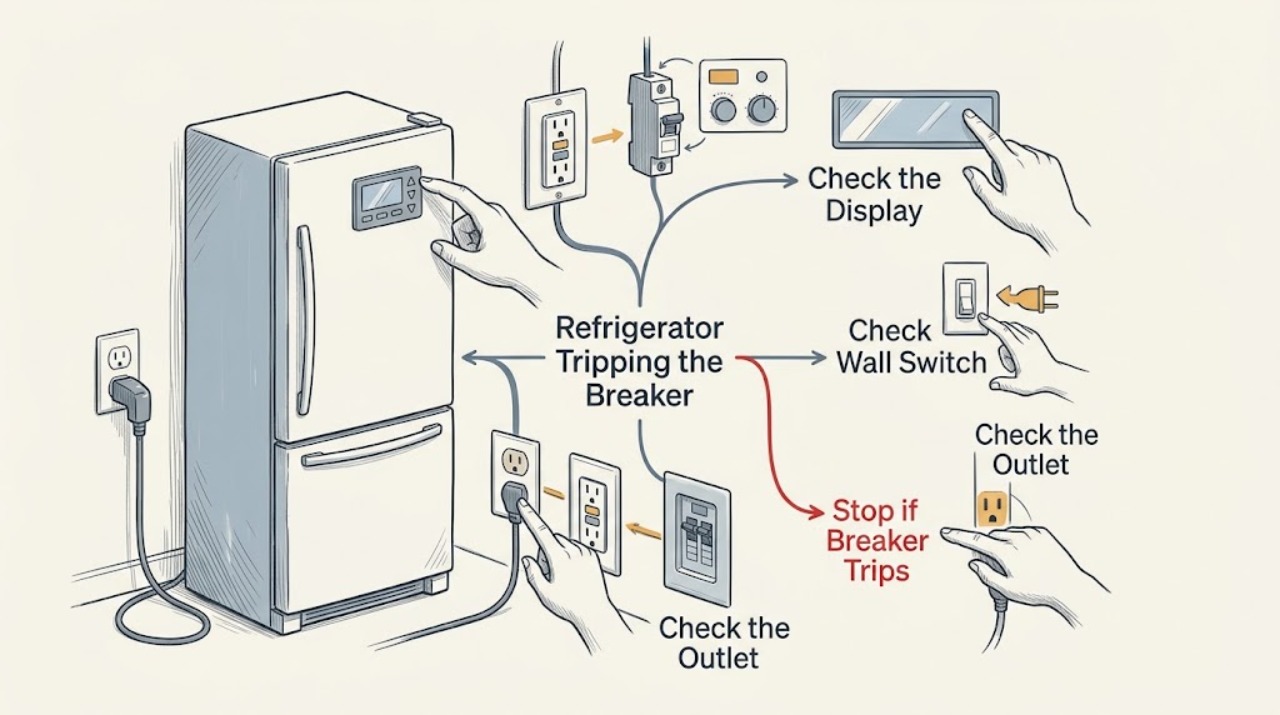
If an Amana refrigerator trips a breaker or GFCI, treat a repeated trip as an electrical fault to isolate, not as a reset to repeat. From a dry, safe position, note whether the trip happens immediately, when the compressor or another load starts, or only after the refrigerator has run; check that the cord is fully inserted into a grounded three-prong outlet, that no extension cord or switched outlet is being used, and that the refrigerator is on a suitable dedicated circuit. Amana says to check the outlet with a lamp or other small appliance and to reset a tripped breaker or GFCI, but if it trips again, the outlet or household circuit needs an electrician or the refrigerator needs qualified appliance service. Do not open the electrical panel, defeat grounding, use a larger fuse or breaker, bypass a GFCI, run a cord through another room, or test live refrigerator parts.
Work through in order
Diagnostic checks
Use only checks that match the exact appliance or system and its official guide.
-
Check 1
From a dry position, identify what opened: the refrigerator's breaker, a GFCI receptacle, or a household fuse. Note whether the refrigerator display and interior light went off, and when the trip occurred relative to plugging in, opening the door, or the refrigerator starting; do not touch a hot, wet, damaged, or sparking connection.
Expected result: The protective device trips immediately, trips when the refrigerator starts, trips after it has run, trips only when another appliance is used, or will not reset.
Next step: For any hazard or repeated trip, leave the refrigerator disconnected when safe and call an electrician or appliance technician. If there is no hazard and the device resets, continue only with the external power-supply checks below and do not repeatedly recreate the trip.
Why this matters
Why: Trip timing helps separate a refrigerator-specific symptom from an overloaded or faulty household circuit, but none of these patterns identifies a safe replacement part. A hot, wet, damaged, or non-resetting device is an immediate electrical stop condition.
-
Check 2
Inspect the cord, plug, and outlet face without removing the outlet cover. Confirm the cord is fully seated in a grounded three-prong outlet, the outlet is not controlled by a wall switch, and no extension cord, adapter, power strip, or improvised connection is being used.
Expected result: The plug is loose, the outlet or cord is warm or discolored, the grounding path is absent, the outlet is switched, or the connection appears correct and undamaged.
Next step: Do not repair the plug, defeat the ground, or continue using a hot or damaged outlet. Have an electrician correct the receptacle or circuit; if the external supply is correct but the refrigerator still trips, arrange appliance service.
Why this matters
Why: Amana specifies a grounded three-prong supply and says not to use an extension cord or a switched outlet. A loose, damaged, hot, or improperly grounded connection can explain a trip and is not a refrigerator-part diagnosis.
-
Check 3
With the refrigerator unplugged only if the plug is safely accessible, use a lamp or other small appliance to check whether the same outlet supplies power. If the outlet is protected by a GFCI, check whether its reset indicator or button shows a trip; do not remove the GFCI cover or test the outlet with exposed probes.
Expected result: The lamp also fails, the GFCI will not reset, the outlet works for the lamp but the refrigerator trips it, or the outlet works and the refrigerator remains disconnected.
Next step: If the outlet or GFCI fails the simple external check, use an electrician. If the outlet works but the refrigerator trips it, do not move the refrigerator to another circuit as a workaround; request qualified appliance diagnosis.
Why this matters
Why: A failed outlet or GFCI points to the household electrical path. An outlet that powers a small load but trips with the refrigerator does not prove the refrigerator is safe; the appliance's starting or operating load may be exposing a circuit or appliance fault.
-
Check 4
Check whether the refrigerator shares its circuit with other high-load appliances, and whether a switch, power strip, extension cord, or recent installation change was added. Use the panel label and normal household information only; do not remove the electrical-panel cover or change breaker size.
Expected result: The refrigerator is on a shared circuit, the trip occurs when another load starts, the circuit was recently changed, or the refrigerator appears to have a dedicated suitable circuit.
Next step: Stop adding loads and have an electrician verify the circuit if its capacity, wiring, or protection is uncertain. Do not install a larger breaker, replace protection with a non-GFCI device, or use an extension cord to avoid the trip.
Why this matters
Why: Amana recommends a separate circuit serving only the refrigerator. A trip that follows another load makes a circuit or load-management issue more likely, while a dedicated circuit with an appliance-only trip makes refrigerator service more important.
-
Check 5
After recording the trip and only when the supply is dry, undamaged, and safely resettable, restore power once using the normal breaker or GFCI reset. Observe the refrigerator from outside for the display, interior light, compressor or fan sound, and any immediate return of the trip; do not repeatedly cycle power.
Expected result: The refrigerator stays powered, the protective device trips immediately, it trips when cooling starts, or it stays powered but does not cool or the control panel remains abnormal.
Next step: If it trips again or behaves abnormally, leave it disconnected when safe and arrange qualified service; use an electrician when the outlet or circuit is implicated. Do not open the cabinet, bypass a protective device, or measure live components.
Why this matters
Why: A single successful reset can restore a power-interruption state, but a returning trip or abnormal operation means the underlying condition remains. Amana's control guidance also notes that an outage or control state can affect the display and cooling function.
-
Check 6
Prepare a service report with the Amana model number, circuit or GFCI involved, trip timing, outlet test result, other loads on the circuit, cord and outlet condition, display or light behavior, and whether cooling returned. Do not identify or order a compressor, relay, control board, cord, or breaker from the trip alone.
Expected result: The trip is repeatable with this refrigerator, the circuit trips with several loads, the trip is intermittent, or no safe repeat test is possible.
Next step: Give the report to an electrician or qualified Amana appliance technician. Keep the refrigerator out of service until the repeated trip or hazard is resolved, and do not use a different circuit as a long-term workaround.
Why this matters
Why: The same symptom can be caused by household wiring, GFCI behavior, an overloaded circuit, a connection, a starting or operating load, or an internal refrigerator fault. The report lets the correct professional choose between electrical and appliance diagnosis without unsafe trial-and-error.
Use your observations
Decision map
Find the observation that best matches what you see, then follow the next safe action.
-
PATH 01Next step
What you see
The outlet or GFCI does not power a lamp or will not reset, or another appliance also causes the protective device to trip.
Do this next
Leave the refrigerator disconnected when safe and arrange electrician service. Do not replace protection with a larger device or bypass the GFCI.
Why this path and its safety boundary
Why it matters: The household receptacle, GFCI, wiring, or circuit is more likely than an Amana-specific part.
-
PATH 02Next step
What you see
The outlet works for a small appliance, the refrigerator is on the specified grounded connection without an extension, and only the refrigerator trips the circuit.
Do this next
Stop repeated reset attempts and arrange qualified Amana appliance service. Provide the trip timing and whether the display, light, fan, or compressor changed.
Why this path and its safety boundary
Why it matters: An appliance-specific starting or operating fault remains possible, but the trip does not identify the cord, compressor, control, or another part.
-
PATH 03Next step
What you see
The trip occurs only when another appliance starts or the refrigerator shares a circuit with other significant loads.
Do this next
Stop adding loads and have an electrician verify the circuit. Do not use an extension cord or install a larger breaker.
Why this path and its safety boundary
Why it matters: Circuit loading, wiring, or protection is more likely than an isolated refrigerator fault.
-
PATH 04Next step
What you see
The refrigerator trips immediately, the cord or outlet is hot or damaged, water is near the connection, or smoke, burning smell, or sparks appear.
Do this next
Do not touch or reset the connection if unsafe. Leave the area as appropriate and contact emergency or qualified electrical service; keep the refrigerator out of service.
Why this path and its safety boundary
Why it matters: This is an immediate electrical safety condition, not a normal compressor-start symptom.
-
PATH 05Next step
What you see
A single safe reset restores power and the refrigerator remains normal without a returning trip, abnormal sound, or control error.
Do this next
Keep the refrigerator on the proper circuit and observe it without repeated cycling. Arrange service if the trip returns or cooling and controls become abnormal.
Why this path and its safety boundary
Why it matters: A temporary power interruption or protective-device event is possible, but the event should still be documented and monitored.
Helpful context
Understand the symptom
A breaker trip tells you that the protective device detected a condition somewhere in the outlet, circuit, connection, or refrigerator; it does not identify a compressor, cord, control, or other part. The timing is useful: an immediate trip points to the supply or a short/fault condition, a trip when the motor starts can involve starting load or the circuit, and a delayed trip can involve an operating fault or another load on the circuit. These are diagnostic patterns for a technician, not permission to open the unit.
Keep the refrigerator door closed as much as practical while power is unavailable and protect temperature-sensitive food. Stop immediately for smoke, a burning smell, sparks, a hot or discolored cord or outlet, water near electrical parts, repeated trips, or a breaker that will not reset. Contact an electrician for the household circuit and qualified appliance service for the refrigerator; do not make the two systems share an improvised extension connection.
When checks do not resolve it
Need a professional?
The outlet or GFCI fails an external lamp check, will not reset, or trips with more than one appliance., The refrigerator alone trips a correct grounded circuit, especially immediately or when cooling starts, or the problem returns after one safe reset., There is smoke, burning smell, sparking, water near electrical parts, a hot or damaged cord or outlet, repeated trips, or any need to open panels or test live wiring.
Have this ready
- The complete Amana model number and whether the refrigerator is on a dedicated circuit, GFCI, or household fuse.
- Which protective device opened, the exact trip timing, other loads on the circuit, and the result of the external outlet check.
- Cord and outlet condition, display and interior-light behavior, cooling or compressor behavior, any smell or noise, and whether a single normal reset changed the symptom.
Common questions
FAQ
Why does my Amana refrigerator keep tripping the breaker?
The trip can involve the outlet, GFCI, household circuit, another load, or the refrigerator itself. Amana recommends a grounded three-prong connection, a separate circuit serving only the refrigerator, no extension cord, and an external outlet check. A repeated appliance-only trip needs qualified diagnosis rather than a guessed part.
Can I reset the breaker for an Amana refrigerator that trips?
Only after checking from a dry, safe position that there is no smoke, burning smell, heat, water, or damaged connection. Amana documents checking and resetting a tripped breaker or GFCI, but if it trips again, stop resetting and call an electrician or appliance technician as appropriate.
Should an Amana refrigerator use an extension cord?
No. Amana's refrigerator power guidance says to use a grounded three-prong outlet and not an extension cord. If the existing outlet is inconvenient or unsuitable, have the circuit corrected rather than routing a cord or using an adapter.
What if the breaker trips when the Amana refrigerator starts cooling?
Record that timing, but do not infer a failed compressor or another part from it. Check only the external outlet, GFCI, dedicated-circuit, cord, and shared-load conditions. If the refrigerator alone trips a correct circuit when cooling starts, leave it out of service and arrange qualified appliance diagnosis.
What should I do if the Amana refrigerator trips a GFCI?
Do not bypass the GFCI. Check for a hot, wet, damaged, or loose connection from a safe position and, only when safe, use the external reset and outlet check described by Amana. A GFCI that will not reset or trips again needs an electrician; an appliance-only repeat trip also needs refrigerator service.
Read the exact guide
Official sources
- No Operation - Will Not Turn On - Side by Side RefrigeratorAmana Product Help · Amana refrigerator no-power guidance for the listed side-by-side family; external power and safety checks are not a universal internal-fault diagnosis
- Control Panel Not Working - RefrigeratorAmana Product Help · Amana control-panel guidance for the listed refrigerator family; display and mode behavior varies by model
Community feedback
Share a repair observation
Share a plain-text repair observation. Accepted observations are published automatically; this page may take a moment to update.