
On this page
Start here
Quick answer
If a Beko refrigerator trips the household breaker, leave the breaker and refrigerator off rather than repeatedly resetting them. Note whether the trip happens as soon as the refrigerator is connected, when the compressor starts, after a defrost or ice-maker event, or only when other loads run. From a dry, ordinary-access position, look for a damaged cord, hot or discolored outlet, moisture, or an overloaded circuit without touching a suspect connection. Beko says a refrigerator that will not work can involve a power or fuse problem and directs users to a qualified electrician for a faulty fuse; Beko also requires a grounded outlet, no extension cord or multi-plug, and an undamaged power cable. A repeated trip, burning odor, heat, smoke, sparking, water near electrical parts, or a breaker that will not stay on needs qualified electrical or authorized appliance service.
Before you begin
Safety first
- This article covers observation from dry, ordinary access only. Do not reset repeatedly, use an extension or multi-plug, open panels, test live voltage, alter wiring or breaker protection, move the refrigerator to another circuit, or work on the compressor or control system.
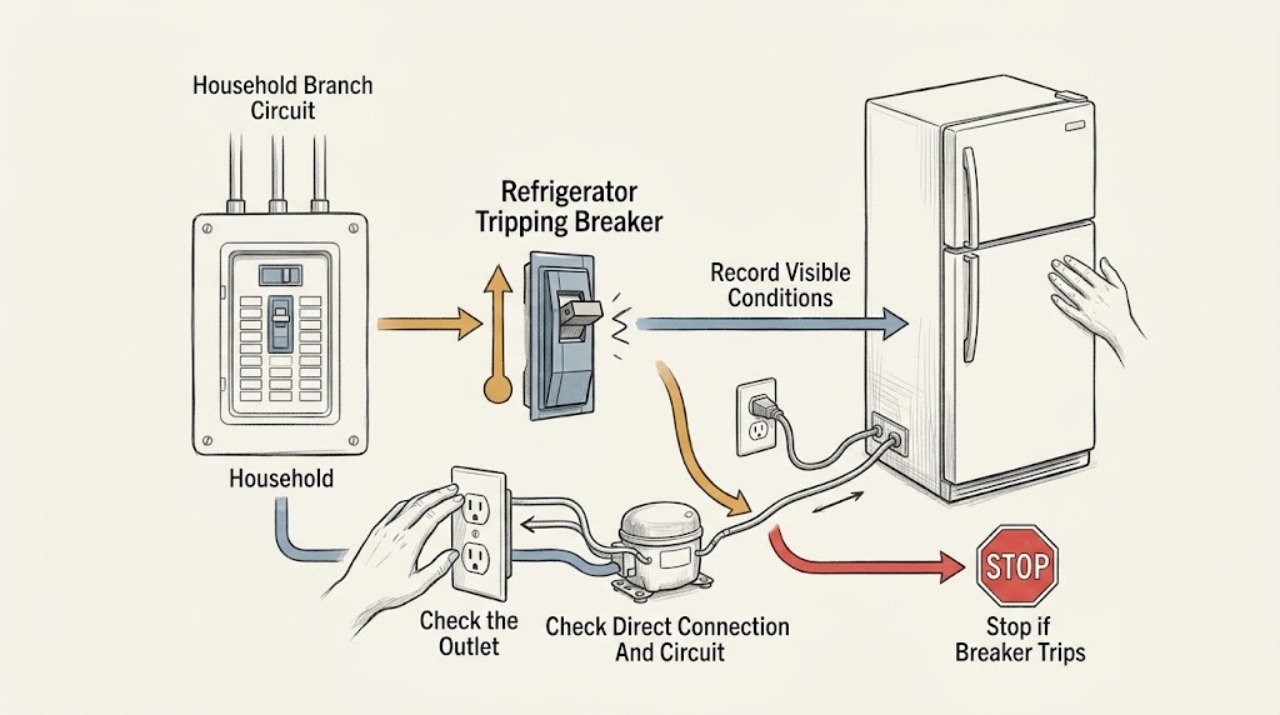
Work through in order
Diagnostic checks
Use only checks that match the exact appliance or system and its official guide.
-
Check 1
Leave the tripped breaker and Beko refrigerator off, then record from a safe position what happened immediately before the trip: plugging in, a compressor start, a defrost or ice-maker event, door opening, or another appliance starting on the same circuit. Do not reset the breaker to reproduce the event.
Expected result: Record whether the trip is immediate, delayed until the refrigerator starts, intermittent, linked to another load, or accompanied by a display or interior-light change.
Next step: Give the timing, last normal operation, model, and any visible signs to a qualified electrician or authorized appliance technician. Keep the refrigerator disconnected until they advise a safe test plan.
Stop if: Do not re-energize the appliance or breaker for another test. Stop and seek urgent qualified help for smoke, sparks, heat, buzzing, burning odor, or water near electrical equipment.
Why this matters
Why: Immediate or repeat trips keep the refrigerator's cord, input, compressor circuit, or the branch circuit in view. A trip only when other loads run can indicate a circuit-loading or wiring issue, while a trip tied to a refrigerator event needs appliance and circuit diagnosis. Timing alone cannot identify a replaceable part.
-
Check 2
From a dry position without touching the connection, visually inspect the accessible power cord, plug, outlet face, and nearby floor or wall for cuts, pinching, discoloration, melted plastic, moisture, or a loose-looking receptacle. Do not pull the refrigerator or handle a suspect plug.
Expected result: Classify the visible path as clean and dry, damaged or pinched, hot or discolored, wet, loose, or hidden and impossible to assess safely.
Next step: Keep the circuit off and arrange qualified electrical service for any damage, heat, wetness, or looseness. Do not replace the plug, cord, outlet, or fuse yourself.
Stop if: Do not touch a wet plug or outlet, remove an outlet cover, use a tester, or continue if there is smoke, sparking, exposed conductor, or a burning smell.
Why this matters
Why: Beko warns that the power cable must not be pinched or damaged and that a grounded, fused outlet is required. Heat, discoloration, moisture, or visible damage raises an electrical hazard; a clean appearance does not rule out an internal refrigerator or circuit fault.
-
Check 3
Without changing the refrigerator connection, note whether the Beko unit is plugged directly into its intended grounded outlet or is sharing an extension cord, multi-plug, or visibly crowded connection. From the panel only if it is dry and normal to access, note which labeled breaker tripped; do not open the panel or reset it repeatedly.
Expected result: Record direct connection, extension or multi-plug use, other loads that lost power, a breaker that trips again, or a panel condition that is wet, hot, damaged, or inaccessible.
Next step: Leave any extension or multi-plug arrangement out of service and have an electrician assess the circuit and outlet. Do not move the refrigerator to another circuit as a workaround or reconnect it to prove the cause.
Stop if: Do not open the electrical panel, alter breaker wiring, bridge a protective device, or handle a wet or hot panel.
Why this matters
Why: Beko's installation guidance calls for a grounded mains connection without extension cords or multi-plugs and says the outlet must meet the manual's requirements. A shared or unsuitable connection can confuse the symptom, but a refrigerator that trips its intended circuit still needs qualified diagnosis.
-
Check 4
With power left off, record the Beko refrigerator's exact model and visible state without moving it: interior temperature trend, whether food is warming, whether the door closes, whether there is water around a plumbed connection, and whether any display or alarm was present before the trip.
Expected result: Record a normal-looking dry cabinet, warming food, water or frost near a water line, a damaged door or seal, a fault display, or an unknown model because the label is not safely accessible.
Next step: Use the model and visible condition when contacting Beko-authorized service or an electrician. Keep the doors closed and follow food-safety guidance while power is unavailable.
Stop if: Do not move, tip, pull, or open the rear or lower covers to find the model or inspect wiring.
Why this matters
Why: Beko says the model number is needed for the correct manual and that a refrigerator may have model-specific controls and connections. Warming food or water near a plumbed connection changes the service urgency; these observations do not justify energizing the appliance again.
-
Check 5
Prepare a service handoff containing the model, trip timing, breaker label, visible cord and outlet condition, other loads affected, food-temperature concern, and any water, odor, heat, noise, or display observation. Keep the appliance off while the professional decides how to test it.
Expected result: Separate what was directly seen from unknown conditions such as internal wiring, compressor start components, control boards, insulation, outlet wiring, and circuit protection behavior.
Next step: Request qualified electrical assessment for the outlet or circuit and authorized appliance assessment for the Beko refrigerator. Give both providers the same no-reenergization history so neither assumes the other system is safe.
Stop if: Do not perform live measurements, open the refrigerator, bypass protection, or reconnect power to test a suspected component.
Why this matters
Why: A breaker trip cannot safely identify whether the refrigerator, outlet, branch wiring, or another load is at fault. Beko directs users to an authorized service agent for continuing technical problems and to a qualified electrician for a faulty fuse or power issue.
Use your observations
Decision map
Find the observation that best matches what you see, then follow the next safe action.
-
PATH 01Safety boundary
What you see
The breaker trips immediately on connection or a cord, plug, outlet, panel, or nearby area shows heat, discoloration, moisture, exposed damage, smoke, or burning odor.
Do this next
Keep the breaker and refrigerator off and call a qualified electrician; involve authorized Beko service for the appliance after the circuit is declared safe.
Why this path and its safety boundary
Why it matters: An electrical safety fault is more likely than a temperature-setting or ordinary cooling issue, and the scene may be unsafe to re-energize.
Safety stop: Do not touch the suspect connection, reset the breaker, unplug a wet cord, or use the appliance until qualified help clears it.
-
PATH 02Safety boundary
What you see
The breaker holds with the refrigerator off but trips when the compressor, defrost, ice-maker, or another refrigerator event would normally occur.
Do this next
Leave the appliance off and arrange authorized Beko appliance service plus electrical assessment if the circuit or outlet has not been verified.
Why this path and its safety boundary
Why it matters: A refrigerator-side load or its connection is more likely than a one-time household power outage, but only a qualified professional can isolate the component safely.
Safety stop: Do not reconnect the refrigerator to time the next event, test a start component, or bypass the breaker.
-
PATH 03Safety boundary
What you see
The trip occurs when the refrigerator and other loads run together, or several outlets or appliances lose power while the refrigerator itself has no visible damage.
Do this next
Keep the refrigerator off until a qualified electrician assesses the circuit and outlet. Do not relocate the refrigerator to another outlet or use an extension as a workaround.
Why this path and its safety boundary
Why it matters: The branch circuit, outlet, wiring, or combined load becomes a primary concern; the refrigerator may be involved but is not established as the sole cause.
Safety stop: Do not open the panel, change breaker size, or repeatedly restore power.
-
PATH 04Safety boundary
What you see
The breaker remains on after a professional-safe restoration, but the Beko refrigerator has no display or interior light, does not cool, or shows a fault indication.
Do this next
Use the exact model manual and request authorized Beko service for a continuing technical problem. Have an electrician verify the outlet if its condition or supply remains uncertain.
Why this path and its safety boundary
Why it matters: The trip may have left an appliance-side power or control problem, or the refrigerator may be set or connected incorrectly; the external observations do not identify which.
Safety stop: Do not open the appliance, test terminals, replace a fuse or control, or keep cycling power.
Helpful context
Understand the symptom
A breaker trip is a safety signal, not a refrigerator reset
The timing of the trip helps a professional separate a household branch-circuit problem from a refrigerator fault, but it does not make repeated resets safe. A trip immediately on connection can point toward the cord, plug, outlet, or input path; a trip when a compressor or another load starts can require appliance and circuit diagnosis. Record the sequence from a safe position and leave the failed combination de-energized.
Keep water and improvised power connections out of the diagnosis
Beko's installation guidance calls for a grounded outlet, direct connection without an extension cord or multi-plug, and a power cable that is not pinched or damaged. Never handle a wet plug or outlet, run a temporary extension, or move a refrigerator to reach a hidden connection. Those steps can create a second electrical hazard and do not identify the underlying fault.
Food safety continues while the circuit is being assessed
Keep the refrigerator and freezer doors closed while power is off and arrange electrical or appliance service promptly. If food is warming, follow local food-safety guidance rather than repeatedly re-energizing the appliance to preserve it. The trip history, model, and visible condition are more useful to a technician than another attempted start.
Only after diagnosis
Potential parts
- refrigerator power cord or plug assembly
Consider this category only if qualified electrical and appliance diagnosis identifies a damaged or failed cord or plug assembly after the circuit and outlet are verified safe.
Confirm the full Beko model, cord routing, grounding requirements, and manufacturer fit information; never substitute a cord based on appearance alone. - refrigerator compressor start or overload assembly
Consider this category only if an authorized technician confirms that a breaker trip coincides with compressor starting and identifies the start or overload assembly as the failed component.
Confirm the exact model, compressor specification, connector arrangement, and manufacturer fit information; a trip symptom does not establish this part.
When checks do not resolve it
Need a professional?
Keep the Beko refrigerator and the tripped circuit off and arrange qualified electrical service for any repeated trip, a breaker that will not stay on, a suspect outlet or panel, damaged or wet cord, heat, discoloration, smoke, sparks, buzzing, or burning odor. Arrange authorized Beko appliance service when the trip is tied to the refrigerator, the appliance remains off after the circuit is safe, cooling does not resume, or an internal compressor, control, or wiring fault is suspected. Do not perform live testing or bypass the protective device.
Safety scope: This article covers observation from dry, ordinary access only. Do not reset repeatedly, use an extension or multi-plug, open panels, test live voltage, alter wiring or breaker protection, move the refrigerator to another circuit, or work on the compressor or control system.
Common questions
FAQ
Why does my Beko refrigerator keep tripping the breaker?
The cause may be the refrigerator's power path, compressor or another appliance-side event, the outlet or branch circuit, or another load sharing the circuit. Record exactly when the trip occurs and leave the refrigerator and breaker off; qualified electrical and authorized appliance service must isolate the fault.
Should I reset the breaker to see if my Beko refrigerator works?
Do not repeatedly reset it or reconnect the refrigerator to reproduce the trip. A single safe restoration is a professional decision when there are no hazard signs; repeated trips, heat, odor, smoke, sparks, or a breaker that will not stay on require qualified electrical help.
Can I plug my Beko refrigerator into an extension cord after a breaker trip?
No. Beko's installation guidance calls for a grounded outlet and says not to use an extension cord or multi-plug. Leave the appliance off and have the outlet and circuit assessed rather than changing the connection as a workaround.
What if the breaker trips only when the refrigerator starts cooling?
That timing makes a refrigerator-side load or its connection a possibility, but it does not identify a compressor or start component. Do not reconnect it to test the pattern; record the timing and arrange authorized Beko service with electrical assessment of the circuit.
When is a Beko refrigerator breaker trip an emergency?
Keep clear and seek prompt qualified help for smoke, sparks, heat, buzzing, burning odor, a wet or damaged cord or outlet, water near electrical equipment, flooding, or a breaker that will not stay on. Do not touch the suspect connection or restore power.
Read the exact guide
Official sources
- How to fix a refrigerator that won't workBeko · Beko's official refrigerator troubleshooting guidance; exact model instructions and local electrical requirements control a particular appliance.
- How to Install Your New Beko RefrigeratorBeko · Beko's official refrigerator installation guidance; the product manual and applicable local electrical requirements control the installed appliance.
Community feedback
Share a repair observation
Share a plain-text repair observation. Accepted observations are published automatically; this page may take a moment to update.