
On this page
Start here
Quick answer
Do not keep resetting a breaker that trips when a Crosley refrigerator is plugged in or starts. From a dry, safe position, note whether the trip is immediate, happens when the compressor or fan starts, occurs later during defrost or ice-maker operation, or affects other appliances on the same circuit. Stop immediately for a burning or electrical smell, smoke, sparks, a hot or damaged plug/cord/outlet, water near electrical parts, melted plastic, or repeated trips; isolate power only if you can do so without touching a hazard and arrange qualified service. Otherwise, verify that the exact model is connected to the correct grounded outlet with no extension cord, adapter, power strip, or improvised splice, and check for a shared or overloaded circuit. Crosley's refrigerator manuals call for a grounded supply and warn against extension cords, adapters, and shared-outlet arrangements; they also direct the owner to check the fuse or circuit breaker when the unit has no power. A single trip immediately after a safe correction can still indicate a supply, cord, compressor-start, fan, defrost, control, wiring, moisture, or other internal fault, so the pattern does not identify a replacement part. Do not open panels, test live voltage, bypass protection, or work on the compressor, wiring, defrost circuit, or sealed system as a household check.
Before you begin
Safety first
- The user may observe the event from a dry position, check the outside of the plug/cord, identify shared loads, read the model label, and document visible conditions without opening equipment. Electrical supply, breaker, receptacle, panel, cord replacement, appliance wiring, compressor/start components, fan, defrost circuit, live testing, and sealed-system work are for qualified personnel.
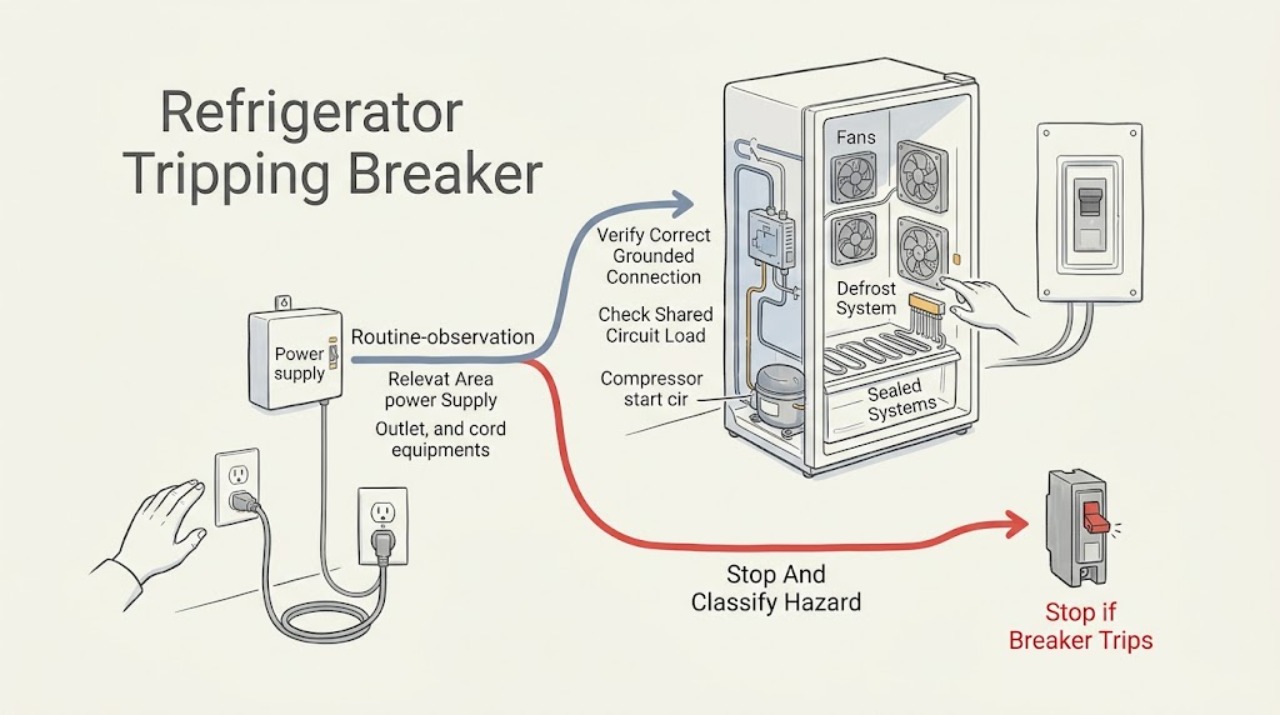
Work through in order
Diagnostic checks
Use only checks that match the exact appliance or system and its official guide.
-
Check 1
Do not reset the breaker again to test the refrigerator. From a dry position, note whether the trip occurred when the plug was inserted, when the compressor or fan started, after a period of running, or around an ice-maker/defrost event. Look only for smoke, sparks, a burning/electrical smell, melted plastic, a hot or damaged cord/plug/outlet, water near electrical parts, or visible scorching.
Expected result: There is a burning smell, smoke, a spark, dangerous heat, visible damage, water near electrics, or the breaker has tripped more than once; or there is one trip with no visible hazard and a clear timing pattern.
Next step: For any hazard or repeat trip, leave the refrigerator off, isolate power only from a safe dry position, protect the food, and arrange qualified appliance/electrical service. If no hazard is visible and this was a single event, continue with the connection and circuit checks without re-energizing just for diagnosis.
Stop if: Do not touch a wet or hot plug, damaged cord, scorched receptacle, exposed conductor, or water near electrical parts; do not keep resetting the breaker.
Why this matters
Why: A hazard sign or repeated trip means the protective event must not be reproduced. A single clean trip still needs its timing classified, because immediate, startup-synchronized, and delayed events point to different supply or appliance fault categories without proving a part.
-
Check 2
With the refrigerator unplugged and the area dry, verify that the plug is fully seated in the receptacle specified by the exact Crosley manual and that the grounding path has not been defeated. Check the plug and cord only from the outside; do not open the plug, outlet, or refrigerator. Confirm that no extension cord, adapter, power strip, splitter, or improvised splice is being used.
Expected result: The unit was on an extension/adaptor or non-grounded arrangement, the plug or receptacle is loose/damaged, the connection is wet or hot, or the connection appears correct and undamaged.
Next step: Remove only an improper accessory if it can be done safely without touching damage, and do not substitute another power device. Have a qualified electrician assess a loose, hot, wet, scorched, or uncertain receptacle. If the connection is correct, continue by documenting the circuit rather than reconnecting repeatedly.
Stop if: Do not defeat the ground, replace a fuse with a higher rating, use an extension cord to reach a different outlet, or open the receptacle or appliance electrical compartment.
Why this matters
Why: An incorrect or damaged supply arrangement can trip protection or create a shock/fire hazard and must be corrected by an appropriate professional or according to the exact installation instructions. A visually correct connection does not rule out an internal appliance fault or an outlet fault under load.
-
Check 3
Without changing breaker ratings or opening the panel, identify what else loses power or was operating when the refrigerator tripped: a microwave, toaster, kettle, heater, dishwasher, laundry appliance, or other high-load device. Note whether the refrigerator shares a circuit, whether the breaker remains open with the refrigerator disconnected, and whether the receptacle shows heat or damage.
Expected result: Other appliances trip the same circuit, the refrigerator shares a heavily loaded circuit, the breaker stays open with the refrigerator unplugged, or the refrigerator is the only load and the breaker opens when it is connected or starts.
Next step: Leave the refrigerator disconnected while a qualified electrician checks the circuit if it will not hold or the load arrangement is uncertain. Do not move the refrigerator to another circuit as a repeated experiment; give the service professional the load and timing information.
Stop if: Do not change breaker size, remove panel covers, bypass a GFCI or other protective device, or repeatedly transfer the refrigerator between outlets.
Why this matters
Why: A shared or overloaded circuit or a supply-side fault is more likely when other loads are involved or the breaker will not hold with the refrigerator disconnected. If the circuit is otherwise stable and only the refrigerator causes the event, an appliance-side fault becomes more likely, but this still does not identify the failed component.
-
Check 4
Use the event record rather than deliberately restarting the unit: distinguish an immediate trip on connection from a trip synchronized with a click, compressor start, or fan start. Note whether the refrigerator had just been moved, unplugged, or restored after an outage, but do not bypass the breaker or hold a switch closed.
Expected result: The breaker opened immediately on connection, opened as the compressor/fan attempted to start, or the exact timing is unknown because the event was not observed.
Next step: Keep the appliance off and arrange qualified diagnosis, especially if the circuit is known good and the refrigerator alone causes the trip. Provide the exact model, timing, sounds, and whether the event began after movement or an outage; do not reconnect simply to obtain a clearer symptom.
Stop if: Do not test with a larger breaker, bypass the overload, bridge a thermostat, probe live terminals, or open the compressor/start-device area.
Why this matters
Why: An immediate event can involve the supply, cord, filter/control, or an appliance short; a start-synchronized event can involve the compressor start circuit, compressor, fan, or wiring. Timing narrows the service diagnosis but cannot safely confirm one of those parts.
-
Check 5
If the trip was delayed, record whether it occurred after normal running, a defrost period, an ice-maker cycle, a fan sound, or a long warm-room run. Observe only from outside for repeated clicking, a stopped fan sound, abnormal heat, frost, water, or a new odor; do not remove covers to watch a component.
Expected result: The event follows a delayed operating or defrost/ice-maker pattern, the cabinet or cord becomes unusually hot, there is water or burning odor, or no abnormal external sign is present.
Next step: Leave the refrigerator de-energized and arrange qualified appliance service. If water is present, isolate the water supply only if that shutoff is accessible and dry; provide the technician with the delay, cycle context, sounds, and visible conditions.
Stop if: Do not remove evaporator or control covers, reach near a fan or heater, dry electrical parts with a heat source, or restart to force a defrost or ice-maker test.
Why this matters
Why: A delayed event can make a fan, defrost heater/control, compressor protection, moisture, wiring, or another internal load more likely than a simple plug-in issue. Heat, water, or odor raises the safety urgency. No visible sign does not make repeated operation safe when the breaker has opened.
-
Check 6
Once the refrigerator is safely left off, photograph or record the model/rating label, the breaker or receptacle description without opening electrical equipment, trip timing, shared loads, control/display status, compressor or fan sounds, odors, heat, frost, water, and any prior move or outage. Do not attempt internal electrical, compressor, defrost, or sealed-system repair.
Expected result: The service record shows a supply-side concern, an immediate/startup trip, a delayed trip, a repeat trip, or a hazard symptom.
Next step: Arrange qualified appliance service and, when the circuit or receptacle is suspect, qualified electrical service. Protect perishable food and follow local food-safety guidance while the refrigerator is off.
Stop if: Do not restore power merely to collect missing information, and do not perform live voltage tests, replace internal parts, bypass protection, add refrigerant, or pierce tubing.
Why this matters
Why: A precise event history helps separate circuit diagnosis from appliance diagnosis and helps a technician plan safe tests. A repeated or hazardous event requires the refrigerator to remain out of service; no observation justifies naming or ordering a part without model-specific testing.
Use your observations
Decision map
Find the observation that best matches what you see, then follow the next safe action.
-
PATH 01Safety boundary
What you see
There is smoke, a burning/electrical smell, a spark, a hot or damaged cord/plug/outlet, water near electrical parts, visible scorching, or the breaker trips repeatedly.
Do this next
Leave the refrigerator off, isolate power only when safe and dry, protect food, and arrange qualified appliance and/or electrical service.
Why this path and its safety boundary
Why it matters: This is a safety fault pattern, not an ordinary reset or cooling check. The source may be the receptacle, cord, wiring, compressor/start circuit, defrost system, moisture, or another internal part, and the symptom alone cannot locate it.
Safety stop: Do not touch the hazard, keep resetting the breaker, or open any electrical enclosure.
-
PATH 02Next step
What you see
The breaker will not hold with the refrigerator unplugged, other high-load appliances share the circuit, or the receptacle is loose, hot, wet, or damaged.
Do this next
Keep the refrigerator disconnected and have a qualified electrician inspect the circuit and receptacle; do not move loads around as a repeated test.
Why this path and its safety boundary
Why it matters: A supply-side overload or fault is more likely than a refrigerator part, although both can coexist. A breaker rating or grounding change is not a user troubleshooting step.
-
PATH 03Safety boundary
What you see
The circuit is otherwise stable, but the refrigerator alone trips immediately on connection or when the compressor/fan attempts to start.
Do this next
Do not reconnect to confirm it. Provide the timing and sounds to a qualified appliance technician and keep the unit de-energized.
Why this path and its safety boundary
Why it matters: An appliance-side short, cord/control issue, compressor start component, compressor, fan, or wiring fault becomes more likely. The timing narrows the diagnostic path but does not select a replacement part.
Safety stop: Do not install a larger breaker or bypass overload/start protection.
-
PATH 04Next step
What you see
The breaker opens only after the refrigerator has run for a while or around a fan, defrost, or ice-maker event, with no known supply overload.
Do this next
Leave the refrigerator off and arrange qualified appliance diagnosis. Report the elapsed time and cycle context rather than repeatedly restarting it.
Why this path and its safety boundary
Why it matters: A heat-related or cycle-related load such as a fan, defrost circuit, control, moisture path, wiring, compressor protection, or another internal component is more plausible than a simple plug-in problem.
-
PATH 05Next step
What you see
There was one trip, no hazard is visible, the circuit appears stable, and the timing is unknown.
Do this next
Record the model and circumstances, avoid unnecessary restart cycles, and arrange service if the refrigerator trips again or shows any abnormal sound, heat, odor, water, or cooling loss.
Why this path and its safety boundary
Why it matters: The event may have been a transient supply event, but an appliance fault cannot be ruled out. A single clean reset is not proof that continued operation is safe.
Helpful context
Understand the symptom
The timing of the trip is more useful than the brand name
A breaker that opens the instant the plug is inserted is a different diagnostic pattern from one that opens only when the compressor starts or after the refrigerator has run for a while. A shared circuit, loose or damaged receptacle, cord problem, moisture, compressor-start load, fan, defrost heater/control, or internal wiring can produce overlapping symptoms. Record the timing and what else was running, but do not repeatedly re-energize the appliance to reproduce it.
Use only the exact model's connection instructions
Crosley refrigerator families are not identical. The cited ARXH4252UW guide specifies a grounded supply and warns against extension cords, adapters, and splices, while the XTS21 manual has its own installation and operating instructions. Confirm the model from the rating label and follow that model's manual for outlet, clearance, ice-maker, and restart details. Never defeat grounding or substitute a multi-outlet device because the existing receptacle is inconvenient.
A breaker trip is a safety boundary, not a reset procedure
If the cord, plug, outlet, cabinet, or nearby area is hot, wet, scorched, smoking, sparking, or smells electrically burnt, leave the refrigerator off. Do not touch a wet plug, pull a damaged cord, remove an electrical cover, or use a breaker as a repeated test switch. A qualified appliance or electrical professional can determine whether the supply or refrigerator is at fault without turning a protective trip into a shock or fire risk.
Internal causes cannot be selected from a symptom alone
Once the outlet and circuit arrangement are known to be correct, a trip synchronized with compressor start may involve a start component or compressor; a delayed trip can involve a fan, defrost circuit, control, wiring, heat, or moisture. These are possibilities, not a part diagnosis. Keep the appliance de-energized and give the technician the model, trip timing, circuit information, sounds, odors, and any visible damage.
Safety boundary
Stop conditions
- Do not repeatedly reset a breaker that trips for the refrigerator.
- Stop immediately for burning/electrical odor, smoke, sparks, a hot or damaged plug/cord/outlet, melted plastic, or visible scorching.
- Stop if water is near electrical parts or the receptacle, cord, cabinet, or floor area is wet.
- Do not open panels, test live voltage, bypass protection, or work on the compressor, defrost circuit, wiring, or sealed refrigeration system.
- Arrange qualified appliance and/or electrical service for any repeat trip or unresolved circuit/appliance-side event.
When checks do not resolve it
Need a professional?
Arrange qualified appliance service after any repeat trip, any trip that occurs when the Crosley refrigerator alone is connected or starts, or any unresolved immediate or delayed trip. Arrange electrical service when the breaker will not hold with the refrigerator unplugged, other loads share the circuit, or the receptacle/cord is loose, hot, wet, scorched, or damaged. Treat smoke, sparks, burning odor, water near electrical parts, melted plastic, or dangerous heat as an urgent stop-use condition. Give the professional the exact model, circuit and receptacle observations, trip timing, other loads, compressor/fan sounds, control/display state, recent move or outage, and visible heat, frost, water, or odor. Do not keep the unit energized while waiting, and do not perform live testing or internal repair.
Safety scope: The user may observe the event from a dry position, check the outside of the plug/cord, identify shared loads, read the model label, and document visible conditions without opening equipment. Electrical supply, breaker, receptacle, panel, cord replacement, appliance wiring, compressor/start components, fan, defrost circuit, live testing, and sealed-system work are for qualified personnel.
Common questions
FAQ
Should I keep resetting the breaker if my Crosley refrigerator trips it?
No. Leave the refrigerator off after a trip, especially after a repeat event or any smoke, burning/electrical odor, spark, hot or damaged plug/cord/outlet, water near electrical parts, or scorching. Crosley's safety guidance supports a grounded connection and qualified handling; repeated resets can turn a protective event into a shock or fire risk.
What if the breaker trips as soon as I plug in my Crosley refrigerator?
Do not plug it in again to confirm the symptom. Record whether the circuit holds with the refrigerator disconnected, inspect only the outside of the cord and receptacle from a dry position, and have a qualified professional assess the supply and appliance. An immediate trip can involve the outlet, cord, control, wiring, or appliance input circuit; it does not identify one part by itself.
Can a shared circuit make a Crosley refrigerator trip the breaker?
Yes, a shared or overloaded circuit is one possible supply-side explanation, especially if other high-load appliances were operating or lose power together. Do not change the breaker rating or repeatedly move the refrigerator between outlets. Leave it disconnected and have a qualified electrician check the circuit when the load arrangement or receptacle is uncertain.
What does it mean if the breaker trips when the Crosley refrigerator starts?
A trip synchronized with a click, compressor start, or fan start makes an appliance-side start circuit, compressor, fan, wiring, or supply fault more plausible than a simple control setting. Timing helps a technician, but it cannot select a replacement part. Keep the refrigerator off and do not bypass overload or start protection.
What if the Crosley refrigerator trips after running for a while?
A delayed trip can be associated with a fan, heat-related protection, defrost or ice-maker circuit, control, moisture, wiring, or another internal load. Note the elapsed time and cycle context without restarting the unit to reproduce it. Leave it off and arrange qualified appliance diagnosis, with electrical service as well if the circuit or receptacle is suspect.
Can I use an extension cord or power strip for a Crosley refrigerator?
Use the exact model's installation instructions. Crosley's ARXH4252UW guide warns against extension cords, adapters, and splices and calls for a grounded supply. Do not defeat grounding or use a power strip to work around a missing or inconvenient receptacle; have the supply corrected by a qualified professional.
Read the exact guide
Official sources
- Top-Freezer Refrigerators Owner’s Manual and Installation InstructionsCrosley · Model-family guidance for grounded installation, outlet/breaker checks, clearance, normal operating cycles and sounds, restart/recovery behavior, and qualified service boundaries; it is not a universal instruction for every Crosley refrigerator.
- ARX443UW - CROSLEY HOME PRODUCTSCrosley Home Products · Confirms the model-specific product/documentation context for ARXH4252UW; it does not establish a universal part diagnosis or electrical procedure for other Crosley refrigerators.
- ARXH4252UWCrosley · Model-specific guidance for grounded electrical connection, no extension cord/adapter/splice, no-power and tripped-breaker checks, safe cleaning and panel boundaries, restart behavior, and qualified service; other Crosley models may differ.
Community feedback
Share a repair observation
Share a plain-text repair observation. Accepted observations are published automatically; this page may take a moment to update.