
On this page
Start here
Quick answer
Do not repeatedly reset a breaker that trips with a Dacor refrigerator. If there is a burning smell, smoke, spark, hot or scorched plug/outlet, exposed wiring, water near an electrical part, or a breaker that will not stay on, stop using the refrigerator and keep clear; isolate power only from a dry, safe upstream point and call emergency or electrical help as appropriate. If the area is dry and there is no visible damage, record whether the breaker tripped when the refrigerator was plugged in, when it started, or after it had been running, and whether other loads lost power—without reconnecting the refrigerator or performing a live test. Dacor planning guidance calls for a grounded, non-GFCI outlet, no extension cord or power strip, and a properly sized dedicated circuit for the covered refrigerator family. Those requirements help an electrician assess the supply, but they do not prove the supply is the cause. A trip that follows the refrigerator, returns on its next connection, or occurs with normal household power can involve a cord, compressor start part, defrost circuit, control, wiring, or moisture and needs qualified Dacor service. Do not open the rear cover, touch the compressor or wiring, replace a fuse, bypass protection, or use another outlet as a test.
Before you begin
Safety first
- Owner checks stop at safe external observation, model identification, visible supply and water context, and documentation without reconnection. Qualified professionals must handle panels, compressor start components, defrost circuits, controls, wiring, insulation tests, and live diagnosis.
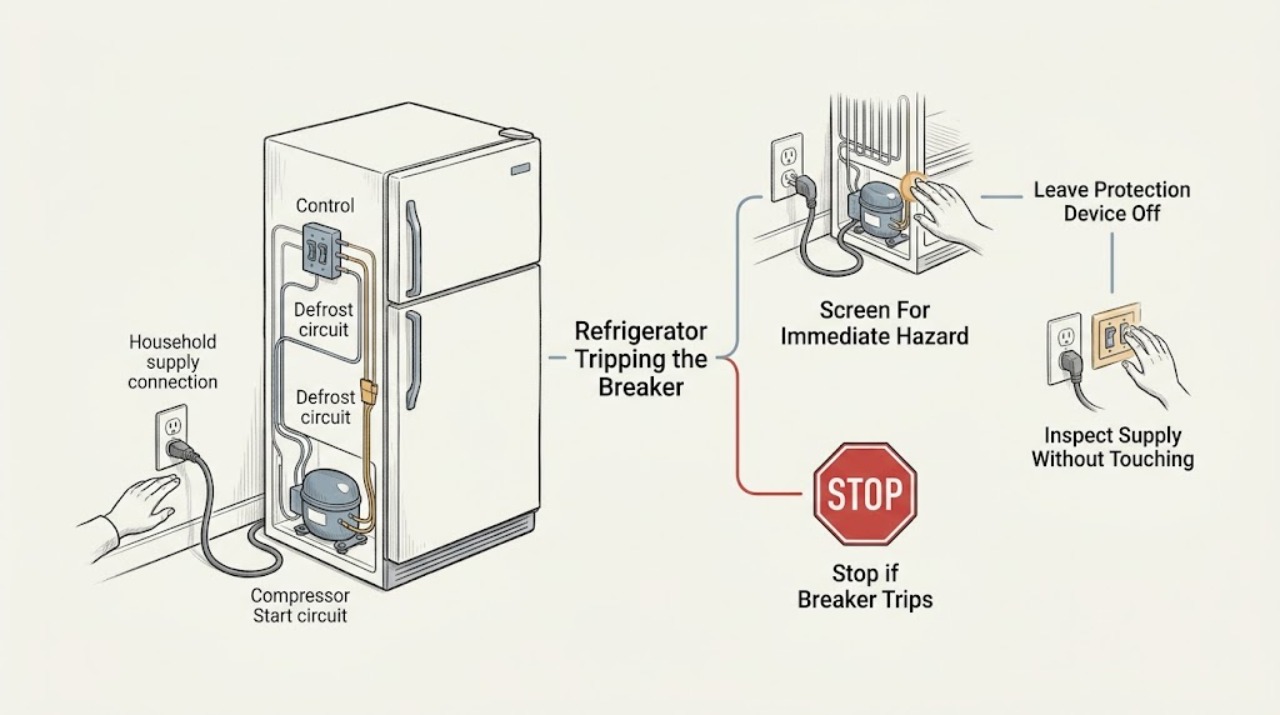
Work through in order
Diagnostic checks
Use only checks that match the exact appliance or system and its official guide.
-
Check 1
From a safe dry position, stop approaching the Dacor refrigerator and look for smoke, flame, arcing, a burning smell, abnormal heat, exposed wiring, a hot or scorched plug or outlet, and water on the floor or near the electrical connection.
Expected result: Smoke or flame is present; an arc, burning odor, hot/scorched supply, exposed wire, or water is visible; or none of those signs is visible.
Next step: For fire or spreading smoke, leave the area and contact local emergency services. Otherwise keep people away and isolate power only from a dry, safe upstream point; do not touch the refrigerator, plug, outlet, water, or breaker if reaching it requires crossing the hazard.
Stop if: Do not use water on an electrical fire, open the refrigerator, or move it to see behind it.
Why this matters
Why: Smoke, fire, heat, arcing, exposed wiring, or water near electrical parts is an immediate hazard and cannot be handled by a reset. The absence of visible damage does not make an unexplained breaker trip safe to repeat.
-
Check 2
Without repeatedly resetting anything, observe the household panel and the refrigerator's accessible power point from a safe location. Note whether the breaker or RCD remains tripped, whether it trips again immediately when the refrigerator is connected, and whether other lights or appliances on the same circuit are also without power.
Expected result: The protective device will not stay on, other loads are also affected, only the refrigerator-related circuit is affected, or the device is on but the refrigerator remains without power.
Next step: Leave the protective device in its current safe off state and arrange electrical inspection when the circuit or outlet is involved, plus Dacor appliance service for a refrigerator-linked trip. Do not reconnect to compare results.
Stop if: Do not cycle the breaker, open the panel, replace a fuse, use a temporary extension, or test live voltage.
Why this matters
Why: A device that will not stay on or a circuit affecting other loads makes a household supply or wiring problem more plausible. A refrigerator-specific trip makes an appliance-side fault more plausible, but neither pattern identifies a safe user repair.
-
Check 3
From outside the hazard area, visually inspect the plug, cord, outlet face, and any visible connection for looseness, discoloration, melting, moisture, crushed insulation, or a switched/power-strip connection. Do not unplug or handle a connection that is hot, wet, damaged, or sparking.
Expected result: The outlet or plug is scorched, loose, wet, hot, damaged, shared through an extension or power strip, or appears intact and directly connected.
Next step: Keep the refrigerator isolated and arrange an electrician for a damaged, hot, wet, loose, shared, or non-grounded supply. Provide the exact connection arrangement to Dacor service; do not substitute another outlet as a test.
Stop if: Do not touch a hot or wet plug, tighten an outlet, remove a cover, use an extension lead, or make a live electrical measurement.
Why this matters
Why: Visible supply damage or an unsuitable connection can explain a trip and requires electrical attention. An intact-looking connection does not clear an internal appliance fault or prove that the outlet is electrically sound.
-
Check 4
From a dry position, look for water at the cabinet base, under-sink or dispenser connection, floor, or accessible hose area, and note whether the refrigerator is built in with its service access restricted. Do not pull, tilt, or remove trim or panels to follow a line.
Expected result: Water or a leak mark is visible, the shutoff is accessible without entering a wet area, the unit is tightly built in, or no water is visible.
Next step: If it is safely reachable from a dry location, close the refrigerator water shutoff and leave power off; otherwise keep clear and have a qualified person isolate it. Arrange appliance service and electrical inspection when water approached electrical parts.
Stop if: Do not reach through water, handle a wet cord, pull the built-in refrigerator forward, remove the kick plate, or open a water or electrical connection.
Why this matters
Why: Moisture near an appliance can contribute to leakage current or damage and raises the urgency of isolation. A built-in installation can hide the cord and electrical components, so the absence of visible water or access does not rule out an internal issue.
-
Check 5
Read the exact Dacor model or product code from an exterior label, paperwork, or the manufacturer's support record while the appliance remains isolated. Record when the trip occurred—at connection, on attempted startup, after running, after a door or water event, or with no obvious trigger—plus any display, sound, odor, or temperature change.
Expected result: The model and trip timing are known, only a partial model is available, the refrigerator was warming, or the timing cannot be observed without reconnecting it.
Next step: Give the record to Dacor service and an electrician when appropriate, and keep the refrigerator out of service until the cause is assessed. Use the exact model resources rather than a generic reset routine.
Stop if: Do not reconnect for one more observation, run a forced defrost, open the rear cover, or perform any internal or live test.
Why this matters
Why: Timing helps a qualified technician distinguish a supply event from a refrigerator-linked event, but startup, compressor, defrost, and control circuits cannot be identified safely by an owner from timing alone. A partial identity is not enough to choose a fuse or internal part.
Use your observations
Decision map
Find the observation that best matches what you see, then follow the next safe action.
-
PATH 01Safety boundary
What you see
Smoke, flame, arcing, burning odor, exposed wiring, a hot or scorched plug/outlet, or water is near the refrigerator's electrical connection.
Do this next
Leave for fire or spreading smoke and contact local emergency services. Otherwise keep clear, isolate power only from a dry safe upstream point, close the water shutoff only if safely reachable, and arrange electrical and Dacor appliance service.
Why this path and its safety boundary
Why it matters: An immediate electrical, fire, or shock hazard is more likely than a routine overload, and the appliance must not be approached for a reset.
Safety stop: Do not touch the wet or hot connection, cross water to reach the panel, use water on an electrical fire, or move the refrigerator.
-
PATH 02Safety boundary
What you see
The breaker will not remain on, other loads on the circuit are affected, or the outlet/cord is loose, damaged, hot, wet, scorched, shared through a strip, or not the required grounded direct connection.
Do this next
Leave the circuit and refrigerator isolated and arrange a qualified electrician. Provide the Dacor connection arrangement and any visible damage; do not substitute another outlet or repeatedly reset.
Why this path and its safety boundary
Why it matters: A household supply, outlet, connection, or wiring problem is at least as plausible as a refrigerator fault, and reconnecting the Dacor could worsen it.
Safety stop: Do not open the panel or outlet, tighten live connections, use an extension, or test voltage.
-
PATH 03Safety boundary
What you see
The trip occurs when the refrigerator is connected or attempts to start, while other household power is normal and there is no user-accessible supply damage.
Do this next
Keep the refrigerator disconnected or isolated and arrange qualified Dacor appliance service. An electrician should also assess the circuit if the protective device or outlet shows any abnormality.
Why this path and its safety boundary
Why it matters: An appliance-side cord, compressor start circuit, defrost circuit, control, wiring, or moisture fault is more likely, but the timing cannot identify the failed component.
Safety stop: Do not reconnect to confirm the pattern, run a diagnostic or defrost cycle, replace a fuse, remove panels, or touch the compressor or wiring.
-
PATH 04Safety boundary
What you see
There was one unexplained trip, no visible heat, odor, smoke, water, or supply damage is present, and the refrigerator's exact cause cannot be established without restoring power.
Do this next
Record the model and timing, keep the refrigerator out of service until the circuit and appliance are assessed, and use Dacor's model-specific resources for the service visit.
Why this path and its safety boundary
Why it matters: A transient household event is possible, but an appliance or circuit fault remains unresolved; the absence of visible damage is not permission for repeated reset testing.
Safety stop: Do not reset repeatedly, use another outlet, operate through a power strip, or treat a temporary return of power as proof of repair.
Helpful context
Understand the symptom
A tripped breaker is a stop signal, not a reset challenge
A breaker can operate because of a household circuit problem, an appliance fault, or both. The first useful distinction is what was visible and when the trip occurred—not how many times the breaker can be reset. Dacor specifies a grounded direct connection and a properly sized circuit for the covered refrigerator family. If the refrigerator is on an extension lead, power strip, switched outlet, or shared circuit, note that fact for the electrician, but do not rearrange a live or damaged connection as a troubleshooting experiment.
Water changes the electrical safety boundary
Dacor's planning guide calls for an accessible water shutoff and leak checks on models with a dispenser or icemaker. If water is near the refrigerator base, plug, outlet, or wiring, stay out of the wet area and do not touch the connection. Power should be isolated only from a safe, dry upstream point; a technician can determine whether moisture reached an appliance circuit or the household supply.
The internal cause is not an owner-level check
A trip that tracks the refrigerator can come from an appliance-side start, defrost, control, wiring, or moisture fault, but the pattern alone cannot identify a part. Dacor publishes model-specific manuals and installation resources, so record the model and symptom sequence and let qualified service use the matching documentation. Do not remove panels, probe terminals, replace a fuse, or bypass a protective device.
Safety boundary
Stop conditions
- Do not repeatedly reset a breaker or RCD after a Dacor refrigerator trip, and do not reconnect the refrigerator merely to reproduce the event.
- Stop immediately for smoke, flame, sparks, burning odor, exposed wiring, a hot or scorched plug/outlet, water near electrical parts, or a breaker that will not stay on.
- Do not use an extension cord, power strip, two-prong adapter, or another outlet as a diagnostic workaround; Dacor specifies model-specific grounded supply requirements.
- Do not open the panel, outlet, refrigerator cover, or kick plate, replace a fuse, bypass protection, touch the compressor or wiring, or perform live testing.
- Keep the refrigerator isolated and arrange qualified appliance service for any refrigerator-linked trip, with electrical inspection when the circuit, outlet, cord, or protective device is involved.
When checks do not resolve it
Need a professional?
Safety scope: Owner checks stop at safe external observation, model identification, visible supply and water context, and documentation without reconnection. Qualified professionals must handle panels, compressor start components, defrost circuits, controls, wiring, insulation tests, and live diagnosis.
Common questions
FAQ
Should I reset the breaker again if my Dacor refrigerator trips it?
No. Do not repeatedly reset it or reconnect the refrigerator to reproduce the trip. Leave the circuit and appliance isolated and arrange electrical inspection and Dacor service as appropriate.
Can I plug a Dacor refrigerator into another outlet to test it?
No. Do not use another outlet, an extension cord, or a power strip as a diagnostic workaround. Dacor's planning guidance calls for a grounded direct connection and model-specific circuit requirements.
What if water is near the Dacor refrigerator when the breaker trips?
Stay out of the wet area and do not touch the plug, cord, outlet, or refrigerator. Isolate power only from a dry, safe upstream point and close the refrigerator water shutoff only if it is safely reachable; arrange professional service.
What information should I give the service technician?
Provide the exact model, trip timing, breaker or RCD behavior, whether other loads were affected, supply arrangement, visible heat/odor/smoke/water, and any interior temperature change. Do not open the refrigerator to find the cause.
Read the exact guide
Official sources
- 30-Inch Column RefrigeratorDacor · Opened official Dacor product page; resources and specifications illustrate why the exact model must be identified and are not a diagnosis for every Dacor refrigerator.
- DRS42SBIWS/DYF42SBIWS Planning GuideDacor · Opened official Dacor planning guide for the DRS42SBIWS/DYF42SBIWS family; electrical and clearance values are model-specific, while the direct-grounded-supply and accessible-shutoff principles provide context for service triage.
Community feedback
Share a repair observation
Share a plain-text repair observation. Accepted observations are published automatically; this page may take a moment to update.