
On this page
Start here
Quick answer
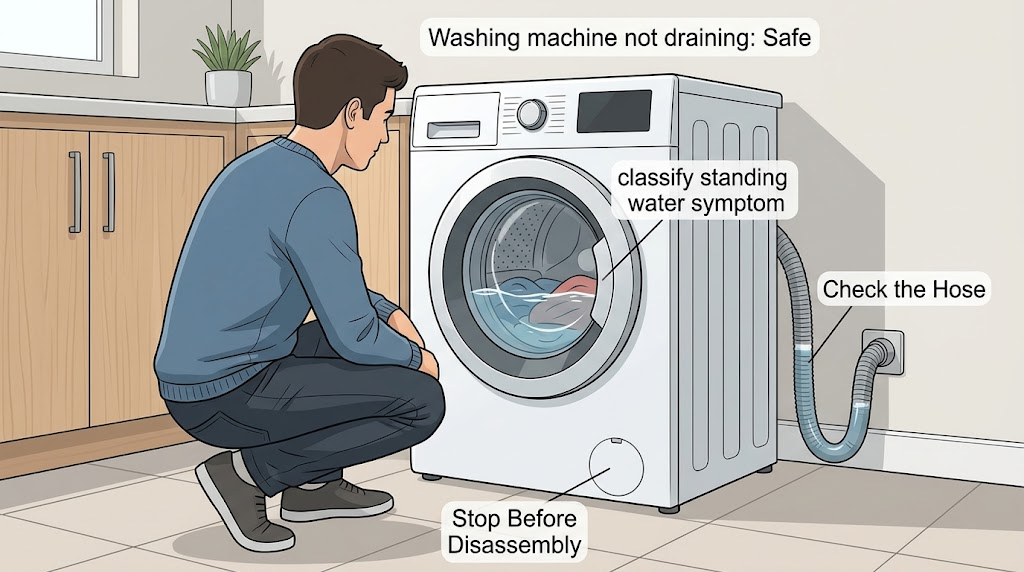
For an Admiral washing machine that will not drain, first note whether it is a top-loader or front-loader, whether the lid or door closes, and whether the load is simply wet or the tub is full of water. With the washer stopped, inspect the visible drain hose for kinks, crushing, clogs, incorrect routing, or a drainpipe problem, and check the selected cycle, spin setting, load balance, and detergent amount. If the model has an accessible pump filter, clean it only as the model manual directs with power disconnected and a container ready for water. Do not tip the washer, remove an inaccessible hose, or reach into a pump. Stop and arrange qualified service for a leak, exposed wiring, repeated electrical trips, a jammed pump, a full tub that cannot be safely emptied, or drainage that remains blocked after these checks.
Work through in order
Diagnostic checks
Use only checks that match the exact appliance or system and its official guide.
-
Check 1
Stop the washer and record whether water is visible in the tub, the load is merely wet, the lid or door is locked, the pump hums, and an error code or flashing indicator appears. Identify whether the Admiral washer is top-load or front-load from normal access.
Expected result: The tub is full, the tub is empty but clothes are wet, the pump hums without moving water, or the cycle stopped with an error or locked door.
Next step: Use the matching manual and proceed to the visible hose, settings, and accessible-filter checks. If the tub is full and there is no safe model-specific emptying procedure, stop and arrange service.
Stop if: Stop for a leak, water near electrical equipment, smoke, sparking, a damaged cord, or a door/lid that cannot be opened by the normal control.
Why this matters
Why: Standing water makes a drain path, filter, pump, or hose issue more likely; an empty tub with wet clothes can instead reflect spin settings, load balance, or excess suds. Filter and manual procedures vary by model and washer type.
-
Check 2
With the washer off and without pulling it from the wall, inspect the visible drain hose and its entry into the standpipe or laundry tub. Look for a kink, crushing, twisting, visible clog, a hose inserted too far, an incorrect support, or a blocked household drain.
Expected result: The hose is visibly restricted or misrouted, the household drain backs up, or the visible drain path appears clear.
Next step: If a loose hose can be corrected from normal access without disconnecting plumbing, follow the exact Admiral installation instructions and make one controlled drain test. If access requires moving the washer, disconnecting a hose, or working with standing water, arrange service.
Stop if: Stop for a leaking hose, a damaged standpipe, water on the floor, a hose that is stuck, or any need to pull a stacked/heavy washer.
Why this matters
Why: A restricted or incorrectly installed path can prevent the pump from moving water or can allow water to siphon or return. A clear visible path does not rule out a hidden blockage, pump fault, or internal hose issue.
-
Check 3
Only if the exact model manual identifies an accessible drain-pump filter or drain tube, disconnect power, place towels and a shallow container, and open the filter cover slowly. Remove only visible lint or small debris the manual permits; do not reach into the pump or dismantle the housing.
Expected result: Water and debris release from the accessible filter, the filter is clear, or the model has no user-accessible filter or the filter will not open normally.
Next step: Reinstall the filter exactly as directed and check for leaks during one controlled drain attempt. If it is inaccessible, seized, damaged, or the washer still will not drain, stop and arrange qualified service.
Stop if: Stop for uncontrolled water, a filter that is stuck, exposed electrical parts, a sharp object, a broken filter, or any need to open a pump or panel.
Why this matters
Why: A clogged accessible filter can restrict draining, but a clear filter does not prove the pump or internal hose is healthy. A model without an accessible filter needs a different model-specific procedure.
-
Check 4
When the tub is empty or the manual gives a safe recovery step, verify that the selected cycle and spin setting are appropriate, then inspect whether the load was a single bulky item, tightly packed, or heavily sudsed. Use the detergent amount and type specified for the washer and load.
Expected result: The cycle uses little or no spin, the load is unbalanced or overloaded, or there are excessive suds; alternatively the settings and load are appropriate.
Next step: Correct only the obvious setting, load, or detergent issue and run one appropriate drain/spin test. If the tub still retains water or the pump makes an abnormal sound, stop and arrange service.
Stop if: Stop if the washer shakes violently, walks, leaks, the lid/door cannot close or unlock normally, or another cycle would leave water standing.
Why this matters
Why: A low-spin setting, uneven load, overload, or excessive suds can leave clothes wet or reduce the washer's spin and pumping behavior without a mechanical drain blockage.
-
Check 5
Before another cycle, decide whether water still remains or the washer still fails to drain after the one safe hose, accessible-filter, and settings check. Do not repeatedly reset the appliance, tip it, or run cycles to force water through an unverified blockage.
Expected result: The washer drains normally after the safe correction, or it remains blocked, hums without draining, shows an error, leaks, or trips power.
Next step: For persistent or hazardous symptoms, leave the washer out of use and arrange qualified appliance service. Provide the model, washer type, water level, error, hose/filter findings, and cycle behavior.
Stop if: Stop now for a full tub without a safe emptying procedure, water near electricity, smoke, sparking, repeated breaker trips, a leaking pump/filter, or an exposed wire.
Why this matters
Why: A resolved hose, filter, or setting issue supports that branch; persistent no-drain behavior suggests a hidden obstruction, pump, motor, control, or installation fault that cannot be identified safely from the outside.
Use your observations
Decision map
Find the observation that best matches what you see, then follow the next safe action.
-
PATH 01Next step
What you see
The tub is empty but clothes are wet and the washer used low/no spin, an unbalanced load, an overload, or excessive suds.
Do this next
Correct the obvious cycle, load, or detergent condition according to the Admiral manual and clothing-care instructions.
-
PATH 02Next step
What you see
The visible drain hose is kinked, crushed, clogged, inserted incorrectly, or the standpipe/laundry tub backs up.
Do this next
Correct only a loose, visible routing issue using the exact model installation instructions; do not disconnect a water-filled hose by guesswork.
-
PATH 03Next step
What you see
The model has an accessible drain-pump filter and it contains lint, coins, or other visible debris.
Do this next
Disconnect power, control the water with towels and a shallow container, clean only the user-accessible filter area described by the manual, and reinstall it correctly.
-
PATH 04Safety boundary
What you see
The model has no accessible filter, the tub remains full, the pump hums without moving water, or visible hose and settings checks do not restore drainage.
Do this next
Do not tip the washer, reach into the pump, disconnect hidden hoses, or open panels.
Why this path and its safety boundary
Safety stop: True
-
PATH 05Safety boundary
What you see
There is a leak, water near electrical equipment, smoke, sparking, exposed wiring, a damaged cord, or repeated breaker trips.
Do this next
Stop the washer immediately and do not run another drain or spin test.
Why this path and its safety boundary
Safety stop: True
Helpful context
Understand the symptom
Start by separating a drain blockage from a spin or cycle issue
An Admiral washer may finish with wet clothes because water was not pumped out, because a gentle or no-spin setting retained water, or because an unbalanced load reduced the spin. Record whether water is visible in the tub, whether the pump hums, whether the lid or door is locked, and whether an error appears. The model number matters: some front-load washers have an accessible drain-pump filter or drain tube, while some top-load machines do not provide a user-accessible way to empty standing water.
Inspect the drain path without pulling the appliance
With the washer off, look at the visible drain hose and the point where it enters the standpipe or laundry tub. A kink, crush, clog, incorrect height, or hose inserted too far can prevent proper pumping or allow water to flow back. Use the exact installation instructions for the Admiral model rather than applying a generic measurement. Do not pull a heavy or stacked washer from the wall or disconnect a hose with water still in the tub unless the manual gives a safe procedure.
Use the filter only when the model makes it accessible
If the exact manual identifies a user-accessible drain-pump filter, disconnect power first, prepare towels and a shallow container, and open it slowly so retained water can be controlled. Remove only visible debris that the manual permits you to remove, then reinstall the filter correctly to prevent leaks. Do not open a sealed pump housing, reach through the filter opening, or assume that every Admiral model has the same filter location or access.
Check settings, balance, and suds before blaming the pump
A delicate, hand-wash, low-spin, or no-spin selection can leave more water in the load without a blocked drain. A single bulky item or an uneven load can also reduce spin speed, while excessive detergent suds can interfere with pumping and spinning. After the tub is empty or the manual gives a safe recovery procedure, use a balanced, appropriately sized load and the correct cycle for the clothing. A repeat failure with a balanced load points back to the drain path or an internal component.
Stop at water, electrical, and internal-pump hazards
Do not continue testing if water is leaking onto the floor or near electrical equipment, the washer trips a breaker, the cord or outlet is damaged, or the pump is silent and the tub remains full. A drain-pump, motor, control, wiring, or internal hose diagnosis requires qualified service. Record the model, top-load/front-load type, water level, error code, cycle and spin setting, hose observations, filter access, and what happened immediately before the failure.
Safety boundary
Stop conditions
- Do not tip the washer, pull a heavy or stacked unit, disconnect hidden hoses, reach into a pump, or open panels to empty a full tub.
- Do not repeatedly reset or run cycles when the washer is blocked, leaking, shaking severely, or humming without draining.
- Stop immediately for water near electrical equipment, smoke, sparking, exposed wiring, a damaged cord, or repeated electrical trips.
Only after diagnosis
Potential parts
- drain pump filter
Consider this only if the exact model has an accessible filter that is confirmed damaged or cannot seal after cleaning; a blocked filter alone does not prove replacement is needed.
Confirm the exact Admiral model and filter design in the owner's manual or technician diagnosis before selecting a replacement. - washing-machine drain pump
Consider this only after a qualified diagnosis confirms the pump is faulty rather than the drain hose, filter, household drain, control, or an internal obstruction.
Confirm the exact Admiral model, pump type, electrical specification, and mounting configuration before any part selection; appearance alone is not proof of fit.
When checks do not resolve it
Need a professional?
The tub remains full and the model provides no safe user-accessible emptying or filter procedure., The pump filter is inaccessible, stuck, damaged, or drainage remains blocked after one safe cleaning., The washer hums without draining, displays an error, leaks, shakes severely, or fails with a clear visible drain path and appropriate load., There is water near electrical equipment, smoke, sparking, exposed wiring, a damaged cord, or repeated breaker trips.
Common questions
FAQ
What should I check first when an Admiral washer will not drain?
Note whether water is still in the tub or the load is only wet, then check the selected spin setting, load balance, and visible drain-hose routing. If the model has an accessible pump filter, the exact manual will describe how to inspect it safely; not every washer has one.
Can an unbalanced load make a washer look like it is not draining?
Yes. A bulky or uneven load can reduce spin speed and leave clothes wet, even when the tub has drained. Redistribute only after the drum stops and the manual permits opening the washer; if water remains in the tub, treat it as a drain-path symptom instead.
Should I clean the drain pump filter on my Admiral washing machine?
Only if the exact model manual identifies a user-accessible filter and gives the procedure. Disconnect power, prepare for retained water, open it slowly, remove only permitted debris, and reinstall it correctly. If the filter is absent, inaccessible, stuck, or damaged, arrange qualified service.
Why does my washer pump hum but not drain?
A kinked or blocked hose, a blocked filter or internal path, or a pump problem can all produce that symptom. Check only the visible hose and a model-approved accessible filter. Do not reach into the pump or open panels; persistent humming with standing water needs service.
When should I stop trying to drain the washer myself?
Stop for a full tub without a safe model-specific emptying method, a leak, water near electrical equipment, smoke, sparking, exposed wiring, repeated breaker trips, severe shaking, or a blocked washer after one safe hose/filter/settings check. Keep it out of use and arrange qualified appliance or plumbing service.
Read the exact guide
Official sources
- Why is My Washing Machine Not Draining?Whirlpool · Supplementary manufacturer guidance; exact Admiral model manual and local plumbing conditions take precedence.
- Not Draining - Washer - Product HelpWhirlpool · Supplementary top-load washer guidance; exact Admiral model requirements may differ.
- Not Draining - Front Load Washer - Product HelpWhirlpool · Supplementary front-load washer guidance; follow the exact Admiral manual for filter access and hose dimensions.
- Admiral Corporation of AmericaAdmiral Corporation of America · Brand and product-category context only; the exact appliance manual governs drainage procedures.
Community feedback
Share a repair observation
Share a plain-text repair observation. Accepted observations are published automatically; this page may take a moment to update.