
On this page
Start here
Quick answer
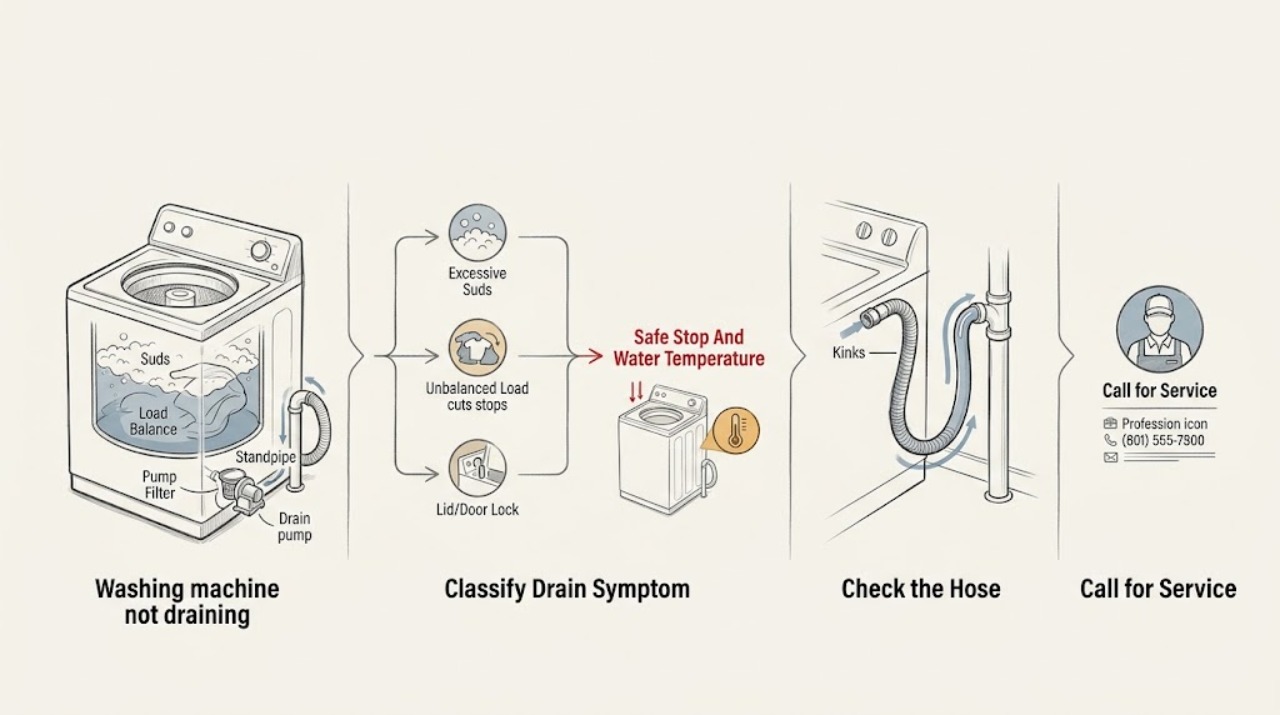
First check whether water is actually in the tub and whether the washer is top-load or front-load. Stop the cycle normally, keep hands out of a moving basket, and disconnect power only when the area is dry and safe. Inspect the visible drain hose for kinks, clogs, incorrect height, excessive insertion, or a sealed connection, following the exact model installation instructions. On models that provide an accessible pump filter, clean it only by the model manual's procedure and prepare for residual water. Excess detergent can create suds that slow or stop pumping and spinning, while a tightly packed or unbalanced load can prevent proper spin and leave clothes wet. If the drain path is clear but water remains, a drain code returns, the pump or filter is inaccessible, or there is a leak, smoke, electrical smell, repeated power trip, or hot water, stop and arrange qualified Amana appliance or electrical service. Do not tip the washer, open a wet cabinet, or force a door containing water.
Work through in order
Diagnostic checks
Use only checks that match the exact appliance or system and its official guide.
-
Check 1
From outside the Amana washer, record whether it is top-load or front-load, whether water is visible, whether the final spin ran, whether clothes are wet, and any exact drain or other error code.
Expected result: The tub is full or partly full, the tub is empty but clothes are wet, the machine stopped before spin, a drain code appears, or there is a leak or electrical warning.
Next step: Follow the water, hose, filter, suds, load, code, or safety branch below and do not reach into a moving basket.
Stop if: Stop immediately for smoke, burning or electrical smell, sparking, water near electrical parts, a damaged cord, hot water release, a leak, or repeated breaker trips.
Why this matters
Why: Visible water directs the next check to the drain hose and pump path. Wet clothes without standing water can reflect spin selection, suds, or imbalance. A code narrows the branch but remains model-dependent.
-
Check 2
Stop the washer using its normal control, wait until the basket is stationary, and if water or a hot cycle is involved, let it cool; disconnect power only from a dry, safe position before inspecting an external hose or any model-approved filter.
Expected result: The basket stops and the water is safe to manage, water remains visible, the machine is still moving or hot, or power and water are in an unsafe state.
Next step: If safe, continue with external drain-hose and installation checks; if not safe, leave the washer off and arrange service.
Stop if: Do not open the door with water visible, touch hot wash water, reach into motion, tip the washer, or work near wet electrical connections.
Why this matters
Why: Stopping motion and accounting for heat prevents hand injury and scalding. Visible water means the door or lid should remain closed until the model-approved drain procedure is complete.
-
Check 3
With power safely isolated and the area dry, inspect the visible drain hose, standpipe, laundry tub, or utility-sink connection for a kink, crush, clog, excessive insertion, tape sealing, or a drain height that does not match the exact installation instructions.
Expected result: A visible hose or drain restriction is found, the connection is sealed or incorrectly routed, the drain path is clear and correctly installed, or water drains and then flows back.
Next step: Correct only a clearly visible routing or blockage issue according to the model instructions, then make one drain or spin attempt; arrange service if water remains or returns.
Stop if: Do not disconnect a pressurized supply hose, use sharp tools in the drain, seal the hose with tape, or run the washer with a leak.
Why this matters
Why: Amana identifies kinks, clogs, incorrect hose insertion or height, sealed connections, and siphoning as installation-related drainage causes. A clear correctly installed path with retained water points toward the pump, filter, or control.
-
Check 4
If the washer is a front-load model with a pump filter that the exact manual identifies as user-accessible, prepare a shallow container and towels, disconnect power, and clean that filter only by the manual's residual-water procedure; if the filter is not accessible, do not remove a panel.
Expected result: The filter contains lint or an object and the washer drains after the documented cleaning, the filter is clear but water remains, or the model has no user-accessible filter.
Next step: Reassemble only as the exact manual directs, check for leaks, and make one drain test; arrange service if water remains, the filter cannot be safely accessed, or the issue returns.
Stop if: Do not open a filter with uncontrolled water, handle hot residual water, tip the machine, reach into the pump, or use a generic procedure for another model.
Why this matters
Why: Amana says the drain-pump filter can be clogged on some front-load models. A clear filter or a model without accessible filter does not rule out an internal pump or control issue.
-
Check 5
If the washer is foamy, pauses during drain or spin, or ends with very wet clothes without a full tub, check the detergent type and amount against the model instructions and use only the recommended HE detergent amount on the next safe cycle.
Expected result: Excessive foam is present, non-HE or excess detergent was used, the washer drains or spins after the model-approved suds-removal cycle, or the same symptom occurs with correct detergent.
Next step: Follow the exact manual's external drain-and-spin or suds-removal instruction once and do not add more detergent; arrange service if the symptom returns.
Stop if: Do not add chemicals to force a result, open a locked door against foam or water, or continue if water reaches electrical parts.
Why this matters
Why: Amana says excessive suds can reduce spin speed and stop pumping, leaving a wet load. A recurrence with correct detergent points to balance, drain, or another fault rather than more detergent adjustment.
-
Check 6
If the washer drains but leaves clothes wet or stops before final spin, wait until the basket is still, redistribute or reduce a tightly packed or single-heavy load, and select only a model-appropriate spin or rinse-and-spin cycle.
Expected result: The load is bunched or overloaded, the washer was using a gentle or low-spin setting, clothes dry after redistribution, or the washer still cannot reach spin.
Next step: Run one appropriate cycle with a balanced load; arrange service if the washer still cannot drain or spin.
Stop if: Do not reach into a moving basket, overload the washer, add water to correct balance, or continue violent shaking.
Why this matters
Why: Amana links unbalanced or overloaded loads and slow spin selections to wet loads and reduced drainage performance. Failure with a balanced load and suitable spin setting suggests a drain, motor, sensor, or control problem.
-
Check 7
If a drain or system code or flashing light appears, copy it exactly, check the exact Amana model guide, and perform only the documented external action once; do not guess that every code means a blocked pump.
Expected result: The code is a model-documented drain or installation condition and clears, an overload or balance code clears after the load is corrected, or the same code returns or is not listed for the model.
Next step: Record the code and result and arrange service if it remains or returns after the model-specific external check.
Stop if: Do not repeatedly clear a code, open panels, bypass lid or door safety, or keep running a washer that leaks or trips power.
Why this matters
Why: Amana's top-load guide identifies a drain code as possible drainage trouble and says error lists may not cover every model. A recurring or unknown code needs qualified diagnosis.
-
Check 8
After the visible hose, filter, detergent, load, and code checks show no hazard, follow the exact model manual's single power or control reset instruction, then make one drain or rinse-and-spin attempt while recording the result.
Expected result: The washer drains normally once, water remains, the same code returns, the control is unresponsive, or the household circuit trips again.
Next step: Leave the washer off when unsafe and arrange qualified Amana appliance or electrical service with the model, water state, code, and checks performed.
Stop if: Do not repeat resets, remove panels, test live parts, open a wet cabinet, or reconnect after smoke, smell, sparking, water intrusion, or a breaker trip.
Why this matters
Why: A one-time reset can clear a temporary control state, but recurrence indicates an unresolved drain, pump, lock, sensor, motor, or control condition. A power trip is an electrical safety event.
Use your observations
Decision map
Find the observation that best matches what you see, then follow the next safe action.
-
PATH 01Safety boundary
What you see
Water remains in the tub or the washer stops before drain and spin.
Do this next
Keep the lid or door closed, safely isolate power, and inspect the visible drain hose and model-approved filter path.
Why this path and its safety boundary
Safety stop: Do not open the door with visible water, handle hot water, or access an internal pump without the exact manual's safe procedure.
-
PATH 02Safety boundary
What you see
The hose is kinked, clogged, sealed, inserted or routed incorrectly, or water drains and flows back.
Do this next
Correct the visible routing or blockage according to the exact installation instructions and make one drain test.
Why this path and its safety boundary
Safety stop: Arrange service for a leak, inaccessible blockage, or retained water after the external path is correct.
-
PATH 03Safety boundary
What you see
A front-load model has an explicitly accessible pump filter and the washer is safely unpowered with controlled residual water.
Do this next
Clean the filter only by the exact model manual, check for leaks, and perform one drain test.
Why this path and its safety boundary
Safety stop: Do not open a filter with hot or uncontrolled water, reach into the pump, or remove a panel when the filter is not user-accessible.
-
PATH 04Safety boundary
What you see
The washer is foamy, drains or spins slowly, or leaves a wet load after excess or unsuitable detergent.
Do this next
Use the correct HE detergent amount and one model-approved suds-removal or drain-and-spin cycle without adding more detergent.
Why this path and its safety boundary
Safety stop: Stop if foam or water reaches electrical parts or the problem recurs with correct detergent.
-
PATH 05Safety boundary
What you see
The tub is empty but clothes are wet, the load is bunched or overloaded, or a low-spin cycle was selected.
Do this next
Redistribute or reduce the load and run one suitable spin cycle after the basket stops.
Why this path and its safety boundary
Safety stop: Arrange service if a balanced load still cannot spin or the washer shakes violently; never reach into motion.
-
PATH 06Safety boundary
What you see
A drain or system code returns, the external drain path is clear, or one safe reset does not restore draining.
Do this next
Leave the washer off when unsafe and arrange qualified Amana service with the exact code and water-state record.
Why this path and its safety boundary
Safety stop: Do not keep clearing codes, remove panels, or test the pump or wiring live.
-
PATH 07Safety boundary
What you see
The washer leaks, releases hot water, has smoke, electrical smell, sparking, a damaged cord, water near electrical parts, or trips power.
Do this next
Stop using the washer and isolate power only if it can be done without contact with water or damaged equipment; arrange qualified appliance or electrical service.
Why this path and its safety boundary
Safety stop: Do not reconnect, open the cabinet, tip the appliance, or attempt manual door or pump release.
Helpful context
Understand the symptom
Water remaining and wet clothes are related but not identical
A tub full of water points first to the drain path or pump. A tub that appears empty but clothes are wet can result from a slow spin, an unbalanced load, excessive suds, or a gentle cycle. Amana also notes that installation details can cause siphoning or poor drainage. Record the water level, model type, final-spin behavior, load, detergent, and any code before changing settings.
Start with the external drain path
A kinked or clogged hose, incorrect standpipe arrangement, taped or sealed connection, or unsuitable drain height can restrict flow or allow siphoning. The correct dimensions differ by model and washer type, so use the exact installation instructions rather than applying one universal measurement. For a front-load unit, a pump filter may be user-accessible on some models; do not assume it is present or safe to open.
Protect against hot water and sudden release
Disconnect power and manage residual water only as the model manual describes. Do not open the door when water is visible, reach into a moving basket, or remove a pump cover without controlling the water path. A persistent drain fault after safe external checks needs service rather than repeated drain attempts.
Safety boundary
Stop conditions
- Stop immediately for smoke, burning or electrical smell, visible sparking, water near electrical parts, a damaged or hot cord, hot-water release, a leak, or repeated breaker trips.
- Stop if water remains after the model-approved drain path and filter checks, the pump or filter is not safely accessible, the door or lid will not release normally, or the drain code returns.
- Do not open a wet cabinet, reach into a moving basket, tip the washer, disconnect a pressurized hose, bypass a lid or door lock, or test live wiring.
Only after diagnosis
Potential parts
- drain pump assembly
Only consider this part if qualified diagnosis confirms a pump fault after the visible hose, standpipe, and model-approved filter path are clear.
Confirm the exact Amana model and manufacturer fit information before ordering; retained water can have several causes besides the pump. - drain pump filter
Only consider this part if the exact model has an accessible filter and qualified diagnosis finds damage or persistent restriction after proper cleaning.
Confirm the exact Amana model and filter design before ordering; not every washer has a user-accessible or replaceable filter.
When checks do not resolve it
Need a professional?
Arrange qualified Amana appliance or electrical service when the visible drain path is clear but water remains, an accessible filter does not resolve the issue, a drain code returns, a balanced load still cannot spin, the pump or lock is inaccessible or abnormal, or any leak, hot water, electrical smell, smoke, sparking, or power trip occurred.
Common questions
FAQ
Why is my Amana washer not draining?
Common model-dependent causes include a kinked or incorrectly routed drain hose, a blocked drain path or pump filter, excessive suds, a tightly packed or unbalanced load, and a lid or door condition that prevents the cycle from advancing. Start with the visible hose and model-approved filter path without opening a wet cabinet.
What should I check if water remains in the Amana washer?
Keep the door or lid closed, stop and isolate power safely, then inspect the visible drain hose and standpipe for kinks, clogs, sealing, or incorrect routing. Some front-load models have an accessible pump filter, but only clean it by the exact manual procedure. If water remains, arrange service.
Can too much detergent stop an Amana washer from draining?
Yes. Amana says non-HE or excessive detergent can create suds that reduce spin speed and interfere with pumping, leaving a wet load. Use only the model-recommended HE detergent amount and do not add more detergent during a suds-removal cycle.
Why is my Amana washer wet but the tub is empty?
The washer may have used a low-spin cycle, stopped spin because of an unbalanced or overloaded load, or reduced spin because of suds. Redistribute or reduce the load after the basket stops and run one model-appropriate spin cycle. If it still cannot spin, arrange service.
What does the drn code mean on an Amana washer?
Amana's top-load error guide identifies drn as a washer-not-draining indication and notes that installation can be involved. Check the exact model manual and visible drain path; if the code remains or returns, arrange service rather than repeatedly clearing it.
Should I open the pump filter on my Amana washer?
Only if the exact model identifies a user-accessible filter and gives a safe residual-water procedure. Some front-load models have one, but not every washer does. Disconnect power safely, control the water, and stop if the filter is inaccessible, water is hot or uncontrolled, or draining still fails.
Read the exact guide
Official sources
- Error Codes in Top Load HE WashersAmana · Amana identifies drain, overload, imbalance, suds, lid, and interrupted-cycle indications and says the exact model manual governs codes and actions.
- Washer Not Draining or Spinning? Troubleshooting GuideAmana · Amana identifies door state, imbalance, spin selection, excessive suds, hose restrictions, and standpipe height as possible drain or spin causes, and describes pump-filter cleaning on some front-load models.
- Not Draining - Front Load WasherAmana · Amana covers accessible pump filters on some front-load models, drain-hose insertion and sealing, standpipe height, and siphoning.
- Not Draining - WasherAmana · Amana covers top-load drain-hose routing, kinks, clogs, standpipe height, detergent and suds, and load balance for wet clothes.
- Owner's ManualAmana · The manual covers drain-hose installation, retained water and wet loads, load balance, suds, HE detergent, door state, and safe model-specific troubleshooting.
Community feedback
Share a repair observation
Share a plain-text repair observation. Accepted observations are published automatically; this page may take a moment to update.