
On this page
Start here
Quick answer
If an AEG washing machine is not draining, first stop the program and note whether water remains in the drum, an E20/E21/C2-type warning or repeated beeps appear, or the pump makes an unusual sound. Unplug the machine and let hot water cool before any filter check. Inspect the visible drain hose for a kink or twist, confirm its installation against the model manual, and clean the pump filter only if your model has an accessible filter and the manual permits it. Check whether the household drain or sink connection is also blocked. If water still remains, the pump hums without moving water, the filter cannot be removed safely, there is a leak, or the problem returns, stop and arrange qualified appliance service.
Before you begin
Safety first
- The reader-level scope is symptom recording, external hose and outlet observation, and model-approved filter access after power is disconnected and water has cooled. Pump replacement, internal blockage clearing, cabinet access, electrical diagnosis, door-lock bypass, and concealed hose work require qualified professionals.
Work through in order
Diagnostic checks
Use only checks that match the exact appliance or system and its official guide.
-
Check 1
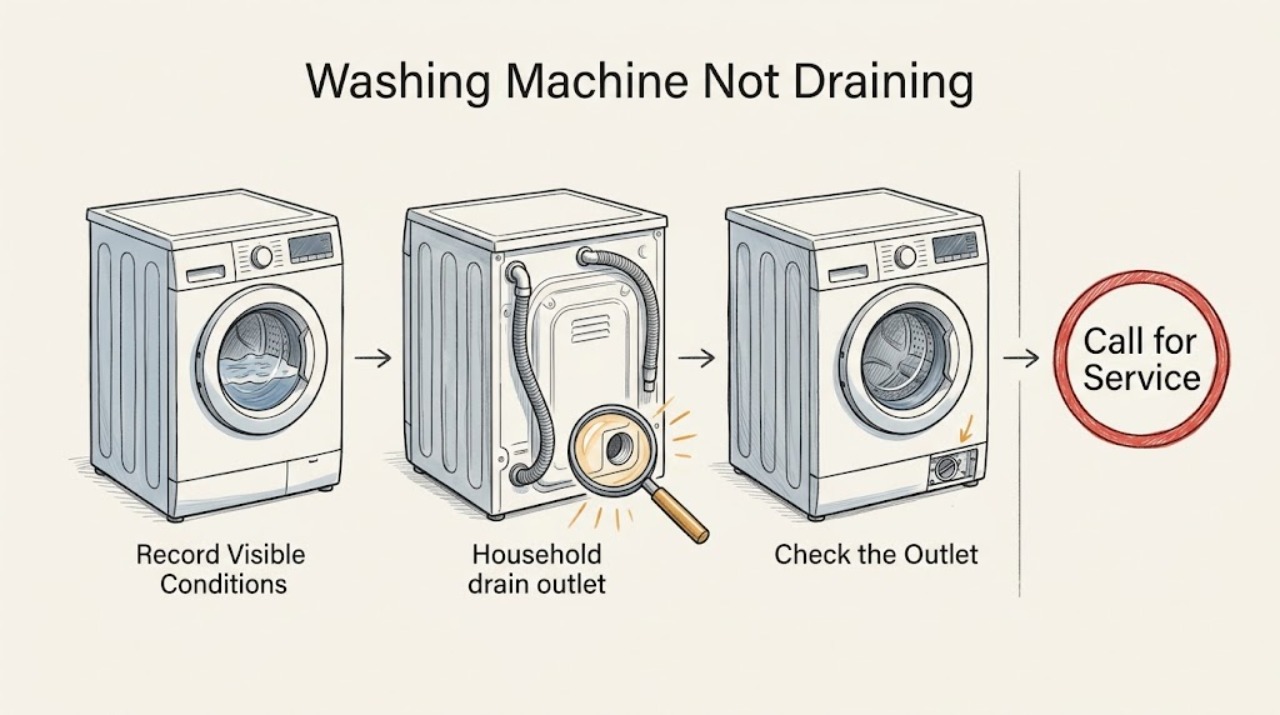
Stop the program and record whether water remains in the drum, whether the drum fails to turn, whether the machine gives an E20/E21/C2-type code or two beeps or flashes, and whether the pump hums or sounds blocked.
Expected result: Classify the result as water left after a cycle, a drain warning, an unusual pump noise, a completely silent drain phase, or a leak or overflow.
Next step: Write down the exact code, sound, and water level, then continue only with checks that match the model manual and the safety boundary.
Stop if: Do not restart a leaking or overflowing machine, touch standing water while it may be hot, or keep running cycles when the pump is making an abnormal noise.
Why this matters
Why: Standing water and drain warnings point to the drain path or pump. A hum with no water movement can indicate a blocked or damaged pump. A leak or overflow changes the priority to water containment and service, not repeated cycle starts.
-
Check 2
With the machine stopped, inspect the visible length of the drain hose and its connection for a kink, twist, crushing, extension joint, or a position that does not match the installation instructions; do not pull the machine out if it is unstable or built in.
Expected result: Record a free, intact hose, a kink or crushed section, a loose or extended connection, or an installation height or insertion depth that does not match the manual.
Next step: Correct only a plainly accessible hose position according to the exact manual, then proceed to the household-outlet check; arrange service if the hose is damaged, hidden, or inaccessible.
Stop if: Do not disconnect a full hose without a spill plan, lift the machine alone, alter the installation by guesswork, or work behind a built-in appliance without safe access.
Why this matters
Why: A kink, twist, narrowed extension, or incorrect installation can restrict flow even when the pump is working. A clear hose makes the filter, household drain, pump, or control path more likely.
-
Check 3
Observe the sink or household drain connected to the washer without adding more water to a machine that is already backed up; check the visible sink connection for an obstruction or poor drainage.
Expected result: Record a household drain that clears normally, a sink or outlet that is slow or blocked, a hose connection that backs up, or no safe way to inspect the outlet.
Next step: Arrange household drain service for a blocked outlet; if the outlet is clear, continue only with the model-approved filter and pump check.
Stop if: Do not pour chemicals into the washer or shared drain, mix drain products, or keep testing by filling the drum when the outlet is backing up.
Why this matters
Why: A slow or blocked household outlet can prevent the machine from emptying even when its internal pump and hose are sound. Normal outlet drainage shifts attention back to the machine filter, pump, or internal path.
-
Check 4
If the exact AEG manual shows an accessible pump filter, disconnect mains power, let the water cool, place a shallow container below the filter, and drain it in the manual's sequence before inspecting the filter recess for lint or objects.
Expected result: Record a clear filter and recess, lint or an object obstructing the filter, a pump impeller that will not move as the manual permits, a filter that will not turn, or water that continues to spill unexpectedly.
Next step: Refit the filter exactly as directed so its seal is seated, then run one permitted Spin/Drain test. Arrange service if the filter is jammed, the pump remains noisy, water leaks, or drainage is still absent.
Stop if: Do not remove a filter while the machine is operating, handle hot water, force the filter, reach into a pump, or continue if the model has no user-accessible filter.
Why this matters
Why: A removable obstruction can explain the drain failure. A jammed filter, damaged impeller, uncontrolled spill, or clear filter with no drainage improvement points toward an internal blockage, pump fault, or unsafe access condition.
-
Check 5
After the hose, outlet, and any permitted filter check are complete, run one model-approved Spin/Drain program and observe the drain flow, pump sound, drum behavior, and whether the code returns.
Expected result: Record normal emptying, partial emptying, no water movement, a returning drain code, renewed humming, or a leak at the filter or hose.
Next step: Stop further cycles and arrange qualified AEG or appliance service for any unresolved result; provide the code, sound, water level, hose condition, and filter result.
Stop if: Do not run repeated drain programs, bypass the door lock, open the cabinet, or test internal wiring or pump terminals.
Why this matters
Why: Normal emptying supports a cleared restriction. Partial or absent emptying, a returning code, humming without flow, or leakage means the cause is not resolved and may involve the pump, an internal blockage, the seal, or electrical control.
Use your observations
Decision map
Find the observation that best matches what you see, then follow the next safe action.
-
PATH 01Safety boundary
What you see
The visible drain hose is kinked, crushed, twisted, incorrectly inserted, or narrowed at an extension joint.
Do this next
Restore the hose position only according to the exact AEG installation instructions, then run one Spin/Drain test; service a damaged or inaccessible hose.
Why this path and its safety boundary
Why it matters: The installation or hose path can restrict the pump's discharge and mimic a failed pump.
Safety stop: Do not pull out an unstable machine, disconnect a full hose without spill control, or change hose height by guesswork.
-
PATH 02Safety boundary
What you see
The sink, trap connection, or household outlet receiving the drain hose is slow, blocked, or backs up.
Do this next
Stop using the affected outlet and arrange household drain service; do not keep filling the washer to test it.
Why this path and its safety boundary
Why it matters: The machine may be able to pump, but the household drain cannot accept the discharge.
Safety stop: Do not pour chemical drain products into the shared drain or mix products already present.
-
PATH 03Safety boundary
What you see
The model has an accessible filter and lint or a small object is found there after power is disconnected and water has cooled.
Do this next
Clean and refit the filter according to the manual, then run one Spin/Drain test and check for leakage; service a jammed filter or persistent fault.
Why this path and its safety boundary
Why it matters: A filter obstruction can stop or reduce pump flow, but clearing it does not prove the pump or internal hose is healthy.
Safety stop: Do not force the filter, touch a pump with power connected, or continue if hot water or uncontrolled water escapes.
-
PATH 04Safety boundary
What you see
The hose and household outlet are clear, the filter is clear or inaccessible, and the machine still leaves water or hums without draining.
Do this next
Stop further cycles and arrange qualified appliance service with the model, code, sound, and checks already completed.
Why this path and its safety boundary
Why it matters: A faulty drain pump, internal blockage, or electrical malfunction is more likely than a simple hose problem.
Safety stop: Do not remove cabinet panels, reach into the pump, bypass controls, or test internal electrical parts.
-
PATH 05Safety boundary
What you see
Water leaks after filter work or hose inspection, the drain fault returns after briefly improving, or the machine repeatedly stops with water inside.
Do this next
Keep the machine out of service, close the water supply if appropriate and accessible, contain only clean external water safely, and arrange professional diagnosis.
Why this path and its safety boundary
Why it matters: A seal, pump, hose, control, or recurring obstruction remains unresolved and can cause water or appliance damage.
Safety stop: Do not run another cycle, open the cabinet, or continue tightening or dismantling parts to chase the leak.
Helpful context
Understand the symptom
Start with the water and the warning, not the filter
Aeg uses “not draining” for several different outcomes: water can remain in the drum, the machine can stop before spin, or a code and beeps can identify a drain fault. E20, E21, and C2 are used in AEG support guidance for draining problems, but the exact display and sounds vary by model. Record the symptom before opening anything, because a full drum can spill and the water may be hot.
Separate the hose, household outlet, and machine pump
A kinked hose, incorrect installation, blocked sink connection, dirty pump filter, or pump fault can all look like the same stopped cycle. Check the visible hose and the household drain first. If the drain hose and outlet are clear but the machine still leaves water behind, the remaining work may involve the pump or an internal blockage and is a service decision.
Drain and filter work requires isolation and spill control
Before a permitted filter check, disconnect the appliance from mains, allow hot water to cool, and place a shallow container below the filter area. Work only from the access provided by the model manual. Do not force a jammed filter, reach into a pump with power connected, or dismantle the cabinet to reach hidden plumbing.
Safety boundary
Stop conditions
- Disconnect power and stop work for hot water, uncontrolled water, a leak, smoke, a burning odor, shock, or a damaged cord or plug.
- Do not remove the filter while the washer is operating; let water cool and use a spill container before any model-approved filter access.
- Do not force a jammed filter, reach into the pump, open the cabinet, bypass the door lock, or test internal electrical components.
- Do not pour drain chemicals into the washer or shared outlet and never mix products already present.
- Arrange qualified appliance or drain service for a persistent no-drain condition, returning code, pump hum without flow, recurring failure, or any leak.
When checks do not resolve it
Need a professional?
Arrange urgent service for a leak, uncontrolled water, electrical smell or shock, or a machine that cannot safely be isolated. Arrange prompt appliance service when an E20/E21/C2-type warning returns, the pump hums without moving water, the filter is jammed or inaccessible, the machine still retains water after the hose and filter checks, or the fault recurs. Arrange household drain service when the sink, trap connection, or outlet itself is blocked. A single shower-only style hose kink or accessible filter obstruction may be corrected only according to the exact AEG manual and with power disconnected.
Safety scope: The reader-level scope is symptom recording, external hose and outlet observation, and model-approved filter access after power is disconnected and water has cooled. Pump replacement, internal blockage clearing, cabinet access, electrical diagnosis, door-lock bypass, and concealed hose work require qualified professionals.
Common questions
FAQ
Why is my AEG washing machine not draining?
Common possibilities include a kinked or incorrectly positioned drain hose, blocked household outlet, dirty pump filter, pump obstruction or failure, excess foam, or an internal or electrical fault. First record the remaining water, code, and pump sound, then use only the checks in the exact model manual.
What does an E20, E21, or C2 warning mean on an AEG washer?
AEG uses these warnings for a draining problem. Check the visible hose position and household outlet, then perform a model-approved filter check only after disconnecting power and allowing hot water to cool. If the warning returns, arrange service.
Can I clean the AEG washing-machine pump filter myself?
Only when the exact model has an accessible filter and its manual permits the procedure. Disconnect mains, let the water cool, place a shallow container below the filter, and follow the manual's draining and refitting sequence. Do not force a jammed filter or reach into the pump.
How can I tell whether the washer drain or the household drain is blocked?
Observe the sink or household outlet without adding water to an already backed-up machine. A slow or blocked outlet points to household drain service; a normally clearing outlet with water still in the drum shifts attention to the washer hose, filter, pump, or internal path.
When should I stop troubleshooting an AEG washer that will not drain?
Stop for a leak, hot or uncontrolled water, an inaccessible or jammed filter, pump humming without flow, a returning drain warning, or water that remains after the manual-approved hose and filter checks. Arrange qualified appliance or drain service rather than opening the cabinet or testing internal parts.
Read the exact guide
Official sources
- Washing machine does not drain, displays error code E20, E21 or C2, emits 2 beeps / 2 flashesAEG · AEG support guidance used for general no-drain triage across front-load, top-load, and washer-dryer models; the exact model manual controls dimensions and access.
- How to Drain a Washing Machine or Washer Dryer (Step-by-Step Guide)AEG · AEG drain guidance used for safe water containment and accessible filter checks; model-specific manual instructions override the generic access examples.
- Washing machine stops in the middle of a cycleAEG · AEG support guidance used to interpret a no-drain symptom that stops the cycle; exact access and controls vary by model.
Community feedback
Share a repair observation
Share a plain-text repair observation. Accepted observations are published automatically; this page may take a moment to update.