
On this page
Start here
Quick answer
A humming pump near the end of a wash or rinse can be normal, but a pump that runs continuously after the programme should have ended needs a safe distinction between a drainage restriction and leak protection. AEG links continuous pumping with its i30 anti-flood condition when water collects in the base, while its drainage guidance also calls for checking the accessible filter/sump, sink connection and drain hose. Note any code, beeps, water on the floor or water entering while the dishwasher is off. Close the water tap and disconnect power if there is a leak, an i30-type symptom or water entering while off; do not bypass the anti-flood device, tilt/open the cabinet or keep restarting the appliance. Persistent pumping or any leak requires authorised service.
Before you begin
Safety first
- Close the water tap and disconnect power if safe for a leak or off-state filling. Do not bypass the anti-flood device, tilt the appliance, open the cabinet, probe wiring or keep restarting it to test a pump.
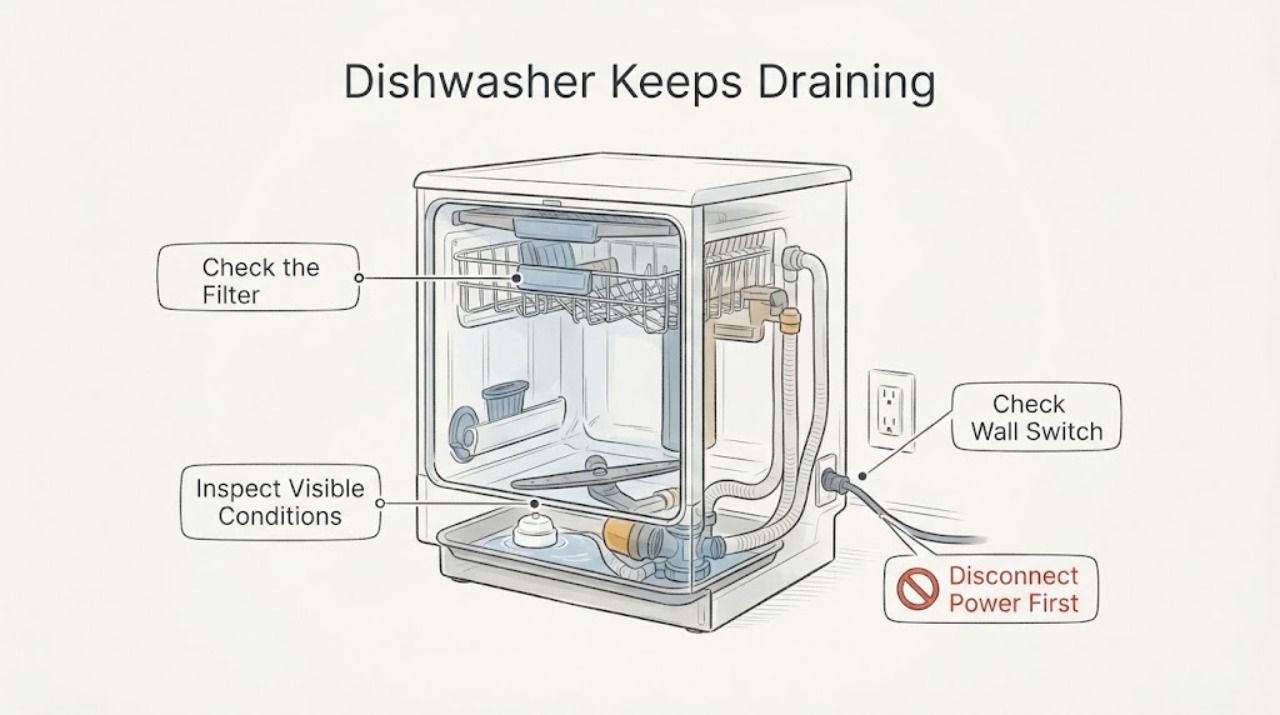
Work through in order
Diagnostic checks
Use only checks that match the exact appliance or system and its official guide.
-
Check 1
Observe one normal programme without opening the cabinet and note whether the pump sound occurs only at the end of a wash/rinse phase or continues after the programme has ended. Record any display code, beep/flash pattern and whether water remains in the tub.
Expected result: The sound stops at the end of the drain phase, or it continues continuously after the programme/cancel state.
Next step: If it stops normally, monitor. If it continues, do not keep restarting the appliance; continue with the safe leak and external drainage checks.
Why this matters
Why: A short end-of-cycle pump sound can be normal. Continuous pumping is outside the normal sound description and can reflect a drainage or leak-protection condition; it does not identify a failed pump by itself.
-
Check 2
Look only at the floor and other accessible areas for water, and note whether the dishwasher is taking in water while switched off. If there is a leak, an i30/three-beep-type indication, or water enters while off, close the dishwasher water tap and disconnect power at the accessible plug or breaker if safe.
Expected result: There is visible water, the anti-flood symptom/code is present, or water enters while the appliance is off; alternatively, the area is dry and no off-state filling is observed.
Next step: For any leak-protection or off-state filling result, leave the tap closed, do not bypass protection or open the cabinet, and arrange authorised service. If dry with no code, continue to accessible drainage checks.
Why this matters
Why: AEG associates continuous pump operation and i30 with anti-flood protection and a possible internal leak. Water entering while off is a flooding risk. A dry exterior does not rule out a base leak.
-
Check 3
After disconnecting power and allowing hot water to cool, clean the user-accessible filter system and inspect the visible sump area for debris using the exact user manual; wear gloves and do not remove panels or reach into hidden pump wiring.
Expected result: The filter/sump is visibly obstructed, it is clear, or it cannot be checked safely without opening the cabinet.
Next step: Remove only loose, visible debris described by the manual and refit the filter correctly. If the area cannot be checked safely or the pump still runs continuously, stop and arrange service rather than opening the cabinet.
Why this matters
Why: AEG lists a blocked filter or sump among causes of drainage problems. A clear accessible area does not prove that the internal pump or control is healthy.
-
Check 4
Inspect only the accessible drain hose and sink connection for a kink, twist, damage or backflow. If the dishwasher was recently installed or moved, confirm from the installation instructions that the sink spigot blanking plug was removed; do not dismantle the cabinet or reroute plumbing beyond the documented connection.
Expected result: The hose is kinked/damaged, the drain inlet is outside the documented installation range, the sink spigot is blocked or the blanking plug remains; alternatively, the accessible drain path looks correct.
Next step: Stop using the appliance if the hose is damaged or water is backing up, and arrange service/plumbing help as appropriate. For a safe, model-documented connection, continue only to one monitored test; persistent pumping needs service.
Why this matters
Why: AEG identifies a blocked sink spigot, incorrect drain-hose installation and a retained blanking plug as drainage problems. Correcting an accessible installation issue does not diagnose an internal leak or pump fault.
-
Check 5
If the tap is open, the floor is dry, the accessible filter/sump and drain connection are clear, and the model manual permits a test, run one suitable programme while remaining nearby. Stop immediately for a leak, abnormal code or persistent pump operation after the expected drain phase.
Expected result: The cycle completes and the pump stops, or the pump remains on/returns immediately to continuous draining.
Next step: For recurrence, close the water tap, disconnect power if safe and arrange authorised service with the model/PNC, code, water observations and checks already completed. Do not repeat cycles to force a diagnosis.
Why this matters
Why: A completed cycle supports that the accessible obstruction or installation condition was involved; it does not prove an internal part is good. Recurrent continuous draining is an unresolved fault or protection response.
Use your observations
Decision map
Find the observation that best matches what you see, then follow the next safe action.
-
PATH 01Next step
What you see
The pump hums only near the end of a wash or rinse and stops when that drain phase completes, with no leak or error indication.
Do this next
Continue normal use while monitoring. If the sound becomes continuous, unusually loud, or affects draining, stop and use the service branch.
Why this path and its safety boundary
Why it matters: AEG describes this timing as normal drain-pump operation.
-
PATH 02Next step
What you see
The pump runs continuously, the appliance shows i30/three beeps, or water is visible on the floor.
Do this next
Close the water tap, disconnect power if safe, do not bypass or tilt/open the cabinet, and arrange authorised service.
Why this path and its safety boundary
Why it matters: AEG links this pattern to anti-flood protection and possible water in the base; the source of the leak is not proven by the symptom.
-
PATH 03Next step
What you see
There is no leak code, but the accessible filter/sump, sink spigot or visible drain hose is blocked, kinked or incorrectly connected.
Do this next
Correct only the documented accessible issue with power off and a cooled appliance. If continuous pumping remains, stop testing and request service.
Why this path and its safety boundary
Why it matters: The result is consistent with an external drainage restriction or installation issue described by AEG, not a confirmed pump failure.
-
PATH 04Next step
What you see
Water enters the dishwasher while it is switched off, or the issue returns immediately after a safe external check.
Do this next
Turn off the water supply, unplug if safe, do not reconnect or run another cycle, and arrange an authorised service visit.
Why this path and its safety boundary
Why it matters: AEG treats off-state filling as a flooding risk and recommends service rather than continued use; a recurring drain symptom remains unresolved.
Helpful context
Understand the symptom
First identify when the pump runs
AEG says a humming or pumping sound near the end of a wash or rinse is normally the drain pump removing water. The useful distinction is whether it stops when the programme finishes and whether there is a code, beeping, visible leak or water entering while the dishwasher is switched off. Do not label every pump sound a failed pump.
Use only accessible checks
With power disconnected where the situation requires it, check the user-accessible filter and sump area for debris, the sink spigot connection and the visible drain hose. AEG also calls out the blanking plug after a new installation or move. These checks stay outside the cabinet and do not require bypassing leak protection.
Continuous pumping can be a flood-protection response
AEG’s i30 guidance says the anti-flood device can keep the drain pump running when water collects in the base. A temporary disappearance after the water is shut off does not prove the source of the leak is fixed. If the pump keeps running or the condition returns, close the tap and arrange authorised service.
When checks do not resolve it
Need a professional?
Arrange authorised AEG service when the pump runs continuously, an i30/anti-flood indication appears, a leak or off-state filling is present, the accessible drain path is clear but the symptom persists, or the symptom returns after one safe documented test. Do not bypass leak protection or open the dishwasher cabinet.
Safety scope: Close the water tap and disconnect power if safe for a leak or off-state filling. Do not bypass the anti-flood device, tilt the appliance, open the cabinet, probe wiring or keep restarting it to test a pump.
Have this ready
- Provide the complete model/PNC, whether the pump stops during a normal drain phase, display code or beep pattern, visible water location, whether water enters while off, recent installation/movement and the accessible filter/hose findings.
Common questions
FAQ
Is a humming drain pump always a fault?
No. AEG says humming or pumping near the end of a wash or rinse is usually normal drain-pump operation. Continuous pumping after the expected phase, especially with a code or leak, needs the safety path described here.
Does continuous draining prove the drain pump is broken?
No. AEG associates one continuous-pump pattern with anti-flood protection and possible water in the base, while blocked filters, the sink connection or drain hose can also affect drainage. Use the safe external checks and service boundary rather than naming a part from the sound.
What should I do if the dishwasher is filling while switched off?
Turn off the water supply and do not use the dishwasher. AEG recommends unplugging it and arranging an authorised service visit once it is safe to do so, because continuing to use it can create a flooding risk.
Can I bypass the anti-flood protection to make the dishwasher run?
No. Do not bypass, tilt or open the cabinet to defeat leak protection. Close the tap, disconnect power if safe and have the source of the condition assessed by authorised service.
What visible drain checks are supported without opening the cabinet?
With power off and hot water cooled, AEG supports checking the user-accessible filter/sump, sink spigot and visible drain hose. It also calls out a retained sink blanking plug after installation or moving. Stop if a check would require cabinet removal.
Read the exact guide
Official sources
- Dishwasher displays error code I20, C2, F2 or AL6, or beeps twice, not drainingAEG Support · Opened AEG support article covering accessible filter/sump, sink spigot, drain-hose and recent-installation blanking-plug checks.
- Water is flowing back into the dishwasherAEG Support · Opened AEG support article covering visible drain-hose installation checks and the stop-use/unplug boundary.
- Dishwasher displays error code i30AEG Support · Opened AEG support article covering continuous drain-pump operation, anti-flood protection, possible base leaks, water shutoff, safe power-off and authorised service.
- Dishwasher Making Noises – Normal Sounds and Signs of a ProblemAEG Support · Opened AEG support article distinguishing normal end-of-cycle drain-pump sound from persistent abnormal performance-related noise.
- Water is being filled into the dishwasher even when it is turned offAEG Support · Opened AEG support article directing authorised service and warning to turn off water and stop using/unplug the appliance for off-state filling.
Community feedback
Share a repair observation
Share a plain-text repair observation. Accepted observations are published automatically; this page may take a moment to update.