
On this page
Start here
Quick answer
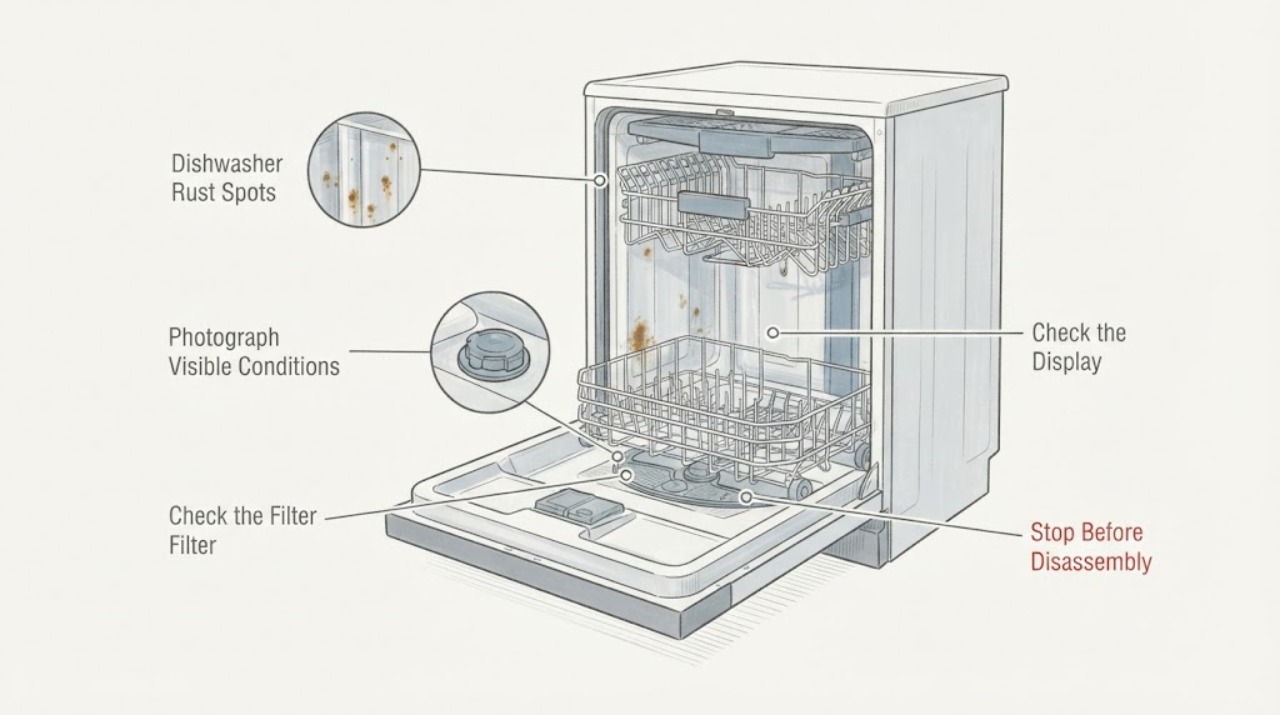
First determine whether the AEG dishwasher has a wipeable deposit or damaged metal. A film that wipes away can be salt or limescale; persistent roughness, pits, flaking or spreading spots are more consistent with damage or corrosion and should not be scrubbed aggressively. With the appliance off, wipe a small accessible area using a soft cloth and inspect the tub, rack coating, filter area and salt-cap area. If the residue is salt or limescale, confirm the water-hardness setting, salt level and salt-cap seal, remove spilled salt, and use only an AEG-approved or dishwasher-specific Machine Care/descaler according to its label and the model manual. AEG’s general guidance says descaler is used once every two months or 60 cycles, so monthly use is not a universal requirement. Never use bleach, chloride cleaners, generic rust remover, steel wool or abrasive pads on the stainless surface. If the metal is pitted, perforated, flaking, leaking or the spots return after correct care, stop experimenting with cleaners and contact AEG or qualified service.
Work through in order
Diagnostic checks
Use only checks that match the exact appliance or system and its official guide.
-
Check 1
Turn the dishwasher off and let accessible surfaces cool. Photograph the spots, then gently wipe one small visible area with a soft damp cloth; do not use a blade, steel wool, scouring pad or chemical rust remover for this identification step.
Expected result: The mark lifts as a film or powder, or it remains attached and the surface feels rough, pitted, flaked or perforated.
Next step: If it is a deposit, continue with the salt, hardness and dishwasher-specific cleaning checks. If the metal is damaged or a leak is present, stop cleaning experiments and arrange AEG or qualified service.
Why this matters
Why: A wipeable film is more consistent with salt, limescale or another deposit than with a failed stainless surface. Persistent roughness, pits, flaking or a hole is evidence of material damage, not a routine scale deposit.
-
Check 2
Inspect the accessible tub bottom, filter area, door edge, rack wires and salt-cap area for spilled salt, a loose salt cap, a chipped rack coating or a foreign rusty item. Do not remove panels or reach into the heater or pump housing.
Expected result: Salt is present outside the reservoir, the cap is not tight, the rack coating is damaged, a rusty item is present, or no external source is visible.
Next step: Wipe up accessible spilled salt with water and a soft cloth, verify the cap according to the model manual, and remove only a dishwasher-safe foreign item. Treat a chipped coating, pitted tub or unexplained recurring spot as a service issue rather than sanding or coating it yourself.
Why this matters
Why: AEG says spilled salt and water-softener problems can leave residues, while damage to a stainless protective layer can allow corrosion. A visible rack or foreign-object source does not prove that the tub itself is rusting.
-
Check 3
Check the dishwasher water-hardness setting, salt indicator/level and rinse-aid setting against the exact AEG manual and local water hardness. Use salt as directed even when multi-tablets are used, and do not increase descaler frequency beyond the product label or model guidance just because spots are visible.
Expected result: The hardness setting is unknown or incorrect, salt is empty or spilled, the cap is loose, or the settings and salt system match the manual.
Next step: Correct only the settings and consumables covered by the exact manual, wipe away salt and run the required empty rinse if salt was spilled. If the residue persists, do not add stronger chemicals; move to the model-specific service boundary.
Why this matters
Why: Incorrect softening or low salt can allow limescale and residue; an apparently correct setting makes a persistent metal defect or another source more important to investigate. Monthly cleaning is not itself proof of the cause.
-
Check 4
If the spot is a removable deposit, run the AEG Machine Care or empty dishwasher-cleaning program with a dishwasher-specific descaler/cleaner exactly as its package and model manual instruct. Leave the door open after the cycle if the manual allows, and inspect the same area after it is dry.
Expected result: The deposit clears without metal damage, decreases but remains, or returns after the cleaning cycle.
Next step: If the spot clears, maintain the documented salt, hardness and cleaning routine. If it remains or returns, stop escalating the chemistry and provide photographs, model/PNC information and the cleaning history to AEG service.
Why this matters
Why: A cleared deposit supports salt/limescale or grease residue as the immediate cause. A persistent or returning spot is not proof that more descaler is needed; it may reflect an ongoing salt/softener issue, a damaged surface, rack corrosion or another source.
-
Check 5
Stop using the dishwasher for testing if you find a hole, sharp flaking metal, a loose rack wire, water leaking from the tub or door, smoke, a burning odor or an electrical symptom. Do not coat, sand, puncture, weld or disassemble the tub or heater as a home remedy.
Expected result: The interior remains intact and dry, or there is structural damage, leakage or another safety symptom.
Next step: Keep the dishwasher off and arrange AEG or qualified service for structural damage, leakage or any electrical symptom. Provide the model/PNC and photographs rather than ordering a generic liner, rack or heater part.
Why this matters
Why: An intact surface can be monitored after correct external care. Structural damage or leakage is outside residue cleaning and can worsen water or electrical risk.
Use your observations
Decision map
Find the observation that best matches what you see, then follow the next safe action.
-
PATH 01Next step
What you see
The mark wipes away as a film or powder and the stainless surface remains smooth.
Do this next
Check the water-hardness setting, salt level and cap, then use the model-approved dishwasher-specific Machine Care/descaler routine; do not use abrasive or chloride chemistry.
Why this path and its safety boundary
Why it matters: The observation is more consistent with salt, limescale or another removable deposit than with corrosion of the tub.
-
PATH 02Next step
What you see
The spot stays attached after gentle wiping and the metal is rough, pitted, flaking or perforated.
Do this next
Stop scraping and chemical experiments, keep the dishwasher out of use if there is a hole or leak, and arrange model-scoped AEG or qualified service.
Why this path and its safety boundary
Why it matters: This is not established as ordinary limescale. AEG explains that damage to the stainless protective layer can expose metal and cause rust spots.
-
PATH 03Next step
What you see
The spots recur after a correct, label-directed Machine Care/descaler cycle and the hardness, salt and cap checks are correct.
Do this next
Stop increasing chemical use and send AEG service the model/PNC, photographs, water-hardness setting, salt history and cleaning product details.
Why this path and its safety boundary
Why it matters: Recurring spots are not evidence that stronger or more frequent descaler will solve the problem; an ongoing source or surface damage remains possible.
-
PATH 04Next step
What you see
There is a leak, hole, sharp flaking metal, smoke, burning odor or an electrical symptom.
Do this next
Stop the appliance and arrange qualified service; do not open panels or attempt a tub, heater or wiring repair.
Why this path and its safety boundary
Why it matters: The issue has crossed the cleaning boundary and may create water, cut or electrical risk.
Helpful context
Understand the symptom
The word rust can describe two different observations in a dishwasher: a removable salt or limescale deposit that has picked up color, or actual damage to a stainless surface or coated rack. The safe next step depends on whether the spot wipes away and whether the metal is smooth, rough, pitted or flaking. Monthly use of a limescale remover does not by itself prove that the cleaner caused corrosion or that the dishwasher needs a replacement part.
The checks below stay with accessible surfaces and the AEG water-softener and cleaning guidance. Use the exact model manual and product label for the program and product dose. Do not scrape the tub, use aggressive acid or chloride chemistry, or open the dishwasher to repair a liner or heater.
When checks do not resolve it
Need a professional?
Provide the full AEG model or PNC, photographs showing whether the spot is on the tub, rack, filter area or door, the water-hardness setting, salt-cap condition, product name and label frequency of the limescale remover, and whether the area is pitted or leaking. Do not order a generic rack, liner, heater or rust-treatment part from the symptom alone.
Common questions
FAQ
Are brown or white spots inside an AEG dishwasher always rust?
No. AEG says wipeable residue can be salt, and a coating that responds to the appropriate limescale check may be hard-water buildup. True surface damage is more concerning when the metal remains rough, pitted, flaking or perforated after gentle wiping.
Is using limescale remover once a month causing the rust?
The frequency alone does not prove causation. AEG's general dishwasher guidance says to use a descaler once every two months or 60 cycles and to follow the product packaging, but the exact model manual and product label control. Do not increase the dose or frequency to chase a persistent spot.
What should I avoid when cleaning rust-looking spots?
AEG warns against chlorides, bleach or disinfectants, stain remover, rust remover, immersion cleaners and abrasive or acid cleaners on stainless steel. Keep the check gentle and use only dishwasher-specific products directed for the exact appliance.
Read the exact guide
Official sources
- Unpleasant odour from the dishwasherAEG · AEG dishwasher accessible cleaning and maintenance boundaries
- Dishwasher leaves white residue on dishes and cutleryAEG · AEG dishwasher salt/limescale residue, salt handling and rinse guidance
- Rust on stainless steel / metal - cleaning productsAEG · AEG appliance stainless-steel rust causes and safe cleaning-product restrictions
- How to prevent limescale build-up in the dishwasher?AEG · AEG integrated and freestanding dishwasher water hardness, salt, Machine Care and descaler guidance
Community feedback
Share a repair observation
Share a plain-text repair observation. Accepted observations are published automatically; this page may take a moment to update.