
On this page
Start here
Quick answer
Check the breaker, external isolator, outlet, remote batteries, timer, and mode before calling for service. Government housing guidance identifies these as common no-start checks and says to consult the manual for an error code. Allow a restart delay after mode changes. Stop for a burning odor, smoke, hot plug, repeated breaker trip, or damaged cord and use a qualified technician.
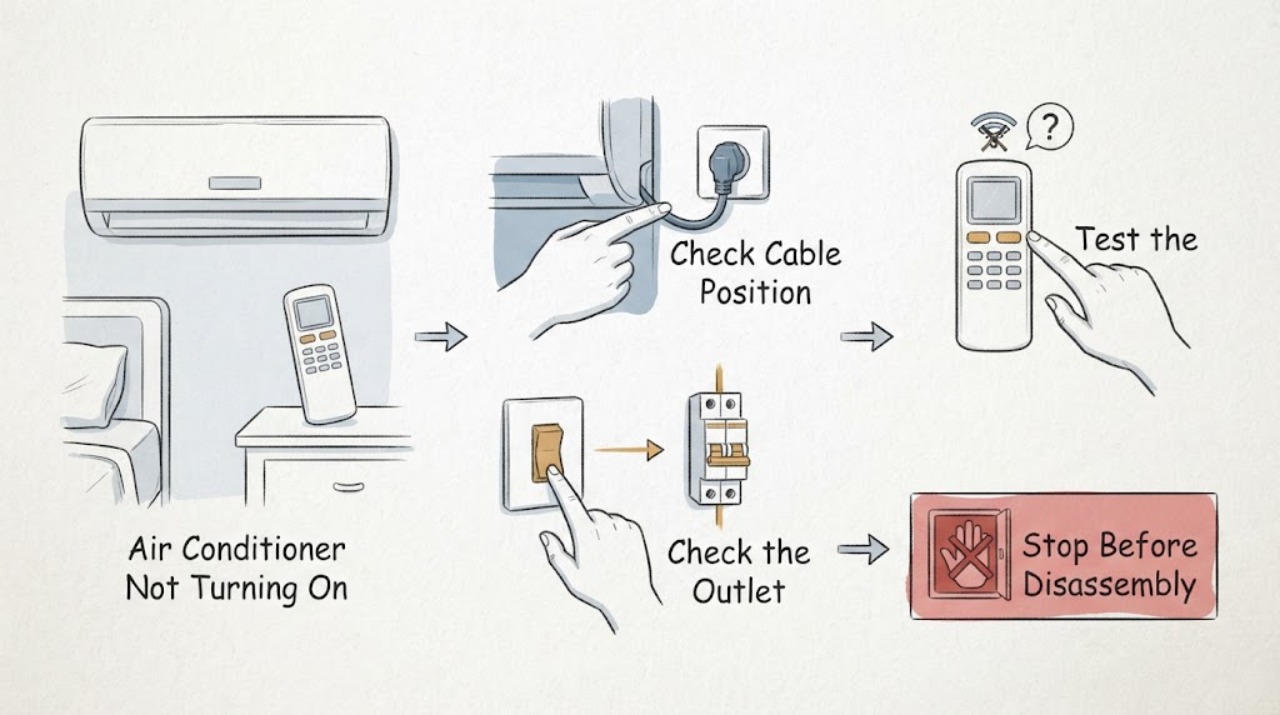
Work through in order
Diagnostic checks
Use only checks that match the exact appliance or system and its official guide.
-
Check 1
Check for smoke, burning odor, hot plug, exposed wire, or repeated breaker operation.
Expected result: A safety warning exists or the unit is normal.
Next step: Disconnect power if safe and arrange qualified service.
Why this matters
Why: A safety symptom overrides routine reset.
-
Check 2
Check the breaker, dedicated isolator, outlet, and visible power cord.
Expected result: Supply is off or normal.
Next step: Restore one obvious switch condition only; service repeated trips.
Why this matters
Why: No display with abnormal supply is a power-path issue.
-
Check 3
Replace remote batteries if needed and confirm the remote display and mode command.
Expected result: Remote is dead, timer is active, or command is received.
Next step: Cancel an accidental timer using the manual and retry once.
Why this matters
Why: A control input can mimic appliance failure.
-
Check 4
Check temperature and operating mode, then wait through the documented restart or mode-change delay.
Expected result: Mode or setpoint is unsuitable, or no response follows the delay.
Next step: Continue only one controlled test.
Why this matters
Why: Protection delays and wrong modes can be normal; no response after them needs diagnosis.
-
Check 5
Clean accessible filters and clear indoor and outdoor airflow paths.
Expected result: Filter or clearance is restricted, or clear.
Next step: Correct accessible obstruction and retest.
Why this matters
Why: Severe restriction can inhibit operation or cause protection.
-
Check 6
Record model, indicators, command, delay, power result, and any code, then stop for recurrence.
Expected result: Unit starts or remains inactive.
Next step: Arrange service with the record.
Why this matters
Why: Persistent no-start after external checks needs electrical/control diagnosis.
Use your observations
Decision map
Find the observation that best matches what you see, then follow the next safe action.
-
PATH 01Next step
What you see
Breaker or isolator is off and the unit is otherwise intact.
Do this next
Restore once and monitor; service a repeat trip.
Why this path and its safety boundary
Why it matters: Supply is the likely cause.
-
PATH 02Next step
What you see
Remote, timer, or mode prevents a start command.
Do this next
Correct using the manual and retest once.
Why this path and its safety boundary
Why it matters: Control input is the likely cause.
-
PATH 03Next step
What you see
Power and commands are normal but no display or response occurs.
Do this next
Arrange service.
Why this path and its safety boundary
Why it matters: Internal control, fuse, or board fault is likely.
-
PATH 04Next step
What you see
Smoke, odor, hot plug, or repeated breaker trip occurs.
Do this next
Disconnect power if safe and obtain qualified service.
Why this path and its safety boundary
Why it matters: Electrical safety risk exists.
Helpful context
Understand the symptom
Separate a completely dead unit from a powered unit that ignores a command. Record indoor and outdoor indicators, remote display, selected mode, and breaker behavior.
Do not open electrical covers or work on refrigerant lines. Use the exact manufacturer manual for reset and error-code meaning.
When checks do not resolve it
Need a professional?
A technician may test supply, fuses, control boards, sensors, fan, and protection circuits.
Common questions
FAQ
What should I check first when an air conditioner will not turn on?
Check breaker, isolator, outlet, remote batteries, timer, mode, and the manual's restart delay.
Can a timer stop an air conditioner starting?
Yes. Check and cancel an accidental timer using the manual.
Should I open the air conditioner cover?
No. Electrical and refrigerant work belongs to qualified service.
When is a no-start unsafe?
Smoke, burning odor, hot plug, damaged cord, or repeated breaker trips require shutdown and service.
Read the exact guide
Official sources
- 家庭用エアコンの設置・修理の工事についてJapan Ministry of Economy, Trade and Industry · Use for safety boundary around electrical AC repair.
- Troubleshooting guidesDepartment of Housing Australia · General household AC guidance; follow the appliance manual for model-specific steps.
Community feedback
Share a repair observation
Share a plain-text repair observation. Accepted observations are published automatically; this page may take a moment to update.