
On this page
Start here
Quick answer
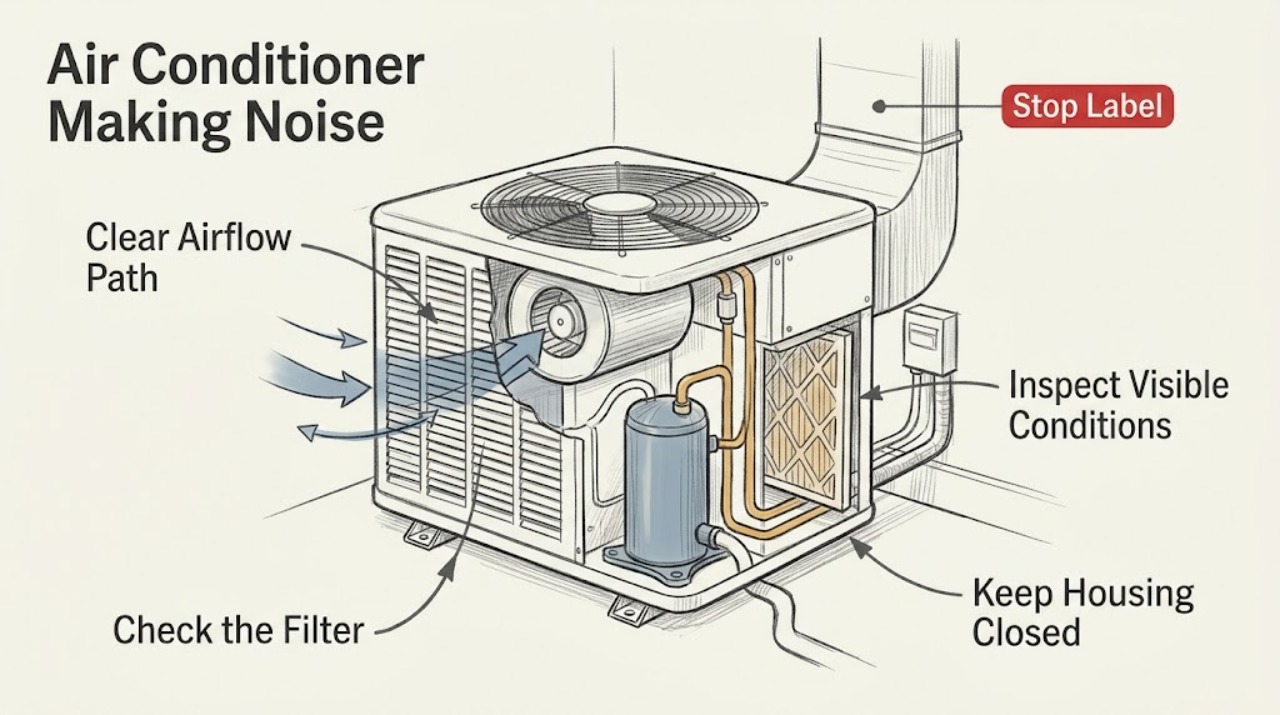
First record where and when your Amana air-conditioner makes the noise: indoors at a vent, at the indoor unit, outdoors, or only when the compressor or fan starts and stops. A soft hum, airflow, brief click, or some cycling sound can be normal, especially when a system is starting, stopping, or changing speed. A sudden change to a buzzing roar, clatter, squeal, grinding sound, severe vibration, or a noise with weak cooling is not a part diagnosis and should be inspected by a licensed HVAC professional. From the user-accessible side, replace or clean the air filter as its instructions allow, make sure supply vents are not blocked, and check that nothing is visibly contacting the cabinet or vent. Do not open the cabinet, reach toward a fan, adjust refrigerant lines, tighten electrical connections, or remove an access panel. Stop the system and arrange urgent professional help for smoke, burning odor, sparks, a hot electrical smell, refrigerant or water leakage, a damaged wire, or repeated breaker trips.
Work through in order
Diagnostic checks
Use only checks that match the exact appliance or system and its official guide.
-
Check 1
From a safe position, describe the noise and its location: indoor vent, indoor cabinet, outdoor cabinet, wall/window, or the surrounding ductwork; note whether it occurs at startup, shutdown, continuously, during airflow, or only during a cooling call.
Expected result: The sound is a soft hum, airflow, click, hiss, ping, vibration, buzz, roar, clatter, squeal, grinding, or scraping, and it may be brief/cycle-related or new/continuous.
Next step: Write down the timing and location for the technician; do not remove a cover or move close to a fan to locate the source. Continue only with the external filter and vent checks when there are no safety warnings.
Why this matters
Why: Brief sounds that follow ordinary compressor, fan, thermostat, or airflow operation can be normal. A significant change from the familiar sound, especially a harsh mechanical or electrical quality, is less likely to be ordinary operation.
-
Check 2
Check the user-accessible air filter and supply/return vents without reaching into the equipment; replace or clean the filter only as its own instructions permit, and make sure vents are not covered.
Expected result: The filter is visibly loaded with dust, a return or supply vent is blocked, several registers are closed, or airflow and the noise remain normal after the filter/vent check.
Next step: Restore only the accessible airflow path and follow the filter maker's replacement guidance. If the sound remains loud, comes from the equipment rather than airflow, or cooling is weak, arrange a licensed HVAC inspection; do not open ductwork or the unit.
Why this matters
Why: Amana says a blocked filter, supply vents, intake ductwork, or too many closed registers can change air pressure and increase noise at the vents. Clearing an external airflow restriction may reduce noise, but it does not rule out a fan, duct, or system fault.
-
Check 3
Observe the outdoor and indoor equipment surroundings from a distance for loose objects, contact with a wall or enclosure, visible debris at the cabinet exterior, or an object vibrating against a grille; do not touch a fan, coil, line, or electrical compartment.
Expected result: The noise changes when a nearby loose object is removed from a safe distance, the cabinet or wall is visibly vibrating, debris is present near an opening, or no external source is visible.
Next step: Remove only an unrelated loose object that is safely reachable without approaching moving equipment. Leave debris near a grille, persistent vibration, or any equipment contact for a licensed HVAC professional; do not reach through a guard or remove it.
Why this matters
Why: A nearby object, installation contact, or debris can amplify vibration or interfere with intended airflow. No visible source does not clear the fan, motor, bearing, compressor, or mounting hardware.
-
Check 4
Compare the noise with cooling performance and thermostat behavior without changing multiple settings: note whether the home still cools, airflow is reduced, the unit runs unusually long, or the thermostat repeatedly calls for cooling.
Expected result: Cooling is stable and the noise is brief/cycle-related, or the noise is paired with weak/no cooling, reduced airflow, unusual cycling, ice, water, or a persistent call for cooling.
Next step: If comfort is stable, document and monitor the familiar pattern. If cooling or airflow is impaired, stop experimenting with settings and arrange a licensed HVAC service visit; do not add refrigerant or inspect sealed components yourself.
Why this matters
Why: Amana notes that variable-speed systems may run longer at lower capacity, so duration alone does not prove failure. A changed noise with poor cooling or airflow makes a fan, compressor, refrigerant, drain, filter, duct, or control issue more concerning.
-
Check 5
Check the thermostat display and visible disconnect/breaker status only from a dry, safe position, and note any error, power interruption, or protective-device trip; do not open the electrical box or panel.
Expected result: The thermostat is normal, the system has power, a breaker or disconnect opened, the display is blank, or the noise is accompanied by smoke, burning odor, sparks, a hot smell, or visible damage.
Next step: For smoke, sparks, burning odor, heat, or visible damage, move away and use emergency help as appropriate. For a repeated trip or blank display, leave the system off and call a licensed HVAC professional or electrician; do not reset protection repeatedly or access the panel.
Why this matters
Why: A protective-device event or electrical warning is not a normal operating noise. A blank display may involve the control or supply, while a trip can indicate an electrical or equipment fault; neither result identifies a part safely.
-
Check 6
Note whether the sound comes from a room vent and whether the filter, vents, or registers are restricted; do not remove a grille or enter the duct to investigate.
Expected result: The unusual noise is strongest at a vent, several vents echo it, airflow is weak, or the vent noise is new despite an open, clean airflow path.
Next step: Keep accessible vents open and the filter maintained as instructed. If the noise remains or airflow is reduced, arrange a licensed HVAC dealer to inspect the duct and system; do not seal, cut, or dismantle ductwork yourself.
Why this matters
Why: Amana says pressure imbalance, blocked filters or vents, intake duct problems, closed registers, debris, or loose/ill-fitting ducts can increase or echo noise through vents. A persistent vent noise needs professional airflow/duct inspection rather than an internal appliance check.
-
Check 7
Gather the Amana model number and serial information from paperwork, the thermostat, or a safe visible label without opening equipment, and prepare the noise description and observations for service.
Expected result: The model is known and the sound is repeatable, or the model cannot be safely located and the noise is intermittent or not reproducible.
Next step: Contact a licensed HVAC dealer for a significant or persistent sound change, and report any cooling, airflow, electrical, water, or safety symptoms. Do not order a component from the noise alone.
Why this matters
Why: Amana says model information helps the technician and that homeowners should not open equipment to find it. A repeatable timing/location description is more useful than guessing whether a fan, motor, compressor, or duct is at fault.
Use your observations
Decision map
Find the observation that best matches what you see, then follow the next safe action.
-
PATH 01Next step
What you see
Do this next
Monitor the pattern and record when it occurs. Escalate if it becomes substantially louder, harsh, continuous, or is joined by poor cooling, water, odor, heat, or an electrical warning.
-
PATH 02Next step
What you see
Do this next
Stop trying to identify the part by opening the unit and arrange a licensed HVAC inspection. Keep clear of the outdoor fan and do not run the system with a guard or access panel removed.
-
PATH 03Next step
What you see
Do this next
Restore the accessible filter and vent path as instructed. If the noise or weak airflow persists, have a licensed HVAC dealer inspect ductwork and system airflow; do not dismantle ducts.
-
PATH 04Next step
What you see
Do this next
Arrange a licensed HVAC service visit and report the noise and performance pattern. Do not add refrigerant, open the cabinet, or operate the system through a worsening fault.
-
PATH 05Next step
What you see
Do this next
Move away and use emergency help as appropriate for active smoke or fire. Otherwise leave the system off and contact a licensed HVAC professional or electrician; do not reset protection repeatedly or touch exposed equipment.
Helpful context
Understand the symptom
The sound pattern is the useful clue
Amana explains that an air conditioner creates sound when it starts, stops, moves air, and transfers heat. A single-stage system may switch on and off distinctly, while two-stage or variable-speed equipment may run longer at lower output. That means a longer or softer cycle is not automatically a failure. The important change is from a familiar soft hum or airflow sound to a new, harsh, continuous, or rapidly worsening noise, especially when cooling or airflow also changes.
Normal-sounding does not mean every noise is harmless
Air movement, compressor operation, pressure changes in refrigerant tubing, and some installation vibration can all be audible. Amana also lists loose parts, motor or bearing wear, debris, out-of-balance components, rubbing piping, dirty coils or filters, and compressor issues as possible reasons a sound changes. Those are possible causes, not a homeowner parts list. The sound should be documented and escalated when it is substantially different or paired with a performance or safety symptom.
Keep the inspection external
User checks should stay at the thermostat, filter, visible vents, accessible cabinet surroundings, and the sound itself. Do not remove an access panel, touch a fan or compressor, inspect refrigerant lines by handling them, tighten electrical connections, or attempt an internal test. Amana's HVAC support materials direct homeowners toward a licensed dealer for diagnosis and ask that model information be gathered without opening equipment.
When checks do not resolve it
Need a professional?
Arrange licensed HVAC service for a sudden or substantial sound change, buzzing roar, clatter, squeal, grinding, severe vibration, persistent vent noise, weak airflow, poor cooling, water/ice, or unusual cycling. Stop the system and obtain urgent qualified or emergency help for smoke, sparks, burning odor, hot electrical smell, visible damage, refrigerant or water leakage near electrical parts, or repeated breaker/disconnect trips. Keep the system off when the condition is unsafe.
Common questions
FAQ
Is it normal for an Amana air conditioner to make noise?
Some noise is expected when a system starts, stops, moves air, and transfers heat. A soft hum, airflow sound, brief click, or cycle-related tone can be normal, but a sudden change to a harsh, loud, continuous, or mechanical sound should be inspected by a licensed HVAC professional, especially if cooling or airflow changes.
Why is my Amana air conditioner rattling or clattering?
Amana lists loose parts, debris, imbalance, worn bearings or motor components, rubbing piping, dirty coils or filters, and compressor issues as possible reasons a sound changes. Check only for safely reachable external objects and filter/vent restrictions. Do not open the unit; arrange licensed HVAC service if the sound persists or worsens.
Why is the noise loudest at my air vents?
A blocked filter or supply/return vent, closed registers, intake duct restriction, pressure imbalance, debris, or loose duct can increase or echo sound through the vents. Restore the accessible filter and vent path as instructed. If noise or weak airflow remains, have a licensed HVAC dealer inspect the ductwork and system.
Does a long-running Amana air conditioner mean the compressor is failing?
Not necessarily. Amana explains that two-stage and variable-speed systems may run longer at lower output to maintain comfort. Long operation becomes more concerning when paired with a significant sound change, weak or absent cooling, reduced airflow, ice, water, or repeated cycling; those symptoms need professional evaluation.
Can I open my Amana air conditioner to find the noisy part?
No. Keep the inspection external. Do not remove a cabinet or access panel, touch fans or compressors, handle refrigerant lines, tighten electrical connections, or run the system with a guard removed. Record the sound and arrange a licensed HVAC inspection instead.
Read the exact guide
Official sources
- Common Noises and Sounds for Air ConditionersWhirlpool Product Help · Official manufacturer guidance used only as general air-conditioner sound context; it is not a model-specific Amana diagnosis or service instruction.
- Air Conditioner SoundsAmana brand HVAC · Direct Amana HVAC guidance on normal sound patterns, changed noises, airflow, and professional inspection; exact equipment design and service procedure vary by model.
- The Air Conditioning Repair Service CallAmana brand HVAC · Direct Amana HVAC service-routing guidance; it is not a homeowner repair procedure or a model-specific noise diagnosis.
Community feedback
Share a repair observation
Share a plain-text repair observation. Accepted observations are published automatically; this page may take a moment to update.