
On this page
Start here
Quick answer
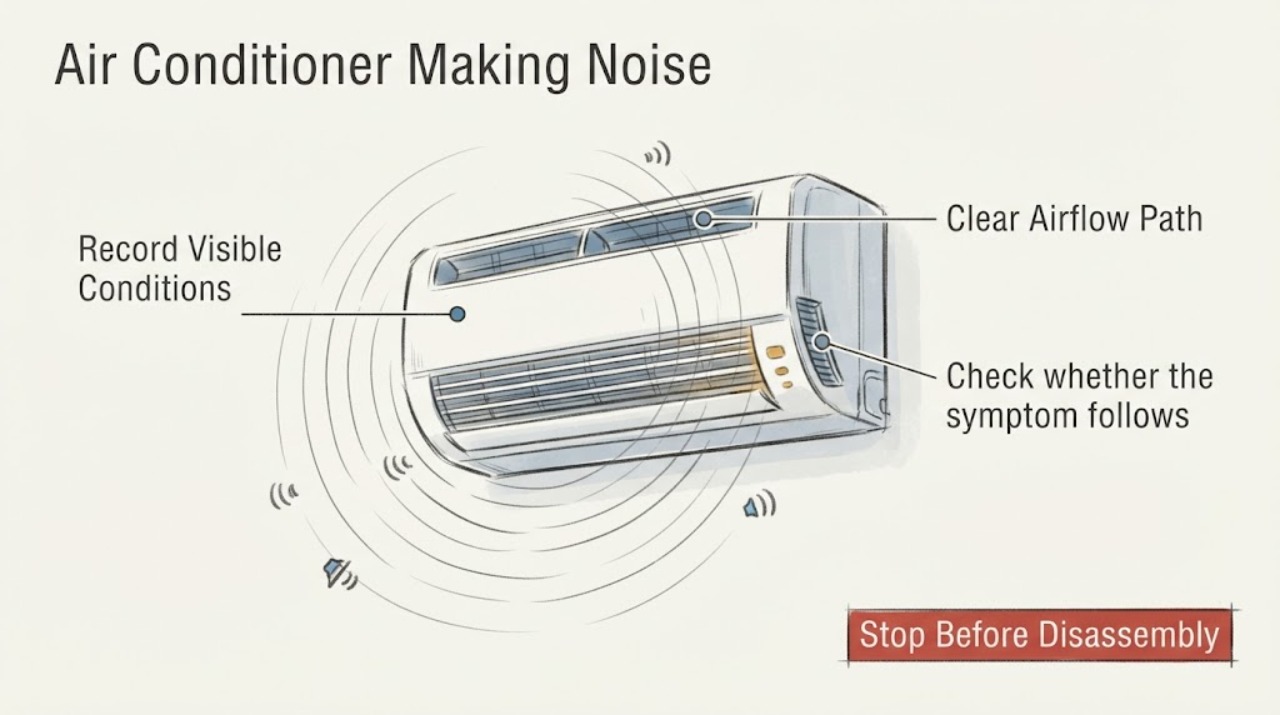
For an air conditioner that is making noise, record the unit type, model, room conditions, controls, airflow and any water or ice. Check only the accessible filter, airflow, installation and control conditions documented for that unit; stop for electrical or refrigerant hazards and arrange qualified HVAC service when the symptom persists.
Work through in order
Diagnostic checks
Use only checks that match the exact appliance or system and its official guide.
-
Check 1
Record the unit type, model, room size, operating mode, setpoint, airflow, and any water or ice.
Expected result: The condition is present, absent, or returns after the check.
Next step: Follow the exact model manual for the documented external check; stop and contact qualified service if the condition persists.
Why this matters
Why: This observation narrows the safe next step but does not identify a universal internal part.
-
Check 2
Check the filter, intake and discharge for blockage and verify the unit is level and installed as the manual requires.
Expected result: The condition is present, absent, or returns after the check.
Next step: Follow the exact model manual for the documented external check; stop and contact qualified service if the condition persists.
Why this matters
Why: This observation narrows the safe next step but does not identify a universal internal part.
-
Check 3
Check whether the symptom follows one mode or setting and whether the room capacity and installation are appropriate.
Expected result: The condition is present, absent, or returns after the check.
Next step: Follow the exact model manual for the documented external check; stop and contact qualified service if the condition persists.
Why this matters
Why: This observation narrows the safe next step but does not identify a universal internal part.
-
Check 4
Stop and arrange HVAC service if the symptom persists after one documented external correction.
Expected result: The condition is present, absent, or returns after the check.
Next step: Follow the exact model manual for the documented external check; stop and contact qualified service if the condition persists.
Why this matters
Why: This observation narrows the safe next step but does not identify a universal internal part.
Use your observations
Decision map
Find the observation that best matches what you see, then follow the next safe action.
-
PATH 01Next step
What you see
The symptom clears after the documented external check and the product remains cool, dry, intact, and otherwise normal.
Do this next
Use the exact model guide and arrange qualified service when the symptom persists or access would require internal disassembly.
Why this path and its safety boundary
Why it matters: A documented setting, obstruction, airflow, water path, or model-specific fault is more likely than a universal part diagnosis.
-
PATH 02Next step
What you see
The symptom persists, returns, or affects more than one function after the model-approved check.
Do this next
Use the exact model guide and arrange qualified service when the symptom persists or access would require internal disassembly.
Why this path and its safety boundary
Why it matters: A documented setting, obstruction, airflow, water path, or model-specific fault is more likely than a universal part diagnosis.
-
PATH 03Next step
What you see
Smoke, fire, sparks, arcing, gas, abnormal heat, swelling, or damaged electrical parts are present.
Do this next
Use the exact model guide and arrange qualified service when the symptom persists or access would require internal disassembly.
Why this path and its safety boundary
Why it matters: A documented setting, obstruction, airflow, water path, or model-specific fault is more likely than a universal part diagnosis.
Helpful context
Understand the symptom
Identify the product before repair
The opened official material supports safe external checks and model identification. It does not justify choosing an internal replacement part from a symptom alone.
When checks do not resolve it
Need a professional?
Contact qualified or authorised service when the exact manual does not resolve the symptom, when it returns after one documented check, or when internal electrical, heating, motor, sealed-system, gas, or refrigerant work would be required. Provide model, serial, symptom timing, and observations.
Common questions
FAQ
Can I choose a replacement part from the symptom alone?
No. The opened official guidance is model-specific and does not establish a compatible internal part from the symptom alone.
Should I keep resetting the appliance?
Use only the exact manual’s documented reset once when safe. If the symptom returns, stop and arrange service.
Read the exact guide
Official sources
- Room Air ConditionersENERGY STAR · Opened official guidance; use the exact product manual and model identity before any model-specific repair.
Community feedback
Share a repair observation
Share a plain-text repair observation. Accepted observations are published automatically; this page may take a moment to update.