
On this page
Start here
Quick answer
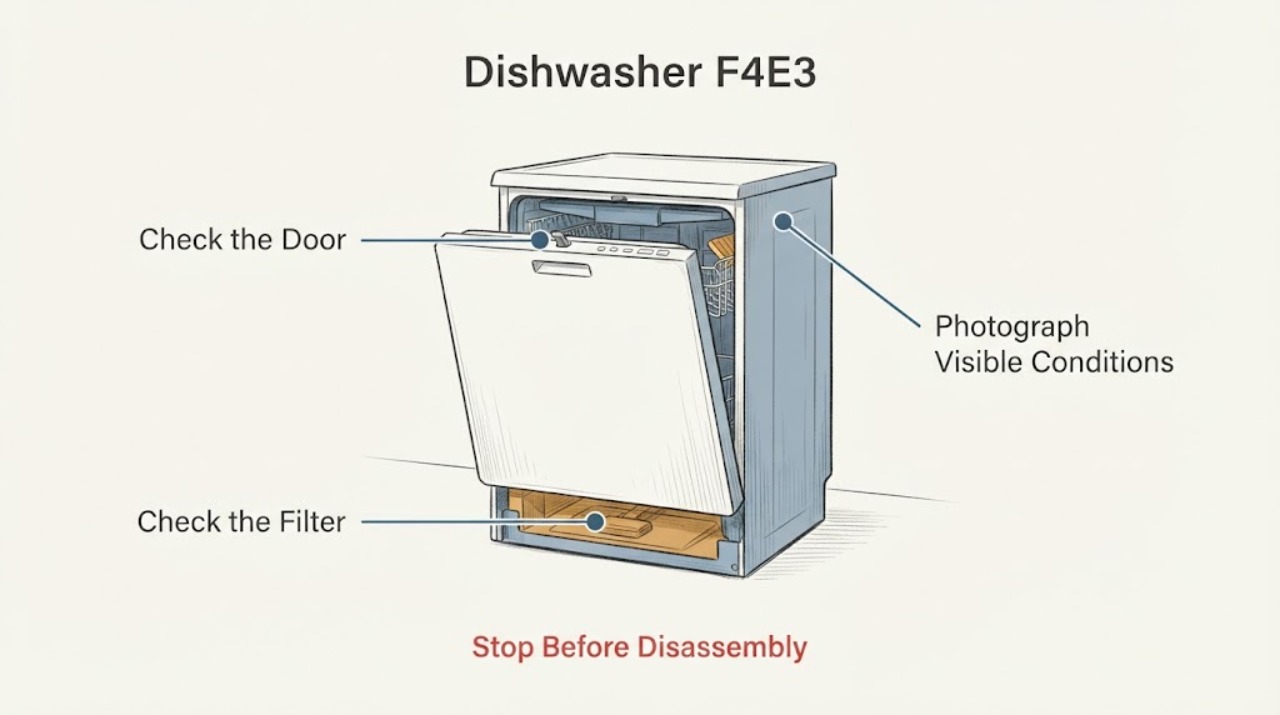
For the Amana ADB1300AFS1, Amana's official dishwasher guidance defines F4E3 as a heating error and recommends one 30-second power disconnection; if the code returns, it directs you to schedule service. That is not a confirmed wash-pump or circulation-motor diagnosis, so do not buy a replacement part from the code alone. Record whether the dishwasher actually filled, whether water remained in the tub, and whether a spray or wash sound was observed on the already-failed run. After safe visual checks, use only the single official power-cycle instruction; if F4E3 returns or the unit still does not wash, stop and arrange qualified service.
Work through in order
Diagnostic checks
Use only checks that match the exact appliance or system and its official guide.
-
Check 1
Photograph or transcribe the complete F4E3 display, or if only the Clean light flashes, count the first and second flash groups and the pauses until the pattern repeats. Record the cycle stage and the moment the dishwasher stopped washing.
Expected result: The display may show F4E3 directly, or the light sequence may be a different two-part code; the unit may have stopped after filling, during washing, or later in the cycle.
Next step: Keep the photo or flash count with the ADB1300AFS1 model number and do not keep restarting the dishwasher to reproduce it.
Why this matters
Why: A complete code determines whether Amana's heating-error guidance applies. A partial or miscounted pattern could send the diagnosis to the wrong category.
-
Check 2
Use the already-failed run and any safe prior observation to note whether water entered the tub, whether standing water remained at the end, and whether a normal spray or wash sound was heard; do not open the door near moving spray arms or start another cycle just to listen.
Expected result: The dishwasher may have filled but stayed quiet, filled and sprayed before stopping, never filled, or left water in the tub.
Next step: Send the fill, sound, and standing-water pattern with the code to service rather than selecting a part from the symptom.
Why this matters
Why: Filled-but-quiet and never-filled are different symptom paths from a heating error. These observations can guide service, but none proves a wash pump, inlet valve, heater, or control failure.
-
Check 3
With the dishwasher powered off and the interior safe to access, inspect only the visible filter and spray-arm openings for a heavy food blockage or an object that is plainly interfering; do not remove panels, reach into the pump area, or use tools to force a part.
Expected result: The visible filter or spray openings may be clear, visibly obstructed, or inaccessible without moving the appliance or opening its base.
Next step: Remove only loose, visible debris if the owner's manual permits it and the appliance remains safe; if access requires disassembly or the code persists, stop and arrange service.
Why this matters
Why: A plainly visible blockage can explain poor washing independently of F4E3, while clear visible parts do not identify an internal circulation or heating component.
-
Check 4
Confirm the complete model label from the normal dishwasher location at the top-left of the tub opening and compare it with ADB1300AFS1 before using any Amana manual or code table.
Expected result: The label may confirm ADB1300AFS1, show a different suffix, or be missing or unreadable.
Next step: Use only the manual matching the complete label. If the identity cannot be confirmed, give the label photo and F4E3 record to qualified service instead of using another model's part list.
Why this matters
Why: Amana's manuals and user steps are model-driven; a different suffix can change the control and service information even when the cabinet looks similar.
-
Check 5
Only if there is no active leak, smoke, burning smell, heat damage, or electrical concern, follow Amana's single power-cycle instruction: disconnect the dishwasher from power for 30 seconds, restore power, and observe the panel without repeatedly running cycles.
Expected result: F4E3 may clear, return immediately, return after a function is selected, or be replaced by another code or an unresponsive panel.
Next step: Stop after this one permitted reset. If F4E3 returns or the dishwasher still does not wash, schedule qualified service and do not order a replacement part from the code alone.
Why this matters
Why: A one-time clear can indicate a transient control state but does not prove that the heating or washing problem is repaired. A returning code is Amana's service boundary.
Use your observations
Decision map
Find the observation that best matches what you see, then follow the next safe action.
-
PATH 01Next step
What you see
F4E3 is confirmed on the ADB1300AFS1 and the dishwasher filled but did not produce a normal wash or spray action.
Do this next
Perform only the visible filter/spray-arm check and one official 30-second power cycle if safe. If the code returns or washing remains absent, arrange service without buying a part.
Why this path and its safety boundary
Why it matters: The no-wash symptom needs to be reported alongside Amana's heating-error code; the combination does not prove a wash pump or circulation motor is the failed part.
-
PATH 02Next step
What you see
The dishwasher never filled, or it filled and left standing water, while the code or light pattern is not confirmed as F4E3.
Do this next
Recount the complete two-part pattern and use the exact ADB1300AFS1 manual. Do not substitute another Amana code or diagnose a pump, valve, or control from the symptom.
Why this path and its safety boundary
Why it matters: The symptom may belong to a water-inlet or drain category rather than the heating-error guidance, and a partial flash count cannot safely decide which one.
-
PATH 03Next step
What you see
F4E3 clears after the one official power cycle and the dishwasher later completes a normal cycle without a leak or abnormal behavior.
Do this next
Record the event and monitor without repeated resets. Stop and arrange service if F4E3, no-wash behavior, poor cleaning, or another code returns.
Why this path and its safety boundary
Why it matters: The event may have been transient, but clearing the code does not prove the heating system or wash action is permanently healthy.
-
PATH 04Next step
What you see
F4E3 returns after the power cycle, the panel remains unresponsive, or the unit still does not wash.
Do this next
Stop troubleshooting and provide service with the exact model, code photo, cycle stage, fill/spray/standing-water observations, and reset result. Do not open the base or control area.
Why this path and its safety boundary
Why it matters: Amana's published user path has been exhausted; the remaining heating, circulation, sensing, wiring, or control cause requires qualified diagnosis.
-
PATH 05Next step
What you see
There is an active leak, water near electrical parts, smoke, a burning odor, sparks, melted material, or repeated breaker operation.
Do this next
Stop the dishwasher, close the water supply if safely accessible, keep clear of electrical hazards, and obtain urgent qualified appliance or electrical help. Do not reset or run another cycle.
Why this path and its safety boundary
Why it matters: Water or electrical safety takes priority over clearing F4E3 or evaluating washing performance.
Helpful context
Understand the symptom
F4E3 changes the first question. On Amana's official dishwasher page it is labeled a heating error, not a published wash-motor or circulation-pump replacement instruction. A dishwasher can still have a separate no-spray symptom, but the error and the symptom must be kept separate until the exact service diagnosis is available.
The ADB1300AFS1 model identity should remain attached to the evidence. Amana's manual page accepts the model number for product literature and identifies the dishwasher model label at the top-left of the tub opening. If the panel only flashes the Clean light, count the two groups and pauses before calling it F4E3; Amana documents that as the way its dishwasher communicates two-part codes.
When checks do not resolve it
Need a professional?
Arrange qualified Amana appliance service if F4E3 returns after the single official power cycle, the dishwasher still does not wash, the panel is unresponsive, the exact model or light code cannot be confirmed, or diagnosis would require a pump, heater, valve, wiring, base, or control-area access. Stop immediately for a leak, water near electrical parts, smoke, burning odor, sparks, melted material, or repeated breaker operation.
Read the exact guide
Official sources
- F4E3 - Dishwasher - Product Help | AmanaAmana · The opened official page labels F4E3 as a heating error, prescribes one 30-second power disconnection, and says to schedule service if the code returns. This is the primary code evidence for the assigned Amana ADB1300AFS1 and does not identify a replacement part.
- Manuals and Guides | AmanaAmana · The opened Amana manuals page requires a model-number search and identifies dishwasher model labels at the top-left of the tub opening. It supports identity confirmation for ADB1300AFS1 but does not provide a part compatibility claim.
- Clean Light Flashing - Dishwasher - Product Help | AmanaAmana · The opened page explains how Amana dishwasher Clean-light flashes communicate two-part F/E codes; it is used to verify whether the assigned ADB1300AFS1 display is actually F4E3 before applying the code page.
Community feedback
Share a repair observation
Share a plain-text repair observation. Accepted observations are published automatically; this page may take a moment to update.