
On this page
Start here
Quick answer
When an AEG dishwasher is not washing dishes cleanly, first check water access to the load rather than assume a failed pump. Load dishes so they do not block the spray arms, select a programme suited to the soil level, check the filters and sump, and clean the spray arms and door gasket with the appliance off. Use Machine Care or an AEG-approved dishwasher-cleaning product when buildup is present and follow the model manual for controls that differ. If dishes remain dirty after those checks, the dishwasher leaves water, will not heat, stops mid-cycle, leaks, or shows a fault, stop experimenting and arrange AEG service.
Before you begin
Safety first
- Turn off and disconnect the dishwasher before filter or spray-arm cleaning. Do not use abrasive/strong chemicals, reach into an inaccessible pump, improvise upper-arm removal, or infer and replace a wash pump/heater/valve without model-specific service evidence.
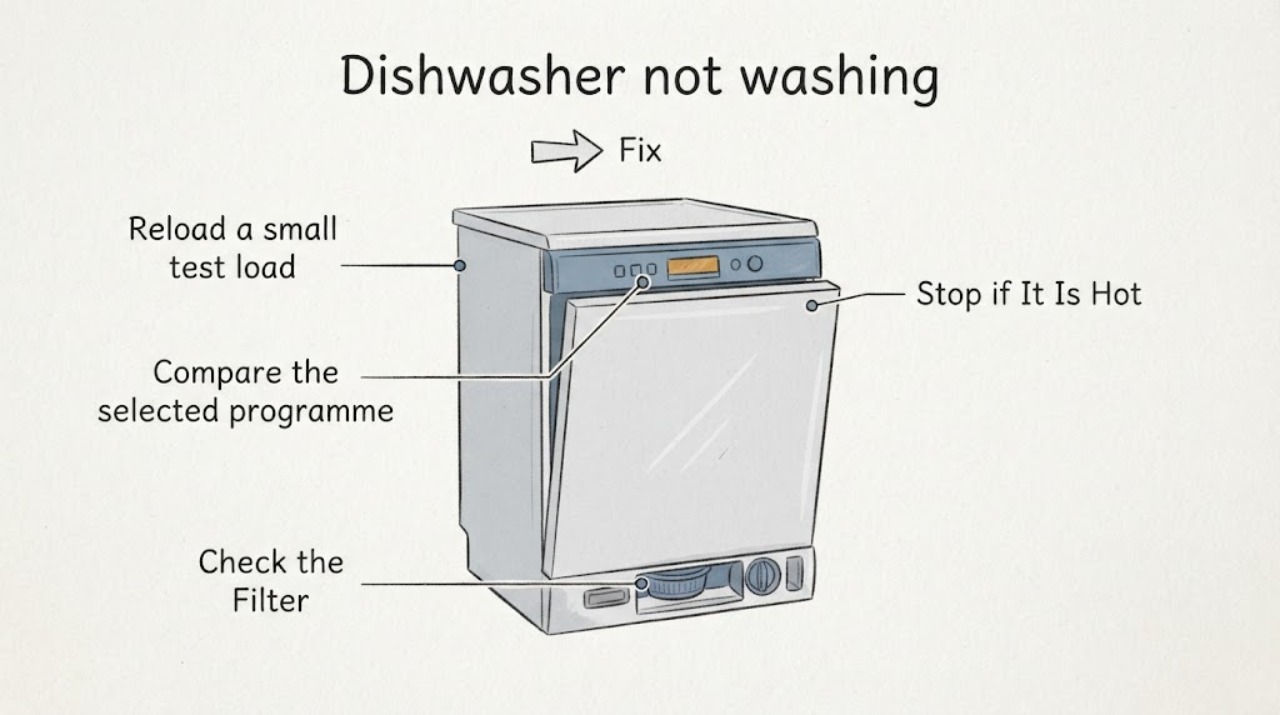
Work through in order
Diagnostic checks
Use only checks that match the exact appliance or system and its official guide.
-
Check 1
Reload a small test load so dishes do not touch, overlap, or block the spray arms, and make sure tall items are in the rack position allowed by the model manual.
Expected result: A spray arm was blocked or dishes were shielded/overlapping, or the load was already correctly spaced.
Next step: Run the model-appropriate programme once with the corrected load; do not call a component failed from a single overloaded cycle.
Why this matters
Why: Blocked water flow can leave particular dishes dirty even when the programme completes. A correctly spaced load that remains dirty shifts attention to programme, detergent, filters, spray arms, and maintenance.
-
Check 2
Compare the selected programme with the load type and soil level, and check the detergent type and measured amount against the appliance and detergent instructions.
Expected result: A short/light-soil programme was used for dried or heavy soil, detergent was unsuitable or unmeasured, or the programme and detergent were appropriate.
Next step: Choose the model-approved programme for the soil and use the instructed detergent amount; repeat the controlled test load.
Why this matters
Why: AEG says a Quick programme may not clean very dirty dishes and provides different programme scopes for light versus normal/heavy residue. More detergent is not a substitute for the correct programme.
-
Check 3
Turn off and disconnect the dishwasher, then inspect the filters and sump for food, glass, plastic, or other debris; clean and reassemble only the user-accessible parts described in the manual.
Expected result: Debris or deposits are present, or filters and sump are clear and correctly installed.
Next step: Clean and reinstall the supported parts, then run the appropriate test programme. Stop if water remains, parts are damaged, or the error returns.
Why this matters
Why: AEG says foreign objects in filters or the sump reduce cleaning performance and can damage the drain pump. Clear filters do not prove the pump or heater is working, but they remove a supported external cause.
-
Check 4
With power disconnected, rinse the spray arms, clear blocked holes only as the model manual allows, and wipe the door gasket and reachable interior with a soft damp cloth.
Expected result: Spray-arm holes or the gasket/interior have visible soil or are clear; upper-arm removal instructions are or are not confirmed for the model.
Next step: Clean and refit the arms according to the manual. If the holes are clear and the result remains poor, move to Machine Care/service rather than dismantling the wash system.
Why this matters
Why: AEG links clogged spray-arm holes with unsatisfactory washing results and says the upper spray-arm procedure varies by model. Abrasive products and sharp or improvised tools can damage the appliance.
-
Check 5
If buildup or odor is present, run the model's Machine Care programme empty or use a dishwasher-specific cleaner according to the AEG and product instructions.
Expected result: The maintenance cycle improves the next load, or dishes remain dirty and the machine leaks, leaves water, stops, fails to heat, or shows a fault.
Next step: Use the complete model number to arrange AEG service for a persistent fault; stop use for leakage, electrical odor, unsafe heat, or repeated failure to complete a cycle.
Why this matters
Why: Maintenance can remove grease and limescale buildup, but persistent poor washing or a heating/drain/leak symptom needs diagnosis beyond the general cleaning guide.
Use your observations
Decision map
Find the observation that best matches what you see, then follow the next safe action.
-
PATH 01Next step
What you see
A small, correctly spaced load cleans after the programme is changed to match its soil level.
Do this next
Use the appropriate rack arrangement and programme for similar loads, following the model manual.
Why this path and its safety boundary
Why it matters: The original problem was consistent with blocked spray flow or an unsuitable short/light-soil programme rather than a confirmed internal failure.
-
PATH 02Next step
What you see
Filters, sump, or spray-arm holes contain debris and the next controlled load improves after cleaning.
Do this next
Keep the filters and spray arms clean using the safe model procedure and avoid sharp or abrasive cleaning methods.
Why this path and its safety boundary
Why it matters: Restricted water circulation or trapped soil was a supported external contributor to the poor result.
-
PATH 03Next step
What you see
The load remains dirty after correct loading, programme, detergent, filters, spray arms, and Machine Care, or the dishwasher leaves water, fails to heat, leaks, stops, or displays a fault.
Do this next
Stop repeated testing and arrange an authorized AEG technician with the full model number, programme, load type, and observed result.
Why this path and its safety boundary
Why it matters: The general user-level checks no longer explain the symptom; the evidence does not identify a particular pump, heater, valve, or control component.
-
PATH 04Next step
What you see
Cleaning requires opening an inaccessible pump, removing an upper spray arm not covered by the model manual, or using abrasive/strong chemical treatment.
Do this next
Leave the part in place and use the exact manual or qualified service; do not improvise a teardown or cleaning chemical.
Why this path and its safety boundary
Why it matters: The requested action is outside the safe, model-supported user checks.
Helpful context
Understand the symptom
“Not washing” can mean food remains on dishes, a film or residue is left behind, or the cycle completes without the expected cleaning effect. AEG's manufacturer guidance starts with water reaching every item: loading, programme choice, detergent, filters, the sump, and spray-arm holes. Because AEG models have different programmes and spray-arm arrangements, keep model-specific controls and removal steps in the owner's manual.
Load for unobstructed water flow
With the dishwasher empty and cool, check how the racks and dishes were arranged. Tall pans, utensils, or overlapping plates can block a spray arm or shield another item. Reload so items do not touch or obstruct the spray path, and use the rack positions described in the manual. If a small, correctly loaded test load cleans normally, the earlier result points toward loading or programme selection rather than a confirmed internal fault.
Match the programme and detergent to the soil
Choose a programme suited to the load and how dry or heavy the soil is. AEG warns that a Quick programme may not clean very dirty dishes; its programme guide also distinguishes short cycles for light residue from longer programmes for normal, heavy, or dried-on residue. Use the detergent type and amount specified for the appliance and detergent, and do not treat more detergent as a repair.
Clean the filters and sump safely
Turn the dishwasher off, disconnect it, and inspect the filters and sump for food, glass, plastic, or other debris. AEG says foreign objects reduce cleaning performance and can damage the drain pump. Clean only the user-accessible parts and reinstall them correctly; do not reach into an inaccessible pump or use sharp tools beyond the model's instructions.
Clear spray-arm holes and clean the gasket
With power disconnected, rinse the spray arms and clear blocked holes using the method in the model manual. AEG notes that the upper spray-arm arrangement varies by model. Wipe the door gasket and reachable interior with a soft damp cloth; avoid abrasive pads, strong chemicals, solvents, or improvised tools. A clogged spray arm or dirty seal can reduce results without proving a failed wash pump.
Run maintenance before arranging service
If buildup, grease, or limescale is present, run Machine Care if your model has it, or use a dishwasher-specific cleaner exactly as directed. AEG describes Machine Care as an empty maintenance programme and recommends regular care; do not put dishes or unapproved chemicals in that cycle. If the same load remains dirty after correct loading, programme, filters, spray arms, and maintenance, use the model number to request service.
When checks do not resolve it
Need a professional?
Arrange AEG service when dishes remain dirty after the documented loading, programme, detergent, filter, spray-arm, and Machine Care checks, or sooner for a leak, abnormal heat, electrical odor, standing water, repeated stop, or fault message.
Safety scope: Turn off and disconnect the dishwasher before filter or spray-arm cleaning. Do not use abrasive/strong chemicals, reach into an inaccessible pump, improvise upper-arm removal, or infer and replace a wash pump/heater/valve without model-specific service evidence.
Have this ready
- Full model number, load type and soil level, programme and options, detergent, whether filters/sump or spray arms were blocked, whether water remains, and any leak, heat, noise, stop, or fault indication.
Common questions
FAQ
Can a Quick programme cause an AEG dishwasher to leave dishes dirty?
Yes, if the load is very dirty or dried on. AEG says Quick is not intended to provide good results for very dirty dishes; choose the programme suited to the soil level in the model manual.
Should I clean the AEG dishwasher filters when it is not washing well?
Yes, but turn the appliance off and disconnect it first. Check the filters and sump for food, glass, plastic, or other debris, then reinstall the filters correctly according to the manual.
Can I remove every AEG spray arm to clean it?
No. AEG says upper spray-arm removal varies by model. Clean and refit it only according to the exact manual; do not force a mounting part or use sharp tools beyond the supported method.
When does an AEG dishwasher that is not washing need service?
Request service when the result remains poor after correct loading, programme, detergent, filter, spray-arm, and Machine Care checks, or when the dishwasher leaks, leaves water, fails to heat, stops, or shows a fault.
Read the exact guide
Official sources
- Dishwasher not cleaning properlyAEG Support · AEG dishwashers; loading, programme, detergent, filters/sump, gasket, spray-arm, maintenance and service guidance for poor cleaning results
- How to clean and maintain your AEG dishwasherAEG Support · AEG dishwashers; safe filter, sump, gasket, spray-arm and Machine Care maintenance with model-dependent upper-arm instructions
- Symbols & programmes on your AEG dishwasherAEG Support · AEG dishwashers; model-dependent programme, touch-panel, soil-level and Machine Care scope
Community feedback
Share a repair observation
Share a plain-text repair observation. Accepted observations are published automatically; this page may take a moment to update.