
On this page
Start here
Quick answer
Moving into an apartment does not establish that the Amana dishwasher is new or identify what was previously used in it. First stop and classify the smell. Amana says a hot-tar or petroleum odor can be normal in a new dishwasher because of sound-deadening material and should dissipate in 4–6 weeks; that explanation applies only when the appliance is actually new and the odor is not accompanied by heat damage, smoke or electrical signs. A food, stagnant-water or detergent-residue odor can come from the tub, filter, spray-arm area or a drain connected to a garbage disposal. If the smell is burning, electrical, gas-like, sharply chemical after an unknown product, or comes with smoke, melting, a hot plug, a leak or symptoms, stop using the dishwasher, ventilate or leave the area as appropriate, and contact the landlord/property manager and qualified service; do not mix cleaners or run another heated cycle to test it.
Work through in order
Diagnostic checks
Use only checks that match the exact appliance or system and its official guide.
-
Check 1
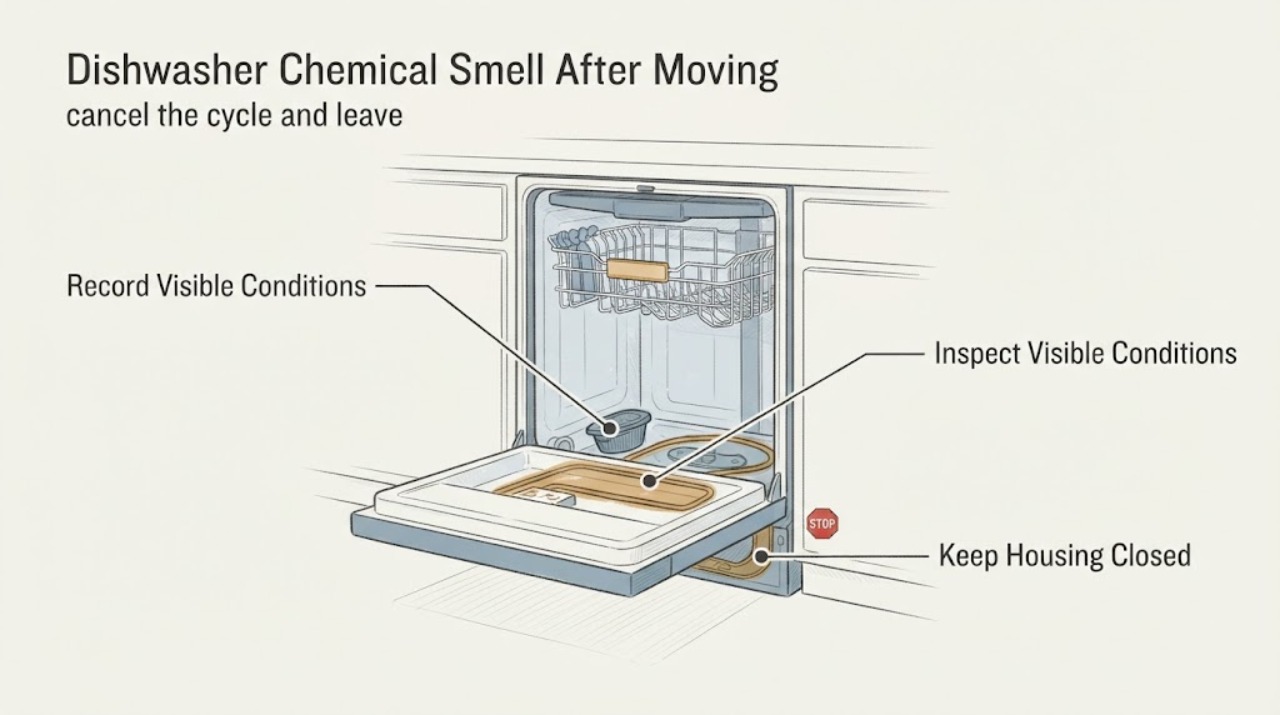
If the smell is present now, cancel the cycle and leave the dishwasher off. Ventilate only if doing so is safe. If there is smoke, visible flame, a hot or melted plug, sparks, a gas-like odor, a leak near electrical equipment, or breathing/eye symptoms, leave the area as needed and contact the building's emergency or qualified service channel; do not restart the appliance.
Expected result: The odor is food-like or musty with no heat damage, or it is burning/electrical/gas-like/sharply chemical or accompanied by smoke, heat, damage, a leak or symptoms.
Next step: For any hazard sign, keep the dishwasher out of service and involve the landlord/property manager and qualified appliance/electrical or building emergency service. Do not mix chemicals or repeatedly reset power.
Why this matters
Why: The first group can proceed to an unpowered external inspection. The second group is a fire, electrical, exposure or water-safety concern and cannot be cleared by a cleaning cycle. Amana's charred-odor guidance specifically limits inspection around the heating element to a completely cooled dishwasher.
-
Check 2
With the dishwasher off and cool, locate the model label and check the owner's materials or ask the landlord/property manager when the unit was installed and what products were used. Record the exact smell description and whether it occurs only during heating, at the door, under the sink or near the drain.
Expected result: The unit is confirmed new and the smell matches hot tar/petroleum, or the unit's age and previous cleaning history are unknown.
Next step: If new installation and the odor is only the described petroleum smell with no hazard signs, ventilate and monitor within the stated period. If the age, model or product history is unknown, keep the model information for the property manager or service provider and continue with the safe visible checks below.
Why this matters
Why: Amana's 4–6 week explanation is scoped to new dishwashers with sound-deadening material. A move-in date alone does not satisfy that condition, so an unknown-age unit should not be labeled normal from smell alone.
-
Check 3
After the dishwasher is completely cool, inspect only accessible areas: the bottom of the tub, filter, spray-arm area, door gasket and the area around the heating element. Look for food soil, standing water, detergent film, melted plastic or charred debris; do not remove panels or touch wiring.
Expected result: There is food or residue with no heat damage, standing water or drain connection issue, or there is melted plastic, charred debris, a damaged element area or unexplained heat damage.
Next step: For ordinary residue, remove only loose accessible debris using the model's instructions and proceed to the cleaning decision. For melting, charring or damage, keep the unit off and arrange qualified service; do not scrape a hot element, energize it to burn residue away or replace an internal part by guesswork.
Why this matters
Why: Amana identifies food soils as an ordinary odor source and says melted plastic or food around the heating element should be checked only after at least 30 minutes of cooling. Visible melting or charring is not an ordinary cleaner-residue branch.
-
Check 4
If the odor is food-like or musty and no hazard sign was found, clean the accessible filter/interior and gasket according to the exact model instructions. Amana's general cleaning article describes either a dishwasher cleaner or 2 cups of white vinegar in an upright glass on the bottom rack with the dry option off; use one approved method only and never combine vinegar, bleach, detergent or an unknown product.
Expected result: The odor improves after the accessible residue is removed, or it remains unchanged, becomes sharper during heating, or returns with smoke, heat or a leak.
Next step: Do not add another chemical. If the odor persists, changes to burning/electrical, or returns with a leak or heat damage, stop use and contact the landlord/property manager and qualified service.
Why this matters
Why: Improvement supports a surface food/residue or drain-path source, but it does not prove that an unknown chemical is safe. Persistence or a hazard change means the issue is not resolved by routine cleaning.
-
Check 5
If the dishwasher drain is visibly connected to a garbage disposal, inspect the accessible sink/disposal area for retained debris or standing water. Amana says to run the disposal to clear debris and clean the dishwasher and disposal, but do not disconnect the drain hose or reach into the disposal while energized.
Expected result: The smell is strongest at the sink or drain and there is visible debris/standing water, or the smell is strongest inside the dishwasher and the drain path looks clear.
Next step: Use only the disposal's normal safe operation if the area is dry and clear; otherwise leave it off. If standing water, a leak or persistent odor remains, request plumbing/appliance service rather than opening hoses or panels.
Why this matters
Why: A disposal-connected drain can transfer odor into the dishwasher. A clear drain path makes that explanation less likely but does not identify an internal dishwasher fault.
Use your observations
Decision map
Find the observation that best matches what you see, then follow the next safe action.
-
PATH 01Next step
What you see
The dishwasher is confirmed newly installed, the odor is specifically hot-tar or petroleum-like, and there is no smoke, melting, electrical heat or leak.
Do this next
Ventilate and monitor within that stated window. If the age is uncertain, the odor worsens, or it does not dissipate, keep use limited and arrange service through the landlord or appliance provider.
Why this path and its safety boundary
Why it matters: Amana says sound-deadening material on some new dishwashers can cause this odor and that it should dissipate in 4–6 weeks.
-
PATH 02Next step
What you see
The smell is food-like, musty or stagnant, and accessible food soil, detergent film or a disposal drain path is found without heat damage.
Do this next
Clean only the accessible areas and use one model-approved cleaning method. If standing water, a leak or odor remains, stop and arrange plumbing or appliance service.
Why this path and its safety boundary
Why it matters: Amana identifies food soils and a garbage-disposal connection as ordinary odor sources.
-
PATH 03Next step
What you see
There is melted plastic, charred food, smoke, a burning/electrical smell, a hot plug, sparks, a gas-like smell, a leak near electrical equipment or symptoms.
Do this next
Keep the dishwasher off, leave or ventilate as safety requires, and contact the landlord/property manager and qualified appliance/electrical or building emergency service. Do not scrape hot parts, open panels, mix cleaners or restore power to reproduce the odor.
Why this path and its safety boundary
Why it matters: This is outside routine odor cleaning. Amana's charred-odor guidance requires the appliance to be completely cooled before any visible heating-element check, and a hazardous smell or damage should not be tested by another cycle.
-
PATH 04Next step
What you see
The unit was already in the apartment, its age or prior cleaning products are unknown, and the smell is sharply chemical but there is no confirmed Amana new-dishwasher petroleum branch.
Do this next
Do not add or mix cleaners and do not run a heated cycle. Ask the landlord/property manager for the model, installation age and product history, then arrange qualified service if the odor persists or cannot be identified.
Why this path and its safety boundary
Why it matters: The available Amana guidance does not identify an unknown chemical product or prove that this particular unit is new; a normal-odor label would be overconfident.
Helpful context
Understand the symptom
Treat the apartment move as context, not a diagnosis
The assigned problem gives no model number and only says the dishwasher was encountered after moving into an apartment. Ask the landlord or property manager whether it was newly installed, what cleaning products were used, and where the model label or owner's manual is. Without that information, an Amana new-dishwasher explanation is a conditional branch, not proof that this unit's smell is normal.
Separate ordinary residue from a stop-use odor
Food, musty or stagnant-water odor supports an accessible cleaning and drain-path check. A hot-tar or petroleum smell can occur during the first weeks of a genuinely new dishwasher. A charred, burning, electrical or sharply chemical odor after an unknown product needs a safety decision first. Do not open panels, touch wiring, pour another product into the tub or run a cycle just to reproduce an unexplained smell.
When checks do not resolve it
Need a professional?
Call the landlord/property manager and qualified appliance service when the dishwasher's age or prior chemical use is unknown and the odor persists; call promptly for melting, charring, smoke, burning/electrical or gas-like odor, a leak near electrical parts, or symptoms. Keep the dishwasher off until the hazard is assessed.
Common questions
FAQ
Does moving into an apartment mean the Amana dishwasher smell is a normal new-appliance smell?
No. Moving in does not establish the dishwasher's installation date. Amana's 4–6 week hot-tar/petroleum guidance is for new dishwashers; verify the age and model with the landlord or property manager before treating that branch as applicable.
Can I add vinegar or another cleaner immediately?
Not when the current product is unknown or the odor is sharply chemical. Do not mix products. For an ordinary food-odor branch with no hazard signs, Amana describes a vinegar rinse or dishwasher cleaner, but use one method and follow the exact model instructions.
What if the smell is burning or comes with melted plastic?
Keep the dishwasher off. After it is completely cool, do not touch wiring or internal panels; arrange qualified service. Amana says to check around the heating element only after cooling when plastic or food may have fallen there, and a burning or damaged condition should not be tested with another cycle.
Read the exact guide
Official sources
- Hot tar or Petroleum Like Odor - DishwasherAmana Product Help · Opened exact Amana dishwasher odor guidance. It is used conditionally for a genuinely new dishwasher; the assigned topic supplies no model or installation age.
- Odor From Garbage Disposal - DishwasherAmana Product Help · Opened exact Amana support page. It supports a visible disposal/drain-path check only; no plumbing configuration is assumed for this apartment.
- Melted Plastic or Charred Food Odor - DishwasherAmana Product Help · Opened exact Amana dishwasher support page. It supports only the visible melted-plastic/charred-food branch and does not identify an internal component for the assigned unit.
- Dishwashers Troubleshooting Cleaning IssuesAmana · Opened exact Amana dishwasher cleaning article. It supports the ordinary food-odor branch and is not a model-specific diagnosis of the unknown apartment unit.
Community feedback
Share a repair observation
Share a plain-text repair observation. Accepted observations are published automatically; this page may take a moment to update.