
On this page
Start here
Quick answer
On the Amana NED4655EW1, a belt that has slipped or broken more than once should be treated as a symptom and repair history, not proof that another belt is the answer. Amana identifies this model family as a 6.5 cu. ft. electric dryer and warns that an oversized load may not tumble and restricts airflow. Stop using the dryer if the belt slips during a cycle, the drum stops, there is a rubber or burning smell, smoke, unusual heat, scraping, or electrical damage. With power safely isolated, record the exact model suffix and repair history, compare a freely tumbling smaller load with the recurrence pattern, and check only visible load, leveling, clearance, lint-screen, and vent conditions. If an empty drum catches, rubs, wobbles, or needs unusual force, or if a correctly sized load still causes recurrence, have a qualified technician inspect the complete drive and drum-support path before approving another belt.
Before you begin
Safety first
- Do not remove panels, reach behind the drum, bypass a belt or door switch, probe live wiring, run the dryer with covers or exhaust parts removed, or keep testing a slipping belt. Stop for smoke, flame, burning or rubber odor, unusual heat, sparks, electrical damage, a stopped or binding drum, or charring.
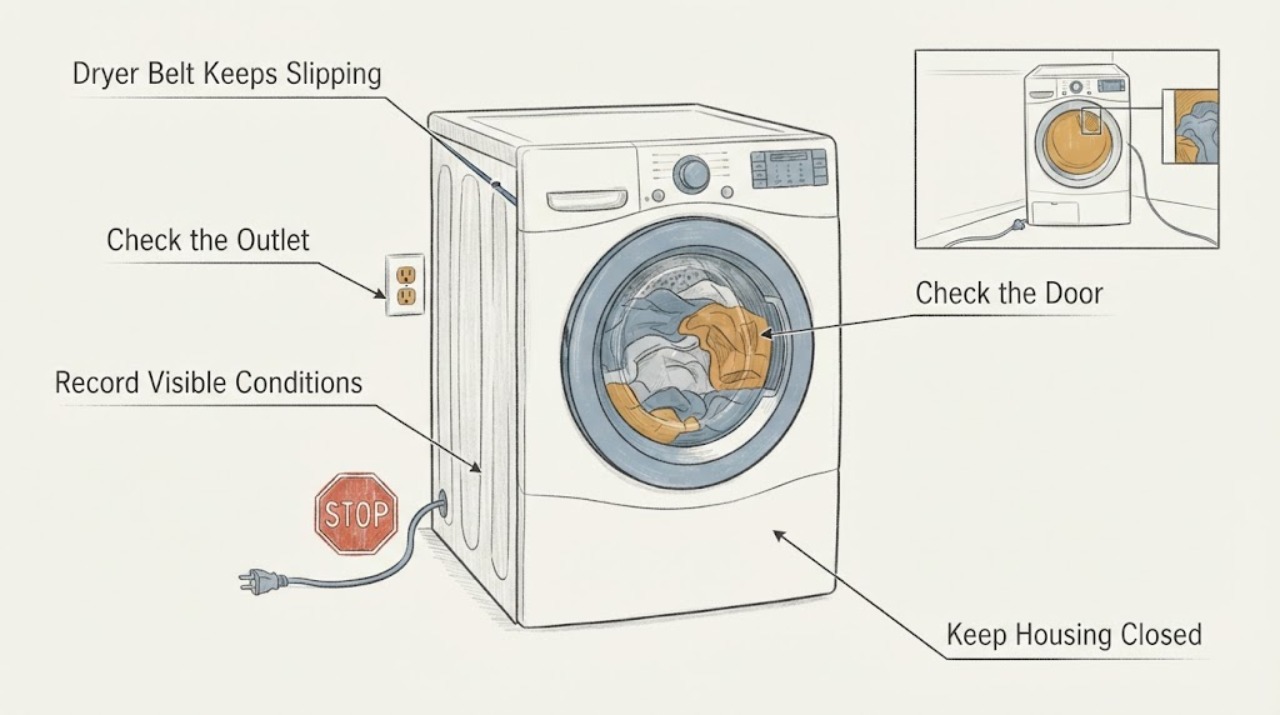
Work through in order
Diagnostic checks
Use only checks that match the exact appliance or system and its official guide.
-
Check 1
Stop the dryer immediately when the belt slips, the drum stops, or you hear a sudden rubbing or snapping sound. Keep it off for smoke, a rubber or burning odor, visible charring, sparks, a hot outlet or cord, or unusual cabinet heat; isolate power only from a safe, dry location. Do not restart the dryer to see whether the belt slips again.
Expected result: The event included smoke, fire, strong odor, abnormal heat, electrical damage, a tripped breaker, a stopped drum, or only a quiet intermittent slip without a hazard sign.
Next step: Keep the dryer isolated and arrange qualified appliance service. For active fire or dangerous smoke, leave the area and obtain emergency help. Preserve the load and note the exact point in the cycle where the event occurred.
Stop if: No repeated powered test, unattended cycle, panel removal, belt-switch bypass, or live electrical measurement.
Why this matters
Why: Smoke, heat, electrical damage, or a failed drive during operation can turn a belt complaint into a fire, shock, or secondary-damage risk. A quiet slip is still not permission to keep cycling the dryer because the underlying drag or alignment condition is unknown.
-
Check 2
With the dryer off, record the complete rating-label identity as NED4655EW1 if that is what the label shows, then write down every belt event: date, whether the belt slipped or snapped, load type and approximate fullness, cycle, noise or odor, who performed the repair, and whether any pulley, roller, seal, motor, drum, or vent work was also done.
Expected result: The suffix is different or unreadable, the belt failed only with bulky or heavy loads, it failed with ordinary loads, or the same symptom returned soon after a belt replacement.
Next step: Give the full label and repair timeline to the technician and request that the cause of the recurrence be documented before another belt is authorized. Do not order a belt from the Amana prefix or a photograph alone.
Stop if: Do not treat the word belt in a prior invoice as proof that the belt was the root cause or that the replacement is correctly matched.
Why this matters
Why: A different suffix can use different parts or service information. Failure limited to a heavy load leaves an overload or drag interaction open; immediate recurrence after a replacement makes installation, alignment, drive, drum-support, or another unresolved condition more important than the fact that a belt was fitted.
-
Check 3
After the dryer is cool and power is safely isolated, remove only a plainly loose load and inspect the drum interior for a tightly packed or balled-up load, one bulky item filling the drum, items wedged at the door opening, or an object that could interfere with drum movement. Do not reach behind the drum or remove any cover.
Expected result: The load fills the drum so tightly that it cannot lift and fall, a comforter or heavy item is packed alone, the load is balled up, or a small mixed load would have room to tumble freely.
Next step: Use smaller loads with similar fabric weights and follow the care labels. If belt slip returns with a smaller freely tumbling load, stop treating load size as the sole explanation and arrange a drive-path inspection.
Stop if: Do not run a test load if the belt has visibly come off, the drum is jammed, there is a burning smell, or any metal, seal, or cabinet damage is visible.
Why this matters
Why: Amana states that an oversized load will not tumble and restricts air movement; its performance guidance recommends roughly one-half to three-quarters drum fullness so items can move. This supports an overload contribution, but it cannot prove that overload alone caused repeated belt damage.
-
Check 4
With the dryer empty, cool, and disconnected from power, check only from the opening whether the drum turns smoothly through a small, gentle movement. Stop if it catches, rubs, wobbles, grinds, or requires unusual force; do not remove the belt, top, rear panel, front panel, or blower housing.
Expected result: The empty drum turns smoothly, or it binds at one point, rubs continuously, wobbles, or has a displaced or torn visible seal.
Next step: Leave the dryer off and give the technician the exact drag pattern. Ask for inspection of the drive belt routing and tension, idler and motor pulley, drum supports, seals, and any obstruction before a belt is replaced again.
Stop if: Do not force a binding drum, lubricate an unknown part, or operate with a torn seal, exposed belt, or rubbing metal.
Why this matters
Why: Smooth empty movement makes a pure overload explanation more plausible but does not rule out an intermittent drive or alignment problem. Repeatable empty-drum drag or wobble makes an internal support, seal, pulley, motor, or alignment condition more likely than an oversized load alone.
-
Check 5
Inspect the accessible installation and airflow conditions without moving the heavy appliance or disconnecting wiring: confirm the dryer is stable on all feet, nothing presses against the drum cabinet, the lint screen is seated and clean, the visible vent hose is not crushed or kinked, and the outside hood is not blocked. Do not run the dryer to test a suspected restriction.
Expected result: The dryer rocks, clearance is poor, the screen is blocked or loose, the hose is crushed or kinked, the hood has lint or debris, airflow is weak, or the visible path is clear.
Next step: Correct only a safe, visible obstruction or clearance issue according to the model installation guidance. Have a qualified vent professional assess a hidden or restricted house vent, and have appliance service assess recurring belt failure.
Stop if: Do not use plastic or foil accordion ducting, reach into hidden ductwork, drag the dryer alone, or operate it with panels or exhaust safety parts removed.
Why this matters
Why: A large load can already restrict tumbling and airflow, and Amana identifies blocked or poorly routed venting as a performance and service-life problem. These checks can reveal a contributing installation condition, but a clear visible path does not rule out an internal drive fault or a blocked house run.
-
Check 6
Prepare a service request that asks for root-cause isolation, not just another belt installation. Include the full model suffix, photos or notes from the last failure, load conditions, empty-drum result, visible vent findings, and every prior part or adjustment. Ask the provider to state what they inspected, what failed, and how the repair will be checked safely.
Expected result: The provider can document a failed or misaligned drive-path item with a model-appropriate inspection, or proposes another belt without explaining the prior recurrence.
Next step: Approve a belt only when its exact fit and routing are verified and the technician explains why it failed. Request a second qualified opinion if the same belt-only repair has already failed repeatedly.
Stop if: Do not continue operation to prove the repair, buy multiple belts for trial, or authorize a guessed pulley, roller, motor, or control part from the symptom alone.
Why this matters
Why: A documented drive-path finding supports a targeted repair. A belt-only recommendation without examining the load, drum resistance, routing, tension, supports, and installation leaves the original failure mechanism unresolved.
Use your observations
Decision map
Find the observation that best matches what you see, then follow the next safe action.
-
PATH 01Next step
What you see
The belt slips only with a tightly packed or bulky load, while a small load would otherwise tumble freely and the empty drum has no catch, rub, wobble, or hazard sign.
Do this next
Use smaller, similar-fabric loads and follow care labels. Stop and arrange service if the belt slips again, the drum stops, or any odor, noise, or heat appears.
Why this path and its safety boundary
Why it matters: An overload contribution is plausible because Amana says an oversized load can stop tumbling and restrict airflow, but the prior belt failure still warrants caution if it recurs.
-
PATH 02Next step
What you see
The empty drum catches, rubs, wobbles, or turns with unusual force, or the belt slips with ordinary loads after a recent replacement.
Do this next
Keep the dryer off and request a qualified inspection of the complete drive and drum-support path, including routing and tension, pulleys, supports, seals, motor load, and obstructions.
Why this path and its safety boundary
Why it matters: A repeatable mechanical or routing condition is more likely than load size alone. The belt remains the observed failure, not a confirmed root cause.
-
PATH 03Next step
What you see
The visible hose is crushed or kinked, the outside hood is blocked, airflow is weak, or the dryer has extended warm-but-damp cycles or elevated laundry-room heat.
Do this next
Leave the dryer off for a burning odor or abnormal heat. Correct safe visible issues and arrange professional vent cleaning or appliance service for hidden restrictions and recurring belt events.
Why this path and its safety boundary
Why it matters: Restricted venting is a supported contributing condition for poor performance and can shorten dryer life, but it does not by itself prove why a belt slipped or broke.
-
PATH 04Next step
What you see
The belt has failed repeatedly, the full suffix is uncertain, the previous repair did not document a cause, or the provider recommends another belt without examining load, drag, routing, supports, and vent conditions.
Do this next
Pause further parts purchases and request a model-specific written diagnosis or second qualified opinion. Provide the complete history and ask what finding would confirm the proposed repair.
Why this path and its safety boundary
Why it matters: The evidence is insufficient for a belt-only repair decision. Repeating the same replacement can leave the original mechanical or installation problem in place.
Helpful context
Understand the symptom
The NED4655EW1 is the full model identity to give a technician. Amana's product page describes the NED4655EW family as a 6.5 cu. ft. electric dryer with Automatic Dryness Control. That confirms the appliance class, but it does not make a belt the confirmed cause of repeated slipping or breakage. Treat the belt as what has been observed or replaced, then look for the condition that makes the drive lose tension, encounter excess drag, or operate under abnormal load.
Amana says a load that is too large will not tumble and limits air movement. That makes overload a meaningful first comparison, but not a complete explanation for a belt that repeatedly fails: if the symptom also occurs with a small, freely moving load or with an empty drum, the case has moved toward an installation or internal mechanical diagnosis.
Only after diagnosis
Potential parts
- dryer drive belt
Consider a belt only after the exact NED4655EW1 identity, belt routing and tension, and the rest of the drive path have been checked by a qualified technician. A prior belt failure does not prove that another belt alone will solve the recurrence.
Verify the complete model suffix and the current manufacturer parts information; do not choose a belt from the Amana brand, NED4655EW prefix, belt appearance, or symptom alone. - dryer drive-path or drum-support component
A pulley, idler, motor, drum support, seal, or related component is conditional only if inspection establishes drag, misalignment, wobble, damage, or an abnormal drive load that explains the belt event.
Do not order a pulley, roller, motor, seal, or other part from belt slipping alone; confirm the exact model and the failed component through professional diagnosis.
When checks do not resolve it
Need a professional?
Call qualified appliance service for any repeat belt slip or break, ordinary-load recurrence, empty-drum drag, wobble, rubbing, an undocumented prior repair, or any need to inspect the internal drive, drum supports, seals, motor, pulleys, or wiring. Call a vent professional for a hidden or obstructed house vent.
Safety scope: Do not remove panels, reach behind the drum, bypass a belt or door switch, probe live wiring, run the dryer with covers or exhaust parts removed, or keep testing a slipping belt. Stop for smoke, flame, burning or rubber odor, unusual heat, sparks, electrical damage, a stopped or binding drum, or charring.
Have this ready
- Provide the exact NED4655EW1 rating-label identity, serial information if requested by the provider, the belt event timeline, load type and fullness, cycle stage, odor and noise details, empty-drum observation, level and clearance findings, lint-screen and vent observations, and every prior part or adjustment.
Common questions
FAQ
Can overloading alone keep breaking the belt on an Amana NED4655EW1?
It may contribute, because Amana says an oversized load may not tumble and restricts airflow, but that guidance does not prove overload is the sole cause of repeated belt failure. If the belt slips with a smaller freely tumbling load or the empty drum drags, request a full drive-path diagnosis.
Should I install another belt if the previous one slipped?
Do not make the belt the default diagnosis. Confirm the full model suffix, document the prior repair, and have a qualified technician verify belt fit and routing along with pulleys, drum supports, seals, motor load, obstructions, and installation conditions before authorizing another replacement.
Does a clear vent rule out the cause of a slipping belt?
No. Amana identifies restricted venting as a performance and service-life problem, so it is worth checking, but a clear visible hose and hood do not rule out hidden duct restriction or an internal drive, support, alignment, or seal problem.
What should I tell the repair technician?
Give the complete NED4655EW1 identity, the dates and results of each belt repair, the load size and fabric mix, the cycle stage, noises or odors, whether the empty drum catches or wobbles, and the accessible vent and leveling findings. Ask for the failed condition and the reason a replacement part addresses it in writing.
Read the exact guide
Official sources
- Using Auto Dry, Timed Dry and EcoBoost - Dryer - Product Help | AmanaAmana · Official Amana dryer guidance used for the load-versus-tumbling decision; it does not diagnose a belt or authorize an internal repair.
- Dryer is not Drying or Experiencing Long Dry Times - Product Help | AmanaAmana · Official Amana dryer performance guidance used for smaller-load comparison, visible airflow checks, and service escalation; it is not a belt-specific parts diagnosis.
- How to Check Venting - Product Help | AmanaAmana · Official Amana venting guidance used for safe external vent and hood checks and the service-life implication of restricted venting; it does not establish a belt root cause.
- 6.5 cu. ft. Electric Dryer with Wrinkle Prevent Option | AmanaAmana · Official Amana product page for the NED4655EW family; used to confirm the electric-dryer identity and 6.5 cu. ft. capacity. The complete NED4655EW1 suffix remains the appliance label identity for service and parts matching.
Community feedback
Share a repair observation
Share a plain-text repair observation. Accepted observations are published automatically; this page may take a moment to update.