
On this page
Start here
Quick answer
First separate a true musty smell from a damp load left too long, a new-dryer or nearby paint/varnish odor, and a burning, gas or solvent warning. Amana says damp clothes left in a washer or dryer for a long time can develop mildew odor; rewash the affected load and remove it promptly after drying. With the dryer unplugged, clean the drum, door-seal area and accessible lint area using mild dish detergent in warm water or another mild nonflammable cleaner, rinse and dry the surfaces, then clean the lint screen. Check for visible crushed or kinked venting and signs of restricted airflow such as long drying, a hot exterior, steam or moisture. Do not run the dryer for a burning, gas, solvent or smoke smell, repeated overheating, or a persistent odor; keep it disconnected when safe and arrange qualified service.
Before you begin
Safety first
- Limit owner work to unplugged accessible cleaning, lint-screen care, visible vent/hood observation and load-handling. Do not open the cabinet, test live electrical or gas parts, bypass safety controls, run the dryer to reproduce a hazardous odor, or use flammable solvents.
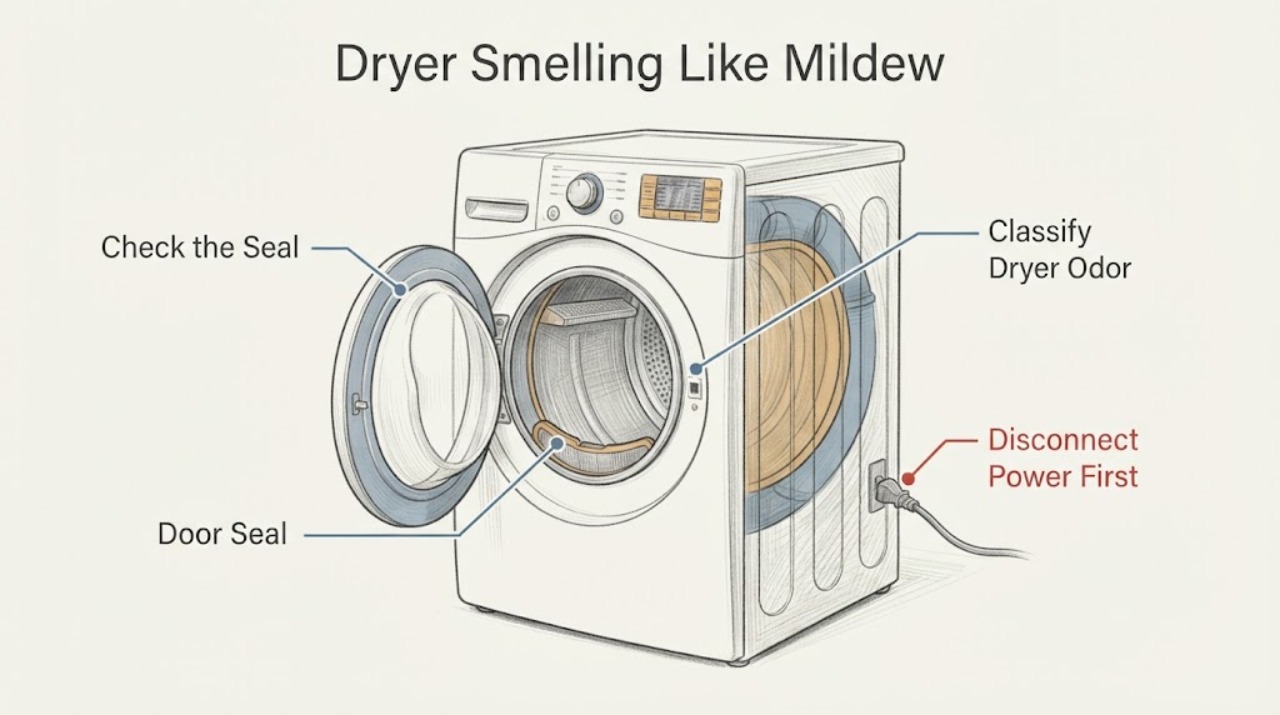
Work through in order
Diagnostic checks
Use only checks that match the exact appliance or system and its official guide.
-
Check 1
With the dryer off, record whether the odor is musty after a damp load, present only on a new appliance, associated with room paint/stain/varnish, or smells like burning, gas, solvent or smoke.
Expected result: The timing and odor category fit one of those patterns, or the smell is unclear or hazardous.
Next step: Use the matching cleaning or damp-load branch; for burning, gas, solvent or smoke, stop using the dryer and arrange service.
Why this matters
Why: Amana documents damp-load mildew odor, temporary new-dryer odor and room fumes as different situations; a hazardous smell is not an owner troubleshooting branch.
-
Check 2
Unplug the dryer, then wipe the drum and accessible door-seal area with warm water and mild hand dish detergent or a mild nonflammable cleaner; rinse with a clean damp cloth and dry fully.
Expected result: Residue or odor is removed, or the smell remains after the surfaces are clean and dry.
Next step: If the odor remains, clean the lint screen and inspect visible venting once; escalate persistent or hazardous odor instead of opening the cabinet.
Why this matters
Why: Amana identifies lint, fabric-softener and detergent residue as odor sources and gives an unplugged drum-cleaning method; persistence is not proof of a failed component.
-
Check 3
Clean the lint screen and accessible lint area; wash residue from the screen with hot water and liquid detergent when needed, rinse and let it dry completely before reinstalling.
Expected result: The screen is clear and dry, or it remains coated, damaged or difficult to clean.
Next step: Reinstall only a clean, dry screen and continue to the visible vent check; do not run without the screen.
Why this matters
Why: Amana says residue can clog the screen, lengthen drying and contribute to lint and odor; a damaged or persistently blocked screen needs model-specific service or replacement guidance.
-
Check 4
Inspect the visible vent hose, exterior hood and surrounding area for crushing, kinks, lint or nesting; note drying time, cabinet heat, steam/moisture, water at the floor, little lint on the screen and outside airflow.
Expected result: The vent is visibly restricted or the airflow warning signs are present, or the path appears clear and airflow is normal.
Next step: Stop for overheating or persistent restriction and arrange qualified vent service; do not dismantle the dryer or use it as a test for an unresolved hazard.
Why this matters
Why: Amana associates those observations with blocked or restricted venting and possible overheating; a clear visible path does not prove that the internal duct is clear.
-
Check 5
Rewash odor-affected clothes and remove them promptly after drying only when the dryer has no hazardous smell; record what cleaning and vent observations changed.
Expected result: The smell clears and stays gone, or it returns, persists, or is accompanied by smoke, burning/gas/solvent odor, overheating, moisture or a Check Vent warning.
Next step: Keep the dryer disconnected when safe and arrange Amana or qualified service for a persistent or hazardous condition; do not test internal parts.
Why this matters
Why: A cleared smell after damp-load and residue care supports an external odor source; persistence or a safety symptom is outside the supported owner checks.
Use your observations
Decision map
Find the observation that best matches what you see, then follow the next safe action.
-
PATH 01Next step
What you see
The smell began after clothes sat damp in the washer or dryer and clears after the load is rewashed, dried promptly and removed.
Do this next
Keep loads moving promptly and repeat the safe drum/lint care if the odor returns; arrange service if it returns with a hot cabinet or airflow symptom.
Why this path and its safety boundary
Why it matters: Amana identifies prolonged damp storage as a source of mildew odor rather than proof of an internal dryer failure.
-
PATH 02Next step
What you see
Residue is found on the drum, door-seal area or lint screen, and the odor improves after unplugged cleaning and complete drying.
Do this next
Maintain the lint screen each load and clean the drum periodically; escalate if the odor persists or the screen cannot be cleaned safely.
Why this path and its safety boundary
Why it matters: Lint, fabric-softener or detergent residue can contribute to odor, and the supported remedy is accessible cleaning rather than component diagnosis.
-
PATH 03Next step
What you see
Long drying, a hot exterior, steam or moisture, water at the floor, little lint on the screen or weak outside airflow accompanies the smell.
Do this next
Stop if the dryer is overheating or a vent warning persists and arrange qualified vent/service inspection; do not open the cabinet.
Why this path and its safety boundary
Why it matters: That pattern makes restricted venting more likely, and Amana treats airflow as a safety and performance issue without identifying a failed internal part.
-
PATH 04Next step
What you see
The odor is present only during first use or while paint, stain or varnish fumes remain nearby, and there is no smoke or overheating.
Do this next
Ventilate and wait until fumes are gone; follow Amana's first-use guidance only when the appliance and room are safe, and do not operate during painting or varnishing.
Why this path and its safety boundary
Why it matters: Amana documents temporary new-dryer odor and room fumes as separate from a mildew smell; the dryer draws surrounding room air.
-
PATH 05Next step
What you see
Burning, gas, solvent or smoke odor, visible scorching, repeated overheating, persistent moisture/vent warning or a smell that remains after safe cleaning is present.
Do this next
Stop using the dryer, disconnect power only if safe, keep clear of gas/smoke hazards and arrange qualified Amana or appliance service. Do not run another test cycle or open the cabinet.
Why this path and its safety boundary
Why it matters: The condition is outside the supported owner checks and may involve a fire, gas, electrical or airflow hazard; odor alone does not identify a component.
Helpful context
Understand the symptom
Classify the smell before running the dryer
A musty smell after a load sat damp points toward the load and retained moisture. A new dryer may have a temporary semi-burning or oily odor, and Amana warns that paint, stain or varnish fumes in the room can be pulled through the dryer. A burning, gas, solvent or smoke smell is a stop condition; it is not a reason to run an empty cycle to see whether the odor clears.
Clean the drum with the appliance disconnected
Unplug the dryer before cleaning. Wipe the drum and the area around the door seal with warm water and a small amount of mild hand dish detergent, or use a mild nonflammable cleaner described by Amana. Rinse with a clean damp cloth or sponge and dry the surfaces with clean towels. Do not mix cleaners, use flammable solvents or open the cabinet.
Remove residue and check the vent path
Wash the lint screen when residue is present and let it dry fully before reinstalling it; vacuum only the accessible lint area. Look at the visible vent hose, outside hood and connection for crushing, kinks, lint or nesting. Long drying, a hot cabinet, steam or moisture, water near the floor, little lint on the screen or weak outside airflow supports a restricted-vent branch rather than a confirmed internal dryer failure.
Rewash the affected load and remove it promptly
If the odor began after clothes remained damp in the washer or dryer, rewash the load and dry it only after the dryer has no hazardous smell and its accessible cleaning and airflow checks are complete. Remove finished clothing promptly. Do not operate the dryer while nearby paint, stain or varnish fumes remain in the room.
Use service for persistent or hazardous odor
Amana's owner guidance ends with cleaning, airflow checks and service escalation. Keep the dryer out of use for smoke, burning, gas or solvent odor, visible scorching, repeated overheating, a Check Vent warning that persists, or an odor that returns after the safe external work. Do not diagnose or replace an internal heater, motor, sensor or control from smell alone.
When checks do not resolve it
Need a professional?
Use Amana or qualified service for persistent or hazardous odor, smoke, burning/gas/solvent smell, overheating, recurring moisture, a continuing vent warning or any internal diagnosis.
Safety scope: Limit owner work to unplugged accessible cleaning, lint-screen care, visible vent/hood observation and load-handling. Do not open the cabinet, test live electrical or gas parts, bypass safety controls, run the dryer to reproduce a hazardous odor, or use flammable solvents.
Common questions
FAQ
Why does my Amana dryer smell like mildew?
Amana says clothes left damp in a washer or dryer for a long time can develop mildew odor. Rewash the load, dry it promptly after the dryer is safe to use, and clean the unplugged drum, door-seal area and lint screen if residue is present.
Can I clean an Amana dryer drum for a musty smell?
Yes, after unplugging the dryer. Amana supports warm water with a small amount of mild hand dish detergent or a mild nonflammable cleaner, followed by wiping with clean water and drying the surfaces. Do not mix cleaners or use flammable solvents.
When should I stop using the dryer for an odor?
Stop for smoke, burning, gas or solvent odor, scorching, repeated overheating, persistent moisture or a continuing vent warning. Keep the dryer disconnected when safe and arrange qualified service rather than opening the cabinet or repeating test cycles.
Read the exact guide
Official sources
- Removing Odors or Smells - DryerAmana · Official Amana family-level guidance for dryers when no exact model is supplied; it distinguishes damp-load mildew odor, new-dryer odor and nearby paint or varnish fumes.
- Cleaning the Dryer DrumAmana · Official Amana dryer-care guidance for owner-accessible drum and lint-area cleaning; no exact model is required for the cleaning boundary.
- Dryer Vent May Be Blocked or RestrictedAmana · Official Amana family-level dryer vent guidance for external airflow and restriction signs; it does not identify an internal component from odor alone.
- Cleaning the Lint Screen on a DryerAmana · Official Amana dryer-care guidance for every-load lint-screen care and periodic residue removal; no exact model is supplied.
- Odor or Smell from a DryerAmana · Official Amana dryer odor guidance for residue or fumes; it is family-level and does not authorize internal repair.
- Troubleshooting Guide: Dryers - Noises and LightsAmana · Official Amana dryer troubleshooting guidance; the vent-warning and service-boundary portions apply at family level without a model number.
Community feedback
Share a repair observation
Share a plain-text repair observation. Accepted observations are published automatically; this page may take a moment to update.