
On this page
Start here
Quick answer
Do not bypass an Amana dryer's thermal fuse or keep replacing it without finding the reason it opened. Unplug the dryer, distinguish an internal thermal-fuse problem from a household fuse or breaker problem, and make only the owner-level checks supported for the model: the lint screen, visible exhaust path, selected heated cycle, and household power. Amana's public dryer guidance identifies restricted airflow and power faults as separate troubleshooting paths, but it does not provide one model-independent thermal-fuse location, part, or replacement procedure. If the thermal fuse opens again, the dryer is still overheating, airflow is poor, or there is scorching or an electrical smell, leave it unplugged and arrange qualified service using the exact model manual.
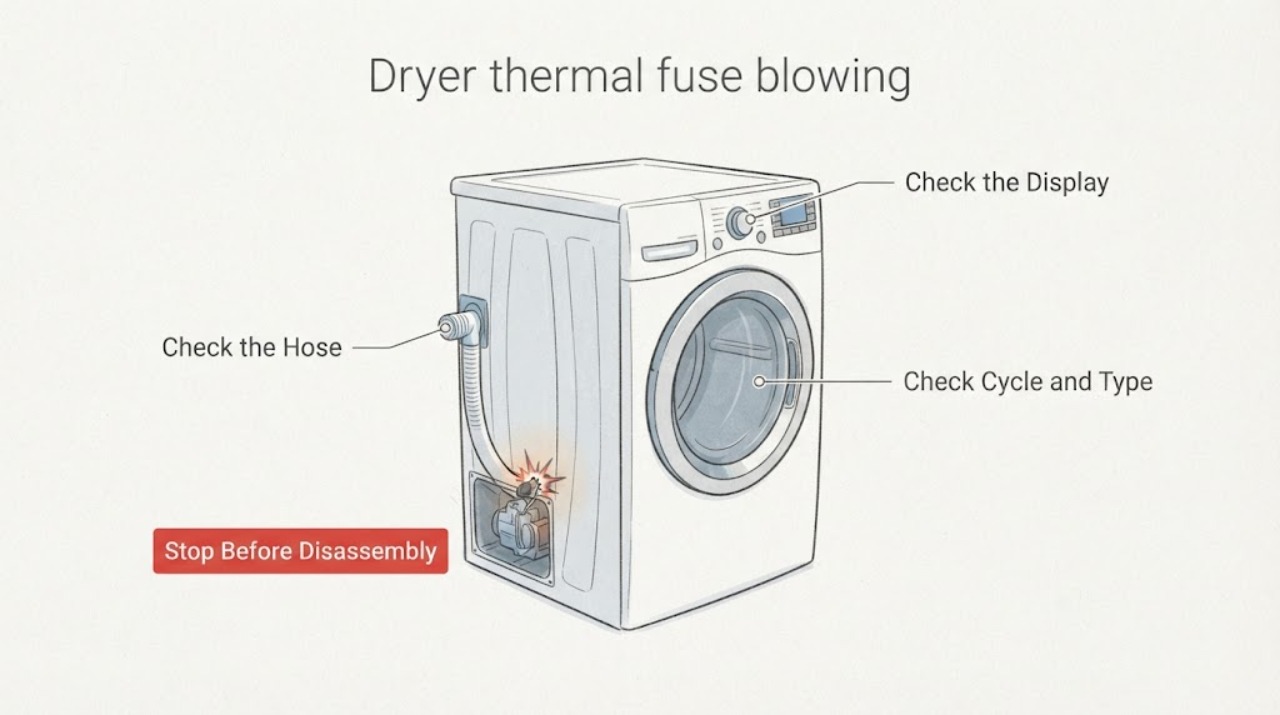
Work through in order
Diagnostic checks
Use only checks that match the exact appliance or system and its official guide.
-
Check 1
Unplug the dryer and confirm what was actually identified as the blown fuse: an internal thermal fuse, a household fuse, a circuit breaker, or an on-screen code. Do not restore operation by bypassing an internal fuse.
Expected result: The dryer is dead but a household fuse or breaker is tripped, or the display shows an F# E#, L2, or another code instead of evidence from an internal fuse inspection.
Next step: For a household fuse or breaker, follow the safe panel instructions and stop if it trips again. For an F# E# code or an uncertain internal-fuse diagnosis, use the exact model manual or arrange service rather than guessing a fuse.
Why this matters
Why: Amana documents household power faults and F# E# service conditions separately from the thermal-fuse topic; a display code or tripped breaker does not identify the internal thermal fuse or its cause.
-
Check 2
With the dryer unplugged, clean the lint screen as the owner's manual directs and inspect the visible exhaust hose and outside termination for lint, crushing, kinks, or an obstruction. Keep this check external; do not open the cabinet.
Expected result: The lint screen or vent is visibly restricted, crushed, kinked, or blocked, or the visible path is clear.
Next step: Correct only the visible restriction and have the home vent professionally inspected when its full route cannot be verified. If the path is clear or the thermal fuse has already opened again, keep the dryer unplugged and escalate to model-specific service.
Why this matters
Why: Amana identifies restricted airflow as a dryer condition and lists lint-screen or vent blockage, crushing, kinks, and excessive turns as the AF/F4E3 path. A clear visible path does not prove that an internal thermal-fuse cause has been ruled out.
-
Check 3
Check the selected cycle and the dryer type without disassembling anything: Air Only/Air Fluff is not a heated cycle; for an otherwise operating dryer, Amana describes a brief empty heated Timed Dry check for heat.
Expected result: The machine was on Air Only, it heats on the documented external check, or it does not heat or stops unexpectedly.
Next step: Select the correct heated cycle only after the dryer is safe and the fuse issue is resolved. Do not repeat a test if the fuse has opened, the dryer overheats, smells scorched, or trips power; arrange service instead.
Why this matters
Why: Air Only intentionally supplies no heat. Heat with long drying times points toward a vent or airflow issue in Amana's guidance, while no heat or an unexpected stop needs the model's power, control, and service path; none of these observations alone proves a thermal-fuse cause.
-
Check 4
For an electric Amana dryer, have the two household fuses or breakers and the power-cord installation checked from the safe external side; for a gas model, confirm only the owner-level gas-supply condition described in its model instructions, without opening the appliance.
Expected result: A household fuse or breaker is open, the cord or supply is visibly wrong, or household supply is intact.
Next step: Correct a safe, visible supply issue or have an electrician address a recurring household trip. If supply is intact and the thermal fuse is open or repeatedly opens, stop using the dryer and use qualified appliance service with the exact model number.
Why this matters
Why: Amana says electric dryers use two household fuses or breakers and that low or missing line voltage can prevent the heater from turning on. A correct household supply does not identify an internal thermal-fuse part or justify live testing.
-
Check 5
Record the complete model number before ordering any fuse or scheduling repair, and compare it with the owner's manual or Amana support path. Do not use a generic thermal-fuse rating, location, or part number for an unknown model.
Expected result: The exact model manual identifies the component and procedure, or the model information is missing or the document does not cover the reported fuse condition.
Next step: Use the exact manual for any model-specific decision. If the fuse has opened repeatedly or the manual does not provide an owner procedure, leave the dryer unplugged and arrange qualified service rather than substituting a part or bypassing the fuse.
Why this matters
Why: Amana directs owners to use the model number for manuals and literature; family-level dryer pages do not establish cross-model component fit or an internal repair procedure.
Use your observations
Decision map
Find the observation that best matches what you see, then follow the next safe action.
-
PATH 01Next step
What you see
The suspected failure is actually a tripped household fuse or breaker, and it stays reset after the safe external check.
Do this next
Follow the Amana power guidance and monitor for recurrence. If the household protection trips again, stop and use an electrician; do not keep restarting the dryer.
Why this path and its safety boundary
Why it matters: This is a household supply event, not proof that the dryer's internal thermal fuse opened.
-
PATH 02Next step
What you see
The lint screen or visible vent is restricted, or the dryer has an AF/F4E3 restricted-airflow indication.
Do this next
Correct the visible restriction and have an inaccessible vent route inspected. If a thermal fuse has opened or opens again, keep the dryer unplugged and arrange model-specific service.
Why this path and its safety boundary
Why it matters: Amana associates that pattern with restricted airflow, including a clogged lint screen, blocked vent, crushed or kinked vent, or excessive turns; it does not by itself prove the internal thermal fuse is the failed part.
-
PATH 03Next step
What you see
The thermal fuse is confirmed open, opens again after a repair, the dryer overheats, or there is scorching, smoke, or an electrical smell.
Do this next
Leave the dryer unplugged, do not bypass or live-test the fuse, and arrange qualified service with the full model number. If there is active smoke or fire, leave the area and contact emergency services.
Why this path and its safety boundary
Why it matters: The internal safety condition has not been resolved and continued operation could create a fire or electrical hazard.
-
PATH 04Next step
What you see
The dryer is on Air Only or the heating check is normal, but the thermal-fuse complaint remains.
Do this next
Stop additional testing and use the exact manual or qualified service. Do not buy a cross-model fuse based on the symptom alone.
Why this path and its safety boundary
Why it matters: Cycle selection or a brief heat observation does not identify the internal fuse cause; a normal result should not be used to clear a repeated fuse opening.
Helpful context
Understand the symptom
Why a repeated thermal-fuse opening needs a model-specific decision
A thermal fuse is an internal safety component, while a household fuse or circuit breaker protects the home's supply. They are not interchangeable. Amana's public dryer pages explain how to check household power, restricted airflow, and heating behavior, but they route model-specific faults to the owner's manual or service. That makes the safe answer different from a generic fuse-replacement recipe: correct visible airflow or supply conditions, then stop if the internal fuse has opened or opens again.
Do not bypass the safety fuse
Disconnect the dryer before any owner-level inspection. Do not bridge the thermal fuse, run the dryer with the fuse removed, probe live terminals, open the cabinet, or substitute a fuse based only on appearance. A fuse that opens again is a stop-and-service signal; the exact model manual and a qualified technician must determine the compatible component and the underlying condition.
Use the result of each external check to choose the next safe step
A tripped household breaker, a crushed or clogged exhaust path, and a dryer that heats normally are different observations. Correct only the visible external condition supported by Amana's guidance. If those checks are clear but the thermal fuse is open, or it opens again, do not infer a part number or internal cause from a generic Amana page; use the exact model documentation or qualified service.
When checks do not resolve it
Need a professional?
Leave the dryer unplugged and arrange qualified service if the internal thermal fuse is confirmed open, opens again, the dryer overheats, airflow remains restricted, a household fuse or breaker repeatedly trips, or there is scorching, smoke, or an electrical smell. Use the exact Amana model number; do not bypass the safety fuse, open the cabinet, or perform live electrical tests.
Common questions
FAQ
Can I bypass an Amana dryer thermal fuse to see whether the dryer runs?
No. Do not bridge, remove, or live-test the thermal fuse. The safe next step is to unplug the dryer, correct any owner-level airflow or supply issue supported for the model, and use qualified service when the internal fuse is open or opens again.
Is a thermal fuse the same as the fuse or breaker in the electrical panel?
No. Amana describes household fuses and breakers as the home's power protection; electric dryers may have two. A household trip does not identify the dryer's internal thermal fuse, and a thermal-fuse symptom should not be treated as a panel-reset procedure.
Can a blocked dryer vent be the reason the thermal fuse opened?
Amana documents restricted airflow as a dryer condition and directs owners to check the lint screen and vent, but the public family pages do not establish a universal thermal-fuse cause for every Amana model. Clear the supported external restriction and use model-specific service for a confirmed or repeated thermal-fuse opening.
What should I do if the thermal fuse blows again after replacement?
Stop using the dryer and unplug it. Do not install another generic fuse, bypass the safety device, or keep testing. Record the complete model number and arrange qualified service to identify the model-specific condition.
Read the exact guide
Official sources
- Checking if a Household Fuse or Circuit Breaker has TrippedAmana · Amana dryers: household fuse and circuit-breaker checks, electric versus gas supply distinction, and electrician escalation
- Error Codes in DryersAmana · Amana dryer error-code meanings and model-manual/service routing
- Dryer is Not HeatingAmana · Amana dryers: heat-check cycle, Air Only behavior, venting and restricted-airflow guidance
- Dryer Not Starting or No OperationAmana · Amana dryers: start, household power, door, cycle, and controls-lock checks with model-manual routing
Community feedback
Share a repair observation
Share a plain-text repair observation. Accepted observations are published automatically; this page may take a moment to update.