
On this page
Start here
Quick answer
Keep the Amana oven out of use if the door is sagging, will not close evenly, has loose glass, or shows a displaced or damaged hinge. Do not pull on, bend, remove, or replace a hinge spring without the exact model instructions: Amana documents more than one oven-door hinge design, and the model is required to identify the correct literature and service path. From a cold, safe appliance, only compare the door gap and other visible alignment signs; do not force a damaged door or repeatedly operate it. Record the model and serial number and arrange qualified Amana appliance service for the spring or hinge assembly.
Before you begin
Safety first
- Keep the oven off if the door is unstable, damaged, or does not close and seal. Do not remove the door, manipulate a spring or hinge latch, open the appliance, or test heating until qualified service confirms the door assembly is safe.
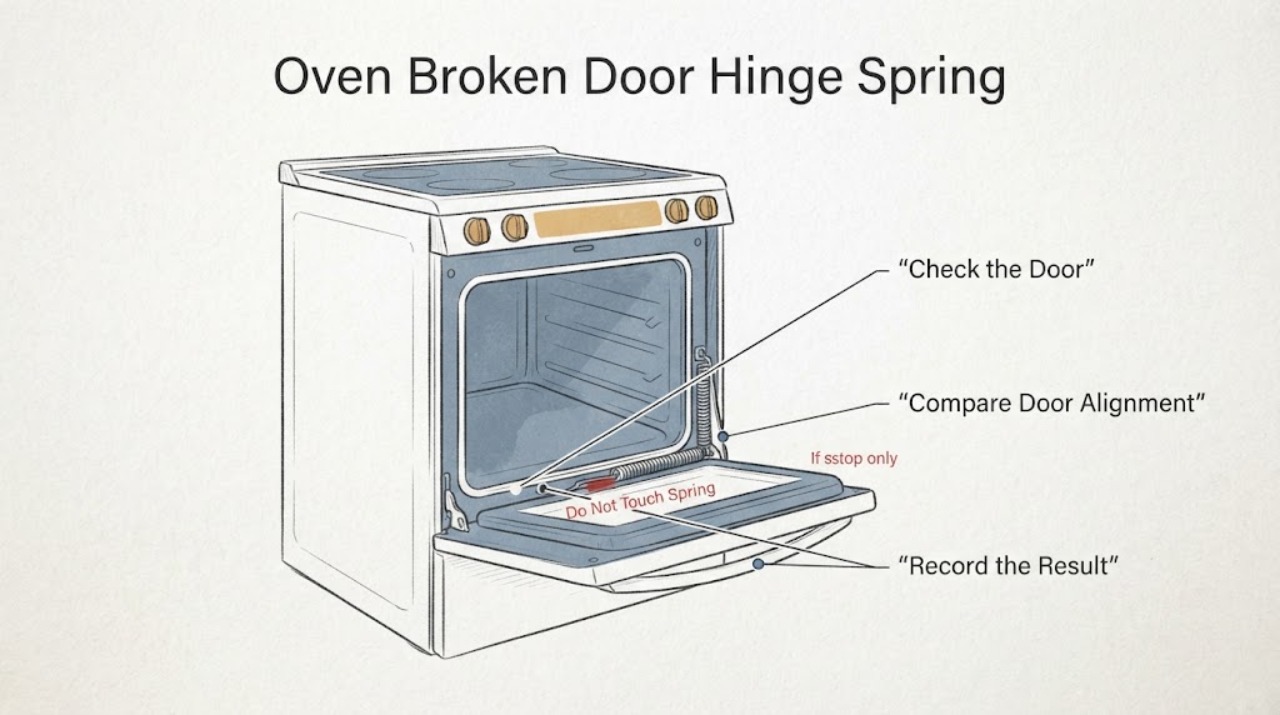
Work through in order
Diagnostic checks
Use only checks that match the exact appliance or system and its official guide.
-
Check 1
Stop using the oven and wait until it is fully cold before looking at the closed door from the outside.
Expected result: The door sags, drops, binds, will not close evenly, has loose glass, or exposes a displaced hinge or spring; or it remains stable and closed.
Next step: If any damage or instability is present, keep the oven out of service and arrange qualified appliance service. Do not force the door or touch the hinge/spring. If no visible hazard is present, continue only with the external identity and alignment checks below.
Why this matters
Why: A door that cannot reliably support or seal itself is unsafe to operate. A stable appearance does not confirm that a hinge spring is intact.
-
Check 2
From the front, compare the door gap at both sides and across the top without opening the door against resistance.
Expected result: One side hangs lower, the gap is uneven, or the door appears square and evenly seated.
Next step: For a lower or uneven side, stop and give the observation to service rather than trying to bend or reseat the spring. For an even gap, continue to identify the model; do not treat the result as clearance to repair the hinge.
Why this matters
Why: Amana says a lower side or uneven gap can indicate that a hinge is not correctly installed; an even gap only describes the current seating and does not rule out a weakened spring.
-
Check 3
Look only at the visible latch and hinge-entry area with the door stable; do not unlock, pry, pull, or remove the door.
Expected result: A notch or space is visible where Amana expects the hinge to seat, the door does not appear fully seated, or no abnormal gap is visible.
Next step: If the hinge is visibly displaced or the spring is exposed, stop and request service. Do not attempt the public door-removal procedure when the hinge or spring is damaged; only a model-specific manual or technician should determine whether the door can be handled safely.
Why this matters
Why: Amana's alignment guidance uses a visible notch or space and a click when a hinge is fully seated to identify an installation issue. This is not a spring-failure test and cannot select a replacement part.
-
Check 4
Record the complete Amana model and serial numbers and whether the appliance is a range or wall oven.
Expected result: The label is readable and identifies the appliance, or the label cannot be found/read safely.
Next step: Provide the identity to Amana support or the service provider. If it remains unknown, do not buy a generic spring or follow another model's hinge instructions.
Why this matters
Why: Amana uses the model number to locate product literature and support, and the label location differs between ranges and wall ovens. Without it, the hinge design and correct parts remain unresolved.
-
Check 5
Arrange qualified Amana appliance service for a reported broken hinge spring or hinge assembly, and provide the model, symptoms, door photographs, and any recent door work.
Expected result: The door is unstable, the spring or hinge is damaged, the model-specific procedure is unavailable, or the alignment concern remains after the external check.
Next step: Keep the oven out of use until the technician clears the door and identifies the correct hinge or spring assembly. Do not open the hinge area, remove the door, compress the spring, or test the oven with the damaged door.
Why this matters
Why: The remaining work involves a heavy door and stored mechanical force with model-specific fitment; the available family guidance does not establish a safe universal homeowner spring repair.
Use your observations
Decision map
Find the observation that best matches what you see, then follow the next safe action.
-
PATH 01Next step
What you see
The door sags, drops, binds, will not close or seal, has loose glass, or exposes a hinge or spring.
Do this next
Leave the oven off and arrange qualified appliance service. Do not touch the spring, remove the door, or keep testing it.
Why this path and its safety boundary
Why it matters: The door cannot be assumed to be mechanically safe, and continued heating could leave an unstable or poorly sealed door in use.
-
PATH 02Next step
What you see
The door sits lower on one side, has an uneven gap, or shows the notch/space that Amana associates with incomplete hinge seating.
Do this next
Stop at the visual observation and give it to service; do not force the door or apply pressure to a spring or hinge.
Why this path and its safety boundary
Why it matters: The visible result is consistent with a seating or installation issue, but it does not prove which hinge or spring component is defective.
-
PATH 03Next step
What you see
The door appears aligned and closed, but the reported hinge spring damage has not been model-verified.
Do this next
Record the model and serial number and obtain the matching Amana manual or technician assessment before any parts order or door removal.
Why this path and its safety boundary
Why it matters: A normal-looking gap cannot confirm spring strength or correct internal seating, and Amana has more than one door hinge design.
-
PATH 04Next step
What you see
The model number is unavailable or the correct model-specific door procedure cannot be confirmed.
Do this next
Do not use a generic spring or another model's instructions. Contact Amana or a qualified technician with photographs and the available appliance information.
Why this path and its safety boundary
Why it matters: Hinge design, spring arrangement, door weight, and compatible parts remain unresolved.
Helpful context
Understand the symptom
Treat the phrase broken door hinge spring as a reported condition, not proof that a particular spring or hinge part has failed. Amana's public door instructions distinguish hinge-latch doors from doors without hinge latches, so a generic spring-removal sequence could be wrong for the appliance.
Make the oven safe before inspecting the door
Turn the oven off and let it become fully cool. Do not use it if the door is sagging, drops, binds, will not seal or close, has loose glass, or exposes a hinge or spring. Keep hands away from the hinge area and do not try to hold a spring in position. If the appliance cannot be made safe without approaching a damaged electrical or gas connection, leave it alone and arrange qualified service.
Use only visible alignment clues
Without removing the door, compare the gap at the top and sides and look for a door that sits lower on one side. Amana says an uneven gap or a lower side can indicate that a hinge is not correctly seated after door work; its alignment guidance also uses a visible notch or space and a click as signs of incomplete seating. Those observations can identify a seating issue, but they do not prove that the spring itself is the failed part.
Confirm the appliance identity before parts or repair work
Photograph the model and serial label and note whether the appliance is a range or wall oven. Amana lists the label locations by appliance type and uses the model number to locate manuals and support. Do not order a generic hinge or spring from the symptom, because the door design and fitment remain unresolved without that identity.
Hand off the hinge or spring repair
Give the service provider the full model and serial number, whether the door is sagging or cannot close, any visible glass or metal damage, when the problem began, and whether the door was recently removed or cleaned. Amana's service page describes Amana-trained and certified technicians and genuine OEM parts; let the technician identify the hinge assembly and any spring, rather than opening the hinge area at home.
When checks do not resolve it
Need a professional?
Arrange qualified Amana appliance service before further use for any sagging, binding, loose-glass, exposed-spring, uneven-gap, or uncertain hinge condition; obtain the model-specific manual before any user-level door handling.
Safety scope: Keep the oven off if the door is unstable, damaged, or does not close and seal. Do not remove the door, manipulate a spring or hinge latch, open the appliance, or test heating until qualified service confirms the door assembly is safe.
Have this ready
- Full model and serial numbers, range or wall-oven form factor, door photographs from closed and partially open positions if safe, gap/alignment observations, visible hinge or glass damage, and whether the door was recently removed or cleaned.
Common questions
FAQ
Can I replace an Amana oven door hinge spring myself?
Do not assume that a generic spring procedure applies. Amana documents more than one door hinge design, and this task has no model number. Keep the oven off if the door is unstable and have qualified service identify the hinge or spring assembly and the correct procedure.
Does an uneven door gap prove the spring is broken?
No. Amana says an uneven gap or a lower side can indicate a hinge is not correctly installed, but that observation does not identify a broken spring. Do not bend or reseat the hinge at home when damage is reported; give the result to service.
Where do I find the Amana oven model number?
Amana lists different locations by appliance type: a range label may be inside the burner box or underneath, while a wall-oven label is on the lower-left frame with the door open. Only inspect a label when doing so is safe; provide the full model and serial numbers to support.
Can I remove the door first to inspect the spring?
Not when a hinge or spring is reported damaged and the exact model is unknown. Amana's door-removal instructions differ by hinge design and require correct latch handling and two-hand support. Stop at the visible check and use qualified service for a damaged assembly.
Read the exact guide
Official sources
- Removing and Replacing the Oven DoorAmana Product Help · Official Amana family-level door guidance. It identifies two door designs, proper two-hand support, hinge seating, and even-gap checks; it does not establish a universal spring repair or fitment for an unspecified model.
- Oven Door Not Aligned - RangeAmana Product Help · Official Amana range alignment guidance used only for visible notch/space, click, and service escalation observations; it is not a diagnosis of a broken spring and is not broadened to a specific wall-oven model.
- Amana Appliance Repair & Warranty Service Near MeAmana Service · Official Amana service page used only for professional-service routing and certified-technician/OEM-part boundary; it does not prove a specific hinge or spring diagnosis.
- Contact UsAmana · Official Amana support page used to require exact model/serial information and to distinguish range versus wall-oven label locations before selecting literature or parts.
Community feedback
Share a repair observation
Share a plain-text repair observation. Accepted observations are published automatically; this page may take a moment to update.