
On this page
Start here
Quick answer
Treat a true gas or rotten-egg odor as a safety event, not a startup behavior to test. Turn the oven and all burners off if you can do so without approaching a suspected leak, do not light anything or operate switches, leave the building and call the gas supplier or fire department from outside. Amana separately says a small new-oven odor or smoke during first use can come from new materials, and a brief whoosh when gas ignites can be normal. Only when the smell is clearly a new-material odor with no gas characteristics and the appliance is otherwise safe should you follow Amana's first-use ventilation and empty-cycle guidance. A gas odor that repeats, persists after the first uses, or occurs with delayed ignition, flame irregularity or soot needs qualified service.
Before you begin
Safety first
- Do not test for a leak with a flame, repeatedly restart the oven, touch switches during a suspected gas leak, open the oven or regulator, adjust pressure, manually light the burner or bypass ignition safety. Evacuate for a true gas odor and call from outside.
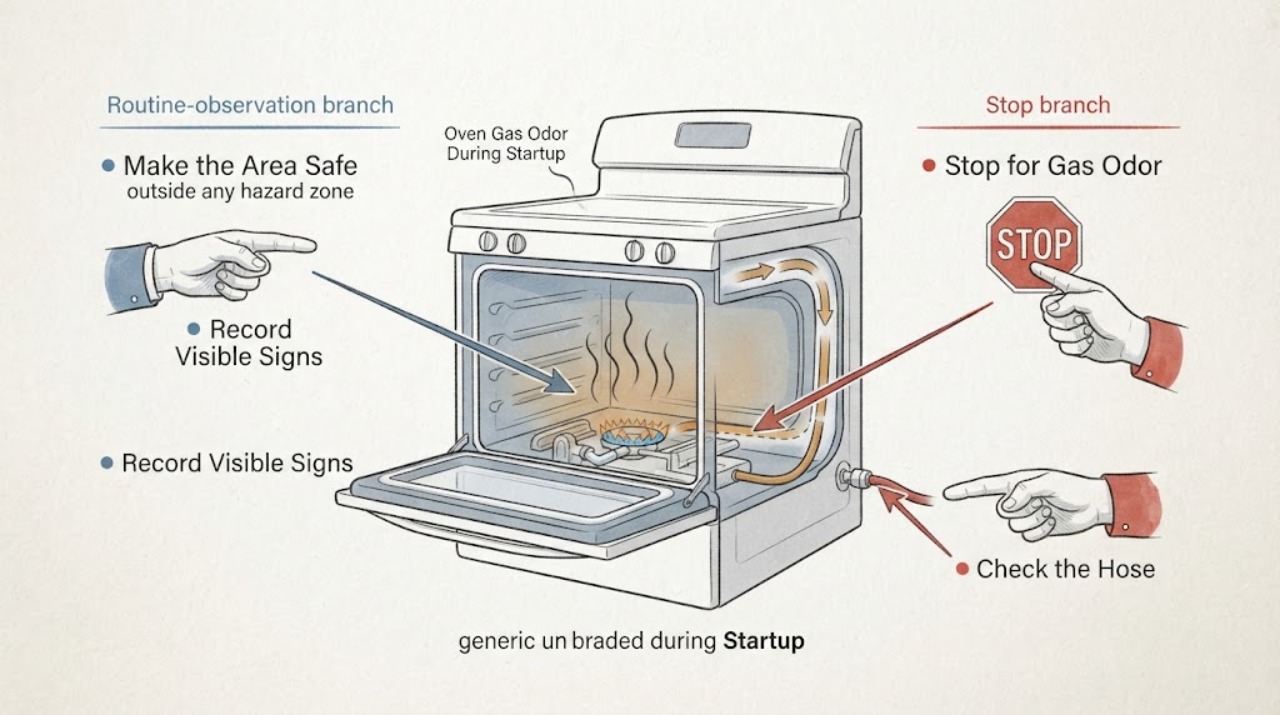
Work through in order
Diagnostic checks
Use only checks that match the exact appliance or system and its official guide.
-
Check 1
From a safe position, turn the oven and surface controls OFF only if you can do so without approaching a suspected leak; classify the report as gas/rotten-egg odor, new-material odor, or only a brief ignition whoosh.
Expected result: The smell is gas-like or rotten-egg-like, the oven is new and smells like packaging or protective coating, or there is only a short whoosh at ignition with no continuing odor.
Next step: If the odor is gas-like, do not continue troubleshooting and follow the evacuation branch. If it is clearly new-material odor or only a normal whoosh, continue only with the corresponding conditional checks below.
Stop if: If the odor cannot be classified without restarting the oven or moving close to it, keep the appliance off and arrange qualified gas-appliance service.
Why this matters
Why: Amana treats these as different patterns: gas odor requires emergency precautions, a small first-use odor can be normal, and a brief ignition whoosh can be normal.
-
Check 2
If any gas or rotten-egg odor is present, do not light an appliance, operate electrical switches, use a phone inside, or try to reproduce the startup event; leave the building and contact the gas supplier or fire department from outside.
Expected result: The odor is present while the oven is off, continues after the controls are off, or is strong enough that its source is uncertain.
Next step: Leave immediately. Call the gas supplier from a neighbor's phone, or call the fire department if the supplier cannot be reached. Do not return to test the oven until the responsible professional says it is safe.
Stop if: If there is no gas-like odor and the report is clearly a new-material smell or brief ignition sound, use the appropriate non-emergency branch without opening or adjusting gas components.
Why this matters
Why: Amana treats gas odor that is not explained by normal operation as a possible gas-safety emergency, not as a user-adjustable ignition issue.
-
Check 3
For a newly installed or first-use oven whose odor is clearly from new parts, insulation, protective oil or shipping materials rather than gas, confirm from outside the cavity that all packaging has been removed and ventilate the room; keep birds in another closed, well-ventilated room.
Expected result: Packaging remains, the smell matches a new-material odor and diminishes with ventilation, or the odor smells like gas or does not diminish.
Next step: If packaging or new-material odor is the clear explanation, follow the exact Amana first-use instructions and do not cook food during the empty cycle. If the odor is gas-like or persists as an unexplained smell, stop and arrange service instead.
Stop if: If the odor is not clearly a new-material odor, do not run another cycle to investigate; use the gas-safety or service branch.
Why this matters
Why: Amana says new-oven odor can be normal and should dissipate after the first few uses, but the source must not be confused with a gas odor.
-
Check 4
Only in the clearly identified first-use branch, follow Amana's empty-cycle guidance: remove packaging, use Bake at 350°F for 60 minutes, ventilate, let the cavity cool and wipe it with a soft damp cloth; do not perform this cycle if a gas odor is suspected.
Expected result: The odor fades after the first-use cycle and does not return, or it remains, becomes stronger, or is accompanied by abnormal flame, smoke or delayed ignition.
Next step: If it fades and there are no gas-safety signs, wait until the cavity is cool before cleaning and resume normal use according to the model manual. If it remains or any gas-like odor appears, keep the oven off and arrange qualified service; use the emergency branch for a true gas odor.
Stop if: If the oven cannot be safely observed without restarting it, leave it off and provide the model and installation history to service.
Why this matters
Why: A fading new-material odor fits Amana's first-use guidance. A persistent or changing odor is not supported by that explanation and needs service or emergency handling.
-
Check 5
If the oven was recently installed or reconnected, provide that history to the installer or service technician rather than attempting to purge the line or adjust a valve yourself; report whether the odor appeared before ignition, during ignition or after the flame established.
Expected result: The appliance was recently installed or reconnected, the odor repeats at every startup, or the oven does not ignite normally.
Next step: Keep the oven off if the odor is gas-like or repeated, and arrange qualified gas-appliance service or installer inspection. Do not open the regulator, alter gas pressure, manually light the oven or bypass ignition safety.
Stop if: If the oven is not newly connected and a safe first-use explanation does not fit, arrange service rather than guessing at an internal gas or ignition component.
Why this matters
Why: Amana notes that air can be trapped in a recently connected gas line and directs owners to installation information, but that information does not authorize repeated testing when gas odor is present.
Use your observations
Decision map
Find the observation that best matches what you see, then follow the next safe action.
-
PATH 01Next step
What you see
The oven is new, the odor is clearly like new materials or packaging, there is no gas-like smell, and the odor diminishes with ventilation.
Do this next
Remove packaging and follow the model's first-use guidance, including the Amana empty cycle before cooking; keep birds away from the fumes and stop if the smell changes to gas-like.
Why this path and its safety boundary
Why it matters: Amana says a small amount of first-use odor or smoke can come from new parts, insulation, protective oil or shipping tape.
-
PATH 02Next step
What you see
There is a gas or rotten-egg odor, the smell remains after the oven is off, or the source cannot be distinguished safely.
Do this next
Do not light anything, touch switches or use a phone inside. Leave the building and call the gas supplier or fire department from outside; do not return to test the appliance.
Why this path and its safety boundary
Why it matters: This is a possible gas emergency, not a normal startup odor.
-
PATH 03Next step
What you see
The only event is a brief whoosh or poof at ignition, the flame establishes normally, and no gas odor remains.
Do this next
Monitor without approaching the burner. If an odor remains, ignition is delayed, or flame behavior is abnormal, turn the oven off and arrange service.
Why this path and its safety boundary
Why it matters: Amana says gas ignition from the Bake or Broil element can make a whooshing sound during normal operation.
-
PATH 04Next step
What you see
The odor repeats after the first-use period, occurs after installation or reconnection, or is accompanied by delayed ignition, abnormal flame, smoke or soot.
Do this next
Keep the oven out of service and contact qualified Amana or gas-appliance service. Do not adjust gas pressure, open the oven, manually light it or substitute a part.
Why this path and its safety boundary
Why it matters: The new-material or normal-ignition explanation is no longer sufficient; the exact model and gas installation need professional assessment.
Helpful context
Understand the symptom
Identify the odor without reproducing it
A true gas or rotten-egg smell must be handled as a possible leak. Do not keep turning the oven on to compare the smell. Amana describes a small first-use odor or smoke from new materials separately, and describes a brief whoosh when the burner ignites as a normal sound. Those descriptions do not make an unexplained gas odor safe; the odor type, whether it remains after the controls are off, and whether the oven is newly installed are the decision points.
The emergency response comes first
If the smell is gas-like or rotten-egg-like, do not light an appliance, touch electrical switches or use a phone inside the building. Leave and call the gas supplier from a neighbor's phone or call the fire department if the supplier cannot be reached. Do not open the oven, adjust a regulator, relight a burner or attempt to locate a leak.
A clearly identified first-use material odor is a different branch
When the oven is new and the odor is clearly the temporary smell of new parts or packaging rather than gas, Amana recommends removing packaging, ventilating the room, moving birds to a separate well-ventilated room and running the empty first-use cycle described for the range. Do not cook food during that cycle. Stop and use the gas-safety branch if the odor resembles gas, becomes stronger, continues after the first uses or is accompanied by abnormal flame, smoke or ignition behavior.
When checks do not resolve it
Need a professional?
For a gas or rotten-egg odor, leave immediately and contact the gas supplier or fire department from outside. Arrange qualified service when the odor repeats, persists beyond the first-use period, appears after installation or reconnection, or occurs with delayed ignition, abnormal flame, smoke or soot. Do not reproduce the smell, open the oven, adjust gas pressure, bypass ignition safety or manually light the oven.
Safety scope: Do not test for a leak with a flame, repeatedly restart the oven, touch switches during a suspected gas leak, open the oven or regulator, adjust pressure, manually light the burner or bypass ignition safety. Evacuate for a true gas odor and call from outside.
Common questions
FAQ
Is a gas smell when an Amana oven starts normal?
Do not assume that a true gas or rotten-egg odor is normal. Amana separately describes a small first-use odor from new materials and a brief whoosh at ignition as possible normal events. If the smell is gas-like, persists after the controls are off, or cannot be classified safely, leave and call the gas supplier or fire department from outside.
What should I do if I smell gas from the oven?
Do not light an appliance, touch electrical switches or use a phone inside. Leave the building and call the gas supplier from a neighbor's phone; if you cannot reach the supplier, call the fire department. Do not return to restart the oven until a responsible professional says it is safe.
Can a new Amana oven smell during its first use?
Amana says a small amount of odor or smoke can be normal during first use because of new parts, insulation, protective oil or shipping tape. Remove packaging, ventilate and follow the first-use empty-cycle instructions, but stop immediately if the smell is gas-like or persists as an unexplained odor.
Is a whoosh or poof from an Amana gas oven normal?
Amana says a whooshing sound when gas ignites from Bake or Broil can be normal and may recur during the cycle. A sound alone is different from a continuing gas odor; if odor remains, ignition is delayed or flame behavior is abnormal, turn the oven off and arrange service.
Read the exact guide
Official sources
- Whoosh or Poof Noise in Oven - RangeAmana · Amana oven/range support guidance; used only to distinguish a brief ignition sound from a continuing gas odor.
- Odors and Smells of Newly Installed Range or OvenAmana · Amana official range and oven guidance; applies only when the odor is clearly a new-material first-use smell and not a suspected gas odor.
- Amana Gas Cooktop - Odors or SmellsAmana · Amana official gas-cooking safety guidance; used for the gas-odor emergency response, not to claim a model-specific oven leak diagnosis.
- Oven Not Working - GasAmana · Amana gas oven support article; used for installation/reconnection context and service escalation, not for user gas-line repair.
Community feedback
Share a repair observation
Share a plain-text repair observation. Accepted observations are published automatically; this page may take a moment to update.