
On this page
Start here
Quick answer
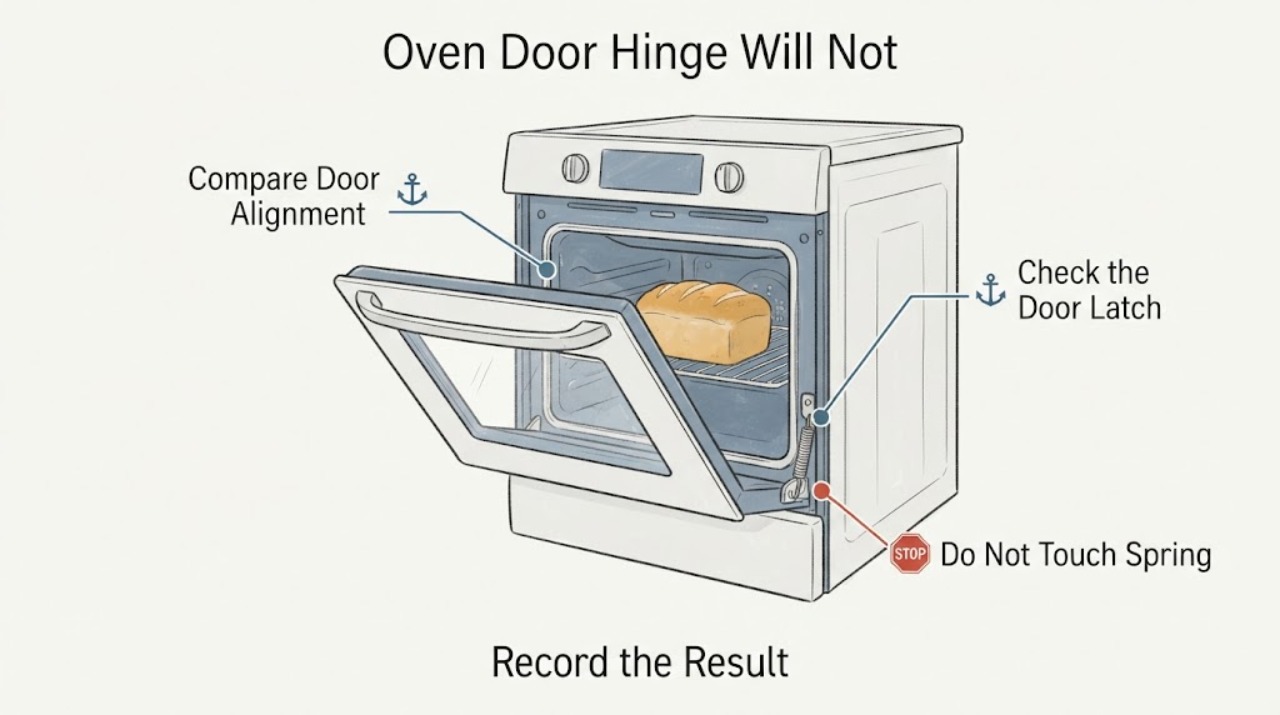
Do not force an Amana ACS7270AS oven door hinge or try to bend a spring while removing the door. First let the oven cool completely, confirm the full model from the range label, and use the exact model's door instructions to identify whether the door has hinge latches. Amana's official guidance says the door is heavy, should be held at both sides rather than the handle, and must seat evenly before the latches are locked. If the hinge will not reach the documented open or removal position, one side sits lower, the door is crooked, or the latch resists, stop: the hinge may be mis-seated, bent, or damaged, but the symptom does not identify a replaceable part. Keep the range out of service until a qualified appliance technician can inspect it, especially if the door cannot close and seal while baking bread.
Before you begin
Safety first
- Keep the oven off and cool. Do not force a spring-loaded hinge, remove hinge hardware under tension, open electrical or gas compartments, or operate with a damaged or unsealed door.
Work through in order
Diagnostic checks
Use only checks that match the exact appliance or system and its official guide.
-
Check 1
Cancel the bake and allow the range and door to become completely cool before touching the hinge area. From the front, record whether the door is stuck partly open, whether one corner is lower, whether the gap is uneven, and whether the glass, gasket, frame, or hinge area is visibly damaged. Do not force the door through resistance or put fingers near a spring-loaded hinge.
Expected result: The door is still hot, the hinge is under obvious tension, the door is crooked, the gasket or glass is damaged, or the door moves freely but stops at a normal position.
Next step: Leave the door and hinge undisturbed until cool. Stop using the oven if the door cannot close and seal evenly; arrange qualified service for visible damage, tension, or a crooked door.
Stop if: Do not pry the hinge, bend a spring, remove hinge hardware under tension, or resume baking to test a door that does not seal.
Why this matters
Why: Heat, stored hinge force, damage, or an uneven door changes this from a cleaning task to a safety and alignment issue. A normal-looking stop cannot be interpreted until the exact model's instructions identify its intended position.
-
Check 2
Verify the complete model number from the appliance label and retrieve its matching Amana manual before choosing a removal method. Compare the visible door hardware with the manual's description of a hinge-latch door or a door without hinge latches; do not infer the design from the ACS7270AS name alone.
Expected result: The full label matches ACS7270AS and the manual clearly identifies the door type, the model is incomplete or different, or no matching door procedure can be found.
Next step: Proceed only with the exact model's instructions when the identity and door type agree. Otherwise stop and send the label photo and door photos to Amana or a qualified technician instead of borrowing a procedure from another range.
Stop if: Do not continue when the manual is for another model, the hardware does not match, or the only available method requires forcing a latch or hinge arm.
Why this matters
Why: Amana's own help page has different steps for the two door types. An incomplete identity or an unmatched procedure leaves the hinge position and latch movement unverified.
-
Check 3
If—and only if—the matched model instructions permit door removal, prepare a flat, soft-covered surface and use two hands on the side edges. Follow only the documented latch position and door stop for that door type; never lift by the handle and never unlock a hinge while the door is unsupported or off the range.
Expected result: Both latches or hinge arms reach the documented position together, the door lifts without binding, one side stops early, a latch will not move fully, or the door begins to twist or drop.
Next step: For a smooth, matching movement, place the heavy door on the prepared surface and continue only as the exact manual directs. For any binding, twist, early stop, or latch resistance, stop with the hinge closed and arrange service.
Stop if: Do not shift the hinge sideways under load, pull harder, remove a spring, or disassemble the door to make the hinge open.
Why this matters
Why: Amana's instructions treat latch position and even side support as prerequisites. Unequal movement, binding, or a latch that will not reach its position is not proof of a specific hinge part; it can reflect seating, alignment, or damage.
-
Check 4
After any permitted reinstallation, hold the door at both sides while checking that both hinges are seated, the door reaches the manual's fully open position, the latches are in their documented locked state, and the closed door has an even gap and seal. Close it slowly; do not use the handle or force a side into alignment.
Expected result: The door is level and opens and closes freely with an even gap, or it remains low on one side, will not reach full opening, rubs the frame, or will not latch evenly.
Next step: If alignment is not correct after one careful, model-matched seating check, stop using the oven and request qualified appliance diagnosis. Tell the technician which side is low and whether the problem began after cleaning or door removal.
Stop if: Do not bake bread, run self-clean, or repeatedly open and close a door that does not seal, latches unevenly, or shows glass/frame damage.
Why this matters
Why: Amana says a door that does not open fully or hangs lower on one side should be removed and replaced correctly; a crooked or rubbing door after that check indicates a service boundary rather than a reason to keep adjusting the hinge.
-
Check 5
Record the event for service: full model label, whether the oven was hot from baking bread, the door's resting angle, which side or hinge stopped, whether a latch was moved, any fall or impact, and whether the door can close without a gap. Do not remove panels or attempt electrical or gas adjustments to solve a mechanical hinge problem.
Expected result: The door was forced, dropped, struck, exposed to high heat, or now leaves a visible gap; or it simply remains difficult to remove with no confirmed damage.
Next step: Keep the range out of service when the seal or alignment is abnormal and provide the record and photos to qualified Amana appliance service. Ask the provider to inspect the hinge receiver and door alignment before quoting a part.
Stop if: Do not run the oven with a damaged or unsealed door, and do not open an electrical compartment or work on the gas path.
Why this matters
Why: Impact, heat, or an unseated hinge can involve the door frame, hinge receiver, latch, or gasket together. The symptom does not justify ordering a hinge without a model-specific fit check.
Use your observations
Decision map
Find the observation that best matches what you see, then follow the next safe action.
-
PATH 01Next step
What you see
The oven is cool, the full ACS7270AS label and matching manual are confirmed, the visible hinge design matches, and both hinges move to the documented position without resistance.
Do this next
Use two hands at the side edges and follow only that exact manual's sequence on a soft, stable surface. Recheck even seating and latch position before closing.
Why this path and its safety boundary
Why it matters: A controlled, model-matched door removal or re-seating may be appropriate; the family fan-noise guidance does not answer this hinge decision.
-
PATH 02Next step
What you see
The hinge will not open fully, one side is lower, the door twists or rubs, a latch will not move to its documented position, or the door still will not reach full opening after one careful matching attempt.
Do this next
Stop applying force, keep the oven out of service, and have a qualified appliance technician inspect the door, hinge receiver, latch, and seal together.
Why this path and its safety boundary
Why it matters: This pattern is consistent with an unseated, misaligned, bent, or damaged door/hinge system, but it does not identify which component failed.
-
PATH 03Next step
What you see
The model is incomplete, the manual cannot be matched, or the door hardware does not match either Amana procedure.
Do this next
Do not remove the door. Confirm the label with Amana or arrange model-specific service using clear photos of both hinges and the door gap.
Why this path and its safety boundary
Why it matters: The safe hinge position and removal method are unverified; another Amana or Whirlpool platform's lever or spring instructions may be wrong for this range.
-
PATH 04Safety boundary
What you see
The door is hot, the hinge or glass is damaged, the door cannot close and seal, there was a drop or impact, or smoke, gas odor, electrical damage, or abnormal heat is present.
Do this next
Stop using the oven, keep people away from the door, and contact qualified appliance service; use emergency help for active smoke, fire, or a strong gas odor.
Why this path and its safety boundary
Why it matters: The immediate risk exceeds a user door-removal check; continuing to bake or manipulating a loaded hinge can worsen injury, fire, gas, or glass hazards.
Safety stop: No forcing, self-clean cycle, repeated baking test, panel removal, gas adjustment, or live electrical work.
Helpful context
Understand the symptom
The ACS7270AS identity matters before any door work. Amana's manuals page asks for the full model number to locate product literature, and Amana publishes more than one oven-door design: one with hinge latches and one without. A generic video or another range's spring-and-lever sequence is not enough to establish the safe method for this range.
Because the reported problem is a hinge that will not open fully while the oven is used for bread, treat heat and door alignment as the first decisions. The official guidance calls the door heavy and requires side support; do not use the handle to lift it, pry the hinge, or continue if the door does not sit level and seal evenly after a documented re-seating attempt.
When checks do not resolve it
Need a professional?
Call qualified Amana appliance service when the hinge does not reach the documented position, the door is uneven or unsealed, the latch resists, the door was dropped or damaged, or the exact model procedure cannot be verified.
Safety scope: Keep the oven off and cool. Do not force a spring-loaded hinge, remove hinge hardware under tension, open electrical or gas compartments, or operate with a damaged or unsealed door.
Have this ready
- Provide the full model label (ACS7270AS if confirmed), photos of both hinge areas and the closed-door gap, the door's resting position, whether the problem followed cleaning or an impact, and whether the oven was hot from baking bread.
Common questions
FAQ
Can I keep baking bread if the oven door hinge will not open fully?
No if the door is crooked, does not close and seal evenly, rubs, or shows damage. Let the oven cool and arrange service rather than compensating with force or continued baking.
Why is the Amana door removal method not stated as one fixed lever sequence?
Amana publishes separate procedures for doors with hinge latches and doors without them, and its manuals page requires the full model number to locate applicable literature. Match ACS7270AS and the visible hardware before following any removal instructions.
Should I replace the hinge based only on the fact that it will not open fully?
No. An incomplete opening can result from seating, alignment, a receiver, latch, frame, or hinge problem. Have the complete door system inspected and confirm model fit before considering a part.
Read the exact guide
Official sources
- Owner's ManualAmana · Official Amana owner manual used only for general boundaries (cool, heavy door, side support, do not lift by handle, keep hinges secured); it is not asserted as the ACS7270AS-specific manual.
- Removing and Replacing the Oven DoorAmana Product Help · Official Amana guidance that explicitly separates hinge-latch and no-latch door types; use only after matching the exact appliance manual and visible hardware.
- Manuals and Guides | AmanaAmana · Official lookup page used to require complete model verification and locate the model-specific manual; it does not itself establish an ACS7270AS door mechanism.
Community feedback
Share a repair observation
Share a plain-text repair observation. Accepted observations are published automatically; this page may take a moment to update.