
On this page
Start here
Quick answer
On an Amana AGR5630BDW1 gas oven, a flame that lights while the igniter clicks and then goes out when the clicking stops is not a normal completed preheat. Amana says igniters click until a flame is detected; this sequence means the flame is not being maintained or confirmed, but it does not identify a replacement part. Stop the oven and, if you smell gas, hear a strong release of gas, see a large or unstable flame, smoke, scorching, or an electrical hazard, leave the area and follow local gas-emergency guidance. If there is no gas odor, perform only safe external checks: confirm the door is fully closed, the oven bottom is not covered, the storage drawer is not interfering with the igniter, and the main and regulator shut-off positions match the exact installation instructions. Because a new igniter did not prove the cause, do not keep retrying preheat, measure igniter current, adjust gas pressure, bypass a safety control, or replace the valve or control board by guesswork; arrange qualified gas-appliance service.
Before you begin
Safety first
- Do not measure igniter current, adjust gas pressure, bypass flame detection or another safety control, manually light the oven, open the burner or control area, remove panels, operate with the range partly disassembled, or continue repeated preheat attempts after flame loss. Leave immediately for gas odor, suspected unburned gas, fire, smoke, sparking, or an unstable flame.
Work through in order
Diagnostic checks
Use only checks that match the exact appliance or system and its official guide.
-
Check 1
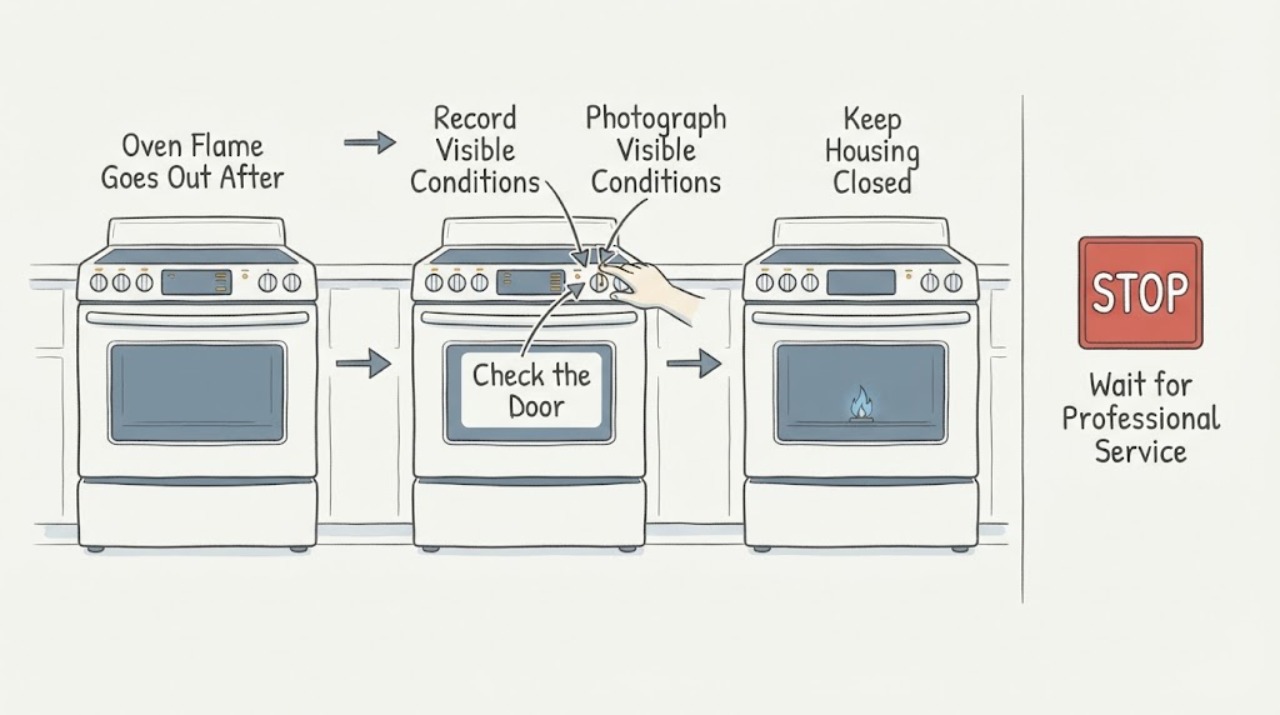
Stop the oven from a safe position and wait for the burner to stop. Record whether the flame was visible, how long it stayed lit, whether clicking stopped before it went out, whether bake, broil, or both are affected, and whether there is gas odor, an abnormal flame, smoke, scorching, sparking, or an electrical symptom.
Expected result: There is gas odor, suspected unburned gas, an abnormal flame, smoke, scorching, sparking, hot wiring, or repeated ignition; or there is a repeatable flame-then-out sequence without a hazard.
Next step: For odor or an active gas or fire concern, leave the area and follow local emergency or gas-service guidance. Without a hazard, keep the oven off and use only stopped-oven external checks; do not run more cycles.
Stop if: Do not relight repeatedly, use a match or lighter, open the burner area, or remain near the appliance while gas odor or an unstable flame is present.
Why this matters
Why: A hazard takes priority. A repeatable flame that goes out as clicking stops is not the normal endpoint Amana describes, but timing does not select one failed part.
-
Check 2
Confirm the identity before using any manual: photograph or transcribe the complete rating-label model, including AGR5630BDW1, and note the market and fuel type. Use Amana's manual portal to locate the document matching the full model rather than relying on a similar AGR5630 series number.
Expected result: The label clearly matches AGR5630BDW1 and a matching Amana document is found, or the suffix, fuel type, or document match is uncertain.
Next step: Use only the matched Amana document for a permitted user step. If identity or the manual is uncertain, stop at external observations and arrange qualified service.
Stop if: Do not choose a valve, igniter, control, pressure setting, wiring repair, or test procedure from a family prefix or online parts listing.
Why this matters
Why: Gas-range ignition and safety arrangements can vary by model and platform. The exact Reddit case matches AGR5630BDW1, but it is not a substitute for the model's own instructions.
-
Check 3
With the oven off and no gas odor, check only visible conditions Amana identifies: the oven door is fully closed, the storage drawer is not overloaded or contacting the igniter area, and the oven bottom is not covered by foil or a liner. Do not remove the oven bottom, flame spreader, igniter, or burner.
Expected result: The door is not fully closed, drawer contents could interfere, foil or a liner covers the oven bottom, or these conditions are correct.
Next step: Correct only a plainly visible condition with the oven off, then do not repeat ignition if the flame previously went out; arrange service if the sequence returns or the condition was already correct.
Stop if: Do not reach through openings, scrape the igniter, remove panels, or test the burner while gas or electrical components may be energized.
Why this matters
Why: Amana says a door position can prevent heating, drawer contents can interfere with the igniter, and a bottom liner can block air or gas flow. These checks do not prove the new igniter or a gas component is defective.
-
Check 4
If there is no gas odor and you can identify the controls without moving or disassembling the range, compare the main gas valve and oven pressure-regulator shut-off position with the exact installation instructions. Note whether the cooktop works while the oven does not and whether the range was recently installed or reconnected.
Expected result: The main supply or regulator shut-off is closed or uncertain, the cooktop works while the oven fails, the range was recently reconnected, or visible valve positions appear correct.
Next step: Follow only the exact manual for an obvious accessible shut-off position; otherwise leave gas components untouched and arrange qualified service. Do not adjust pressure or disconnect the line.
Stop if: If there is gas odor or uncertainty about a valve, leave the area and obtain qualified help; do not keep trying bake or broil.
Why this matters
Why: Amana explains that a cooktop can work while an oven-specific regulator shut-off prevents oven gas, and that trapped air can matter after reconnection. Correct visible valve position does not establish pressure, valve operation, ignition, or flame sensing.
-
Check 5
Record the repair history without opening the range: the date and identity of the new igniter, whether bake and broil were affected, whether the oven worked normally after replacement, and whether the fault is intermittent or occurs on every preheat. Include a safe photo or exact description of the flame-then-out timing.
Expected result: The new igniter briefly improved operation, the same fault returned, bake and broil both fail, only one mode fails, or the event cannot be reproduced reliably.
Next step: Give the full history to a qualified technician and request a written model-specific diagnosis that states what was observed, what was tested by the technician, and what result supports any proposed repair.
Stop if: Do not buy or install another igniter, valve, or control board solely because the prior part was new or a forum suggests it.
Why this matters
Why: A new igniter and a returning symptom do not prove the replacement failed or identify the next part. Mode-specific, intermittent, and flame-loss patterns need system diagnosis rather than elimination replacement.
-
Check 6
Keep the oven out of service when the flame goes out after clicking stops, and request qualified gas-appliance service. Provide the exact model, bake and broil results, external valve and door checks, flame timing, gas-odor history, and every part already replaced. Do not attempt internal electrical or gas diagnosis.
Expected result: A qualified provider can reproduce the failure and document a model-specific test result, or cannot reproduce it and proposes a part without isolating the fault.
Next step: Approve work only after the provider explains the observed result and safe post-repair verification. If the provider cannot isolate the cause, seek a second qualified diagnosis rather than continuing part swaps.
Stop if: Do not measure igniter current, adjust gas pressure, bypass flame safety, operate with panels removed, or continue using the oven while it repeatedly loses flame.
Why this matters
Why: A documented result can support a targeted repair; a part guess, reset, or one temporarily successful preheat does not prove the ignition and flame-safety system is resolved.
Use your observations
Decision map
Find the observation that best matches what you see, then follow the next safe action.
-
PATH 01Safety boundary
What you see
There is gas odor, suspected unburned gas, a loud gas release, an abnormal or unstable flame, smoke, scorching, sparking, or hot or damaged wiring.
Do this next
Leave the area and follow local gas-emergency or fire guidance for an active hazard; otherwise keep the range off and arrange qualified service.
Why this path and its safety boundary
Why it matters: This is an immediate gas, fire, or electrical safety branch, not an invitation to try ignition again.
Safety stop: No relighting, repeated cycle, pressure adjustment, internal access, or breaker-reset experiment.
-
PATH 02Next step
What you see
The flame lights during preheat, the igniter clicking stops, and the flame then goes out, especially when both bake and broil show the same sequence.
Do this next
Keep the oven out of service, stop replacing parts by elimination, and provide the exact AGR5630BDW1 sequence to a qualified gas-appliance technician.
Why this path and its safety boundary
Why it matters: Amana's normal description is clicking until a flame is detected; this exact sequence is consistent with failure to maintain or confirm the flame, but does not identify the igniter, valve, wiring, ground path, or control as failed.
-
PATH 03Next step
What you see
The door, drawer, oven-bottom covering, and visible gas shut-off positions are correct, but the oven still loses flame or remains cold while the cooktop works.
Do this next
Arrange qualified service and provide the model, fuel and market details, bake-versus-broil result, flame timing, and repair history; leave gas pressure and internal controls untouched.
Why this path and its safety boundary
Why it matters: The accessible causes Amana lists have not corrected the symptom. Cooktop operation does not prove the oven branch is receiving or sustaining gas correctly.
-
PATH 04Next step
What you see
Only one mode fails, or the sequence occurs intermittently and is absent when a technician arrives.
Do this next
Keep a record or safe video from outside the oven only if there is no gas or fire hazard, and ask what model-specific observation will capture the failure. Do not keep cycling the oven to make it happen.
Why this path and its safety boundary
Why it matters: The mode and timing are valuable evidence, but an intermittent or mode-specific failure still does not prove a particular part.
-
PATH 05Next step
What you see
A provider can reproduce the failure and documents a result that isolates a component or installation condition, then completes a safe repair and verification.
Do this next
Keep the service report and follow safe verification instructions. Stop and reopen the service case if flame loss, gas odor, abnormal flame, or no heat returns.
Why this path and its safety boundary
Why it matters: A model-specific documented result is stronger than the fact that an igniter was recently replaced or that one later cycle worked.
Helpful context
Understand the symptom
What the clicking sequence tells you
A short click during gas-oven ignition is expected while the system is trying to detect a flame. In the exact AGR5630BDW1 report, the flame appears, clicking stops, and the flame goes out; bake and broil both show the pattern. That is timing evidence, not a part verdict. Document it as a flame-maintenance or flame-confirmation failure while the igniter, burner, wiring, control, gas supply, and valve remain service-level possibilities.
Why a new igniter does not close the case
Replacing an igniter changes the repair history but does not show that the new part is correct, correctly installed, receiving the intended signal, or that the flame is being sensed after ignition. Do not infer a valve, control board, pressure, or wiring fault from timing alone. Give a qualified technician the exact model, bake and broil behavior, timing, gas-odor history, and prior work.
When checks do not resolve it
Need a professional?
Arrange qualified gas-appliance service whenever the AGR5630BDW1 flame goes out when clicking stops, the condition returns after a new igniter, bake and broil both fail, external checks are correct, or diagnosis would require access to the igniter, burner, gas valve, wiring, grounding, control, or flame-safety path.
Safety scope: Do not measure igniter current, adjust gas pressure, bypass flame detection or another safety control, manually light the oven, open the burner or control area, remove panels, operate with the range partly disassembled, or continue repeated preheat attempts after flame loss. Leave immediately for gas odor, suspected unburned gas, fire, smoke, sparking, or an unstable flame.
Have this ready
- Provide AGR5630BDW1, full rating-label information, market and fuel type, bake and broil results, exact flame and clicking sequence, whether the cooktop works, gas-odor or abnormal-flame history, visible door, drawer, liner and valve checks, and the date and identity of the new igniter installation.
Common questions
FAQ
Does a new igniter prove the gas valve or control board is bad when the flame goes out?
No. The new part changes the history but does not prove its fit, installation, control signal, flame confirmation, gas supply, valve, wiring, grounding, or control behavior. The exact sequence needs model-specific service diagnosis rather than another part guess.
Is it normal for an Amana gas oven to click during preheat?
Amana says short clicking is normal while the igniters are trying to detect a flame. A flame that goes out when clicking stops is different from a normal completed ignition and should not be repeatedly tested.
Can I adjust the gas pressure or test the igniter myself?
No. Do not adjust pressure, measure igniter current, bypass flame safety, open the burner or control area, or manually light the oven. Check only safe external conditions described by the exact Amana instructions and arrange qualified service.
Read the exact guide
Official sources
- Oven Not Working - Cooktop Working - ClickingAmana Product Help · Official Amana troubleshooting page used only for safe external checks and the boundary to service; it is not an AGR5630BDW1 internal diagnostic.
- Clicking Noise in a Gas OvenAmana Product Help · Official Amana gas-oven support page used for the normal clicking sequence; it does not establish a component failure for AGR5630BDW1.
- Installation InstructionsAmana · Official Amana gas-range installation PDF opened for the ignition sequence, flame behavior, and stop-and-service boundary; confirm the exact AGR5630BDW1 manual through the model lookup before installation work.
- Manuals and Guides | AmanaAmana · Official Amana lookup page used to require the complete rating-label model before applying installation or operation instructions.
- Gas oven turns off as soon as igniter stops clicking, igniter is brand newReddit r/appliancerepair · Exact Reddit post used as a matching lived-experience report only; it does not establish a confirmed component diagnosis or repair.
Community feedback
Share a repair observation
Share a plain-text repair observation. Accepted observations are published automatically; this page may take a moment to update.