
On this page
Start here
Quick answer
Confirm the oven is set to a normal bake or broil cycle, the door is fully closed, and a delayed start, control lock, or demo mode is not preventing heating. If it is a gas range, use the model instructions to verify the oven's regulator shut-off and main gas valve; if it is electric, check only the accessible controls and whether the circuit is supplying the appliance. Do not open live wiring or gas components. If the oven still does not heat after the safe external checks, record the model and arrange appliance service.
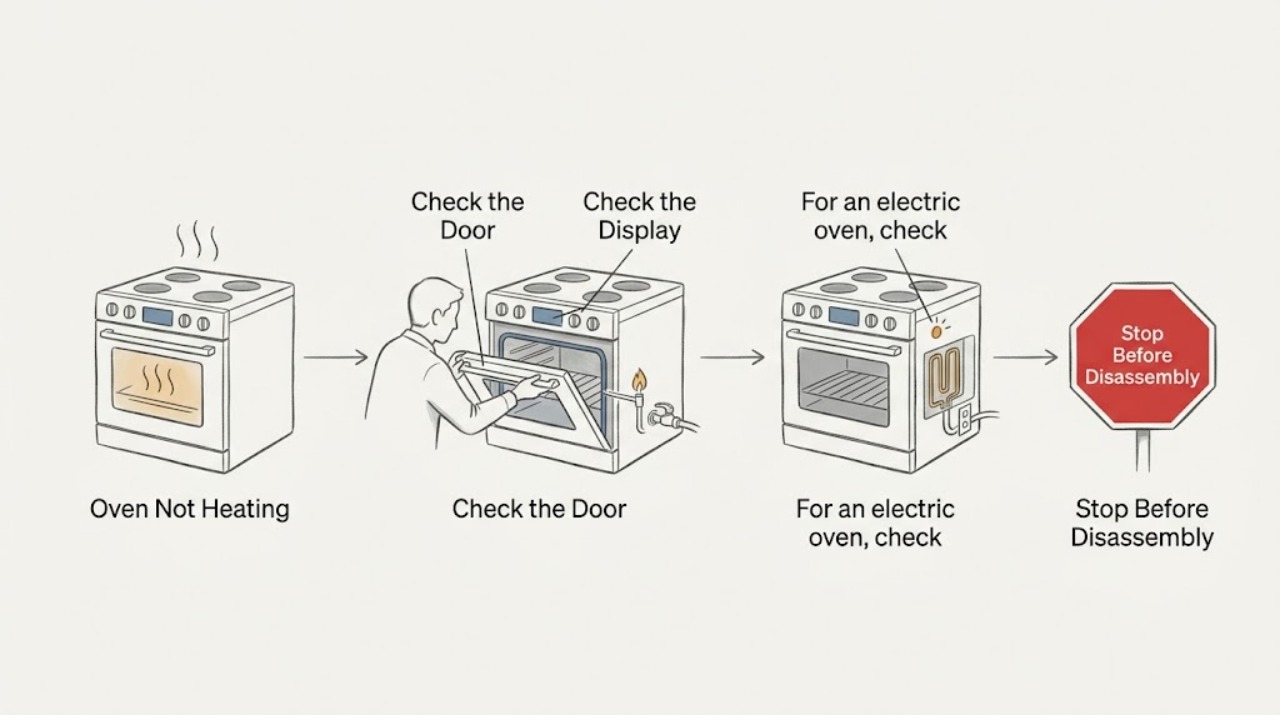
Work through in order
Diagnostic checks
Use only checks that match the exact appliance or system and its official guide.
-
Check 1
Cancel the current program, select the model's standard bake or broil mode, start it, and close the door completely; do not open the door repeatedly while checking for heat.
Expected result: The display accepts the cycle and the oven begins its normal heating indication, or the cycle starts but no heat appears with the door closed.
Next step: Allow the cycle to begin once and compare the behavior with the exact Owner's Manual; if there is still no heat, identify the oven type and continue with the matching checks.
Stop if: Stop if the door, hinge, gasket, or latch is damaged, the oven emits smoke or an unusual burning smell, or gas odor is present.
Why this matters
Why: A door or program-state issue can prevent heating without a failed heater; continued no-heat operation after a valid start points toward power, gas, control, or heating hardware.
-
Check 2
Inspect the display for Control Lock, demo mode, delayed start, Sabbath or other special mode indicators, and use only the model manual's procedure to cancel or exit them.
Expected result: A lock, demo, delayed-start, or special mode is active, or the controls show a normal ready state with no such indication.
Next step: Cancel the mode according to the manual, start a normal cycle once, and observe whether the oven now responds.
Stop if: Stop if the control is cracked, wet, intermittently activating, or would require opening the console to diagnose.
Why this matters
Why: A non-heating control state can make the oven appear defective even though the heating circuit has not been commanded; a normal state shifts attention to supply and heating hardware.
-
Check 3
For an electric oven, check the accessible household breaker or fuse status and confirm the appliance is connected as specified by its installation instructions; do not remove the terminal cover or probe wiring.
Expected result: The breaker or fuse is open, the appliance was newly installed or reconnected, or the supply appears normal but the oven remains cold.
Next step: If the breaker or fuse has opened, do not repeatedly reset it; arrange an electrician or appliance technician if it opens again. If installation wiring is uncertain, stop and use a qualified electrician.
Stop if: Stop for repeated breaker trips, exposed conductors, scorch marks, a hot outlet, or any uncertainty about the appliance connection.
Why this matters
Why: A supply or connection problem can leave controls partly active while preventing heating; a normal accessible supply makes a heating element, sensor, relay, or control fault more plausible but does not identify which one.
-
Check 4
For a gas oven, only if the area is free of gas odor and the installation instructions identify the controls, verify that the oven's regulator shut-off and main gas valve are in the required position; do not disassemble the regulator or ignite gas manually.
Expected result: The cooktop works but the oven gas shut-off is closed, the main valve is closed, the supply status is uncertain, or both valves appear correct.
Next step: Correct an obvious shut-off position only as described by the model instructions; if the oven remains cold, arrange service and leave gas components untouched.
Stop if: Stop immediately for gas odor, hissing, a failed ignition with unburned gas, smoke, or any need to open a gas component.
Why this matters
Why: A gas range can supply the cooktop while an oven-specific regulator shut-off blocks the oven; uncertain gas supply or a correct valve state requires qualified diagnosis rather than repeated ignition attempts.
-
Check 5
Arrange qualified appliance service when the oven stays cold after the correct cycle, door, control, and supply checks, or when an element, igniter, sensor, relay, or gas component is suspected; provide the model, oven type, display state, and checks performed.
Expected result: No safe external correction restores heat, or the oven has a recurring error, intermittent heating, damaged component, or abnormal odor or sound.
Next step: Keep the oven out of service until it is diagnosed and give the technician the exact sequence that failed, including whether the cooktop works and whether broil or bake differs.
Stop if: Stop using the oven for any smoke, gas odor, scorching, exposed wiring, repeated electrical trips, or uncontrolled heating.
Why this matters
Why: The remaining fault may be inside a high-voltage, high-temperature, or gas circuit and cannot be assigned to a single replacement part from the no-heat symptom alone.
Use your observations
Decision map
Find the observation that best matches what you see, then follow the next safe action.
-
PATH 01Next step
What you see
The oven door is not fully closed or the latch, hinge, or gasket is damaged.
Do this next
Arrange qualified service and follow the exact model guidance.
Why this path and its safety boundary
Why it matters: Stop the cycle, correct only an obvious closure issue described in the manual, and arrange service for damaged door hardware; heating may be inhibited while the door is open.
-
PATH 02Next step
What you see
Control Lock, demo mode, delayed start, or another special mode is active.
Do this next
Arrange qualified service and follow the exact model guidance.
Why this path and its safety boundary
Why it matters: Exit it using the exact model manual, then start one normal cycle; do not assume a failed element until the command state is correct.
-
PATH 03Next step
What you see
An electric oven has an open breaker, fuse, recent electrical installation, or uncertain connection.
Do this next
Arrange qualified service and follow the exact model guidance.
Why this path and its safety boundary
Why it matters: Do not open the terminal area; stop repeated resets and have a qualified electrician or appliance technician verify the supply and connection.
-
PATH 04Next step
What you see
A gas range's cooktop works but the oven does not heat and the oven regulator shut-off or main gas valve may be closed.
Do this next
Arrange qualified service and follow the exact model guidance.
Why this path and its safety boundary
Why it matters: Use the installation instructions to identify the required valve position; if gas odor or uncertainty exists, stop and obtain qualified gas service.
-
PATH 05Next step
What you see
The oven heats in one mode but not another, such as bake versus broil.
Do this next
Arrange qualified service and follow the exact model guidance.
Why this path and its safety boundary
Why it matters: Record which mode works and which does not, then arrange model-specific service; do not assume the shared control or a particular element is at fault.
-
PATH 06Next step
What you see
The door, controls, accessible supply, and gas or electric branch are correct but the oven remains cold.
Do this next
Arrange qualified service and follow the exact model guidance.
Why this path and its safety boundary
Why it matters: Stop testing and arrange qualified appliance service for internal heating, sensing, control, or gas diagnosis.
Helpful context
Understand the symptom
Start with the control state
A powered display does not prove that a heating cycle has actually started. Confirm the selected mode and start command, then look for a delayed-start setting, control lock, demo mode, or a door that is not fully closed. These are model-dependent controls, so use the Owner's Manual for the exact sequence instead of guessing at a button combination.
Separate electric and gas checks
An electric oven and a gas oven can show the same symptom while needing different checks. On a gas range, the cooktop may work even when the oven's regulator shut-off prevents gas from reaching the oven. On either type, leave wiring, terminals, igniter, burner, and live gas components to qualified service. If there is a gas smell, smoke, scorching, or a tripped circuit, stop using the appliance and address the hazard first.
Safety boundary
Stop conditions
- There is gas odor, hissing, failed ignition with suspected unburned gas, smoke, or scorching.
- A breaker trips repeatedly, wiring is exposed, or the outlet or appliance connection is hot or damaged.
- The door, latch, hinge, gasket, control panel, element, burner, or igniter is damaged and would require dismantling.
- The oven heats unpredictably, cannot be controlled, or continues heating after the cycle is canceled.
- Diagnosis would require opening live electrical or gas compartments or bypassing a safety control.
- Safe external checks do not restore heat.
Only after diagnosis
Potential parts
Only if a qualified diagnosis identifies a failed heating component in the affected mode; the no-heat symptom alone does not establish the correct part.
Only for a gas model after the gas path is confirmed and a qualified technician identifies the failed component; never bypass a safety control.
Only when inspection confirms that the door cannot close fully and the model manual or technician identifies the matching hardware.
When checks do not resolve it
Need a professional?
The oven remains cold after the correct cycle, closed door, control-state, and supply checks., An electric supply or recent connection is uncertain, or the breaker or fuse opens again., A gas oven's regulator or main valve status is uncertain, or the oven still does not heat with the valves correctly positioned., Only bake or only broil fails, or heating is intermittent., An element, igniter, sensor, relay, control, door interlock, or other internal component is suspected.
Common questions
FAQ
Why does my Amana oven turn on but not heat?
A display can be active while the cycle is delayed, locked, in demo mode, blocked by an incompletely closed door, or missing an electrical or gas supply. Check those external states for the exact model before assuming an internal part failed.
Why does my Amana gas cooktop work but the oven stays cold?
Amana notes that the oven has a regulator shut-off path distinct from the home's main gas valve, so a cooktop that works does not prove the oven gas path is open. Use the installation instructions and stop for any gas odor or uncertainty.
Can I reset an Amana oven that is not heating?
Some display errors can clear after the model's specified power reset, but a reset is not a substitute for diagnosing a persistent no-heat condition. Follow the exact manual and do not repeatedly reset a tripping circuit.
Should I replace the heating element first?
No. Door state, control mode, power or gas supply, wiring, sensing, and controls can all produce no heat. Have the model and failed mode diagnosed before selecting a component.
Read the exact guide
Official sources
- Error Codes for Cooking Appliances - Product Help | AmanaAmana · Supports using the model manual for display meanings and the limited power-reset procedure; it does not identify a no-heat part without model-specific diagnosis.
- Broil Not Working - Range - Product Help | AmanaAmana · Supports the door-closed condition for broiling and the service boundary; it is not a complete diagnosis for all bake failures or all Amana models.
- Oven Not Heating - Powering On - Electric - Product Help | AmanaAmana · Supports door, recent electrical installation, control lock, demo mode, delayed start, and service checks for electric Amana ovens; exact model behavior remains manual-specific.
- Ranges Troubleshooting Guide | AmanaAmana · Supports routing oven temperature and performance issues to the relevant Amana guidance and using professional repair when unresolved.
- Oven Not Working - Cooktop Working - Not Clicking - Product Help | AmanaAmana · Supports external door, oven-bottom, storage-drawer, regulator shut-off, main gas valve, and grounded-supply checks; gas work beyond the documented external check requires qualified service.
Community feedback
Share a repair observation
Share a plain-text repair observation. Accepted observations are published automatically; this page may take a moment to update.