
On this page
Start here
Quick answer
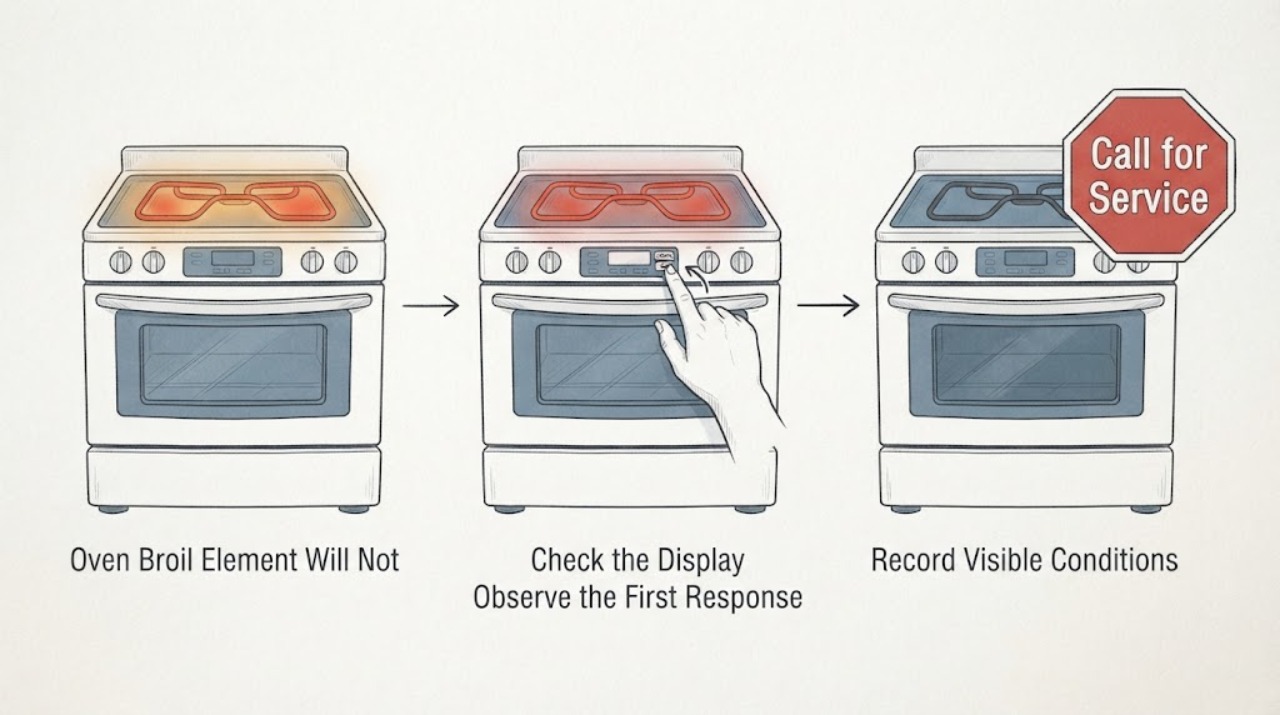
Do not unplug the broil element from the control board or use the oven with a disconnected top element. Amana says oven elements normally cycle on and off during a cycle, and that opening the door during broiling turns the broil element off for the applicable model; a broil element that stays energized continuously during Bake, after the oven is turned Off, or while the oven is overheating is outside that safe operating description. Turn the oven off and disconnect its power at the accessible breaker or disconnect only if you can do so safely, keep the door closed, and do not restart it to test the theory. Record the full model number and arrange Amana or qualified range service; no generic control-board, relay, element, wiring, or bottom-only baking workaround is safe to recommend without the model and a professional diagnosis.
Work through in order
Diagnostic checks
Use only checks that match the exact appliance or system and its official guide.
-
Check 1
Stop the oven and disconnect power at the accessible range or wall-oven breaker/disconnect only if the panel and surrounding area are dry and safe to reach. Do not reach into the cavity, touch the upper element, remove a terminal, or pull a control-board connector.
Expected result: The broil element is still glowing or heating, the oven is getting hotter after Off, there is smoke or a burning smell, or the breaker trips; alternatively, the element is cold and only the cooling fan is audible.
Next step: Keep power off and keep the oven unused until qualified service checks it. For smoke or fire, leave the area and use local emergency procedures; do not reconnect power to test whether the element stops.
Why this matters
Why: Continued heat or a safety symptom requires the appliance to remain de-energized. A cooling fan can run after a cycle without meaning that the heating element is still powered.
-
Check 2
From outside the closed oven, note the selected mode, whether the symptom occurs during Bake or after Off, whether the top element cycles or remains continuously bright, whether the cooling fan is the only remaining sound, and whether any display or error message is present. Do not open the door as a way to test or suppress the heater.
Expected result: The element cycles off and on during a normal cycle, the fan continues after the cycle, or the element stays continuously on outside the documented mode.
Next step: Record the observation and model label for service. Leave the oven disconnected for continuous heat, abnormal temperature, or an element that ignores the normal control state.
Why this matters
Why: Amana describes element cycling and post-cycle cooling-fan operation as normal behaviours. Continuous broil heat outside that pattern is not established as normal and cannot be assigned to a particular part from observation alone.
-
Check 3
Read the full Amana model number and serial information from the frame, label, or documentation without moving a built-in oven or removing panels. Locate the matching Amana manual and write down the mode and exact symptom for the service request.
Expected result: A matching manual is available, or the model remains unknown and the control/element arrangement cannot be confirmed.
Next step: Give the model, symptom timing, display state, and whether the element stayed hot after power-off to Amana or a qualified appliance technician. Do not use a manual for another series.
Why this matters
Why: Amana directs users to model-number manuals and service, and oven control layouts and safety circuits vary by model. An unknown model cannot support a safe connector, relay, element, or reset instruction.
-
Check 4
After power is isolated and the oven is fully cool, make only a visual exterior and cavity observation for a visibly damaged element, scorch mark, melted connector visible without removing anything, damaged door seal, or heavy residue. Do not clean around energized parts or attempt a continuity, voltage, or resistance test.
Expected result: Damage, scorching, an unusual smell, a loose or damaged door, or a normal-looking cavity is observed.
Next step: Photograph the safe, unpowered condition for service and leave the oven disconnected. Do not order or install a replacement element or control board based only on appearance.
Why this matters
Why: Visible damage or a safety symptom supports urgent professional inspection; a normal-looking element does not clear the control or wiring fault and does not justify reconnecting power.
Use your observations
Decision map
Find the observation that best matches what you see, then follow the next safe action.
-
PATH 01Next step
What you see
The broil element remains glowing or heating after Bake is selected, after Off, or while the oven is visibly overheating; smoke, burning smell, scorching, or a breaker trip is also present.
Do this next
Keep power isolated and arrange Amana or qualified appliance service. Do not reconnect, open the control area, disconnect the element, or use the bottom element alone.
Why this path and its safety boundary
Why it matters: The symptom is outside the verified normal cycling description and creates an overheating or electrical risk.
-
PATH 02Next step
What you see
The upper element cycles on and off during a normal mode, the cavity is not overheating, and only the cooling fan continues after the cycle.
Do this next
Use the exact model manual to confirm the mode and indicator behaviour. If the element changes to continuous heat or ignores Off, disconnect power and request service.
Why this path and its safety boundary
Why it matters: Amana describes cycling elements and a post-cycle cooling fan as normal operation on its general support guidance.
-
PATH 03Next step
What you see
The oven is not clearly in a normal cycle, the model-specific manual is unavailable, or the user is considering removing the control-board connection to keep using Bake.
Do this next
Do not perform the modification. Keep the oven off and have a qualified technician identify the failed circuit and approve any repair.
Why this path and its safety boundary
Why it matters: The requested workaround would change a high-power heating circuit without model-specific authorization and could leave an energized loose conductor or defeat safety logic.
Helpful context
Understand the symptom
A cooling fan is different from a broil element that remains energized
Amana says a cooling fan may continue for several minutes after a cooking cycle to cool the cavity and electronic controls. Separately, Amana says the bake and broil elements normally cycle on and off during a cycle through a limiter. Hearing a fan or seeing an element cycle is therefore not the same as a broil element staying on continuously. If the top element remains visibly energized during ordinary Bake, after Off, or while heat is rising abnormally, treat the oven as unsafe to operate rather than trying to make Bake work with the top element disconnected.
Do not bypass the heating circuit
The control board, wiring, element terminals, door switches, and thermal protections are model-specific and can remain hazardous even when a control appears Off. Amana's support pages route users to the model manual and service when the normal guidance does not resolve an oven problem. A disconnected broil lead can create an unsafe exposed connection, defeat the intended control logic, or hide a fault while the lower element is still energized.
When checks do not resolve it
Need a professional?
Provide the technician with the full Amana model and serial information, mode selected, when the broil element stays on, whether it cycles, what happens after Off, any display/error state, breaker behavior, and any odor or visible damage.
Common questions
FAQ
Can I disconnect the broil element and keep using the lower bake element?
No. Disconnecting a high-power heating lead changes the oven's wiring and control circuit and can leave an unsafe connection or hide the fault. Keep the oven off and have the model-specific circuit diagnosed by a qualified technician.
Is it normal for the broil element to turn on during Bake?
Amana says bake and broil elements can cycle on and off during a cycle to maintain temperature. The important distinction is whether the upper element cycles normally or stays continuously energized outside the selected mode; continuous heat requires service.
Why does the oven sound like it is still running after I turn it off?
Amana says the cooling fan may continue for several minutes after a cooking cycle to cool the cavity and electronic controls. Confirm from a safe position that the heating element is not still energized; if it is, disconnect power and request service.
Read the exact guide
Official sources
- Not Turning OffAmana · Used only to route unresolved not-turning-off issues to model documentation and service; it contains no generic control-board or element-disconnection procedure.
- Oven Elements Turning On/Off - Electric RangeAmana · Amana general electric-range guidance; used to distinguish normal cycling from a broil element that remains continuously energized, without assigning a part fault to the unknown model.
- Oven Not Shutting OffAmana · Amana family-level guidance used only to distinguish post-cycle fan operation from ongoing heating; exact model controls any further procedure.
- Oven Not Heating - Powering On - ElectricAmana · Used for the model-manual requirement and service boundary; no terminal, wiring, or control instruction is transferred to the unknown Amana oven.
Community feedback
Share a repair observation
Share a plain-text repair observation. Accepted observations are published automatically; this page may take a moment to update.