
On this page
Start here
Quick answer
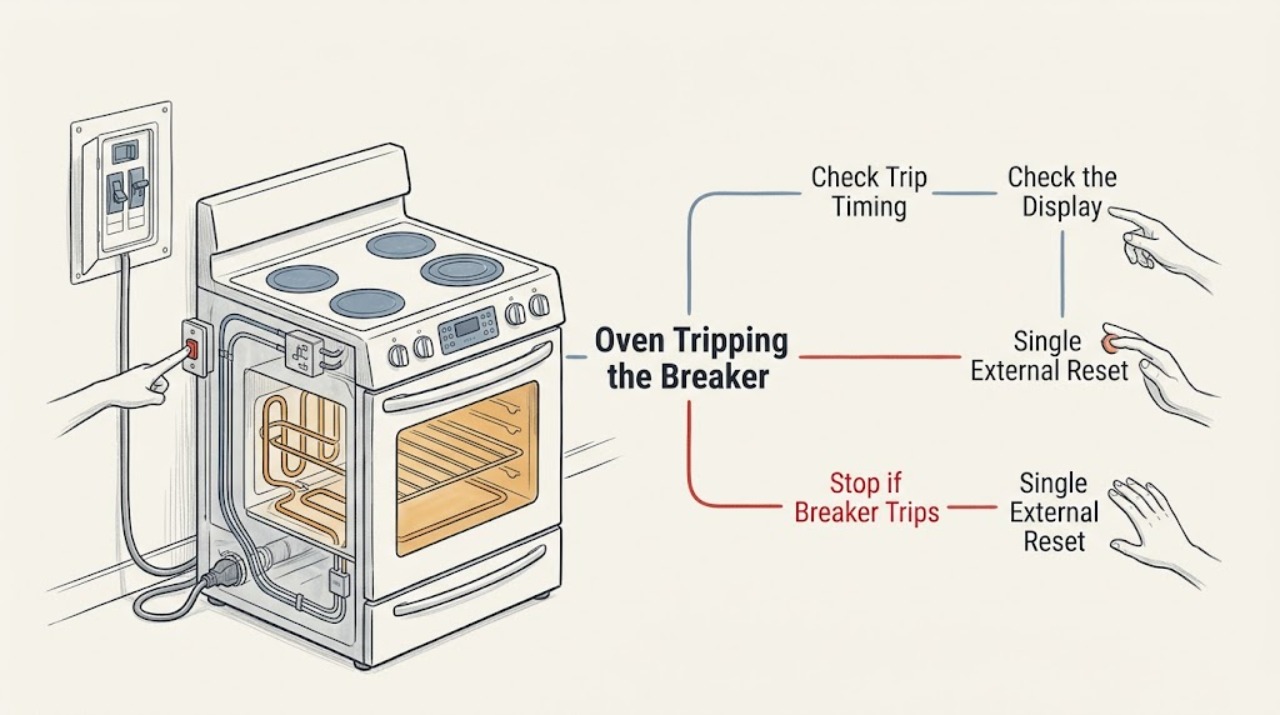
If an Amana oven trips the breaker, reset it only once when there is no visible hazard and note whether the trip happens immediately or only when a cooking function starts. Check only the external breaker, recent outage or installation context, and any display code. If it trips again, shows F9 or F9 E0, or there is smoke, a burning odor, a damaged cord, or exposed wiring, leave it off and use a qualified electrician or appliance technician instead of opening the range.
Work through in order
Diagnostic checks
Use only checks that match the exact appliance or system and its official guide.
-
Check 1
With the oven controls off, record whether the breaker trips immediately when reset, only after a cooking function is selected, or only after the oven has been heating for a while. Note whether the display is blank or shows a code.
Expected result: The trip timing and display state can be described without removing a panel or touching wiring.
Next step: Use the matching branch below and do not keep retrying a condition that trips the breaker.
Stop if: Stop if there is smoke, a burning odor, visible heat damage, a damaged cord, water near the appliance, or exposed wiring.
Why this matters
Why: An immediate trip is more consistent with a supply or connection fault; a trip when heat starts implicates the load or heating circuit; a code adds a control or wiring clue. These are triage clues, not proof of a failed part.
-
Check 2
If there is no visible hazard, turn the oven controls off and reset the household breaker once. Wait for the display to return and make one normal operation check; do not repeatedly cycle the breaker.
Expected result: The breaker either stays on with a normal display, trips again, or leaves the display absent or partial.
Next step: If it trips again, leave it off and proceed to professional service. If the display is absent or partial while the breaker stays on, use the display-reset branch.
Stop if: Do not substitute a larger fuse or breaker, use an extension cord, or continue resetting a breaker that trips.
Why this matters
Why: A breaker that trips again indicates an unresolved electrical fault or overload. A stable breaker with no display follows Amana's power and display reset path, but it does not make internal repair safe for an unqualified person.
-
Check 3
Read the exact display message after the reset and compare it with the model's Amana manual. If the problem followed a power outage, note that context separately; do not guess at a code that is not shown.
Expected result: The display may be normal, blank, or show F9, F9 E0, or another model-specific message.
Next step: For F9/F9 E0 or a recurring code, disconnect power at the breaker and arrange a qualified electrician or appliance technician. For a normal display, continue only with the external control checks.
Stop if: Do not remove the control panel or attempt outlet or terminal rewiring yourself.
Why this matters
Why: Amana troubleshooting identifies F9/F9 E0 on applicable electric-range controls as a possible miswired-outlet indication after an outage or power event. A persistent or unrecognized code needs model-specific service rather than repeated resets.
-
Check 4
Ask whether the oven was newly installed, moved, or recently rewired. From outside the appliance, look only for a loose-looking or heat-damaged cord, plug, or accessible connection; do not pull the range out or open a terminal cover.
Expected result: There is either a recent installation or wiring change, visible external damage, or no recent change and no visible damage.
Next step: For recent installation, suspected miswiring, or damage, keep power off and call a qualified electrician or appliance technician. If there is no such context, continue to the control and function branch only if the breaker remains stable.
Stop if: Do not expose terminals, handle conductors, or perform electrical measurements while the appliance is energized.
Why this matters
Why: A trip beginning after installation raises the priority of checking the installation and cord/terminal arrangement against the model instructions by a qualified person. Visible heat damage is a safety stop regardless of timing.
-
Check 5
Only when the breaker has remained on and there is no hazard, verify that the intended cooking mode and temperature were actually selected, and check whether Delay Start or Control Lock is active. Use the model manual for the control sequence.
Expected result: The oven starts normally, stays powered but will not start, or trips when a specific heating mode is selected.
Next step: If controls are correct but the oven will not start, use the model manual or request appliance service. If a heating mode trips the breaker, leave it off and report the exact mode and timing.
Stop if: Stop testing at the first repeat trip, unusual heat, odor, noise, or display fault.
Why this matters
Why: A lock or delayed start can mimic a no-operation complaint without explaining a breaker trip. A trip tied to one heating mode is a repeatable fault pattern that requires service, not more mode tests.
-
Check 6
Write down the model number, breaker behavior, exact display text, whether the trip occurred at power-up or when heat began, recent outage or installation history, and any visible damage. Give this record to the electrician or appliance technician.
Expected result: The technician receives a reproducible symptom description without the appliance being repeatedly energized.
Next step: Leave the breaker off if the trip recurs or any hazard is present, and schedule qualified service; do not open the appliance to identify the failed component.
Stop if: Do not continue troubleshooting after a repeat trip or any sign of electrical or heat damage.
Why this matters
Why: These details separate a supply or installation concern from an appliance-side fault and help the professional choose a safe inspection path.
Use your observations
Decision map
Find the observation that best matches what you see, then follow the next safe action.
-
PATH 01Next step
What you see
The breaker trips as soon as it is reset, before a cooking mode is selected.
Do this next
Leave the breaker off and arrange an electrician or appliance technician. Provide the model and exact timing.
Why this path and its safety boundary
Why it matters: The fault is present before the heating load is requested; supply, cord, connection, or appliance wiring needs qualified diagnosis.
-
PATH 02Next step
What you see
The breaker holds until Bake, Broil, convection, or another heating function is selected.
Do this next
Stop using the oven, leave power off, and report the exact mode and timing to qualified service.
Why this path and its safety boundary
Why it matters: The repeatable trigger is the added cooking load or its circuit; it is not a reason to keep testing modes.
-
PATH 03Next step
What you see
F9, F9 E0, or another code returns after a power event or reset.
Do this next
Disconnect power and use a qualified electrician or appliance technician rather than clearing the code repeatedly.
Why this path and its safety boundary
Why it matters: On applicable Amana electric-range controls, F9/F9 E0 can indicate a possible miswired outlet; other codes are model-specific.
-
PATH 04Next step
What you see
The tripping began after installation, moving, or electrical work.
Do this next
Keep the appliance off and have the installation checked against the Amana instructions by a qualified person.
Why this path and its safety boundary
Why it matters: The installation and connection arrangement becomes a high-priority professional check.
-
PATH 05Next step
What you see
The breaker remains on and there is no hazard, but the oven does not begin cooking.
Do this next
Check the model manual's control guidance once. If controls are correct and the oven still fails, request appliance service.
Why this path and its safety boundary
Why it matters: A control lock, delayed start, selected mode, or a separate no-operation fault may be involved; the breaker symptom is not currently reproducible.
-
PATH 06Next step
What you see
There is smoke, a burning odor, heat-damaged insulation, a damaged cord, water near the appliance, or exposed wiring.
Do this next
If safe to do so, keep clear and isolate power at the breaker; arrange qualified electrical or appliance service. If there is an active fire or immediate danger, use local emergency procedures.
Why this path and its safety boundary
Why it matters: This is an immediate safety boundary, not a normal troubleshooting branch.
Helpful context
Understand the symptom
The timing of the trip is the most useful safe clue. A breaker that trips as soon as power is restored points toward the supply, cord, connection, or a short that is present before heating begins. A trip that occurs only when Bake, Broil, or another heating function starts points toward the added load or that heating circuit. This timing narrows the handoff description; it does not justify removing covers or testing energized wiring.
Keep the first checks external. Amana's guidance is to check the household breaker or fuse, consider a recent outage or installation, and use the model manual for a displayed fault. On some Amana electric-range controls, F9 or F9 E0 is associated with a possible miswired outlet; treat that as a reason for a qualified electrician, not as a code to clear repeatedly.
If the breaker holds but the oven still does not start, check the selected controls, delay-start setting, and control lock before assuming the breaker was the only fault. Any repeat trip, persistent fault, heat damage, smoke, burning smell, damaged power cord, or exposed conductor is a stop point: leave the appliance de-energized and arrange qualified service.
Safety boundary
Stop conditions
- Do not repeatedly reset a breaker that trips.
- Do not change the fuse or breaker rating or use an extension cord to keep the oven running.
- Do not remove panels, expose terminals, or test energized wiring.
- Stop immediately for smoke, burning odor, heat damage, damaged cord, water, or exposed wiring.
- Use qualified electrical or appliance service for persistent trips, suspected miswiring, or an unresolved fault.
When checks do not resolve it
Need a professional?
Call a qualified electrician or appliance technician when the breaker trips again, the trip follows installation or rewiring, F9/F9 E0 or another code returns, the cause is not clear after one safe external reset, or any smoke, burning odor, heat damage, damaged cord, water, or exposed wiring is present. Do not remove covers, handle terminals, or perform energized electrical tests.
Have this ready
- Amana model number, exact display text, trip timing, selected cooking mode, recent outage or installation details, and photographs of only safely visible external damage.
Common questions
FAQ
Why does my Amana oven trip the breaker as soon as I reset it?
An immediate trip means the fault is present before a cooking mode is selected. Leave the breaker off and have the supply, connection, cord, and appliance checked by a qualified professional; do not keep resetting it.
What if the breaker trips only when Bake or Broil starts?
That repeatable timing points to the added heating load or its circuit, but it does not identify a safe user-replaceable part. Stop using the oven and report the exact mode and timing to qualified service.
What do F9 and F9 E0 mean on an Amana range?
On applicable Amana electric-range controls, the owner's guidance associates F9 or F9 E0 with a possible miswired outlet. If the code returns, disconnect power and use a qualified electrician rather than repeatedly clearing it.
Can I keep using the oven if the breaker reset works once?
Only make one cautious external operation check when there is no hazard. If the breaker trips again, or there is smoke, burning odor, heat damage, a damaged cord, water, or exposed wiring, leave it off and arrange qualified service.
What should I tell the electrician or appliance technician?
Provide the model number, exact display text, whether the trip occurred at power-up or when heat began, the selected mode, and any recent outage, installation, or visible external damage.
Read the exact guide
Official sources
- No or Partial Display - Range - Product HelpAmana Product Help · Amana ranges with a blank or partial display
- Circuit Breaker Tripped or Fuse Blown - Electric Range - Product HelpAmana Product Help · Amana electric ranges and wall ovens: breaker, fuse, power, and installation-context checks
- Owner's ManualAmana · Amana electric range owner's manual troubleshooting and control operation
- Oven Not Working - Product HelpAmana Product Help · Amana range and oven no-operation troubleshooting routes
- Not Working After Power Outage - ElectricAmana Product Help · Amana electric ranges after a power outage or power event
Community feedback
Share a repair observation
Share a plain-text repair observation. Accepted observations are published automatically; this page may take a moment to update.