
On this page
Start here
Quick answer
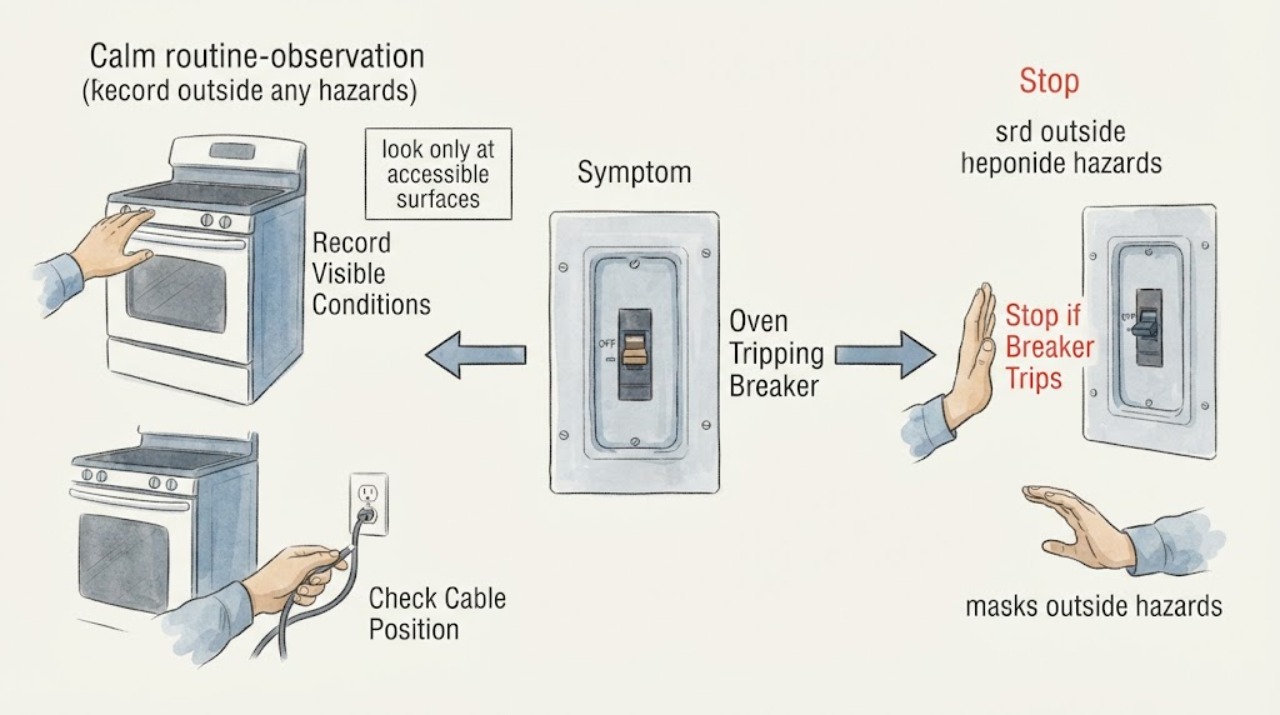
A Monogram oven that trips a breaker has triggered an electrical protection device; do not keep resetting it or bypass the protection. Record whether the trip occurs immediately, when a mode starts, as a bake or broil element heats, after cleaning or moisture, during self-clean, or when a fan starts. Once the appliance is off and safe, check only the model's installation power requirements and visible damage. A breaker that trips again, a hot or loose outlet, smoke, burning odor, sparks, moisture, or a damaged cord requires the oven to remain off and an electrician or qualified appliance technician to investigate.
Work through in order
Diagnostic checks
Use only checks that match the exact appliance or system and its official guide.
-
Check 1
Leave the oven off after the breaker trips and record the event without resetting it repeatedly. Note whether the trip was immediate on restoration, at mode selection, when heating began, after a fan started, during self-clean, or after cleaning or a spill; also record any display code.
Expected result: The trip is immediate, tied to a particular mode or heating phase, follows moisture or cleaning, occurs during self-clean, or has no consistent timing.
Next step: Keep the appliance off and give the timing, model, fuel type, and code to a qualified electrician or appliance technician. Do not reproduce the trip as a test.
Why this matters
Why: Immediate trips can point toward the household circuit or a hard fault; a trip when a particular load is energized can point toward the appliance or its circuit. Timing narrows the service diagnosis but does not prove which part failed.
-
Check 2
From a safe position, identify the breaker or fuse serving the Monogram oven and compare its labeling with the exact installation instructions. Do not remove the panel cover, change the protection rating, move wires, or access a built-in junction box.
Expected result: The circuit size or wiring cannot be confirmed, two linked breakers are not both on, the installation is new or recently altered, or the supply appears correctly configured.
Next step: If the rating, wiring, or installation is uncertain, leave the oven off and arrange an electrician. If the circuit is confirmed but the oven trips under load, arrange appliance diagnosis rather than changing protection.
Why this matters
Why: GE says the appliance must be on the correctly sized protection and that an incorrect size or installation requires the installer or an electrician. A built-in oven's supply is not a user adjustment.
-
Check 3
Once the oven is cool and de-energized by the normal household control, look only at accessible surfaces for a cracked or ruptured bake/broil element, melted insulation, scorch marks, moisture, a damaged cord, a loose plug, or a warm, discolored, or smoky receptacle. Do not touch or remove a component to inspect it.
Expected result: An element has a visible break or rupture, the area is wet, the cord or plug is damaged, the receptacle is hot or discolored, or no visible damage is present.
Next step: For any damage, moisture, heat, odor, or spark, keep the oven off and call a qualified professional. Do not resume use merely because the element looks intact.
Why this matters
Why: GE identifies damaged heating elements as a possible source of a trip, while CPSC identifies hot receptacles, odors, arcing, damaged insulation, and shocks as electrical hazard signs. No visible damage does not clear the appliance.
-
Check 4
Separate a power or control symptom from a heating symptom without energizing the oven again: note whether the display, clock, and light had power before the trip, whether the trip occurred when Bake, Broil, convection, or a fan was selected, and whether only self-clean was involved.
Expected result: The display was blank, the controls worked until a heating or fan mode started, only self-clean caused the event, or multiple modes cause the trip.
Next step: Provide the sequence to service. Do not use another mode as a substitute test, and do not use surface burners on a range if the shared appliance supply has a known electrical hazard.
Why this matters
Why: A blank display and an immediate trip raise a supply or short-circuit concern; a trip when a particular load starts points toward that load or its wiring. Self-clean adds high heat and latch/control conditions and should not be repeated to compare results.
-
Check 5
If the trip followed cleaning, a spill, steam, or water exposure, leave the oven and surrounding electrical area unpowered and do not wipe inside energized controls or junction areas. Record where the moisture was seen and whether the breaker trips without another start attempt.
Expected result: Moisture is visible near controls, the cord, receptacle, lower trim, or a service opening, or the area appears completely dry but the trip continues.
Next step: Do not restore power to test. Have a qualified professional assess moisture intrusion, the appliance, and the circuit before use.
Why this matters
Why: Moisture can create a shock or short-circuit hazard. Dry-looking surfaces do not confirm that internal insulation or connections are safe, especially after a trip.
-
Check 6
If a technician or the exact Monogram manual permits one controlled reset after the cause has been eliminated, restore power only once and observe from a safe position without starting a heat cycle. Stop immediately if the breaker trips again, the display shows a fault, the fan or control behaves abnormally, or the oven smells hot.
Expected result: The breaker holds with the oven idle, trips immediately again, or trips only when a mode or component is energized.
Next step: Leave the breaker and appliance in the safe off state and arrange service. Do not perform a second reset, use an extension cord, increase the breaker rating, or bypass protection.
Why this matters
Why: A breaker that holds at idle does not prove the oven is safe under load; a repeat trip is evidence of an unresolved circuit or appliance fault. GE directs further diagnosis to an electrician or repair technician.
Use your observations
Decision map
Find the observation that best matches what you see, then follow the next safe action.
-
PATH 01Next step
What you see
The protection opens as soon as it is restored, before a cooking mode is selected.
Do this next
Do not reset again. Leave the oven off and have the household circuit, breaker, wiring, and appliance supply checked by an electrician.
-
PATH 02Next step
What you see
The oven has controls or a display, but trips when Bake, Broil, convection, or another heating load starts.
Do this next
Record the mode and timing, leave it off, and arrange appliance service. A visible element rupture or burning odor is an immediate stop condition.
-
PATH 03Next step
What you see
The event began after cleaning, a spill, steam, or water exposure.
Do this next
Do not energize the oven to dry or retest it. A qualified professional should assess the appliance and circuit for moisture and insulation damage.
-
PATH 04Next step
What you see
Normal cooking has not tripped the circuit, but self-clean does or will not complete.
Do this next
Do not run self-clean again. Record the phase and any code, allow the appliance to cool if safe, and arrange model-specific service for the high-heat cycle and controls.
-
PATH 05Next step
What you see
There is heat, discoloration, smoke, odor, arcing, a loose connection, exposed insulation, moisture, or an electrical shock.
Do this next
Stop touching the equipment and keep the circuit off if it can be done without approaching danger. Contact a qualified electrician or emergency service as appropriate.
-
PATH 06Next step
What you see
The protection does not trip while idle after one permitted reset, but the oven will not operate normally or trips when a load starts.
Do this next
Do not interpret an idle circuit as a pass. Leave the oven unused and arrange qualified appliance service with the exact model and event sequence.
Helpful context
Understand the symptom
Treat the trip as a safety signal
A breaker opens because the circuit has seen a condition its protection is meant to interrupt. The useful first fact is when it happens: as soon as power is restored, when a cooking mode starts, after the oven warms, during self-clean, or after cleaning or a spill. That timing is evidence for a professional, not permission to repeat the event.
Gas and electric Monogram models still need electrical safety checks
A gas oven can use electricity for controls, ignition, and valves; a dual-fuel range can have gas surface burners with an electrically powered oven. An electric or dual-fuel oven may also trip when an element or fan circuit is energized. Identify the fuel configuration from the model documentation, but do not apply a gas or element test to a model you cannot identify.
What not to test
Do not repeatedly reset the breaker, install a larger fuse or breaker, use an extension cord, hold a breaker on, or remove covers. Do not touch a wet appliance, a warm or discolored receptacle, exposed wiring, or a damaged cord. Do not run self-clean to reproduce a trip.
Safety boundary
Stop conditions
- Stop immediately for smoke, burning or electrical odor, visible sparks or arcing, a hot or discolored plug/outlet, exposed or melted insulation, water near electrical parts, an electrical shock, uncontrolled heating, or a carbon-monoxide or fire alarm.
- Do not repeatedly reset the breaker, install a larger fuse or breaker, bypass protection, use an extension cord, hold a breaker on, move a built-in oven, remove covers, or inspect live wiring.
- Do not run a cooking or self-clean cycle to reproduce a trip. Leave the oven off until a qualified professional identifies and corrects the cause.
Only after diagnosis
Potential parts
- bake or broil heating element
Consider this category only when the exact model documentation or a qualified technician confirms a cracked, ruptured, or electrically failed heating element.
Heating elements vary by Monogram model and cavity position. Confirm the complete model and manufacturer fit information before ordering; do not replace or test a part in an energized oven. - oven control or cooling fan component
Consider this category only after a qualified diagnosis links the trip to a control or fan circuit rather than the household supply.
Controls and fan assemblies are model-specific and may require electrical and built-in appliance service procedures. Do not choose a part from timing alone.
When checks do not resolve it
Need a professional?
Arrange an electrician when the breaker trips immediately, the circuit rating or installation is uncertain, the outlet or cord is hot or damaged, or a shock, moisture, arcing, or wiring concern exists. Arrange qualified Monogram appliance service when the trip occurs during a mode, heating element, fan, control, or self-clean phase, or when the breaker holds only until the oven is energized. Provide the exact model, fuel configuration, displayed code, and trip timing.
Common questions
FAQ
Should I reset the breaker one more time to see if the Monogram oven works?
No if it has already tripped or trips again. Record when it happened, leave the oven off, and have the circuit or appliance assessed. Repeated resetting can conceal an unresolved fault.
Why does the oven trip only when Bake or Broil starts?
That timing means a heating load or its circuit becomes active at that point, but it does not identify the failed component. A damaged element is one possibility; qualified service should distinguish it from wiring, control, fan, or supply faults.
Can a gas Monogram oven trip a breaker?
Yes. Gas ovens still use electrical controls and ignition/valve systems. Do not use a manual ignition workaround; a trip is an electrical safety event regardless of the fuel configuration.
What if the trip started after cleaning or a spill?
Keep the appliance unpowered and do not energize it to dry or retest. Moisture near electrical parts can create shock or short-circuit risk and should be assessed by a qualified professional.
Is a breaker that holds while the oven is idle a pass?
No. The oven may trip only when a heating element, fan, control, or self-clean load starts. An idle breaker result does not clear the appliance for cooking.
When is the breaker trip an emergency?
Treat smoke, burning odor, visible arcing, a hot or discolored outlet, exposed or melted insulation, water near electrical parts, shock, a fire alarm, or a carbon-monoxide alarm as an immediate stop condition. Leave the area when appropriate and contact emergency or qualified help.
Read the exact guide
Official sources
- Range & Wall Oven - Self-Clean Does Not Turn OffGE Appliances · GE/Monogram-family self-clean control and power-off escalation guidance
- Range & Wall Oven - Oven Error, Fault or Function CodesGE Appliances · GE/Monogram-family wall-oven error-code, reset, and service context
- Range & Wall Oven - Oven Heating Element FailureGE Appliances · GE/Monogram-family bake and broil element failure and trip symptoms
- CPSC Guide to Home Wiring HazardsU.S. Consumer Product Safety Commission · Household wiring, breaker, receptacle, cord, overheating, arcing, and shock safety
- User Manual & Care for ZET2SHSSMonogram / GE Appliances · Monogram wall-oven model identification and exact manual resources
- Range & Wall Oven - No PowerGE Appliances · GE/Monogram-family range and wall-oven power and double-breaker checks
- GE Appliance - Circuit Breaker TripsGE Appliances · GE/Monogram-family appliance circuit-breaker and wall-oven trip guidance
Community feedback
Share a repair observation
Share a plain-text repair observation. Accepted observations are published automatically; this page may take a moment to update.