
On this page
Start here
Quick answer
A Siemens oven that trips a breaker has an overload, short, earth fault, installation problem, or appliance fault until a qualified person proves otherwise. Do not keep resetting the breaker, use an extension lead or power strip, or run the oven again to see when it trips. Record whether the trip occurs immediately, when a mode starts, as heat begins, when a fan runs, after cleaning, or only with another appliance on the circuit. From a dry safe position, check only accessible signs such as a loose or scorched connection, moisture, a damaged cord, or a display code. Leave the oven isolated for repeated trips, smoke, burning odor, arcing, a hot outlet, water, or any need to remove panels. Gas models add a separate fuel hazard: if gas is smelled, leave the area and follow local emergency guidance without operating switches.
Before you begin
Safety first
- User checks are limited to normal controls and safe external observations. Do not keep resetting the breaker, energize the oven for a test, move a built-in or gas appliance, remove panels, inspect gas connectors, or probe live wiring.
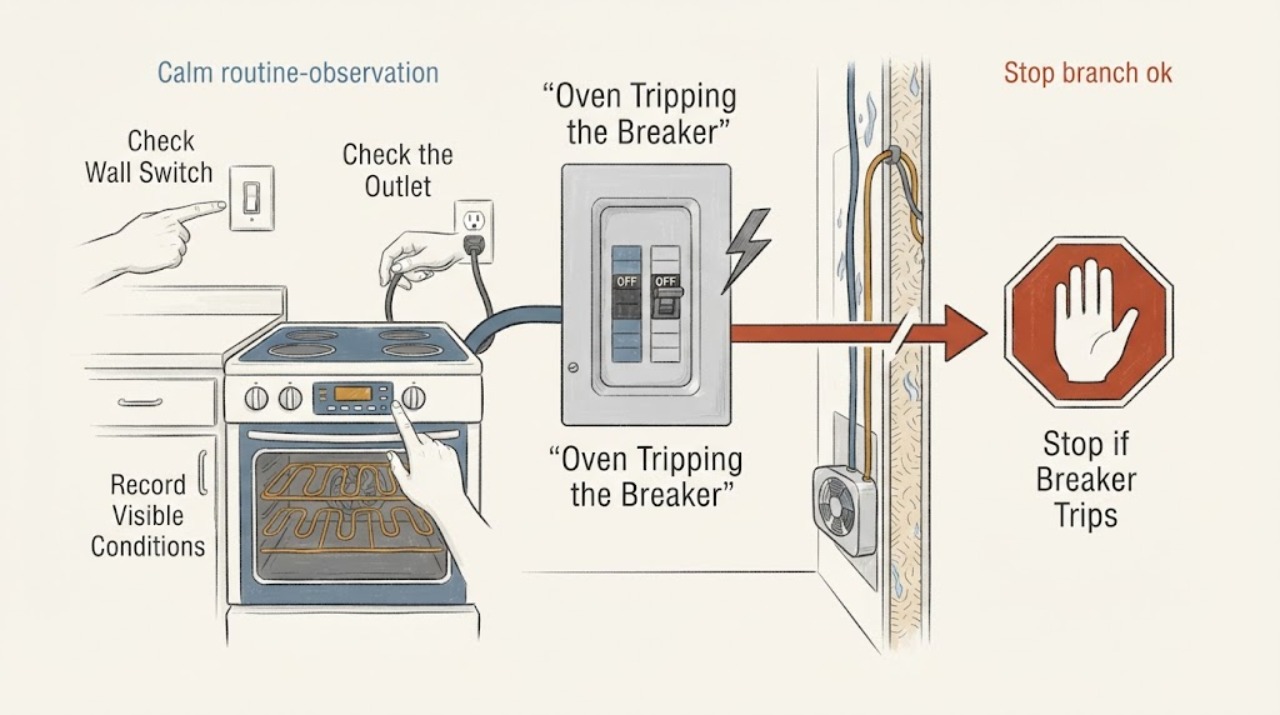
Work through in order
Diagnostic checks
Use only checks that match the exact appliance or system and its official guide.
-
Check 1
Stop cooking, use the normal oven control only if it responds without sparks or heat damage, and record the exact point at which the breaker opens: immediately on power, when a mode starts, when heat begins, when a fan starts, during cleaning, or after another appliance is used. Do not reset it just to repeat the event.
Expected result: The trip is immediate, linked to a heating or fan stage, linked to a self-clean or steam feature, linked to moisture or cleaning, or linked to a shared circuit.
Next step: Keep the oven out of use and give the stage, mode, display behavior, and other-load information to qualified appliance service or an electrician. Do not run a second cycle as a test.
Stop if: Stop immediately for smoke, arcing, burning odor, a hot connection, a wet oven, or a breaker that opens again.
Why this matters
Why: Trip timing helps a technician separate supply and installation causes from a mode-specific oven load or internal fault, but it does not identify a safe user repair.
-
Check 2
From a dry, safe position, leave the oven switched off and isolate its supply only as your installation and local safety rules allow. Do not touch a wet plug, reach behind a built-in oven, open the consumer unit repeatedly, or use an extension lead, power strip, or alternate outlet to test it.
Expected result: The breaker remains open, the oven is hard-wired or inaccessible, the connection is wet or hot, or the oven can be left isolated without crossing a hazard.
Next step: Leave the circuit and oven isolated and arrange qualified electrical or appliance service. If the home circuit also feeds other equipment, have the circuit assessed rather than shifting the oven to another outlet.
Stop if: Do not handle a wet or scorched connection, exposed conductor, hot outlet, or breaker panel affected by water.
Why this matters
Why: Isolation prevents another fault event, while an inaccessible or damaged connection makes the installation itself a professional boundary.
-
Check 3
With the oven isolated and cool, inspect only from outside for a damaged or trapped power lead, loose faceplate, scorch mark, melted plastic, unusual discoloration, moisture, or a smell from the outlet or adjacent cabinet. Do not remove trim, terminal covers, the rear panel, or the oven from its housing.
Expected result: There is visible damage or heat evidence, moisture near the oven connection, a loose outlet, or no external sign despite the breaker trip.
Next step: Photograph the condition without touching it and provide the observation to a qualified technician or electrician. Do not tape, splice, tighten, or replace the connection as a user trial.
Stop if: Stop for exposed wiring, soot, melted material, a loose outlet, a hot wall plate, water, or any need to pull out the built-in oven.
Why this matters
Why: Visible damage or moisture is enough to stop use and have the supply checked. A clean exterior does not rule out an internal heater, fan, relay, control, or insulation fault.
-
Check 4
Record the oven type and the selected function without energizing it again: conventional heat, fan-assisted heat, grill, steam, microwave-combination, or self-cleaning where fitted. Note whether the problem began after cleaning, a spill, installation, relocation, or a change in the connected hob or circuit.
Expected result: Only one heating mode trips, the fan or cooling stage is implicated, the trip began after cleaning or a spill, or every mode trips immediately.
Next step: Keep the oven isolated and supply the mode and history to service. Do not use self-cleaning, steam, or another heating mode to dry or clear a suspected fault.
Stop if: Stop for trapped moisture, smoke, burning residue, an oven that continues heating after the control is off, or any repeated trip.
Why this matters
Why: A mode-specific or recent-moisture pattern narrows the technician's inspection, while every-mode behavior raises concern about the supply, control input, or common protection path.
-
Check 5
From the unpowered or safely isolated state, write down the exact model identifier and any error code, flashing display, clock behavior, or control symptom that appeared before the trip. Use the model manual or Siemens service page for interpretation; do not clear a code by repeatedly cycling the supply.
Expected result: A code or display fault returns, the display goes blank after the trip, controls remain unresponsive, or the oven appears normal while the breaker stays open.
Next step: Provide the model, code, display state, and trip timing to Siemens service or a qualified electrician. Do not substitute a reset for diagnosis.
Stop if: Stop for a code associated with overheating, electrical damage, smoke, gas, or any instruction that requires internal access.
Why this matters
Why: The display state can distinguish loss of supply from a control or oven fault, but a code does not make opening the appliance safe and should be preserved for service diagnosis.
-
Check 6
If the Siemens appliance is gas or dual-fuel, determine from the model documentation whether a gas connection exists, but do not move the oven or inspect the connector. If gas odor or hissing is present, leave immediately and avoid lights, switches, and other electrical equipment.
Expected result: There is no fuel odor and the model is electric, or a gas odor, hissing, flame problem, or suspected connector issue is present.
Next step: For a gas odor or suspected leak, leave the area and contact local gas or emergency services from outside. For a gas or dual-fuel oven with only breaker symptoms, leave it isolated and arrange qualified appliance and electrical service.
Stop if: Never relight, move, adjust gas fittings, or operate switches in a suspected gas leak.
Why this matters
Why: A gas event can create an ignition and explosion hazard separate from the breaker fault. The absence of odor does not authorize opening a gas or electrical component.
Use your observations
Decision map
Find the observation that best matches what you see, then follow the next safe action.
-
PATH 01Next step
What you see
The breaker trips again, trips immediately, or opens at a repeatable heating, fan, or control stage.
Do this next
Stop resetting it, leave the oven isolated, and arrange qualified appliance and electrical assessment. Provide the exact stage and model information.
-
PATH 02Next step
What you see
A cord, connection, outlet, cabinet area, or control area is hot, scorched, melted, wet, loose, or visibly damaged.
Do this next
Do not touch or move the oven. Isolate the supply only from a safe dry position and request qualified service; do not tape or replace parts as a trial.
-
PATH 03Next step
What you see
The trip began after a spill, cleaning, steam, flooding, or moisture near the oven or electrical connection.
Do this next
Keep the appliance isolated and allow qualified service to assess moisture and insulation. Do not energize it to dry the interior or pull out a built-in unit.
-
PATH 04Next step
What you see
The appliance is gas or dual-fuel and gas odor, hissing, or abnormal flame is present.
Do this next
Leave immediately without operating electrical switches or moving the oven, then contact local gas or emergency services from outside.
-
PATH 05Next step
What you see
The breaker opened once and no visible damage is found, but the cause and circuit condition are not known.
Do this next
Do not treat one event as cleared. Keep the oven off until the circuit and appliance are assessed, especially if the event followed installation, cleaning, or a mode change.
-
PATH 06Next step
What you see
External checks are inconclusive or the fault may involve a heater, fan, relay, control, wiring, insulation, or built-in connection.
Do this next
Provide the model, installation type, mode, trip timing, display state, and safe photographs to qualified Siemens appliance service or an electrician. Do not open the oven.
Helpful context
Understand the symptom
The trip timing is useful evidence, not a reason to keep testing
A breaker that opens as soon as the oven is energized points toward supply, wiring, or an input fault; a trip when a heating mode begins can implicate a high-load circuit or heating path; a trip after warming, fan operation, or cleaning can point to a heat- or moisture-related fault. These are diagnostic clues for service, not user-level tests. Write down the exact mode and stage, then leave the oven isolated.
Built-in ovens can have model-specific connections
Siemens service pages link each oven model to its user manual, installation instruction, and repair information. A powered display does not prove that the heating circuit is healthy, and a familiar-looking breaker does not prove that the circuit or connection is correctly rated. Do not pull out a built-in oven or access terminals; provide the exact model to a qualified technician.
Electric and gas ovens need different stop rules
For an electric or dual-fuel oven, smoke, arcing, burning odor, a hot outlet, or repeated trips is an electrical stop condition. For a gas-capable model, a gas odor or hissing sound is an evacuation condition, not a valve-adjustment check. Do not move a gas appliance to inspect a connector, and do not operate lights or switches in a suspected gas leak.
Safety boundary
Stop conditions
- Do not repeatedly reset a breaker, run another heating or cleaning cycle, or use an extension lead, power strip, or alternate outlet as a test.
- Stop for smoke, burning odor, arcing, a hot or discolored outlet, exposed wiring, a damaged cord, or any water near the oven connection.
- Do not remove panels, pull out a built-in oven, probe live parts, replace a fuse with another rating, or bypass protective devices.
- For a gas or dual-fuel oven, leave immediately for gas odor, hissing, abnormal flame, or suspected leakage; do not operate switches or move the appliance.
- Do not use the oven again until qualified service clears a repeated trip, wet appliance, visible damage, or unexplained breaker operation.
Only after diagnosis
Potential parts
- heating element or heater assembly
Consider this only after qualified diagnosis links a repeat trip during a heating stage to a failed heater or insulation fault.
Confirm the exact Siemens model and service documentation before ordering; a similar oven does not establish fit. - cooling fan or control component
Consider this only when qualified diagnosis links the trip to fan operation or control switching after the supply circuit has been cleared.
Fan and control arrangements vary by model and must be assessed and fitted by qualified service.
When checks do not resolve it
Need a professional?
Arrange qualified Siemens appliance or electrical service after any repeated, immediate, or mode-linked breaker trip, or whenever the circuit, outlet, cord, heating path, fan, control, or installation is uncertain. Seek urgent help for smoke, arcing, burning odor, a hot connection, water near electrics, or gas odor; leave a suspected gas leak before contacting local gas or emergency services from outside.
Safety scope: User checks are limited to normal controls and safe external observations. Do not keep resetting the breaker, energize the oven for a test, move a built-in or gas appliance, remove panels, inspect gas connectors, or probe live wiring.
Common questions
FAQ
Why does my Siemens oven trip the breaker when it starts heating?
A heating-stage trip can involve the oven load, a heater or insulation fault, the circuit, or the connection. Do not run another cycle to confirm it. Record the mode and leave the oven isolated for qualified assessment.
Can I reset the breaker once to see if the Siemens oven works?
Do not use repeated resets as a test. If the breaker opened after a spark, odor, heat, moisture, or an unexplained fault, keep the oven off. Qualified electrical or appliance service should identify the cause before re-energizing it.
What if the Siemens oven trips only during self-cleaning or after cleaning?
Treat that timing as useful evidence of a heat- or moisture-related issue, not as permission to try the cycle again. Keep the appliance isolated and provide the cleaning history and mode to service.
Does a gas Siemens oven need a different response?
Yes. A gas or dual-fuel model adds a fuel hazard. If gas is smelled or heard, leave immediately without operating switches or moving the oven, then contact local gas or emergency services from outside. A breaker trip without gas odor still needs qualified service.
Can I pull out a built-in Siemens oven to inspect the wiring?
No. Built-in connections and internal wiring are not user checks. Leave the oven isolated, photograph only safe visible conditions, and have a qualified appliance professional or electrician assess the installation.
Read the exact guide
Official sources
- CPSC Issues Winter Weather Safety Tips to Prevent Fires and Carbon Monoxide PoisoningU.S. Consumer Product Safety Commission · Gas-leak evacuation and electrical-switch safety guidance
- Service Page - Built-in oven | HB63AB551B/35Siemens Home Appliances · Siemens built-in oven model documentation, manuals, installation instructions, and professional repair paths
- Appliance Safety TipsElectrical Safety Foundation International · Electrical appliance breaker, cord, connector, water, and authorized-repair safety guidance
Community feedback
Share a repair observation
Share a plain-text repair observation. Accepted observations are published automatically; this page may take a moment to update.