
On this page
Start here
Quick answer
Treat a Hotpoint oven that trips the breaker as an electrical fault until it has been checked. Do not keep resetting the breaker, change the fuse rating, use an extension lead, or bypass a protective device. Note whether it trips as soon as the oven circuit is switched on, when a heating mode starts, only in one mode, or after the oven has warmed. If there is smoke, burning smell, sparking, heat damage, a damaged cord, or gas odor, stop immediately and use the appropriate emergency or qualified-service path. A licensed electrician should check the supply and a qualified appliance engineer should check the oven when the fault follows the appliance or a particular function.
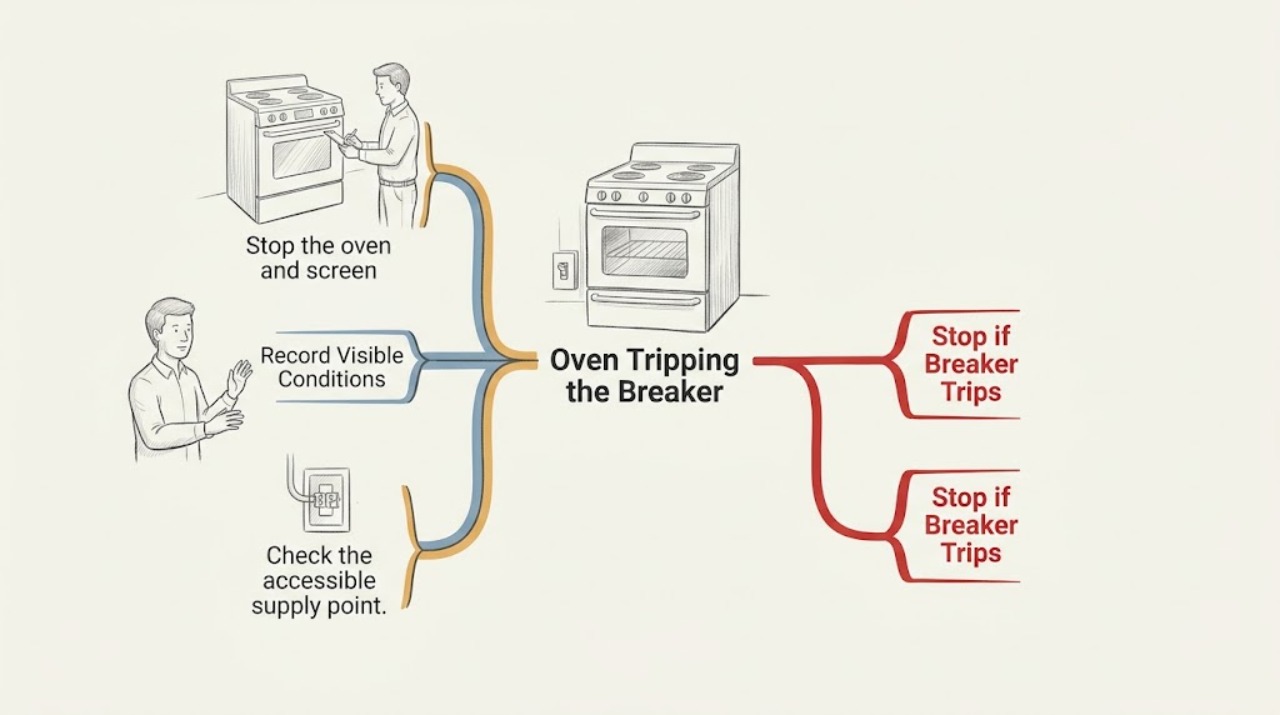
Work through in order
Diagnostic checks
Use only checks that match the exact appliance or system and its official guide.
-
Check 1
Stop the oven and screen for an immediate fire, shock, or gas hazard.
Expected result: Look and listen from a safe position for smoke, flame, sparks, a burning or electrical smell, melted or discoloured controls, a hot or damaged plug or cable, gas odor, or water near electrical parts.
Next step: Do not reset the breaker or turn the oven back on. If there is smoke or flame, leave the area and use the local emergency procedure. For gas odor, leave the area and contact the appropriate gas emergency service from a safe location. For electrical or water damage, isolate power only from a dry safe location and arrange qualified help.
Why this matters
Why: These signs can indicate active fire, shock, or gas risk. A protective trip should not be defeated while any warning remains.
-
Check 2
Record exactly when the breaker trips without deliberately repeating the fault.
Expected result: Use the last safe event and any existing notes to classify the timing: immediately when the oven isolator or circuit is switched on, when a bake, grill, fan, or other heating mode starts, only in one mode, after several minutes of heating, or when the cooling fan runs after cooking.
Next step: Give the timing, selected mode, oven temperature setting, and whether the oven was hot or cold to the electrician or appliance engineer. Do not start several modes to compare them.
Why this matters
Why: Immediate trips keep the supply, isolator, cord, or input wiring in the foreground. A trip when heat begins makes a heating circuit or its wiring a service possibility. A mode-specific trip narrows the affected function. A fan that runs after shutoff can be normal, but a new trip during that period is not a normal fan symptom.
-
Check 3
Check the accessible supply point only when there is no smoke, odor, water, or visible damage.
Expected result: Confirm whether other household circuits are working and identify the oven's normal accessible switch, isolator, fuse, or breaker. Look only at the outside of the outlet, switch, plug, and cable for looseness, scorching, or damage; do not remove covers or touch terminals.
Next step: Leave the oven isolated after a trip. Never install a larger fuse, alter the breaker, use an extension lead, or test live voltage. Have an electrician verify the circuit and have an appliance engineer inspect the oven when the appliance is implicated.
Why this matters
Why: If the supply device trips with the oven disconnected or the trip affects other equipment, the household circuit, protection, or wiring needs an electrician. If the supply is stable until the oven is connected or a function is selected, the appliance path becomes more likely.
-
Check 4
Compare the last safe occurrence with the cooking function and appliance state.
Expected result: Write down whether the oven was in conventional bake, fan-assisted cooking, grill, a cleaning function, or another named mode; whether the trip happened from cold or only after heating; and whether the door, controls, or fan behaved abnormally first.
Next step: Do not run the other modes as a comparison test. Supply the mode history and model information to qualified service, and keep the oven off until the trip cause is found.
Why this matters
Why: A single-mode or heat-dependent pattern helps service distinguish a function-specific load from a general supply problem. A trip after the oven warms can involve heat-sensitive insulation, a heating element circuit, a fan motor, wiring, or a control relay, but the part cannot be identified safely from the symptom alone.
-
Check 5
After the oven is cool and isolated, perform only a visual external check and locate the model information.
Expected result: Check for a loose door seal, cracked glass, a displaced control knob, damaged accessible cable insulation, scorch marks, or moisture around the appliance. Photograph the rating plate or model label without moving a built-in oven or removing panels.
Next step: Do not pull out a built-in oven, open the rear, remove the terminal cover, or test continuity on installed wiring. Give the model, installation type, visible damage, and trip timing to an electrician or qualified appliance engineer.
Why this matters
Why: Visible damage or moisture increases the need to keep the appliance isolated. The model and product code let Hotpoint supply the correct manual, safety notice information, and service guidance; they do not make internal repair safe for an unqualified user.
-
Check 6
Use Hotpoint's manual and safety-notice lookup, then arrange the correct professional inspection.
Expected result: Use the model number to find the exact manual and check whether Hotpoint has a safety notice for the appliance. Tell the service provider whether the oven is gas, electric, or part of a cooker, and which protective device operated.
Next step: Keep the oven out of service until the responsible electrician or appliance engineer confirms it is safe. Hotpoint's repair service can handle oven faults; household supply or breaker faults belong with a licensed electrician.
Why this matters
Why: A model-specific manual may define the permitted isolation and installation requirements. A safety notice can change the instruction from troubleshooting to immediate non-use. The supply and appliance specialists may need to inspect different sides of the fault.
Use your observations
Decision map
Find the observation that best matches what you see, then follow the next safe action.
-
PATH 01Safety boundary
What you see
The breaker trips immediately when the oven isolator or circuit is switched on, before a cooking mode starts.
Do this next
Leave the oven isolated and have the supply and appliance input checked.
Why this path and its safety boundary
Safety stop: If the breaker stays on until a mode is selected, record that timing and use the heat or mode-specific branch.
-
PATH 02Safety boundary
What you see
The breaker trips as soon as bake, grill, fan-assisted heat, or another heating mode is selected.
Do this next
Do not select the mode again; record the mode and leave the oven isolated.
Why this path and its safety boundary
Safety stop: If the trip occurs before any mode is selected, return to the immediate-trip supply branch.
-
PATH 03Safety boundary
What you see
The breaker trips only after the oven has heated for several minutes.
Do this next
Stop using the oven and report the warm-up delay, selected mode, and any smell, fan change, or visible heat damage.
Why this path and its safety boundary
Safety stop: If the event was immediate rather than heat-dependent, use the immediate-trip or mode-start branch.
-
PATH 04Safety boundary
What you see
The trip occurs in one particular function but not during the last safe use of another function.
Do this next
Record the exact function and do not use another mode as a test.
Why this path and its safety boundary
Safety stop: If all functions appear to trigger the trip, have the supply and general appliance input checked.
-
PATH 05Safety boundary
What you see
Only the cooling fan runs after the oven is switched off and no breaker trip or hazard occurs.
Do this next
Allow the cooling cycle to finish and consult the model manual if the fan duration is unexpected.
Why this path and its safety boundary
Safety stop: If the fan is paired with a trip, smoke, odor, or unusual heat, stop and use the safety branch.
-
PATH 06Safety boundary
What you see
There is smoke, gas odor, burning smell, sparking, heat damage, water near electrics, or the breaker trips again.
Do this next
Stop immediately and do not reset or reconnect the oven.
Why this path and its safety boundary
Safety stop: Continue no further testing; keep the oven isolated until the responsible professional has inspected it.
Helpful context
Understand the symptom
A breaker trip is a protective event, not a nuisance to work around. The timing gives the electrician or appliance engineer useful evidence: a trip before a cooking mode begins points toward supply, cord, switch, or input wiring; a trip when heat starts points toward a loaded heating circuit or its wiring; a trip only in one function narrows the affected circuit. These are diagnostic directions, not permission to open the oven.
Hotpoint ovens may keep a cooling fan running after shutoff to protect the controls. Fan operation by itself is not the same symptom as a breaker trip. If the fan is accompanied by smoke, a burning smell, visible heat damage, or another trip, leave the appliance off and arrange qualified help.
Safety boundary
Stop conditions
- Stop immediately for smoke, flame, sparking, gas odor, burning or electrical smell, visible melting or scorching, a damaged cable or plug, water near electrical parts, or a breaker that trips again.
- Do not repeatedly reset the breaker, fit a larger fuse, alter the protective device, use an extension lead, or bypass an isolator or safety control.
- Do not remove an oven panel, terminal cover, or built-in oven from its housing; do not test live voltage or work on internal wiring.
- Do not assume an unaffected cooking mode is safe after another mode trips. Keep the oven isolated until the cause is checked.
Only after diagnosis
Potential parts
- heating element or heating-circuit assembly
Consider only if qualified diagnosis links the trip to a specific heating mode or a heating circuit after safe supply checks.
Confirm the exact Hotpoint model and appliance configuration; do not open the oven or replace a live-wired component. - cooling-fan motor or fan wiring assembly
Consider only when a technician confirms the fault follows the cooling or fan circuit and not the household supply.
Fit depends on the exact model and revision; a normally running cooling fan alone does not justify replacement. - control relay or wiring assembly
Consider only after a qualified technician identifies a mode-specific control, relay, or harness fault.
Do not infer a board or harness failure from breaker timing alone; verify the model and repair diagnosis first.
When checks do not resolve it
Need a professional?
Call a licensed electrician when the breaker or fuse trips with the oven disconnected, other equipment is affected, the outlet or isolator is damaged, or the household circuit is uncertain., Call a qualified Hotpoint appliance engineer when the trip follows the oven, starts with a cooking mode, occurs after warm-up, or returns after a safe supply check., Use the urgent safety or gas-emergency path for smoke, flame, gas odor, sparking, burning smell, or heat damage; do not reconnect the oven while waiting.
Have this ready
- The Hotpoint model and product code, if safely visible
- Whether the appliance is electric or gas and built-in or freestanding
- Which protective device operated and whether it resets with the oven isolated
- Whether the trip was immediate, at mode start, after warm-up, or limited to a specific function
- Any smoke, odor, sparks, heat damage, water, fan behavior, or previous repair history
Common questions
FAQ
Why does my Hotpoint oven trip the breaker immediately?
An immediate trip can involve the household supply, isolator, cord, appliance input, or internal wiring. Leave the oven isolated and have an electrician check the supply and a qualified appliance engineer check the oven; do not keep resetting the breaker.
Why does the breaker trip only when the oven heats?
A heat-dependent trip can point toward a heating circuit, fan, wiring, or control component, but the exact part cannot be identified from timing alone. Record the mode and warm-up timing, then arrange qualified service.
Can I use a different oven mode if only grill trips the breaker?
No. A mode-specific trip still indicates an unresolved protective event. Keep the oven isolated and have the appliance checked instead of using another mode as a comparison test.
Is a Hotpoint oven fan running after shutoff a breaker fault?
Not by itself. Hotpoint says a cooling fan may run after the oven is switched off to protect the controls. If the fan is accompanied by a trip, smoke, burning smell, sparks, or unusual heat, stop using the oven and arrange qualified help.
Should I reset the breaker one more time to see whether the oven works?
No. Repeated resets can increase risk and erase the useful timing pattern. After a trip, keep the oven isolated and report which function was selected and whether the trip happened immediately or after warm-up.
Read the exact guide
Official sources
- Hotpoint Appliances Safety NoticesHotpoint UK · Hotpoint appliance safety notices, model lookup, unplugging, and non-use instructions
- Hotpoint Service Gas & Electric Cooker RepairHotpoint UK · Hotpoint gas and electric cooker repair guidance, manuals, power isolation, and professional service
- Hotpoint Oven Troubleshooting & RepairHotpoint UK · Hotpoint oven troubleshooting, cooling-fan behavior, maintenance guidance, and service escalation
Community feedback
Share a repair observation
Share a plain-text repair observation. Accepted observations are published automatically; this page may take a moment to update.