
On this page
Start here
Quick answer
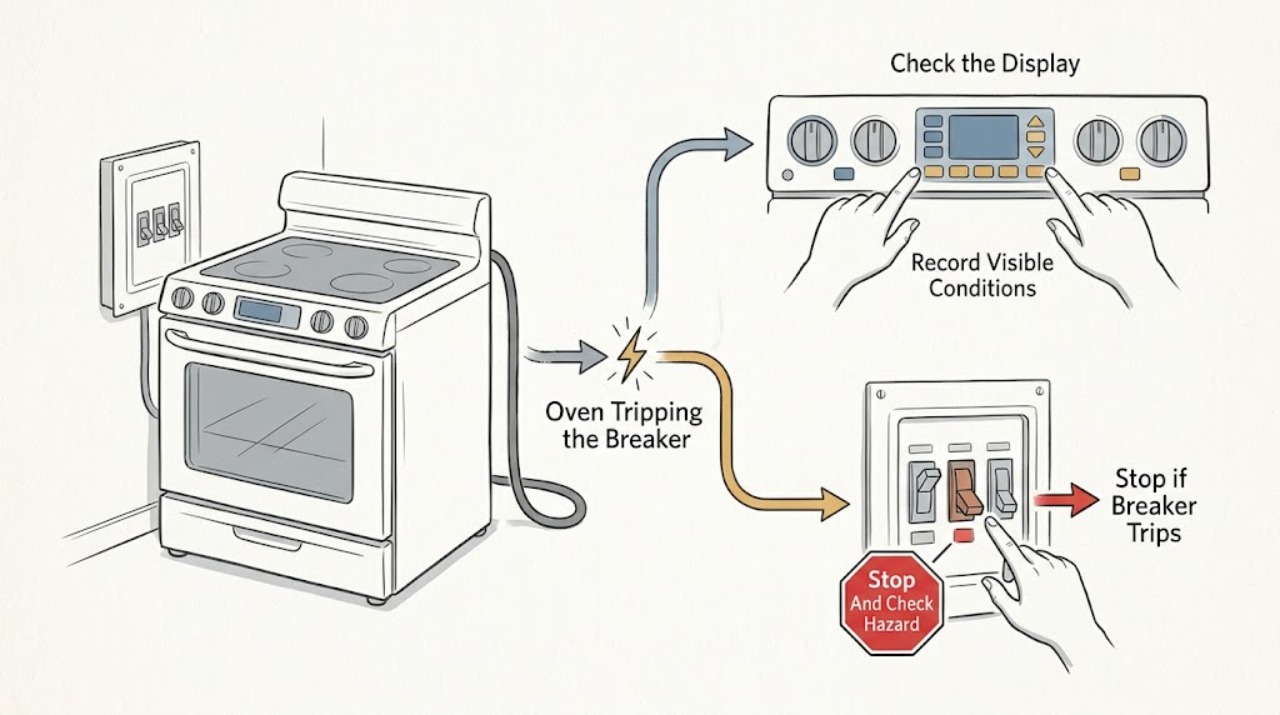
A Wolf oven that trips a breaker has an electrical supply, installation, or appliance fault until a qualified professional proves otherwise. Do not keep resetting the breaker or open the oven. From a safe, dry position, record whether the trip happens when power is restored, when a mode starts, when heat begins, during a particular cavity or function, or after the oven has been running. Note any display code, smoke, burning smell, hot outlet, arcing, moisture, or visible damage. Wolf advises checking displayed messages, confirming the correct dedicated supply and wiring, and having an electrician assess installation or breaker concerns; unresolved appliance faults need certified service. Leave the circuit off for smoke, heat, arcing, water near electrical parts, or a repeated trip.
Before you begin
Safety first
- An electrician can assess the household circuit, supply, wiring, and protective device; a qualified appliance technician can then diagnose the Wolf oven without repeated energizing or user access to live parts.
Work through in order
Diagnostic checks
Use only checks that match the exact appliance or system and its official guide.
-
Check 1
Stop using the Wolf oven after the trip and observe the oven front, accessible plug or cord area, outlet if present, and surrounding floor from a dry, safe position. Do not touch a hot or damaged part, move the oven, or open a panel.
Expected result: There may be no visible sign, or there may be smoke, a burning smell, melted material, heat, arcing, water, or a damaged cord or outlet.
Next step: If any hazard is present, keep the oven and circuit off and use urgent electrical or fire support as appropriate. If no hazard is visible, continue with a one-time record of when the trip occurred without resetting it again.
Why this matters
Why: A visible heat, fire, moisture, or electrical warning changes this from a diagnostic inconvenience to a safety event. No visible sign does not make repeated energizing safe.
-
Check 2
Write down the exact event already observed: trip when the breaker was restored, when the oven was powered, when a mode was selected, when preheating or another heat function began, during one cavity, or after the oven had operated for a while. Include whether other kitchen circuits changed state.
Expected result: The trip may be immediate, tied to one command or heat function, limited to one cavity, or delayed until operation has continued.
Next step: Do not recreate the event. Give the timeline, affected function, model, and any other circuit symptoms to an electrician or qualified appliance technician.
Why this matters
Why: The timing separates a possible supply or installation event from a function-specific appliance event for the technician. It does not identify a replaceable part by itself.
-
Check 3
If the display is still safely visible, record the complete error code, warning, blinking pattern, selected cavity, and mode exactly as shown. Do not use a code from another Wolf series and do not keep powering the oven to make the message reappear.
Expected result: There may be no message, a power-loss or control message, a mode-specific warning, or a recurring code after the trip.
Next step: Photograph or transcribe the display only from a safe position, then leave the circuit off if the breaker has tripped again and arrange service.
Why this matters
Why: Wolf notes that not every model provides diagnostic codes, so a blank message does not rule out an electrical issue. A recurring message gives service a model-specific lead.
-
Check 4
Without opening electrical equipment, note whether the Wolf oven appears to have its own dedicated circuit, whether the breaker label matches the oven, and whether another nearby appliance or outlet also lost power. Do not infer proper sizing or wiring from the label and do not change the circuit.
Expected result: The circuit may appear shared, the breaker or supply may be unclear, another outlet may be off, or the visible arrangement may look dedicated and normal.
Next step: Leave wiring and breaker work to a qualified electrician. Provide the installation context and trip stage to the technician rather than trying another reset.
Why this matters
Why: A shared, unclear, or affected household supply makes an electrician's evaluation important. A normal-looking dedicated arrangement does not clear an internal oven fault.
-
Check 5
If the trip history already identifies a double-oven cavity or a particular mode, record that distinction without testing the other cavity or mode. Include whether the event occurred during bake, broil, convection, self-clean, or another displayed function only when that was already observed.
Expected result: The event may be linked to one cavity or function, or it may affect the whole oven as soon as the supply is restored.
Next step: Do not switch modes to compare them. Leave the oven off and provide the exact cavity, function, and timing to qualified service.
Why this matters
Why: A function-specific event gives a service technician a narrower safe diagnostic path. A whole-unit event points to the supply or common oven power path, but still does not prove the cause.
-
Check 6
Only if the installation guide or Wolf support directs a reset, there is no smoke, odor, heat, damage, moisture, or active hazard, and a qualified person has confirmed it is safe, use one documented supply reset for the specified interval. Do not use a reset to test a suspected short and do not repeat it after another trip.
Expected result: The oven may restore its display without tripping, remain off, or trip again as soon as power returns or a function is selected.
Next step: If the breaker trips again or the oven remains abnormal, leave it off at the electrical supply and arrange qualified electrical or Wolf appliance service.
Why this matters
Why: A one-time recovery can clear a temporary control state, but it does not prove that the circuit or oven is repaired. A repeat trip is a stop condition.
-
Check 7
Prepare the exact model and serial information, installation date if known, circuit or breaker label, trip stage, affected cavity or mode, display message, and all visible safety symptoms for the service request. Do not remove covers to find additional numbers.
Expected result: The record may show an installation-context pattern, an oven-function pattern, or an unresolved whole-unit trip with no visible clues.
Next step: Keep the oven out of service until the cause is evaluated, especially when the trip recurs or any heat, odor, smoke, water, or arcing was present.
Why this matters
Why: A complete timeline helps separate an electrician's supply assessment from an appliance diagnosis and prevents unsafe trial-and-error.
Use your observations
Decision map
Find the observation that best matches what you see, then follow the next safe action.
-
PATH 01Next step
What you see
Smoke, burning or melting odor, visible arcing, a hot plug or outlet, damaged cord, water near electrical parts, or a repeated trip is present.
Do this next
Stop using the oven and keep people away. Isolate power only from a dry, safe location without touching damaged equipment.
-
PATH 02Next step
What you see
The breaker trips as it is restored or immediately when the oven circuit is energized.
Do this next
Leave the breaker off and record the immediate timing, display state, and whether other circuits are affected without another reset.
-
PATH 03Next step
What you see
The breaker holds until a cooking mode, heating function, self-clean function, or one cavity is selected, then trips.
Do this next
Leave the circuit off and record the exact mode, cavity, display, and timing already observed. Do not switch functions to compare them.
-
PATH 04Next step
What you see
The oven operates for a period and then loses power or trips, without a clear immediate event.
Do this next
Leave the oven off and record elapsed operation, cavity, mode, displayed temperature or message, and any fan, heat, odor, or surrounding-temperature observation made before the trip.
-
PATH 05Next step
What you see
The circuit appears shared, the supply arrangement is unclear, another outlet is also without power, or the installation does not match the exact guide.
Do this next
Do not modify the circuit or move the oven. Leave the breaker off and have a qualified electrician assess the installation and household supply.
-
PATH 06Next step
What you see
No visible hazard is present, but the breaker has already tripped and the cause is not clear.
Do this next
Do not repeat the reset simply to obtain more information. Preserve the first trip timing, display state, and affected function.
Helpful context
Understand the symptom
Treat a trip as a symptom, not a reset button
A breaker can trip because of the household circuit, installation, or the oven, and the trip itself does not identify a relay, element, wiring fault, or breaker defect. The useful first record is timing: immediately when power is restored, when a cooking mode is selected, when heat begins, during one cavity or function, or after a period of operation. Never repeat the event just to collect a better pattern.
Use the model and installation information
Wolf products are not all wired or controlled the same way. The exact model, single or double cavity, installation guide, display message, and supply arrangement matter. Wolf's official guidance calls for a correctly wired, properly sized, dedicated supply and says an electrician may be needed for installation or breaker issues. Do not infer a breaker rating or wiring method from another model.
Keep the inspection external
Only observe the accessible breaker indication, plug or cord area, and nearby surfaces from a dry, safe position. Do not remove an oven panel, pull out a built-in unit, probe voltage, open the breaker enclosure, loosen terminals, or replace a fuse with a larger one. A qualified electrician or appliance technician can test the circuit safely.
What the timing can and cannot tell you
A trip at one repeatable event is useful evidence, not a component diagnosis. For example, a trip as power returns and a trip only when a heating mode starts lead a technician to different checks, but neither proves a particular part. Record the event and leave the circuit off when the symptom returns.
Safety boundary
Stop conditions
- Stop immediately for smoke, burning or melting odor, visible arcing, a hot or damaged plug or outlet, exposed wiring, water near electrical parts, or a repeated breaker trip. Keep the oven off and use urgent electrical or fire support as appropriate.
- Do not repeatedly reset the breaker, substitute a larger fuse or breaker, bypass GFCI or AFCI protection, or change the oven's supply wiring. Wolf's installation guidance is for a properly sized, dedicated supply; an electrician should assess the installation.
- Do not remove oven panels, pull out a built-in unit, probe live wiring, loosen terminals, or test an element, relay, control, or breaker while energized.
- Stop if the breaker trips when a heating, self-clean, gas-ignition, or other mode starts, or if the oven shuts off again after a reset. Do not switch functions to compare them.
- Stop if a door, control, or cavity issue requires force or bypassing a safety device. Record the condition and arrange model-specific service.
Only after diagnosis
Potential parts
- circuit breaker or protective device
Consider only after an electrician confirms a defective or unsuitable protective device; a trip alone does not prove the breaker is the failed part.
The device and circuit must meet local requirements and the exact Wolf installation guide; replacement is qualified electrical work. - oven heating element or ignition load
Consider only when a qualified appliance technician links a repeatable mode or heat-stage trip to a confirmed component fault.
Electric and gas or dual-fuel designs differ; verify the exact Wolf model and professional fitment before any repair. - oven control or relay board
Consider only after supply, installation, and external safety checks are normal and service confirms a control or relay fault.
Control parts are model-specific and require professional diagnosis and installation.
When checks do not resolve it
Need a professional?
Request qualified electrical or appliance service after any breaker trip, with urgency increased for an immediate or repeated trip, a mode-specific trip, or any heat, odor, smoke, arcing, moisture, or visible damage.
Safety scope: An electrician can assess the household circuit, supply, wiring, and protective device; a qualified appliance technician can then diagnose the Wolf oven without repeated energizing or user access to live parts.
Have this ready
- Provide the full model and serial information, single or double oven status, circuit or breaker context, exact trip stage, affected cavity and mode, display code or message, time in operation before the event, and all visible safety symptoms.
Common questions
FAQ
Why does my Wolf oven trip the breaker?
Wolf lists installation, supply, and appliance electrical or mechanical issues as possible causes. The timing of the trip helps a qualified professional choose safe tests, but it does not identify a part by itself.
Should I keep resetting the Wolf oven breaker?
No. Do not repeat a reset after a trip. If an exact guide or support instruction permits one safe reset, a returning trip means leave the oven off and arrange qualified electrical or appliance service.
What should I record when the Wolf oven trips?
Record whether it happened at power restoration, mode selection, heat start, one cavity or function, or after a period of operation. Include the model, display message, circuit context, and any smoke, odor, heat, arcing, moisture, or visible damage already observed.
Can a Wolf oven share a circuit with another appliance?
Wolf guidance calls for a properly sized, dedicated supply. Do not change wiring or infer suitability from a label; have a qualified electrician assess the exact installation.
When is a Wolf oven breaker trip an emergency?
Treat smoke, burning or melting odor, visible arcing, a hot outlet or plug, exposed damage, water near electrical parts, or a repeated trip as stop conditions. Keep clear, leave the circuit off when safe, and use urgent electrical or fire support as appropriate.
Read the exact guide
Official sources
- Wolf Product Turns Off by ItselfSub-Zero, Wolf, and Cove · Wolf electric oven unexpected shutdown, electrical or control issues, thermal cutout, cooling fan, reset, and service guidance
- Wolf Electric Oven Does Not Turn OnSub-Zero, Wolf, and Cove · Wolf electric oven blank display, power, 30-second reset, control response, and service guidance
- Wolf Does Not Operate in One or All ModesSub-Zero, Wolf, and Cove · Wolf oven and appliance power supply, one-mode or all-mode operation, breaker, GFCI, outlet, and service guidance
- Circuit Breaker Tripping or No PowerSub-Zero, Wolf, and Cove · Sub-Zero and Wolf breaker trips, dedicated supply, installation, GFCI or AFCI, electrician, and service guidance
Community feedback
Share a repair observation
Share a plain-text repair observation. Accepted observations are published automatically; this page may take a moment to update.